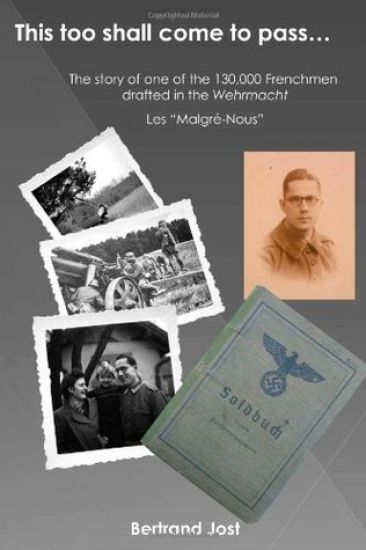
August 25, 1942. A day of infamy for Alsace-Lorraine. The Nazis have just decided to draft the first Frenchmen of Alsace and Lorraine in the Wehrmacht, the German Army. Later, many would even be drafted in the infamous "Waffen SS." For Marius Meyer, my grandfather, the draft date was April 16, 1943, not even three years after he had been discharged from the French Army in the wake of the tragic defeat of 1940. But he has no choice for the draft dodgers see their families deported somewhere to the East. So he leaves his wife and daughter to go to war, once again. His destination is Kustrin, in Eastern Germany, a few steps closer to the much feared Russian Front...Marius wrote the following poem about this painful moment of departure: "Now goodbye you, my dear homelandDear land of Alsace, goodbye We must go to a remote land Dear land of Alsace, goodbye And we leave with some ... feeling.Gone to the Wehrmacht into the uniform - Dear homeland, oh dear ]Thus they went through the town and landAnd were soon recognized everywhere A far-out hand wave, last moment of blissAnd all this was already part of the past.And always resonates of home this melody Like the complaints of the little flower from 'Forget me not '"This book is the story of my Grandfather, one of the 130,000 Frenchmen drafted in the German Army during World War II. 32,000 of them would be killed in action and 10,500 are still missing in action to this day. It is one of the first books in English dealing with the tragedy of French nationals forced to wear the German uniform in World War II.
The Problems of Philosophy: Large Print by Bertrand Russell In the following pages I have confined myself in the main to those problems of philosophy in regard to which I thought it possible to say something positive and constructive, since merely negative criticism seemed out of place. For this reason, theory of knowledge occupies a larger space than metaphysics in the present volume, and some topics much discussed by philosophers are treated very briefly, if at all. We are delighted to publish this classic book as part of our extensive Classic Library collection. Many of the books in our collection have been out of print for decades, and therefore have not been accessible to the general public. The aim of our publishing program is to facilitate rapid access to this vast reservoir of literature, and our view is that this is a significant literary work, which deserves to be brought back into print after many decades. The contents of the vast majority of titles in the Classic Library have been scanned from the original works. To ensure a high quality product, each title has been meticulously hand curated by our staff. Our philosophy has been guided by a desire to provide the reader with a book that is as close as possible to ownership of the original work. We hope that you will enjoy this wonderful classic work, and that for you it becomes an enriching experience.
The first essay, which gives its title to the volume, endeavours to define the respective spheres of logic and mysticism. Bertrand Russell describes this and the four essays that follow as entirely popular'. They are concerned with The Place of Science in a Liberal Education, A Free Man's Worship, and The Study of Mathematics.
Bertrand Russell, 3rd Earl Russell (1872 - 1970) was a British philosopher, logician, mathematician, political activist and Nobel laureate. He led the British "revolt against idealism" in the early 1900s and is considered one of the founders of analytic philosophy along with his predecessor Gottlob Frege and his prot g Ludwig Wittgenstein. In this book, written in 1918, he offers his assessment of three competing streams in the thought of the political left: Marxian socialism, anarchism and syndicalism.