Kirjojen hintavertailu. Mukana 11 522 273 kirjaa ja 12 kauppaa.

Kirjahaku

Etsi kirjoja tekijän nimen, kirjan nimen tai ISBN:n perusteella.

1000 tulosta hakusanalla Carlo Gozzi

Chance in Chains: A Story of Monte Carlo

Chance in Chains: A Story of Monte Carlo

Guy Thorne

Createspace Independent Publishing Platform
2015
nidottu
It was nine o'clock at night, and the thirty huge dynamos of the Soci t G n rale Electrique of Paris were nearly all at work. In the great glass-roofed hall of the Mont Parnasse Central Power Station blue-bloused workmen moved quietly over the shining floors of white concrete, pausing now and then by this or that purring, spitting monster, scrutinising the whirring, glittering copper drums, listening with experienced ears for the slightest variation in the deep wasp-like hum, touching a lever here, adjusting a screw there, or oiling a bearing with tin cans beaked like a snipe.
Solid Angle Computation with Monte Carlo Methods

Solid Angle Computation with Monte Carlo Methods

Khalid Jamil

Createspace Independent Publishing Platform
2017
pokkari
Book DescriptionsWhat motivated me to write this book? The knowledge pertaining to solid angle and its computation is scattered in bits and parts in the scientific literature. It is my feeling that no such book exists that explains the concepts of solid angles explicitly and enunciates the ab initio computation methods. This motivated me to write a book about the solid angle.This book pictorially explains the concepts of solid angles and gives the salient features of solid angles along with the necessary mathematical development for computation. Why Monte Carlo methods?I have specifically chosen Monte Carlo methods to compute solid angles because the students are fascinated to learn Monte Carlo methods. Monte Carlo methods have been explained in a simple way starting with ab initio principles without involving too many mathematical jargons. This book not only provides an opportunity to readers to learn Monte Carlo methods but also. helps the readers to apply Monte Carlo methods in the field of their interest in addition to compute solid angles.What is RAHI method?Monte Carlo methods can be applied to determine solid angles not only by solving the intricate solutions of multidimensional integrals but also by shining light on the given surface and determining the solid angles. This has been termed as Ray Hitting (RAHI) method. RAHI method is simple to understand and simple to apply.MATLAB ProgramIn implementing Monte Carlo methods in solid angles computations, some rudimentary knowledge of programming like MATLAB is, however, required. The MATLAB programs have been given in its simplest forms to conduct simulation experiments with solid angle computations and apply in the various field of interest.Chapter wise book appraisal.This book contains step-by-step solved examples and easy to implement MATLAB programs. Chapter 1 "Solid Angle" gives a pictorial illustration of solid angles. It gives the salient features of solid angle, basics requirements for the formation of solid angles in 3D-space. Moreover, definitions and mathematical developments of solid angles are summarized.Chapter 2 "Monte Carlo Methods" gives an understanding of Monte Carlo methods from scratches. Explains the Golden Rule of Monte Carlo and Hit-or-Miss methods. It makes easy to understand and implement the methods. Examples are given for understanding the methods.Chapter 3 'Random Numbers" provide the users to review that how grandpa clock can fulfill your needs to generate random numbers.Chapter 4. "Integration with Monte Carlo" helps to solve step-by-step the single/double/triple and higher order integrals by Monte Carlo Methods. After explaining the method with simple examples, the MATLAB programs are appended.Chapter 5. "Solid Angle Computation" gives step by step examples of computing solid angles subtending with: (a) a point and Plane surface, (b) Disk, and (c) Cylinder. Several solved examples are given using MATLAB programs. Listing of simple MATLAB programs are provided. Applications of RAHI method are given for all cases.Finally, computation of solid angles between a Line and a Disk has been given with explanation. RAHI and triple integration methods have been employed.ConclusionsAfter learning basic rules and practicing examples from all five chapters, one may be able to compute solid angle with any situation including a solid angle with an irregular shaped surface.
Backward Simulation Methods for Monte Carlo Statistical Inference

Backward Simulation Methods for Monte Carlo Statistical Inference

Fredrik Lindsten; Thomas B. Schön

now publishers Inc
2013
nidottu
Monte Carlo methods, in particular those based on Markov chains and on interacting particle systems, are by now tools that are routinely used in machine learning. These methods have had a profound impact on statistical inference in a wide range of application areas where probabilistic models are used. Moreover, there are many algorithms in machine learning that are based on the idea of processing the data sequentially; first in the forward direction, and then in the backward direction.Backward Simulation Methods for Monte Carlo Statistical Inference reviews a branch of Monte Carlo methods that are based on the forward-backward idea, and that are referred to as backward simulators. In recent years, the theory and practice of backward simulation algorithms have undergone a significant development, and the algorithms keep finding new applications. The foundation for these methods is sequential Monte Carlo (SMC). SMC-based backward simulators are capable of addressing smoothing problems in sequential latent variable models, such as general, nonlinear/non-Gaussian state-space models (SSMs).However, this book also clearly shows that the underlying backward simulation idea is by no means restricted to SSMs. Furthermore, backward simulation plays an important role in recent developments of Markov chain Monte Carlo (MCMC) methods. Particle MCMC is a systematic way of using SMC within MCMC. In this framework, backward simulation gives us a way to significantly improve the performance of the samplers.This monograph discusses several related backward-simulation-based methods for state inference as well as learning of static parameters, both using a frequentistic and a Bayesian approach. This is an excellent primer for anyone interested in this active research area.
An Introduction to Quantum Monte Carlo Methods

An Introduction to Quantum Monte Carlo Methods

Tao Pang

MORGAN CLAYPOOL PUBLISHERS
2016
sidottu
Monte Carlo methods have been very prominent in computer simulation of various systems in physics, chemistry, biology, and materials science. This book focuses on the discussion and path-integral quantum Monte Carlo methods in many-body physics and provides a concise but complete introduction to the Metropolis algorithm and its applications in these two techniques. To explore the schemes in clarity, several quantum many-body systems are analysed and studied in detail. The book includes exercises to help digest the materials covered. It can be used as a tutorial to learn the discussion and path-integral Monte Carlo or a recipe for developing new research in the reader's own area. Two complete Java programs, one for the discussion Monte Carlo of 4^He clusters on a graphite surface and the other for the path-integral Monte Carlo of cold atoms in a potential trap, are ready for download and adoption.
An Introduction to Quantum Monte Carlo Methods

An Introduction to Quantum Monte Carlo Methods

Tao Pang

Morgan Claypool Publishers
2016
nidottu
Monte Carlo methods have been very prominent in computer simulation of various systems in physics, chemistry, biology, and materials science. This book focuses on the discussion and path-integral quantum Monte Carlo methods in many-body physics and provides a concise but complete introduction to the Metropolis algorithm and its applications in these two techniques. To explore the schemes in clarity, several quantum many-body systems are analysed and studied in detail. The book includes exercises to help digest the materials covered. It can be used as a tutorial to learn the discussion and path-integral Monte Carlo or a recipe for developing new research in the reader's own area. Two complete Java programs, one for the discussion Monte Carlo of 4^He clusters on a graphite surface and the other for the path-integral Monte Carlo of cold atoms in a potential trap, are ready for download and adoption.
Applied Analytics - Quantitative Research Methods: Applying Monte Carlo Risk Simulation, Strategic Real Options, Stochastic Forecasting, Portfolio Opt
THIRD EDITION (2022) The Applied CQRM Book Series showcases how the advanced analytics covered in the Certified in Quantitative Risk Management (CQRM) certification program can be applied to real-life business problems. In Volume I, we show how Risk Simulator and ROV BizStats can be used to perform quantitative analysis in graduate and postgraduate research. Pragmatic applications are emphasized in order to demystify the many elements inherent in quantitative analysis. A statistical black box will remain a black box if no one can understand the concepts despite its power and applicability. It is only when the black box methods become transparent, so that researchers can understand, apply, and convince others of their results, value-add, and applicability, that the approaches will receive widespread attention. This transparency is achieved through step-by-step applications of quantitative modeling as well as presenting multiple cases and discussing real-life applications. This book is targeted at those individuals who have completed the CQRM certification program but can also be used by anyone familiar with basic quantitative research methods--there is some-thing for everyone. It is also applicable for use as a second-year MBA/MS-level or introductory PhD textbook. The examples in the book assume some prior knowledge of the subject matter. Additional information on the CQRM program can be obtained at: www.iiper.org www.realoptionsvaluation.com THE BASICSCentral Tendency, Spread, Skew, KurtosisProbability, Bayes' Theorem, Trees, Combination, PermutationClassical, Standard, P-Value, CICentral Limit TheoremType I-IV Errors, Sampling BiasesData Types & Collection Design ANALYTICAL METHODST-Tests: Equal/Unequal/Paired Variance, F-Test, Z-TestANOVA, Blocked, Two-Way, ANCOVA, MANOVALinear/Nonlinear CorrelationNormality & Distributional Fitting: Kolmogorov-Smirnov, Chi-Square, Akaike Information Criterion, Anderson-Darling, Kuiper's, Schwarz/Bayes, Box-CoxNonparametrics: Runs, Wilcoxon, Mann-Whitney, Lilliefors, Q-Q, D'Agostino-Pearson, Shapiro-Wilk-Royston, Kruskal-Wallis, Mood's, Cochran's Q, Friedman'sInter/Intra-Rater Reliability, Consistency, Diversity, Internal/External Validity, PredictabilityCohen's Kappa, Cronbach's Alpha, Guttman's Lambda, Inter-Class Correlation, Kendall's W, Shannon-Brillouin-Simpson Diversity, Homogeneity, Grubbs Outlier, Mahalanobis, Linear & Quadratic Discriminant, Hannan-Quinn, Diebold-Mariano, Pesaran-Timmermann, Precision, Error ControlLinear/Nonlinear Multivariate RegressionMulticollinearity, HeteroskedasticityStructural Equation Modeling (SEM), Partial Least Squares (PLS)Endogeneity, Simultaneous Equations Methods, Two-Stage Least SquaresGranger Causality, Engle-GrangerAdvanced Regressions: Poisson, Deming, Ordinal Logistic, Ridge, Weighted, Bootstrap ARTIFICIAL INTELLIGENCE AND MACHINE LEARNING (DATA SCIENCE)Bagging Linear BootstrapBagging Nonlinear BootstrapClassification and Regression Trees CARTCustom FitDimension Reduction Principal Component AnalysisDimension Reduction Factor AnalysisEnsemble Common FitEnsemble Complex FitEnsemble Time-SeriesGaussian Mix & K-Means SegmentationK-Nearest NeighborsLinear Fit ModelMultivariate Discriminant Analysis (Linear)Multivariate Discriminant Analysis (Quadratic)Neural Network (Cosine, Tangent, Hyperbolic)Logistic Binary ClassificationNormit-Probit Binary ClassificationPhylogenetic Trees & Hierarchical ClusteringRandom ForestSegmentation ClusteringSupport Vector Machines SVM
Applied Analytics - Probability Distribution: Applying Monte Carlo Risk Simulation, Strategic Real Options, Stochastic Forecasting, Portfolio Optimiza
The Applied CQRM Book Series showcases how the advanced analytics covered in the Certified in Quantitative Risk Management (CQRM) certification program can be applied in real-life business problems. In Volume II, we show how Risk Simulator can be used to generate various probability distributions as well as how to interpret the results and use their analytical properties for making strategic decisions.Pragmatic applications are emphasized in order to demystify the many elements inherent in probability analysis. A black box will remain a black box if no one can understand the concepts despite its power and applicability. It is only when the black box methods become transparent, so that researchers can understand, apply, and convince others of their results, value-add, and applicability, that the approaches will receive widespread attention. This transparency is achieved through step-by-step applications of quantitative modeling as well as presenting multiple cases and discussing real-life applications. This book is targeted at those individuals who have completed the CQRM certification program but can also be used by anyone familiar with basic quantitative research methods--there is something for everyone. It is also applicable for use as a second-year MBA/MS-level or introductory PhD textbook. The examples in the book assume some prior knowledge of the subject matter. Additional information on the CQRM program can be obtained at: www.iiper.org www.realoptionsvaluation.com
Applied Analytical - Enterprise Risk Management: Applying Monte Carlo Risk Simulation, Strategic Real Options, Stochastic Forecasting, Portfolio Optim
The Applied CQRM Book Series showcases how the advanced analytics covered in the Certified in Quantitative Risk Management (CQRM) certification program can be applied to real-life business problems. In Volume IV, we show how these analytics can be applied in the context of Enterprise Risk Management, using both qualitative risk registers and extending the results using quantitative analytical methods.Pragmatic applications are emphasized in order to demystify the many elements inherent in risk analysis. A black box will remain a black box if no one can understand the concepts despite its power and applicability. It is only when the black box methods become transparent, so that researchers can understand, apply, and convince others of their results, value-add, and applicability, that the approaches will receive widespread attention. This transparency is achieved through step-by-step applications of quantitative modeling as well as presenting multiple cases and discussing real-life applications. This book is targeted at those individuals who have completed the CQRM certification program but can also be used by anyone familiar with basic quantitative research methods--there is something for everyone. It is also applicable for use as a second-year MBA/MS-level or introductory PhD textbook. The examples in the book assume some prior knowledge of the subject matter. Additional information on the CQRM program can be obtained at: www.iiper.org www.realoptionsvaluation.com
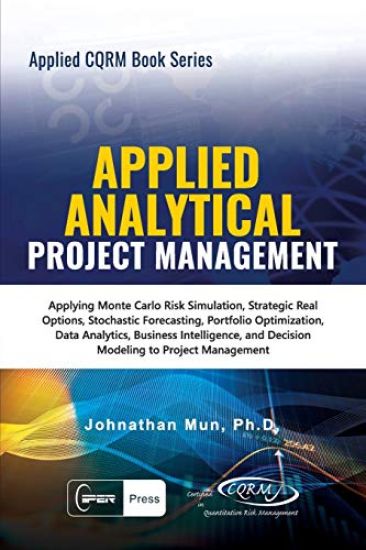
Applied Analytical - Applied Project Management: Applying Monte Carlo Risk Simulation, Strategic Real Options, Stochastic Forecasting, Portfolio Optim
The Applied CQRM Book Series showcases how the advanced analytics covered in the Certified in Quantitative Risk Management (CQRM) certification program can be applied to real-life business problems. In Volume VI, we show how to model and risk simulate complex projects to obtain schedule and cost risks.Pragmatic applications are emphasized in order to demystify the many elements inherent in risk analysis. A black box will remain a black box if no one can understand the concepts despite its power and applicability. It is only when the black box methods become transparent, so that researchers can understand, apply, and convince others of their results, value-add, and applicability, that the approaches will receive widespread attention. This transparency is achieved through step-by-step applications of quantitative modeling as well as through presenting multiple cases and discussing real-life applications. This book is targeted at those individuals who have completed the CQRM certification program but can also be used by anyone familiar with basic quantitative research methods--there is something for everyone. It is also applicable for use as a second-year MBA/MS-level or introductory PhD textbook. The examples in the book assume some prior knowledge of the subject matter. Additional information on the CQRM program can be obtained at: www.iiper.org www.realoptionsvaluation.com
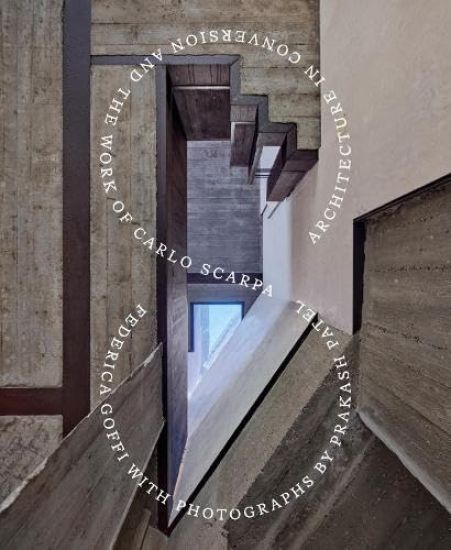
Architecture in Conversion and the Work of Carlo Scarpa

Architecture in Conversion and the Work of Carlo Scarpa

Federica Goffi

LUND HUMPHRIES PUBLISHERS LTD
2025
sidottu
The work of Modernist architect Carlo Scarpa (1906-1978) is exemplary of an in-between practice, which is neither architecture nor conservation, but rather, architecture in conversion, dependent upon time, weather, and tempo. This book discusses the notion of architecture in conversion, revealing it to be radically different from current conservation practices, and to entail more than a change of use. Scarpa’s work represents ‘a radical turn in how we see or understand something’. The significance of time, weather and tempo within Scarpa’s work, as well as the influences of artists such as Man Ray and Emilio Vedova and composer Luigi Nono, are revealed through a close analysis of Scarpa’s drawings and details from key buildings and their histories of multiple authorship. The book examines drawing as central to Scarpa’s practice: in lieu of creating physical models, his muti-directional drawings foreshadow the orbital movements of digital modeling techniques. Based on discussions with many of his collaborators, the book highlights Scarpa’s collaborative approach, as well as the importance of all senses in his architecture. The book concludes by introducing the notion of ‘unfinished architecture’, and by discussing various contemporary architects’ projects which follow Scarpa’s approach to conversion of buildings.
El Chico Que Lo Sabía (Carlo Acutis)

El Chico Que Lo Sabía (Carlo Acutis)

Corinna Turner

Unseen Books
2020
pokkari
MUERTE? DEFINE LA MUERTE."Tienes leucemia""Eso es lo que dijo el doctor. Mam y pap se lo han tomado tan mal, que se pelean. Me siento impotente. Tal vez por eso recurr al Padre Thomas. Pero me ha dado una estampa de Carlo Acutis, como si un chico santo que se ha muerto vaya a servirme para algo.""Pero, qu tengo que perder?"Daniel acaba de recibir la peor noticia que puede recibir un adolescente. Los adultos que forman parte de su vida se derrumban. Desesperado, se dirige a un sacerdote para pedir ayuda, y este le habla de un chico de su edad, Carlo Acutis, que muri no hace mucho.Daniel est convencido de que el sacerdote pierde el tiempo. Pero mientras lucha por aceptar su futuro incierto, se desarrolla una extra a amistad entre l y el chico santo y muerto, que quiz no est tan muerto, despu s de todo.El Chico que lo Sab a es el primer t tulo de la nueva serie de "Amigos en las Alturas" de Corinna Turner, nominada a la Medalla Carnegie. Si siempre te han interesado los santos, pero encuentras sus biograf as aburridas y dif ciles de entender, este relato apasionante es para ti.