Kirjojen hintavertailu. Mukana 11 244 527 kirjaa ja 12 kauppaa.

Kirjahaku

Etsi kirjoja tekijän nimen, kirjan nimen tai ISBN:n perusteella.

1000 tulosta hakusanalla Collin Hansen

Légendes Infernales

Légendes Infernales

J. Collin De Plancy

Editions Saint-Sebastien
2016
nidottu
Nul ne peut servir deux ma tres. S. MATTHIEU, ch. VI, v. 24. Celui qui n'est pas avec moi est contre moi; celui qui n'amasse pas avec moi dissipe. S. MATTHIEU, ch. XII, v. 30. Comme il tait difficile de classer m thodiquement ces l gendes et de les lier par des consid rations qui eussent pu ennuyer le lecteur, nous nous sommes priv de transitions, et dans les r flexions qui naissaient de ces singuliers r cits, nous avons t sobre. On verra donc quelquefois le diable impuissant et bafou la suite du diable triomphant, et la l gende s rieuse pr c der ou suivre la l gende qui tient du conte. Car tout n'est pas vrai dans cette galerie, et pourtant il y a bien plus de vrai que ne le croiront la plupart des lecteurs. (www.sainteface.net)
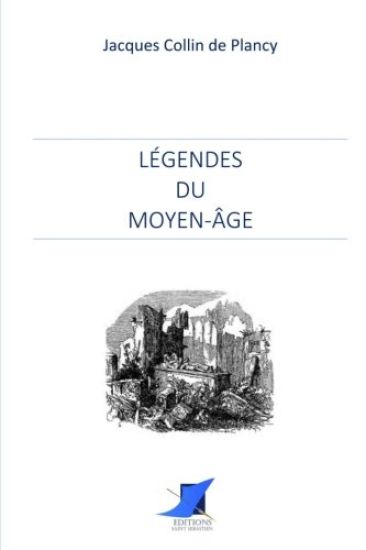
Légendes du Moyen-Âge

Légendes du Moyen-Âge

J. Collin De Plancy

Editions Saint-Sebastien
2016
nidottu
Le fait du moyen- ge, c'est ce qu'il a produit par lui-m me et de son propre fond, et je ne crains pas d'affirmer que par l c'est une des plus grandes et des plus belles poques de l'humanit . Mgr Pierre-Louis Parisis S'il est vrai, comme le dit Albert le Grand, qu'on ne puisse appeler Barbares que les peuples d pourvus de lois, de civilisation, de discipline r gl e qui les disposent bien vivre, le nom de Barbares ne convient qu'aux peuplades devenues enti rement sauvages. Les envahisseurs du quatri me si cle n' taient pas tomb s si bas. Dans nos livres d'histoire, on fait na tre le moyen- ge aux invasions des Francs, qui n' taient pas des barbares; puis on cl t cet ge de transition la prise de Constantinople par les barbares v ritables: les bandes de Mahomet II m ritaient ce nom. Les Francs avaient des lois, des moeurs, une civilisation commenc e et des r gles de discipline. Les musulmans taient, comme ils le sont encore aujourd'hui, des sauvages camp s et toujours pr ts envahir. (www.sainteface.net)
Introduction to Statistics in Metrology

Introduction to Statistics in Metrology

Stephen Crowder; Collin Delker; Eric Forrest; Nevin Martin

Springer Nature Switzerland AG
2020
sidottu
This book provides an overview of the application of statistical methods to problems in metrology, with emphasis on modelling measurement processes and quantifying their associated uncertainties. It covers everything from fundamentals to more advanced special topics, each illustrated with case studies from the authors' work in the Nuclear Security Enterprise (NSE). The material provides readers with a solid understanding of how to apply the techniques to metrology studies in a wide variety of contexts. The volume offers particular attention to uncertainty in decision making, design of experiments (DOEx) and curve fitting, along with special topics such as statistical process control (SPC), assessment of binary measurement systems, and new results on sample size selection in metrology studies. The methodologies presented are supported with R script when appropriate, and the code has been made available for readers to use in their own applications. Designed to promote collaboration between statistics and metrology, this book will be of use to practitioners of metrology as well as students and researchers in statistics and engineering disciplines.
Introduction to Statistics in Metrology

Introduction to Statistics in Metrology

Stephen Crowder; Collin Delker; Eric Forrest; Nevin Martin

Springer Nature Switzerland AG
2021
nidottu
This book provides an overview of the application of statistical methods to problems in metrology, with emphasis on modelling measurement processes and quantifying their associated uncertainties. It covers everything from fundamentals to more advanced special topics, each illustrated with case studies from the authors' work in the Nuclear Security Enterprise (NSE). The material provides readers with a solid understanding of how to apply the techniques to metrology studies in a wide variety of contexts. The volume offers particular attention to uncertainty in decision making, design of experiments (DOEx) and curve fitting, along with special topics such as statistical process control (SPC), assessment of binary measurement systems, and new results on sample size selection in metrology studies. The methodologies presented are supported with R script when appropriate, and the code has been made available for readers to use in their own applications. Designed to promote collaboration between statistics and metrology, this book will be of use to practitioners of metrology as well as students and researchers in statistics and engineering disciplines.
Steinkohlenteer

Steinkohlenteer

Heinz-Gerhard Franck; Gerd Collin

Springer-Verlag Berlin and Heidelberg GmbH Co. K
2012
nidottu
Fortschritte der Verfahrenstechnik sowie die Entwicklung der Petrochemie und verwandter Industrien haben einen Strukturwandel auf dem Gebiete des Steinkohlenteers und seiner Aufarbeitung einge- leitet. Verfahrenstechnisch ist dieser Strukturwandel gekennzeichnet durch die Konzentrierung auf wenige zentrale kontinuierlich arbeitende Grossanlagen. Hinsichtlich der Verwendung der Teerprodukte wurden neue Einsatz- gebiete erschlossen. So liefert das Steinkohlenteerpech heute in Form der Elektrodenpeche und des Pechkokses wichtige Rohstoffe fur die elektrochemische und die elektrothermische Industrie und ist nicht mehr vornehmlich ein Bindemittel fur Steinkohlenbriketts oder fur den Strassenbau wichtig. Steinkohlenteeroele haben neben ihren bewahrten Verwendungszwecken insbesondere als Impragnieroel, Waschoel und Heiz- oel eine neue Verwendung als Ausgangsstoff fur die Produktion hoch- wertiger Russe gefunden. Daneben hat der Steinkohlenteer weiterhin grosse Bedeutung als Grundstoff fur synthetische Farbstoffe, Heilmittel und Kunststoffe. Die Erforschung der chemischen Zusammensetzung des Steinkohlen- teers erhielt einen enormen Aufschwung durch die Gaschromatographie und Spektroskopie. Die Zahl der identifizierten Teerinhaltsstoffe stieg von rd. 190 im Jahre 1945 auf etwa 475 im Jahre 1966. Parallel mit der Entwicklung der Forschung verlief der Fortschritt in der technischen Gewinnung reiner Teerinhaltsstoffe und ihrer Folgeprodukte als wichtiger Rohstoffe fur die Farbstoff-, Kunststoff- und pharmazeutische Industrie.