Kirjojen hintavertailu. Mukana 12 016 292 kirjaa ja 12 kauppaa.

Kirjahaku

Etsi kirjoja tekijän nimen, kirjan nimen tai ISBN:n perusteella.

1000 tulosta hakusanalla Contrubting Authors

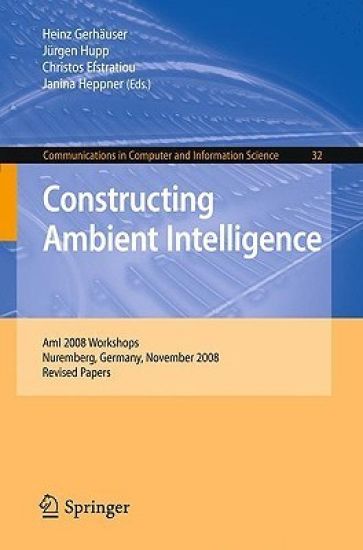
Constructing Ambient Intelligence

Constructing Ambient Intelligence

Springer-Verlag Berlin and Heidelberg GmbH Co. K
2010
nidottu
Ambient intelligence (AmI) was established in the late 1990s as a recent paradigm for electronic environments for the timeframe of 2010–2020. AmI is essentially an elabo- tion of Mark Weiser’s vision of ubiquitous computing. Weiser was aiming at a novel mobile computing infrastructure integrated into the networked environment of people. AmI is the idea of a technology that will become invisibly embedded in our natural s- roundings, present whenever we need it, enabled by simple and effortless interaction, attuned to all our senses, adaptive to users, context-sensitive, and autonomous. AmI refers to smart electronic environments that are sensitive and responsive to the presence of people. Since its adoption the vision has grown and fully developed, bec- ing quite influential in the development of novel ideas for information processing and new concepts for multi-disciplinary fields including electrical engineering, computer science, industrial design, user interfaces, and cognitive sciences. The AmI system - fords a basis for new paradigms of technological innovation within a multi-dimensional society. The added value of the AmI vision is the fact that the large-scale integration of electronics into the environment allows the actors, i. e. , people and objects, to collaborate with their surroundings in a natural measure. This is directly related to the increasing societal demand for communication and the exchange of information.
Constructing Ambient Intelligence

Constructing Ambient Intelligence

Springer-Verlag Berlin and Heidelberg GmbH Co. K
2012
nidottu
This book constitutes the refereed proceedings of the AmI 2011 Workshops, held in Amsterdam, The Netherlands, in November 2011. The 55 revised full papers presented were carefully reviewed and selected from numerous submissions. The papers are organized in topical sections on aesthetic intelligence: designing smart and beautiful architectural spaces; ambient intelligence in future lighting systems; interactive human behavior analysis in open or public spaces; user interaction methods for elderly, people with dementia; empowering and integrating senior citizens with virtual coaching; integration of AMI and AAL platforms in the future internet (FI) platform initiative; ambient gaming; human behavior understanding: inducing behavioral change; privacy, trust and interaction in the internet of things; doctoral colloquium.
Contrasting Sue and Arabella in Thomas Hardy´s Jude the Obscure
Seminar paper from the year 2009 in the subject English - Literature, Works, grade: 12, University of Marburg, course: The Pre-Modern Novel: Hardy and Conrad, language: English, abstract: Two completely different women, Susanna Bridehead and Arabella Donn, share the same man in Thomas Hardy s Jude the Obscure. Jude s cousin Sue is a "pretty, liquid-eyed, light-footed young woman" . Her mind, her education, her unconventional beliefs and especially her insistence on these beliefs impress Jude. His affection to Arabella Donn is quite different. She whom he addressed was a fine dark-eyed girl, not exactly handsome, but capable of passing as such at a little distance, despite some coarseness of skin and fibre. She had a round and prominent bosom, full lips, perfect teeth, and the rich complexion of a Cochin hen's egg. She was a complete and substantial female animal -- no more, no less. Of course, Sue and Arabella are not just contrasting in their appearance but they have oppositional ideas, beliefs and attitudes towards life. Therefore, they lead their lives under different circumstances and get different social recognition. By this example, Hardy criticizes the rigidity of certain conventions in the Victorian Age. In the following I will analyse various aspects which demonstrate the differences between the two characters, namely the two women's relation to Jude and their attitude towards sexuality, marriage, motherhood, religion and education.