Kirjojen hintavertailu. Mukana 11 627 220 kirjaa ja 12 kauppaa.

Kirjahaku

Etsi kirjoja tekijän nimen, kirjan nimen tai ISBN:n perusteella.

1000 tulosta hakusanalla David O Scheiding

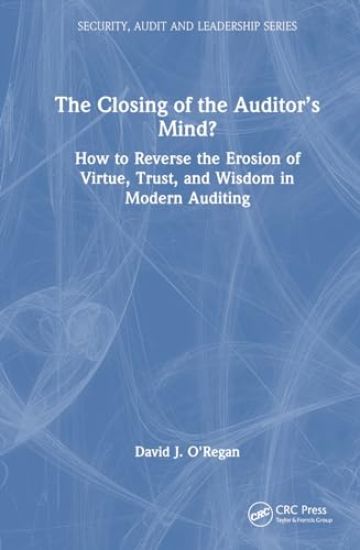
The Closing of the Auditor’s Mind?

The Closing of the Auditor’s Mind?

David J. O'Regan

TAYLOR FRANCIS LTD
2024
sidottu
In The Closing of the Auditor’s Mind?, author David J. O’Regan describes internal auditing as an important "binding agent" of social cohesion, for the accountability of individuals and organizations and also at aggregated levels of social trust. However, O’Regan also reveals that internal auditing faces two severe challenges – an external challenge of adaptation and an internal challenge of fundamental reform.The adaptation challenge arises from ongoing, paradigmatic shifts in accountability and social trust. The command-and-control, vertical hierarchies of traditional bureaucracies are being replaced in importance by networked, flattened patterns of accountability. The most challenging assurance demands of the modern era are increasingly located in three institutional domains – in the inner workings of organizations; in intermediary spaces at organizational boundaries; and in extra-mural locations. Internal auditing continues to cling, barnacle-like, to the inner workings of traditional, bureaucratic structures, and it has little to offer the emerging assurance demands on or beyond institutional boundaries. The reform challenge arises from internal auditing’s prevailing tendency toward a rigid, algorithmic, checklist mindset that suppresses practitioners’ creativity and critical thinking. This trend is increasingly narrowing internal auditing’s intellectual and moral horizons. Under the pressures of these challenges, internal auditing is struggling to fulfil its primary purpose of serving the public interest.O’Regan’s powerful book focuses on:The redistribution of social trust from traditional, hierarchical institutions to diffuse, horizontally distributed networksThe perennial validity of the classical virtues as the humane foundation of professional activityThe role of creative expertise in promoting professional wisdomThe Closing of the Auditor’s Mind? is a philosophical audit of a profession on the threshold of crisis. The book presupposes no prior knowledge of philosophy, nor indeed of auditing. Philosophical technicalities are contained in an Appendix, leaving the main text jargon-free. O’Regan provides original and striking perspectives on the malaise of modern internal auditing, and he proposes radical remedies. This captivating and well-informed book is a must-read for all who are concerned with our collective socio-economic and political well-being.
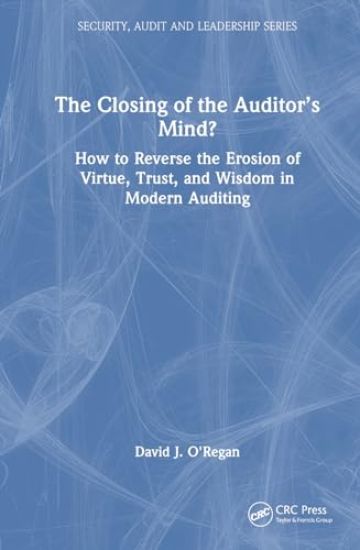
The Closing of the Auditor’s Mind?

The Closing of the Auditor’s Mind?

David J. O'Regan

TAYLOR FRANCIS LTD
2024
nidottu
In The Closing of the Auditor’s Mind?, author David J. O’Regan describes internal auditing as an important "binding agent" of social cohesion, for the accountability of individuals and organizations and also at aggregated levels of social trust. However, O’Regan also reveals that internal auditing faces two severe challenges – an external challenge of adaptation and an internal challenge of fundamental reform.The adaptation challenge arises from ongoing, paradigmatic shifts in accountability and social trust. The command-and-control, vertical hierarchies of traditional bureaucracies are being replaced in importance by networked, flattened patterns of accountability. The most challenging assurance demands of the modern era are increasingly located in three institutional domains – in the inner workings of organizations; in intermediary spaces at organizational boundaries; and in extra-mural locations. Internal auditing continues to cling, barnacle-like, to the inner workings of traditional, bureaucratic structures, and it has little to offer the emerging assurance demands on or beyond institutional boundaries. The reform challenge arises from internal auditing’s prevailing tendency toward a rigid, algorithmic, checklist mindset that suppresses practitioners’ creativity and critical thinking. This trend is increasingly narrowing internal auditing’s intellectual and moral horizons. Under the pressures of these challenges, internal auditing is struggling to fulfil its primary purpose of serving the public interest.O’Regan’s powerful book focuses on:The redistribution of social trust from traditional, hierarchical institutions to diffuse, horizontally distributed networksThe perennial validity of the classical virtues as the humane foundation of professional activityThe role of creative expertise in promoting professional wisdomThe Closing of the Auditor’s Mind? is a philosophical audit of a profession on the threshold of crisis. The book presupposes no prior knowledge of philosophy, nor indeed of auditing. Philosophical technicalities are contained in an Appendix, leaving the main text jargon-free. O’Regan provides original and striking perspectives on the malaise of modern internal auditing, and he proposes radical remedies. This captivating and well-informed book is a must-read for all who are concerned with our collective socio-economic and political well-being.

Property Valuation Techniques

Property Valuation Techniques

David Isaac; John O'Leary

Red Globe Press
2013
nidottu
The third edition of this popular textbook offers a comprehensive and student-friendly exploration of the application of property valuation and appraisal techniques. Thoroughly revised and re-structured, it covers topics including risk, residential lease extensions, enfranchisement and cash flows. The text explain the theory concisely but at the same time seeks to show the application of different techniques in the contexts which are often encountered in practice. Detailed yet accessible, Property Valuation Techniques is ideal reading both for second and third year undergraduates; for postgraduates, both those new to the subject and those looking to extend their knowledge; and for practitioners who are not valuers but require some familiarity with the vocabulary, principles and application of the valuation toolkit or who are looking to refresh and develop their understanding of property valuation.
Property Development

Property Development

David Isaac; John O'Leary; Mark Daley

Red Globe Press
2016
nidottu
The fully revised and updated third edition of this textbook provides a comprehensive guide to the property development process, taking readers from initial project evaluation to planning, funding, construction and disposal. The last ten years have seen regional planning apparatus swept away and replaced by new neighbourhood plans and more prominence is now given to financial viability in planning policy and decision making. The uncertainty of the financial crisis and the associated housing crash have given way to a new wave of commercial and housing development, and in this period of growth it is more important than ever to be aware of the risks and opportunities inherent in the property market. This book is an ideal companion for students on courses in estate management, land economics, property development, real estate, surveying, construction, planning and related subjects. The book will also have value for practitioners in any of these fields who as part of their CPD obligations may be looking to refresh and update their knowledge.
Clinical Phenomenology and Cognitive Psychology

Clinical Phenomenology and Cognitive Psychology

David Fewtrell; Kieron O'Connor

Routledge
2015
nidottu
Cognitive therapies are often biased in their assessment of clinical problems by their emphasis on the role of verbally-mediated thought in shaping our emotions, and in stressing the influence of thought upon feeling. Alternatively, a more phenomenological appraisal of psychological dysfunction suggests that emotion and thinking are complementary processes which influence each other.Cognitive psychology developed out of information-processing models, whereas phenomenological psychology is rooted in a philosophical perspective which avoids the assumptions of positivist methodology. But, despite their different origins, the two disciplines overlap and complement each other. This book, originally published in 1995, illustrates how feeling states are a crucial component of mental health problems and, if adequately differentiated, can result in a greater understanding of mental health.
American Warrior

American Warrior

Gary O'Neal; David Fisher

St. Martin's Griffin
2014
nidottu
The epic story of one of America's greatest soldiers, Ranger Hall of Fame member Gary O'Neal, who served his country for forty years Chief Warrant Officer Gary O'Neal is no ordinary soldier. For nearly forty years, he has fought America's enemies, becoming one of the greatest Warriors this nation has ever known. Part Native American, O'Neal was trained in both military combat and the ways of his native people, combining his commitment to freedom with his respect for the enemy, his technical fighting skills with his fierce warrior spirit. From his first tour in Vietnam at seventeen to fighting in both Gulf wars, O'Neal was nothing less than a super soldier. A minefield of aggression bordering on a justice-seeking vigilante, O'Neal kept fighting even when wounded, refusing to surrender in the face of nine serious injuries and being left more than once. O'Neal earned countless military honors as a member of the elite Army Rangers corps, a founding member of the legendary first Department of Defense antiterrorist team, a member of the Golden Knights Parachuting Team, and more, devoting his life to training the next generation of soldiers. His unbelievable true stories are both shocking and moving, a reminder of what it means to be a true American hero. In O'Neal's own words, he "wasn't born a warrior"--life made him one. American Warrior will serve as inspiration for American men and women in uniform today, as well as appeal to the countless veterans who served their country alongside O'Neal.
Episodes in California Colonial History (Offprint)
This is an offprint of two chapters of a more complete monograph published by the author under the title of "How America's First Settlers Invented Chattel Slavery." That book is still available from the publisher, but the two chapters reproduced here are because they have particular relevance to contemporary subjects and discussions, particularly surrounding the recent canonization of Father Junipero Serra. The subject of the reprinted chapters is the dehumanization of Native Americans and Africans with Language, Laws, Guns, and Religion, especially during the colonization of early settlers in the United States. The two chapters reproduced in this offprint are from a larger work published in the Series "Berkeley Insights in Linguistics and Semiotics" and are reproduced here, by the author, with the kind permission of Peter Lang Publishers, Inc., New York.
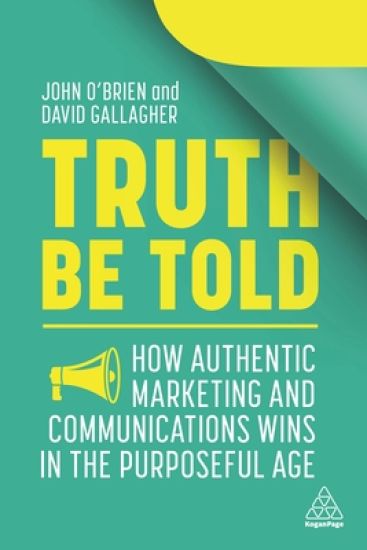
Truth Be Told

Truth Be Told

John O'Brien; David Gallagher

Kogan Page Ltd
2021
nidottu
Purpose as a business philosophy has resulted in organizations struggling to make sense of what they need to do and made 'purpose washing' commonplace. Identify the challenges and opportunities in the age of purpose and learn how to create authentic messaging, activate successful campaigns and asses the value that these have for key audiences. Purpose has become a leadership and managerial imperative for businesses large and small, non-profit organizations and charities. However, many businesses don't know how to clearly execute this, and the marketing and PR function of many companies struggle disproportionately as a result. This had led to an increase in cynicism and the growth of 'purpose washing'. However, when purpose is created with an authentic culture, the opportunity for building brand reputation and positive customer engagement is significant. Truth Be Told will help readers understand exactly how to achieve this and present the core truths of their company or organization, to drive clear, authentic purpose powered communication.
Truth Be Told

Truth Be Told

John O'Brien; David Gallagher

Kogan Page Ltd
2021
sidottu
Purpose as a business philosophy has resulted in organizations struggling to make sense of what they need to do and made 'purpose washing' commonplace. Identify the challenges and opportunities in the age of purpose and learn how to create authentic messaging, activate successful campaigns and asses the value that these have for key audiences. Purpose has become a leadership and managerial imperative for businesses large and small, non-profit organizations and charities. However, many businesses don't know how to clearly execute this, and the marketing and PR function of many companies struggle disproportionately as a result. This had led to an increase in cynicism and the growth of 'purpose washing'. However, when purpose is created with an authentic culture, the opportunity for building brand reputation and positive customer engagement is significant. Truth Be Told will help readers understand exactly how to achieve this and present the core truths of their company or organization, to drive clear, authentic purpose powered communication.
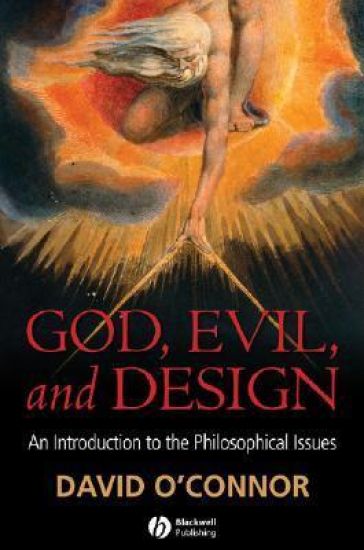
God, Evil and Design

God, Evil and Design

David K. O'Connor

Wiley-Blackwell (an imprint of John Wiley Sons Ltd)
2008
sidottu
Although vast and complex, the universe is orderly in many ways, and conditions at its beginning were right for the eventual evolution of life on this planet. But with life there is death, and with sentient life there is great pain and suffering, often with no apparent justification or purpose. Taking these things together, is it reasonable to conclude that the universe was brought about by God? Moreover, does the magnitude of seemingly pointless suffering square with the idea that God exists, or is it good reason to think there is no God? These questions come up for many people, not just religious believers, and are examined in this engaging and thought-provoking book. Starting out with no pre-disposition to theism, atheism, or agnosticism, God, Evil, and Design takes up these questions in order to see where an impartial investigation leads. To achieve impartiality, the reader is invited to simulate ignorance insofar as his or her own religious preference is concerned. With this approach, God, Evil, and Design provides both a fresh look at important and controversial issues in philosophy and an excellent introduction to the contemporary debates surrounding them. Lively and non-technical, this book will be accessible to anyone with an interest in these topics.
God, Evil and Design

God, Evil and Design

David K. O'Connor

Wiley-Blackwell (an imprint of John Wiley Sons Ltd)
2008
nidottu
Although vast and complex, the universe is orderly in many ways, and conditions at its beginning were right for the eventual evolution of life on this planet. But with life there is death, and with sentient life there is great pain and suffering, often with no apparent justification or purpose. Taking these things together, is it reasonable to conclude that the universe was brought about by God? Moreover, does the magnitude of seemingly pointless suffering square with the idea that God exists, or is it good reason to think there is no God? These questions come up for many people, not just religious believers, and are examined in this engaging and thought-provoking book. Starting out with no pre-disposition to theism, atheism, or agnosticism, God, Evil, and Design takes up these questions in order to see where an impartial investigation leads. To achieve impartiality, the reader is invited to simulate ignorance insofar as his or her own religious preference is concerned. With this approach, God, Evil, and Design provides both a fresh look at important and controversial issues in philosophy and an excellent introduction to the contemporary debates surrounding them. Lively and non-technical, this book will be accessible to anyone with an interest in these topics.
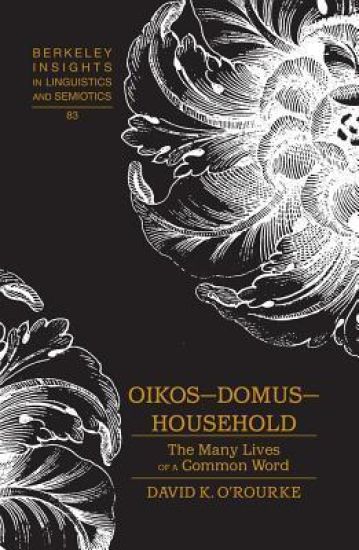
Oikos – Domus – Household

Oikos – Domus – Household

David K. O'Rourke

Peter Lang Publishing Inc
2013
sidottu
Oikos – Domus – Household: The Many Lives of a Common Word describes historic episodes in the lives of these words, from the Greek oikos and Roman domus to our current family and home. The episodes highlight their function as controlling metaphors used very differently from culture to culture, but often as ways to control basic issues, like the context in which women become pregnant and the control of land and its transmission to heirs. This book also describes how these words and their current equivalents, home and family, are used as metaphors to illustrate how people who count are supposed to live and also to justify disinterest in people who do not count. One of the most important functions of the household is providing a dependable context in which pregnancy can be controlled. It describes how another key interest, continuing the male line, is embodied. Currently family is a politically useful, normative fiction. Family and home have little concrete meaning other than as metaphors for how people are supposed to live. There is no consistent meaning for these words from one era and one culture to another. Each episode is described on its own trying to avoid «history by hindsight.» There are no attempts to trace causes from one time or event to another, but rather an attempt, to the limited extent possible, to describe episodes seen within their own contexts and mindsets. However, the fact that women can now have control over their own pregnancy is seen as a radical change in the role and definition of family and household.
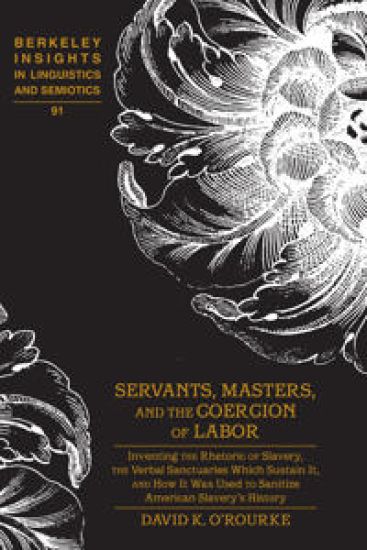
Servants, Masters, and the Coercion of Labor

Servants, Masters, and the Coercion of Labor

David K. O’Rourke

Peter Lang Publishing Inc
2015
sidottu
This book by David K. O’Rourke presents a study of language and linguistic forms and the roles they played in the initial imagining, developing, and maintaining of a society based on coerced labor. It focuses especially on the contexts of coercion and on the differences in the roles of masters and servants from society to society. In the interaction between colonial powers and conquered peoples, O’Rourke also describes how the European colonial nations imposed their own languages, social metaphors, and utopian views as a way to disconnect those they conquered from their historic roots and re-imagine, redefine, rename, and map them into new lands and places inhabited by inferior peoples needing control by masters who understand how they should now live. O’Rourke begins by describing how this rewriting of history is not new. He calls on well-established classical and biblical language studies to describe how older and historic oral histories and texts were rewritten to reshape the past to fit new and more useful views. He explains how rhetoric, metaphor, and pseudo-sciences were used to change Europe’s earlier contracted and coerced labor in colonial America into the chattel slavery that became the hallmark of the new and growing United States. O’Rourke also describes how the dominant culture’s current values, foundational metaphors, and sacred notions were woven together into linguistic shelters that served to enshrine the repressive process from questioning and dissent. These same linguistic elements were then used after emancipation to maintain and sanitize the remains of the slave system by presenting it as a benign institution.