Kirjojen hintavertailu. Mukana 11 699 587 kirjaa ja 12 kauppaa.

Kirjahaku

Etsi kirjoja tekijän nimen, kirjan nimen tai ISBN:n perusteella.

1000 tulosta hakusanalla Derek Gerrard

The Coasts of Bohemia

The Coasts of Bohemia

Derek Sayer

Princeton University Press
2000
pokkari
In The Winter's Tale, Shakespeare gave the landlocked country of Bohemia a coastline--a famous and, to Czechs, typical example of foreigners' ignorance of the Czech homeland. Although the lands that were once the Kingdom of Bohemia lie at the heart of Europe, Czechs are usually encountered only in the margins of other people's stories. In The Coasts of Bohemia, Derek Sayer reverses this perspective. He presents a comprehensive and long-needed history of the Czech people that is also a remarkably original history of modern Europe, told from its uneasy center. Sayer shows that Bohemia has long been a theater of European conflict. It has been a cradle of Protestantism and a bulwark of the Counter-Reformation; an Austrian imperial province and a proudly Slavic national state; the most easterly democracy in Europe; and a westerly outlier of the Soviet bloc. The complexities of its location have given rise to profound (and often profoundly comic) reflections on the modern condition. Franz Kafka, Jaroslav Hasek, Karel Capek and Milan Kundera are all products of its spirit of place. Sayer describes how Bohemia's ambiguities and contradictions are those of Europe itself, and he considers the ironies of viewing Europe, the West, and modernity from the vantage point of a country that has been too often ignored. The Coasts of Bohemia draws on an enormous array of literary, musical, visual, and documentary sources ranging from banknotes to statues, museum displays to school textbooks, funeral orations to operatic stage-sets, murals in subway stations to censors' indexes of banned books. It brings us into intimate contact with the ever changing details of daily life--the street names and facades of buildings, the heroes figured on postage stamps--that have created and recreated a sense of what it is to be Czech. Sayer's sustained concern with questions of identity, memory, and power place the book at the heart of contemporary intellectual debate. It is an extraordinary story, beautifully told.

Universities in the Marketplace

Universities in the Marketplace

Derek Bok

Princeton University Press
2004
pokkari
Is everything in a university for sale if the price is right? In this book, one of America's leading educators cautions that the answer is all too often "yes." Taking the first comprehensive look at the growing commercialization of our academic institutions, Derek Bok probes the efforts on campus to profit financially not only from athletics but increasingly, from education and research as well. He shows how such ventures are undermining core academic values and what universities can do to limit the damage. Commercialization has many causes, but it could never have grown to its present state had it not been for the recent, rapid growth of money-making opportunities in a more technologically complex, knowledge-based economy. A brave new world has now emerged in which university presidents, enterprising professors, and even administrative staff can all find seductive opportunities to turn specialized knowledge into profit. Bok argues that universities, faced with these temptations, are jeopardizing their fundamental mission in their eagerness to make money by agreeing to more and more compromises with basic academic values. He discusses the dangers posed by increased secrecy in corporate-funded research, for-profit Internet companies funded by venture capitalists, industry-subsidized educational programs for physicians, conflicts of interest in research on human subjects, and other questionable activities. While entrepreneurial universities may occasionally succeed in the short term, reasons Bok, only those institutions that vigorously uphold academic values, even at the cost of a few lucrative ventures, will win public trust and retain the respect of faculty and students. Candid, evenhanded, and eminently readable, Universities in the Marketplace will be widely debated by all those concerned with the future of higher education in America and beyond.
Our Underachieving Colleges

Our Underachieving Colleges

Derek Bok

Princeton University Press
2008
pokkari
Drawing on a large body of empirical evidence, former Harvard President Derek Bok examines how much progress college students actually make toward widely accepted goals of undergraduate education. His conclusions are sobering. Although most students make gains in many important respects, they improve much less than they should in such important areas as writing, critical thinking, quantitative skills, and moral reasoning. Large majorities of college seniors do not feel that they have made substantial progress in speaking a foreign language, acquiring cultural and aesthetic interests, or learning what they need to know to become active and informed citizens. Overall, despite their vastly increased resources, more powerful technology, and hundreds of new courses, colleges cannot be confident that students are learning more than they did fifty years ago. Looking further, Bok finds that many important college courses are left to the least experienced teachers and that most professors continue to teach in ways that have proven to be less effective than other available methods. In reviewing their educational programs, however, faculties typically ignore this evidence. Instead, they spend most of their time discussing what courses to require, although the lasting impact of college will almost certainly depend much more on how the courses are taught. In his final chapter, Bok describes the changes that faculties and academic leaders can make to help students accomplish more. Without ignoring the contributions that America's colleges have made, Bok delivers a powerful critique--one that educators will ignore at their peril.
Jews and the Military

Jews and the Military

Derek J. Penslar

Princeton University Press
2013
sidottu
Jews and the Military is the first comprehensive and comparative look at Jews' involvement in the military and their attitudes toward war from the 1600s until the creation of the state of Israel in 1948. Derek Penslar shows that although Jews have often been described as people who shun the army, in fact they have frequently been willing, even eager, to do military service, and only a minuscule minority have been pacifists. Penslar demonstrates that Israel's military ethos did not emerge from a vacuum and that long before the state's establishment, Jews had a vested interest in military affairs. Spanning Europe, North America, and the Middle East, Penslar discusses the myths and realities of Jewish draft dodging, how Jews reacted to facing their coreligionists in battle, the careers of Jewish officers and their reception in the Jewish community, the effects of World War I on Jewish veterans, and Jewish participation in the Spanish Civil War and World War II. Penslar culminates with a study of Israel's War of Independence as a Jewish world war, which drew on the military expertise and financial support of a mobilized, global Jewish community. He considers how military service was a central issue in debates about Jewish emancipation and a primary indicator of the position of Jews in any given society. Deconstructing old stereotypes, Jews and the Military radically transforms our understanding of Jews' historic relationship to war and military power.
How to Be a Better Birder

How to Be a Better Birder

Derek Lovitch

Princeton University Press
2012
pokkari
This unique illustrated handbook provides all the essential tools you need to become a better birder. Here Derek Lovitch offers a more effective way to go about identification--he calls it the "Whole Bird and More" approach--that will enable you to identify more birds, more quickly, more of the time. He demonstrates how to use geography and an understanding of habitats, ecology, and even the weather to enrich your birding experience and help you find something out of the ordinary. Lovitch shows how to track nocturnal migrants using radar, collect data for bird conservation, discover exciting rarities, develop patch lists--and much more. This is the ideal resource for intermediate and advanced birders. Whether you want to build a bigger list or simply learn more about birds, How to Be a Better Birder will take your birding skills to the next level. * Explains the "Whole Bird and More" approach to bird identification * Demonstrates how to use geography, habitats, ecology, and the weather to be a better birder * Shows how to bird at night using radar, collect conservation data, develop patch lists--and more * Offers essential tools for intermediate and advanced birders
The Politics of Happiness

The Politics of Happiness

Derek Bok

Princeton University Press
2010
sidottu
During the past forty years, thousands of studies have been carried out on the subject of happiness. Some have explored the levels of happiness or dissatisfaction associated with typical daily activities, such as working, seeing friends, or doing household chores. Others have tried to determine the extent to which income, family, religion, and other factors are associated with the satisfaction people feel about their lives. The Gallup organization has begun conducting global surveys of happiness, and several countries are considering publishing periodic reports on the growth or decline of happiness among their people. One nation, tiny Bhutan, has actually made 'Gross National Happiness' the central aim of its domestic policy. How might happiness research affect government policy in the United States - and beyond? In "The Politics of Happiness", former Harvard president Derek Bok examines how governments could use the rapidly growing research data on what makes people happy - in a variety of policy areas to increase well-being and improve the quality of life for all their citizens. Bok first describes the principal findings of happiness researchers. He considers how reliable the results appear to be and whether they deserve to be taken into account in devising government policies. Recognizing both the strengths and weaknesses of happiness research, Bok looks at the policy implications for economic growth, equality, retirement, unemployment, health care, mental health, family programs, education, and government quality, among other subjects. Timely and incisive, "The Politics of Happiness" sheds new light on what makes people happy and how government policy could foster greater satisfaction for all.
The Politics of Happiness

The Politics of Happiness

Derek Bok

Princeton University Press
2011
pokkari
During the past forty years, thousands of studies have been carried out on the subject of happiness. Some have explored the levels of happiness or dissatisfaction associated with typical daily activities, such as working, seeing friends, or doing household chores. Others have tried to determine the extent to which income, family, religion, and other factors are associated with the satisfaction people feel about their lives. The Gallup organization has begun conducting global surveys of happiness, and several countries are considering publishing periodic reports on the growth or decline of happiness among their people. One nation, tiny Bhutan, has actually made "Gross National Happiness" the central aim of its domestic policy. How might happiness research affect government policy in the United States--and beyond? In The Politics of Happiness, former Harvard president Derek Bok examines how governments could use the rapidly growing research data on what makes people happy--in a variety of policy areas to increase well-being and improve the quality of life for all their citizens. Bok first describes the principal findings of happiness researchers. He considers how reliable the results appear to be and whether they deserve to be taken into account in devising government policies. Recognizing both the strengths and weaknesses of happiness research, Bok looks at the policy implications for economic growth, equality, retirement, unemployment, health care, mental health, family programs, education, and government quality, among other subjects. Timely and incisive, The Politics of Happiness sheds new light on what makes people happy and how government policy could foster greater satisfaction for all.
Higher Education in America

Higher Education in America

Derek Bok

Princeton University Press
2013
sidottu
Higher Education in America is a landmark work--a comprehensive and authoritative analysis of the current condition of our colleges and universities from former Harvard president Derek Bok, one of the nation's most respected education experts. Sweepingly ambitious in scope, this is a deeply informed and balanced assessment of the many strengths as well as the weaknesses of American higher education today. At a time when colleges and universities have never been more important to the lives and opportunities of students or to the progress and prosperity of the nation, Bok provides a thorough examination of the entire system, public and private, from community colleges and small liberal arts colleges to great universities with their research programs and their medical, law, and business schools. Drawing on the most reliable studies and data, he determines which criticisms of higher education are unfounded or exaggerated, which are issues of genuine concern, and what can be done to improve matters. Some of the subjects considered are long-standing, such as debates over the undergraduate curriculum and concerns over rising college costs. Others are more recent, such as the rise of for-profit institutions and massive open online courses (MOOCs). Additional topics include the quality of undergraduate education, the stagnating levels of college graduation, the problems of university governance, the strengths and weaknesses of graduate and professional education, the environment for research, and the benefits and drawbacks of the pervasive competition among American colleges and universities. Offering a rare survey and evaluation of American higher education as a whole, this book provides a solid basis for a fresh public discussion about what the system is doing right, what it needs to do better, and how the next quarter century could be made a period of progress rather than decline.
Higher Education in America

Higher Education in America

Derek Bok

Princeton University Press
2015
pokkari
Higher Education in America is a landmark work--a comprehensive and authoritative analysis of the current condition of our colleges and universities from former Harvard president Derek Bok, one of the nation's most respected education experts. Sweepingly ambitious in scope, this is a deeply informed and balanced assessment of the many strengths as well as the weaknesses of American higher education today. At a time when colleges and universities have never been more important to the lives and opportunities of students or to the progress and prosperity of the nation, Bok provides a thorough examination of the entire system, public and private, from community colleges and small liberal arts colleges to great universities with their research programs and their medical, law, and business schools. Drawing on the most reliable studies and data, he determines which criticisms of higher education are unfounded or exaggerated, which are issues of genuine concern, and what can be done to improve matters. Some of the subjects considered are long-standing, such as debates over the undergraduate curriculum and concerns over rising college costs. Others are more recent, such as the rise of for-profit institutions and massive open online courses (MOOCs). Additional topics include the quality of undergraduate education, the stagnating levels of college graduation, the problems of university governance, the strengths and weaknesses of graduate and professional education, the environment for research, and the benefits and drawbacks of the pervasive competition among American colleges and universities. Offering a rare survey and evaluation of American higher education as a whole, this book provides a solid basis for a fresh public discussion about what the system is doing right, what it needs to do better, and how the next quarter century could be made a period of progress rather than decline.
Prague, Capital of the Twentieth Century

Prague, Capital of the Twentieth Century

Derek Sayer

Princeton University Press
2015
pokkari
Setting out to recover the roots of modernity in the boulevards, interiors, and arcades of the "city of light," Walter Benjamin dubbed Paris "the capital of the nineteenth century." In this eagerly anticipated sequel to his acclaimed Coasts of Bohemia: A Czech History, Derek Sayer argues that Prague could well be seen as the capital of the much darker twentieth century. Ranging across twentieth-century Prague's astonishingly vibrant and always surprising human landscape, this richly illustrated cultural history describes how the city has experienced (and suffered) more ways of being modern than perhaps any other metropolis. Located at the crossroads of struggles between democratic, communist, and fascist visions of the modern world, twentieth-century Prague witnessed revolutions and invasions, national liberation and ethnic cleansing, the Holocaust, show trials, and snuffed-out dreams of "socialism with a human face." Yet between the wars, when Prague was the capital of Europe's most easterly parliamentary democracy, it was also a hotbed of artistic and architectural modernism, and a center of surrealism second only to Paris. Focusing on these years, Sayer explores Prague's spectacular modern buildings, monuments, paintings, books, films, operas, exhibitions, and much more. A place where the utopian fantasies of the century repeatedly unraveled, Prague was tailor-made for surrealist Andre Breton's "black humor," and Sayer discusses the way the city produced unrivaled connoisseurs of grim comedy, from Franz Kafka and Jaroslav Hasek to Milan Kundera and Vaclav Havel. A masterful and unforgettable account of a city where an idling flaneur could just as easily be a secret policeman, this book vividly shows why Prague can teach us so much about the twentieth century and what made us who we are.
Jews and the Military

Jews and the Military

Derek J. Penslar

Princeton University Press
2015
pokkari
Jews and the Military is the first comprehensive and comparative look at Jews' involvement in the military and their attitudes toward war from the 1600s until the creation of the state of Israel in 1948. Derek Penslar shows that although Jews have often been described as people who shun the army, in fact they have frequently been willing, even eager, to do military service, and only a minuscule minority have been pacifists. Penslar demonstrates that Israel's military ethos did not emerge from a vacuum and that long before the state's establishment, Jews had a vested interest in military affairs. Spanning Europe, North America, and the Middle East, Penslar discusses the myths and realities of Jewish draft dodging, how Jews reacted to facing their coreligionists in battle, the careers of Jewish officers and their reception in the Jewish community, the effects of World War I on Jewish veterans, and Jewish participation in the Spanish Civil War and World War II. Penslar culminates with a study of Israel's War of Independence as a Jewish world war, which drew on the military expertise and financial support of a mobilized, global Jewish community. He considers how military service was a central issue in debates about Jewish emancipation and a primary indicator of the position of Jews in any given society. Deconstructing old stereotypes, Jews and the Military radically transforms our understanding of Jews' historic relationship to war and military power.
The Struggle to Reform Our Colleges

The Struggle to Reform Our Colleges

Derek Bok

Princeton University Press
2017
sidottu
Why efforts to improve American higher educational attainment haven't worked, and where to go from here During the first decade of this century, many commentators predicted that American higher education was about to undergo major changes that would be brought about under the stimulus of online learning and other technological advances. Toward the end of the decade, the president of the United States declared that America would regain its historic lead in the education of its workforce within the next ten years through a huge increase in the number of students earning "quality" college degrees. Several years have elapsed since these pronouncements were made, yet the rate of progress has increased very little, if at all, in the number of college graduates or the nature and quality of the education they receive. In The Struggle to Reform Our Colleges, Derek Bok seeks to explain why so little change has occurred by analyzing the response of America's colleges; the influence of students, employers, foundations, accrediting organizations, and government officials; and the impact of market forces and technological innovation. In the last part of the book, Bok identifies a number of initiatives that could improve the performance of colleges and universities. The final chapter examines the process of change itself and describes the strategy best calculated to quicken the pace of reform and enable colleges to meet the challenges that confront them.
Postcards from Absurdistan

Postcards from Absurdistan

Derek Sayer

PRINCETON UNIVERSITY PRESS
2022
sidottu
A sweeping history of a twentieth-century Prague torn between fascism, communism, and democracy—with lessons for a world again threatened by dictatorshipPostcards from Absurdistan is a cultural history of Prague from 1938, when the Nazis destroyed Czechoslovakia’s artistically vibrant liberal democracy, to 1989, when the country’s socialist regime collapsed after more than four decades of communist party rule. Derek Sayer shows that Prague’s twentieth century, far from being a story of inexorable progress toward some “end of history,” whether fascist, communist, or democratic, was a tragicomedy of recurring nightmares played out in a land Czech dissidents dubbed Absurdistan. Situated in the eye of the storms that shaped the modern world, Prague holds up an unsettling mirror to the absurdities and dangers of our own times.In a brilliant narrative, Sayer weaves a vivid montage of the lives of individual Praguers—poets and politicians, architects and athletes, journalists and filmmakers, artists, musicians, and comedians—caught up in the crosscurrents of the turbulent half century following the Nazi invasion. This is the territory of the ideologist, the collaborator, the informer, the apparatchik, the dissident, the outsider, the torturer, and the refugee—not to mention the innocent bystander who is always looking the other way and Václav Havel’s greengrocer whose knowing complicity allows the show to go on. Over and over, Prague exposes modernity’s dreamworlds of progress as confections of kitsch.In a time when democracy is once again under global assault, Postcards from Absurdistan is an unforgettable portrait of a city that illuminates the predicaments of the modern world.
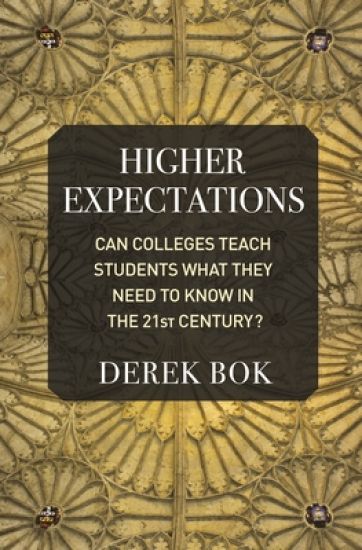
Higher Expectations

Higher Expectations

Derek Bok

PRINCETON UNIVERSITY PRESS
2020
sidottu
How our colleges and universities can respond to the changing hopes and needs of societyIn recent decades, cognitive psychologists have cast new light on human development and given colleges new possibilities for helping students acquire skills and qualities that will enhance their lives and increase their contributions to society. In this landmark book, Derek Bok explores how colleges can reap the benefits of these discoveries and create a more robust undergraduate curriculum for the twenty-first century.Prior to this century, most psychologists thought that creativity, empathy, resilience, conscientiousness, and most personality traits were largely fixed by early childhood. What researchers have now discovered is that virtually all of these qualities continue to change through early adulthood and often well beyond. Such findings suggest that educators may be able to do much more than was previously thought possible to teach students to develop these important characteristics and thereby enable them to flourish in later life.How prepared are educators to cultivate these qualities of mind and behavior? What do they need to learn to capitalize on the possibilities? Will college faculties embrace these opportunities and make the necessary changes in their curricula and teaching methods? What can be done to hasten the process of innovation and application? In providing answers to these questions, Bok identifies the hurdles to institutional change, proposes sensible reforms, and demonstrates how our colleges can help students lead more successful, productive, and meaningful lives.
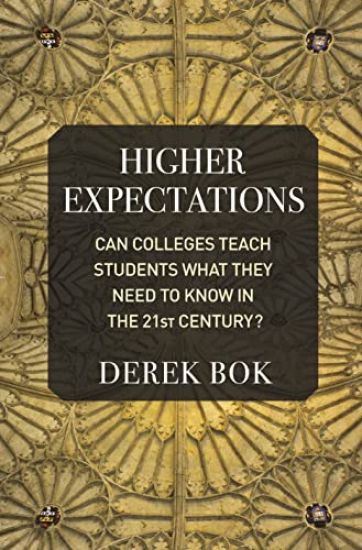
Higher Expectations

Higher Expectations

Derek Bok

PRINCETON UNIVERSITY PRESS
2022
pokkari
How our colleges and universities can respond to the changing hopes and needs of societyIn recent decades, cognitive psychologists have cast new light on human development and given colleges new possibilities for helping students acquire skills and qualities that will enhance their lives and increase their contributions to society. In this landmark book, Derek Bok explores how colleges can reap the benefits of these discoveries and create a more robust undergraduate curriculum for the twenty-first century.Prior to this century, most psychologists thought that creativity, empathy, resilience, conscientiousness, and most personality traits were largely fixed by early childhood. What researchers have now discovered is that virtually all of these qualities continue to change through early adulthood and often well beyond. Such findings suggest that educators may be able to do much more than was previously thought possible to teach students to develop these important characteristics and thereby enable them to flourish in later life.How prepared are educators to cultivate these qualities of mind and behavior? What do they need to learn to capitalize on the possibilities? Will college faculties embrace these opportunities and make the necessary changes in their curricula and teaching methods? What can be done to hasten the process of innovation and application? In providing answers to these questions, Bok identifies the hurdles to institutional change, proposes sensible reforms, and demonstrates how our colleges can help students lead more successful, productive, and meaningful lives.
Postcards from Absurdistan

Postcards from Absurdistan

Derek Sayer

PRINCETON UNIVERSITY PRESS
2024
pokkari
A sweeping history of a twentieth-century Prague torn between fascism, communism, and democracy—with lessons for a world again threatened by dictatorshipPostcards from Absurdistan is a cultural history of Prague from 1938, when the Nazis destroyed Czechoslovakia’s artistically vibrant liberal democracy, to 1989, when the country’s socialist regime collapsed after more than four decades of communist party rule. Derek Sayer shows that Prague’s twentieth century, far from being a story of inexorable progress toward some “end of history,” whether fascist, communist, or democratic, was a tragicomedy of recurring nightmares played out in a land Czech dissidents dubbed Absurdistan. Situated in the eye of the storms that shaped the modern world, Prague holds up an unsettling mirror to the absurdities and dangers of our own times.In a brilliant narrative, Sayer weaves a vivid montage of the lives of individual Praguers—poets and politicians, architects and athletes, journalists and filmmakers, artists, musicians, and comedians—caught up in the crosscurrents of the turbulent half century following the Nazi invasion. This is the territory of the ideologist, the collaborator, the informer, the apparatchik, the dissident, the outsider, the torturer, and the refugee—not to mention the innocent bystander who is always looking the other way and Václav Havel’s greengrocer whose knowing complicity allows the show to go on. Over and over, Prague exposes modernity’s dreamworlds of progress as confections of kitsch.In a time when democracy is once again under global assault, Postcards from Absurdistan is an unforgettable portrait of a city that illuminates the predicaments of the modern world.
Looking Backward

Looking Backward

Derek L. Phillips

Princeton University Press
2014
pokkari
When social reformers blame the current ills of Western culture on the loss of community, they often evoke an ideal past in which societies were characterized by shared values, respect for tradition, commitment to the common good, and similar attributes. Communitarians assert that community was prominent in the past, and argue that reclaiming the role community formerly played is necessary to counter the negative effects of individualism and liberal thinking. Considering the relevance of community for our moral and political life today, Derek Phillips offers the first thorough critique of the historical, often nostalgic, claims that underlie dominant versions of communitarian philosophy. Originally published in 1993. The Princeton Legacy Library uses the latest print-on-demand technology to again make available previously out-of-print books from the distinguished backlist of Princeton University Press. These editions preserve the original texts of these important books while presenting them in durable paperback and hardcover editions. The goal of the Princeton Legacy Library is to vastly increase access to the rich scholarly heritage found in the thousands of books published by Princeton University Press since its founding in 1905.
Toward a Just Social Order

Toward a Just Social Order

Derek L. Phillips

Princeton University Press
2014
pokkari
Derek Phillips presents a strong case for the importance of normative theories about the just social organization of society. Most sociologists urge the avoidance of value judgments, but Professor Phillips argues for a notion of a just social order that reflects a twin concern with explanatory and normative thinking. Originally published in 1986. The Princeton Legacy Library uses the latest print-on-demand technology to again make available previously out-of-print books from the distinguished backlist of Princeton University Press. These editions preserve the original texts of these important books while presenting them in durable paperback and hardcover editions. The goal of the Princeton Legacy Library is to vastly increase access to the rich scholarly heritage found in the thousands of books published by Princeton University Press since its founding in 1905.
Looking Backward

Looking Backward

Derek L. Phillips

Princeton University Press
2016
sidottu
When social reformers blame the current ills of Western culture on the loss of community, they often evoke an ideal past in which societies were characterized by shared values, respect for tradition, commitment to the common good, and similar attributes. Communitarians assert that community was prominent in the past, and argue that reclaiming the role community formerly played is necessary to counter the negative effects of individualism and liberal thinking. Considering the relevance of community for our moral and political life today, Derek Phillips offers the first thorough critique of the historical, often nostalgic, claims that underlie dominant versions of communitarian philosophy. Originally published in 1993. The Princeton Legacy Library uses the latest print-on-demand technology to again make available previously out-of-print books from the distinguished backlist of Princeton University Press. These editions preserve the original texts of these important books while presenting them in durable paperback and hardcover editions. The goal of the Princeton Legacy Library is to vastly increase access to the rich scholarly heritage found in the thousands of books published by Princeton University Press since its founding in 1905.
Toward a Just Social Order

Toward a Just Social Order

Derek L. Phillips

Princeton University Press
2016
sidottu
Derek Phillips presents a strong case for the importance of normative theories about the just social organization of society. Most sociologists urge the avoidance of value judgments, but Professor Phillips argues for a notion of a just social order that reflects a twin concern with explanatory and normative thinking. Originally published in 1986. The Princeton Legacy Library uses the latest print-on-demand technology to again make available previously out-of-print books from the distinguished backlist of Princeton University Press. These editions preserve the original texts of these important books while presenting them in durable paperback and hardcover editions. The goal of the Princeton Legacy Library is to vastly increase access to the rich scholarly heritage found in the thousands of books published by Princeton University Press since its founding in 1905.