England, 1814: Edmund Percy has been driven from the hurricane-haunted seas of the Caribbean to the heart of England's tranquil Hampshire in search of the Dark Queen foretold to him. He must unriddle the taunting mystery of her past, if he can; and he must use that discovered secret to win her with his most silver persuasions. It seems that all his efforts avail nothing, and the days and minutes allotted to his quest race away. Then fate or Providence slips a last chance into his hand . . .An epic, a romance, and a mystery, Edmund Persuader is the tale of a man both blessed and cursed by his powers of persuasion. Those powers seem to perform the greatest wonders when they work him ill, yet fail when he needs them most-until he can emerge from the depths of moral error and climb toward the exaltation of redeeming love.This is volume 3 of 5 volumes.
England, 1814: Edmund Percy has been driven from the hurricane-haunted seas of the Caribbean to the heart of England's tranquil Hampshire in search of the Dark Queen foretold to him. He must unriddle the taunting mystery of her past, if he can; and he must use that discovered secret to win her with his most silver persuasions. It seems that all his efforts avail nothing, and the days and minutes allotted to his quest race away. Then fate or Providence slips a last chance into his hand . . .An epic, a romance, and a mystery, Edmund Persuader is the tale of a man both blessed and cursed by his powers of persuasion. Those powers seem to perform the greatest wonders when they work him ill, yet fail when he needs them most-until he can emerge from the depths of moral error and climb toward the exaltation of redeeming love.This is volume 4 of 5 volumes.
England, 1814: Edmund Percy has been driven from the hurricane-haunted seas of the Caribbean to the heart of England's tranquil Hampshire in search of the Dark Queen foretold to him. He must unriddle the taunting mystery of her past, if he can; and he must use that discovered secret to win her with his most silver persuasions. It seems that all his efforts avail nothing, and the days and minutes allotted to his quest race away. Then fate or Providence slips a last chance into his hand . . .An epic, a romance, and a mystery, Edmund Persuader is the tale of a man both blessed and cursed by his powers of persuasion. Those powers seem to perform the greatest wonders when they work him ill, yet fail when he needs them most-until he can emerge from the depths of moral error and climb toward the exaltation of redeeming love.This is volume 1 of 5 volumes.
England, 1814: Edmund Percy has been driven from the hurricane-haunted seas of the Caribbean to the heart of England's tranquil Hampshire in search of the Dark Queen foretold to him. He must unriddle the taunting mystery of her past, if he can; and he must use that discovered secret to win her with his most silver persuasions. It seems that all his efforts avail nothing, and the days and minutes allotted to his quest race away. Then fate or Providence slips a last chance into his hand . . .An epic, a romance, and a mystery, Edmund Persuader is the tale of a man both blessed and cursed by his powers of persuasion. Those powers seem to perform the greatest wonders when they work him ill, yet fail when he needs them most-until he can emerge from the depths of moral error and climb toward the exaltation of redeeming love.This is the fifth and final volume of the novel.
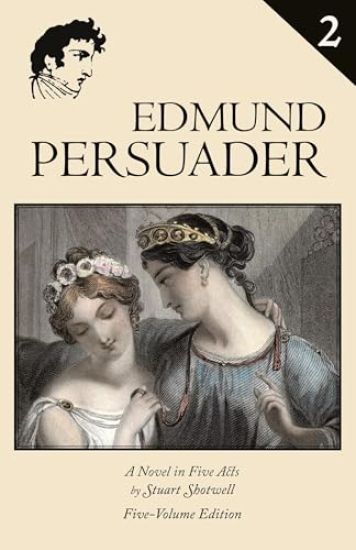
England, 1814: Edmund Percy has been driven from the hurricane-haunted seas of the Caribbean to the heart of England's tranquil Hampshire in search of the Dark Queen foretold to him. He must unriddle the taunting mystery of her past, if he can; and he must use that discovered secret to win her with his most silver persuasions. It seems that all his efforts avail nothing, and the days and minutes allotted to his quest race away. Then fate or Providence slips a last chance into his hand . . .An epic, a romance, and a mystery, Edmund Persuader is the tale of a man both blessed and cursed by his powers of persuasion. Those powers seem to perform the greatest wonders when they work him ill, yet fail when he needs them most-until he can emerge from the depths of moral error and climb toward the exaltation of redeeming love.This is volume 2 of 5 volumes.
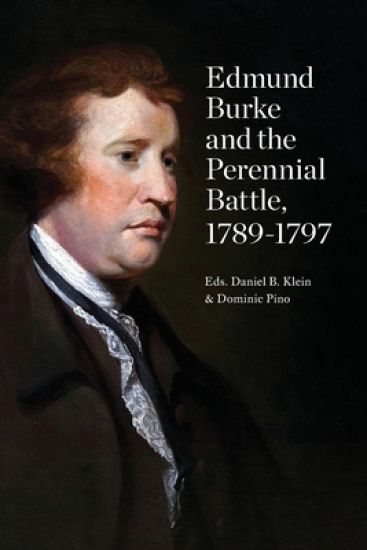
Edmund Burke's interpretation of the revolution in France, beginning 1789, is nothing short of an interpretation of human nature, and of Western civilization. Now the most penetrating and timeless passages of Burke's writings 1789 to his death in 1797 are collected for accessible enjoyment and edification. The passages come from Reflections on the Revolution in France (1790), An Appeal from the New to the Old Whigs (1791), Letters on a Regicide Peace (1795-96), and six other writings penned during those momentous years. The editors of this volume have left the bulk of those texts behind, selecting only crisp and cogent passages. The result is not a mere collection of nuggets, but a sourcebook of Burke's most profound body of thought.Burke instills appreciation of liberty and of its dependence on a political order that is stable, functional, reasonable, and reformable. He interprets the French Revolution as downstream from human nature and human instinct, but also as the expression of a new and wrongheaded quasi-religion. He exposes its dogmatism, rationalism, hypocrisy, incivility, and chic radicalism. Our modern world, he exhorts, must not forsake the morals and beliefs upon which liberal arrangements depend.Hear a living voice, now urgently relevant. With candor and openness Burke pours out his sentiments and bravely expresses the farthest reaches of his understanding of the moral universe. His brilliance, erudition, and passion are on full display, a soul offering a statement for the ages.
Edmund C. Berkeley (1909 – 1988) was a mathematician, insurance actuary, inventor, publisher, and a founder of the Association for Computing Machinery (ACM). His book Giant Brains or Machines That Think (1949) was the first explanation of computers for a general readership. His journal Computers and Automation (1951-1973) was the first journal for computer professionals. In the 1950s, Berkeley developed mail-order kits for small, personal computers such as Simple Simon and the Braniac. In an era when computer development was on a scale barely affordable by universities or government agencies, Berkeley took a different approach and sold simple computer kits to average Americans. He believed that digital computers, using mechanized reasoning based on symbolic logic, could help people make more rational decisions. The result of this improved reasoning would be better social conditions and fewer large-scale wars. Although Berkeley’s populist notions of computer development in the public interest did not prevail, the events of his life exemplify the human side of ongoing debates concerning the social responsibility of computer professionals.This biography of Edmund Berkeley, based on primary sources gathered over 15 years of archival research, provides a lens to understand social and political decisions surrounding early computer development, and the consequences of these decisions in our 21st century lives.
Edmund C. Berkeley (1909 – 1988) was a mathematician, insurance actuary, inventor, publisher, and a founder of the Association for Computing Machinery (ACM). His book Giant Brains or Machines That Think (1949) was the first explanation of computers for a general readership. His journal Computers and Automation (1951-1973) was the first journal for computer professionals. In the 1950s, Berkeley developed mail-order kits for small, personal computers such as Simple Simon and the Braniac. In an era when computer development was on a scale barely affordable by universities or government agencies, Berkeley took a different approach and sold simple computer kits to average Americans. He believed that digital computers, using mechanized reasoning based on symbolic logic, could help people make more rational decisions. The result of this improved reasoning would be better social conditions and fewer large-scale wars. Although Berkeley’s populist notions of computer development in the public interest did not prevail, the events of his life exemplify the human side of ongoing debates concerning the social responsibility of computer professionals.This biography of Edmund Berkeley, based on primary sources gathered over 15 years of archival research, provides a lens to understand social and political decisions surrounding early computer development, and the consequences of these decisions in our 21st century lives.
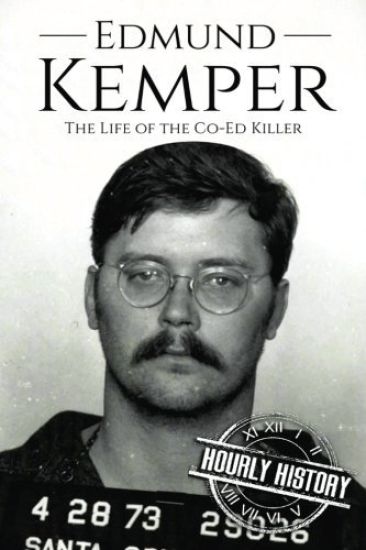
Welcome To Real Crime By Real Killer. This is a series where we explore how normal individuals turned their darkest fantasy into a reality.Edmund Emil Kemper III achieved notoriety as a serial killer when he took the lives of 10 people between August 27, 1964, and April 21, 1973. His victims included his adoptive grandparents, six co-eds from the University of Santa Cruz, his mother, and his mother's friend. This book explored the life of Kemper from his abusive childhood to his sentencing in November 1973.The horror of Kemper's actions goes beyond the killing of his victims; it was what he did with his victims' bodies after killing them. Necrophilia, cannibalism, and dismemberment were all part his routine in his attempts to satiate his morbid desires. Just as terrifying as his dark fantasies were his ability to appear and function as an average person, allowing him to avoid raising suspicion in those he interacted with, including law enforcement.Contrary to the myth that serial killers kill indiscriminately, Kemper's killing spree may have been rooted in the hatred that he felt for his mother. In an interview after his capture, he admitted that he was intentionally developing his killing skills with each co-ed that he killed. He was training for the ultimate murder, which was the killing of his mother.From beginning to end, the book provides insights to why Kemper became a serial killer as well as his mindset behind the killings.Scroll up, click "Add to Cart", and delve into the dark story. This true-crime account isn't for the faint of heart. Read it if you dare.
Reflections on the Revolution in France is a political pamphlet written by the British statesman Edmund Burke and published in November 1790. One of the best-known intellectual attacks against the French Revolution, Reflections is a defining tract of modern conservatism as well as an important contribution to international theory. Above all else, it has been one of the defining efforts of Edmund Burke's transformation of "traditionalism into a self-conscious and fully conceived political philosophy of conservatism". 3] The pamphlet has not been easy to classify. Academics have had trouble identifying whether Burke, or his tract, can best be understood as "a realist or an idealist, Rationalist or a Revolutionist". Thanks to its thoroughness, rhetorical skill, and literary power, it has become one of the most widely known of Burke's writings and a classic text in political theory. In the twentieth century, it greatly influenced conservative and classical liberal intellectuals, who recast Burke's Whiggish arguments as a critique of communist and revolutionary-socialist programmes..... Edmund Burke (12 January - 1729 - 9 July 1797) was an Irish statesman born in Dublin, as well as an author, orator, political theorist, and philosopher who, after moving to London, served as a member of parliament (MP) for many years in the House of Commons with the Whig Party. Burke was a strong proponent of maintaining solid moral virtues in society, and of the importance of religion in attaining that virtue and keeping society together. These views were expressed in his A Vindication of Natural Society. Burke criticized British treatment of the American colonies, including through its taxation policies. He also supported the American Revolution, believing both that it couldn't affect British or European stability and would be an innovative experiment in political development because the Americas were so far away from Europe and thus could have little impact on England. Burke is remembered for his support for Catholic emancipation, the impeachment of Warren Hastings from the East India Company, and for his staunch opposition to the French Revolution. In his Reflections on the Revolution in France, Burke claimed that the revolution was destroying the fabric of good society, traditional institutions of state & society, and condemned the persecution of the Catholic Church that resulted from it. This led to his becoming the leading figure within the conservative faction of the Whig Party, which he dubbed the "Old Whigs", as opposed to the pro-French Revolution "New Whigs", led by Charles James Fox. In the nineteenth century Burke was praised by both conservatives and liberals. Subsequently, in the twentieth century, he became widely regarded as the philosophical founder of modern conservatismointed Inspector of the Imports and Exports in the Custom House, which he resigned to become Usher of the Exchequer, which gave him at first 3900 per annum but this increased over the years. Upon coming of age he became Comptroller of the Pipe and Clerk of the Estreats which gave him an income of 300 per annum.Walpole decided to go travelling with Thomas Gray and wrote a will whereby he left Gray all his belongings. In 1744 Walpole wrote in a letter to Conway that these offices gave him nearly 2,000 per annum; after 1745 when he was appointed Collectorship of Customs, his total income from these offices was around 3,400 per annum............
Edmund Kemper To the average American, there was nothing out of the ordinary about Edmund Kemper before 1973. Standing at six-foot-nine, the young man was a giant, but he was gentle, soft spoken, and shy. He lived with his mother into his mid-twenties and frequented local bars, cozying up to police officers-a job he had once hoped to hold himself but couldn't since he was too tall. This was one reality of Kemper's life-the reality he wanted those around him to see. There was another side to the man though, a much darker side. Kemper's actions in his life shocked America, who dubbed him the Co-Ed Killer for his urge to murder and violate co-ed girls in Northern California. Inside you will read about... - Hatred is Born - Kemper's First Murders - Institutionalized with an IQ of 145 - The Co-Ed Killer - Kemper's Grand Finale: The Death of His Mother - Arrest, Imprisonment, and Parole And much more
Edmund Burke 12 January 1730 - 9 July 1797) was an Irish statesman born in Dublin, as well as an author, orator, political theorist and philosopher, who after moving to London in 1750 served as a member of parliament (MP) between 1766 and 1794 in the House of Commons with the Whig Party. Burke was a proponent of underpinning virtues with manners in society and of the importance of religion in moral life.These views were expressed in his A Vindication of Natural Society. Burke criticized British treatment of the American colonies, including through its taxation policies. He also supported the rights of the colonists to resist metropolitan authority, though he opposed the attempt to achieve independence. Burke is remembered for his support for Catholic emancipation, the impeachment of Warren Hastings from the East India Company and for his staunch opposition to the French Revolution. In his Reflections on the Revolution in France, Burke claimed that the revolution was destroying the fabric of good society, traditional institutions of state and society and condemned the persecution of the Catholic Church that resulted from it. This led to his becoming the leading figure within the conservative faction of the Whig Party, which he dubbed the "Old Whigs", as opposed to the pro-French Revolution "New Whigs", led by Charles James Fox
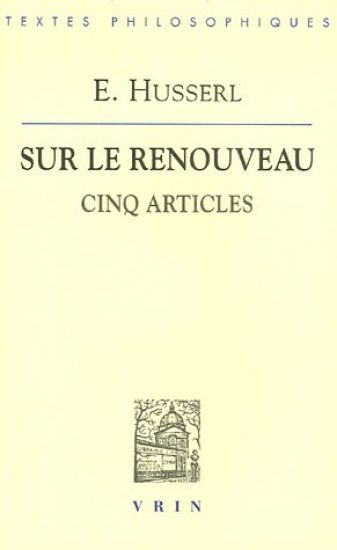
A l'invitation de la revue japonaise Kaizo, Husserl redige, entre 1922 et 1924, une serie de cinq articles consacres a l'ethique et centres sur le theme du renouveau (Erneuerung). Il cherche a y definir les conditions d'un renouveau ethique de l'homme europeen grace auquel pourra etre surmontee la crise culturelle qui le touche et que lui a brutalement revelee la Premiere Guerre mondiale. La recherche que developpe ici Husserl permet d'apprehender les differents champs et articulations de son ethique: ethique a la fois materiellement determinee et regie par des lois purement formelles, ethique individuelle s'inscrivant necessairement dans une ethique sociale, ethique eidetique et apriorique mais rapportee a une interpretation de l'histoire et de la culture europeennes. Elle montre aussi que la question ethique n'est pas pour Husserl une problematique a part, mais qu'elle met en oeuvre la totalite de la recherche philosophique, y compris dans sa dimension logique, en lui assignant la tache generale de redonner son sens a l'ideal d'une vie et d'une culture rationnelles.
D cryptez la pens e de Husserl avec l'analyse de Paideia ducation Que faut-il retenir de l'oeuvre du philosophe ? Retrouvez tout ce que vous devez savoir de Husserl dans une analyse de r f rence pour comprendre rapidement le sens de sa pens e. R dig e de mani re claire et accessible par un enseignant, cette analyse propose notamment une biographie du philosophe, une tude de sa pens e et une bibliographie de ses principaux ouvrages. Une analyse philosophique compl te et d taill e pour mieux comprendre le philosophe Paideia ducation en deux mots: Pl biscit aussi bien par les passionn s de philosophie que par les lyc ens, Paideia ducation est consid r comme une r f rence en mati re d'analyses d'oeuvres litt raires et philosophiques. Celles-ci ont t con ues pour guider les lecteurs et rendre accessible des ouvrages et philosophes de premier plan. Nos auteurs appartiennent aux milieux universitaire et de l' ducation, gage de s rieux pour vous faire d couvrir les plus grands auteurs de la philosophie mondiale.
This book is the first extended critical study of the early modern poet Edmund Spenser from the perspective of animal studies. With an introduction situating Spenser in current discussions of animal life and literary form, and early modern animal studies, the book proceeds in four sections: “Animals and Cultural Practices”; “Animals, Slavery, and Race”; “Animals in Complaints”; “Readers and Poetics in The Faerie Queene”. Contributors discuss a broad range of Spenser’s work, putting it into dialogue with a number of early modern discourses, including politics, poetics, and natural history.
This book is the first extended critical study of the early modern poet Edmund Spenser from the perspective of animal studies. With an introduction situating Spenser in current discussions of animal life and literary form, and early modern animal studies, the book proceeds in four sections: “Animals and Cultural Practices”; “Animals, Slavery, and Race”; “Animals in Complaints”; “Readers and Poetics in The Faerie Queene”. Contributors discuss a broad range of Spenser’s work, putting it into dialogue with a number of early modern discourses, including politics, poetics, and natural history.
Husserls "Logische Untersuchungen" sind eines der detailliertesten Bucher, die je uber die Phanomenologie des Bewusstseins geschrieben wurden. Die beiden 1900 ("Prolegomena") und 1901 ("Logische Untersuchungen") erschienenen Bande enthalten nicht nur Beitrage zu den in den Logikbuchern der Zeit vielfach diskutierten Themen Bedeutung, Begriff, Urteil, Erkenntnis und Wahrheit, sie weiten diese Analysen auch auf Bewusstseinsakte, wie Wahrnehmungen, Imaginationen, Gefuhle und die Intentionalitat schlechthin aus. Immer wieder Erkenntnisse fruherer Kapitel aufnehmend, verbinden sie sich schliesslich zu einem umfassenden Gesamtbild der Struktur von mentalen Erlebnissen. Damit liefern sie wichtige Beitrage zu heute hochaktuellen Debatten in der Erkenntnistheorie und der Philosophie des Geistes. Die phanomenologische Methode erweist sich in der Philosophie immer mehr als unverzichtbare Quelle der Information und Argumentation, die empirischen Bestimmungen vorgeschaltet und deshalb auch fur die Einzelwissenschaften von Bedeutung ist. Sowohl fur die analytische wie fur die kontinentale Philosophie bieten die "Logischen Untersuchungen" zahlreiche Anknupfungspunkte. Ganz im Sinne Husserls vereinigt der Kommentarband Forscher aus unterschiedlichen Schulen zu einer Kooperation in Sachen Phanomenologie."