Kirjojen hintavertailu. Mukana 11 342 296 kirjaa ja 12 kauppaa.

Kirjahaku

Etsi kirjoja tekijän nimen, kirjan nimen tai ISBN:n perusteella.

1000 tulosta hakusanalla Emanuel Herrmann

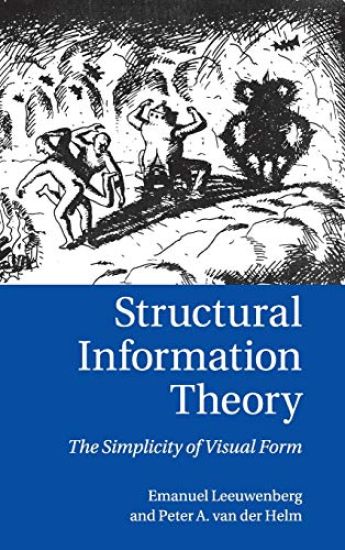
Structural Information Theory

Structural Information Theory

Emanuel Leeuwenberg; Peter A. van der Helm

Cambridge University Press
2012
sidottu
Structural information theory is a coherent theory about the way the human visual system organises a raw visual stimulus into objects and object parts. To humans, a visual stimulus usually has one clear interpretation even though, in theory, any stimulus can be interpreted in numerous ways. To explain this, the theory focuses on the nature of perceptual interpretations rather than on underlying process mechanisms and adopts the simplicity principle which promotes efficiency of internal resources rather than the likelihood principle which promotes veridicality in the external world. This theoretically underpinned starting point gives rise to quantitative models and verifiable predictions for many visual phenomena, including amodal completion, subjective contours, transparency, brightness contrast, brightness assimilation and neon illusions. It also explains phenomena such as induced temporal order, temporal context effects and hierarchical dominance effects, and extends to evaluative pattern qualities such as distinctiveness, interestingness and beauty.

Structural Information Theory

Structural Information Theory

Emanuel Leeuwenberg; Peter A. van der Helm

Cambridge University Press
2015
pokkari
Structural information theory is a coherent theory about the way the human visual system organises a raw visual stimulus into objects and object parts. To humans, a visual stimulus usually has one clear interpretation even though, in theory, any stimulus can be interpreted in numerous ways. To explain this, the theory focuses on the nature of perceptual interpretations rather than on underlying process mechanisms and adopts the simplicity principle which promotes efficiency of internal resources rather than the likelihood principle which promotes veridicality in the external world. This theoretically underpinned starting point gives rise to quantitative models and verifiable predictions for many visual phenomena, including amodal completion, subjective contours, transparency, brightness contrast, brightness assimilation and neon illusions. It also explains phenomena such as induced temporal order, temporal context effects and hierarchical dominance effects, and extends to evaluative pattern qualities such as distinctiveness, interestingness and beauty.

Language Contact in the Early Colonial Pacific

Language Contact in the Early Colonial Pacific

Emanuel J. Drechsel

Cambridge University Press
2017
pokkari
This volume presents a historical-sociolinguistic description and analysis of Maritime Polynesian Pidgin. It offers linguistic and sociohistorical substantiation for a regional Eastern Polynesian-based pidgin, and challenges conventional Eurocentric assumptions about early colonial contact in the eastern Pacific by arguing that Maritime Polynesian Pidgin preceded the introduction of Pidgin English by as much as a century. Emanuel J. Drechsel not only opens up new methodological avenues for historical-sociolinguistic research in Oceania by a combination of philology and ethnohistory, but also gives greater recognition to Pacific Islanders in early contact between cultures. Students and researchers working on language contact, language typology, historical linguistics and sociolinguistics will want to read this book. It redefines our understanding of how Europeans and Americans interacted with Pacific Islanders in Eastern Polynesia during early encounters and offers an alternative model of language contact.
World Ordering

World Ordering

Emanuel Adler

Cambridge University Press
2019
pokkari
Drawing on evolutionary epistemology, process ontology, and a social-cognition approach, this book suggests cognitive evolution, an evolutionary-constructivist social and normative theory of change and stability of international social orders. It argues that practices and their background knowledge survive preferentially, communities of practice serve as their vehicle, and social orders evolve. As an evolutionary theory of world ordering, which does not borrow from the natural sciences, it explains why certain configurations of practices organize and govern social orders epistemically and normatively, and why and how these configurations evolve from one social order to another. Suggesting a multiple and overlapping international social orders' approach, the book uses three running cases of contested orders - Europe's contemporary social order, the cyberspace order, and the corporate order - to illustrate the theory. Based on the concepts of common humanity and epistemological security, the author also submits a normative theory of better practices and of bounded progress.
World Ordering

World Ordering

Emanuel Adler

Cambridge University Press
2019
sidottu
Drawing on evolutionary epistemology, process ontology, and a social-cognition approach, this book suggests cognitive evolution, an evolutionary-constructivist social and normative theory of change and stability of international social orders. It argues that practices and their background knowledge survive preferentially, communities of practice serve as their vehicle, and social orders evolve. As an evolutionary theory of world ordering, which does not borrow from the natural sciences, it explains why certain configurations of practices organize and govern social orders epistemically and normatively, and why and how these configurations evolve from one social order to another. Suggesting a multiple and overlapping international social orders' approach, the book uses three running cases of contested orders - Europe's contemporary social order, the cyberspace order, and the corporate order - to illustrate the theory. Based on the concepts of common humanity and epistemological security, the author also submits a normative theory of better practices and of bounded progress.
Wilhelm von Humboldt and Early American Linguistics

Wilhelm von Humboldt and Early American Linguistics

Emanuel J. Drechsel

Cambridge University Press
2024
sidottu
Wilhelm von Humboldt (1767–1835), an early pioneer in the philosophy of language, linguistic and educational theory, was not only one of the ?rst European linguists to identify human language as a rule-governed system –the foundational premise of Noam Chomsky's generative theory – or to re?ect on cognition in studying language; he was also a major scholar of Indigenous American languages. However, with his famous naturalist brother Alexander 'stealing the show,' Humboldt's contributions to linguistics and anthropology have remained understudied in English until today. Drechsel's unique book addresses this gap by uncovering and examining Humboldt's in?uences on diverse issues in nineteenth-century American linguistics, from Peter S. Duponceau to the early Boasians, including Edward Sapir. This study shows how Humboldt's ideas have shaped the ?eld in multiple ways. Shining a light on one of the early innovators of linguistics, it is essential reading for anyone interested in the history of the ?eld.
The Volatility Smile

The Volatility Smile

Emanuel Derman; Michael B. Miller

John Wiley Sons Inc
2016
sidottu
The Volatility Smile The Black-Scholes-Merton option model was the greatest innovation of 20th century finance, and remains the most widely applied theory in all of finance. Despite this success, the model is fundamentally at odds with the observed behavior of option markets: a graph of implied volatilities against strike will typically display a curve or skew, which practitioners refer to as the smile, and which the model cannot explain. Option valuation is not a solved problem, and the past forty years have witnessed an abundance of new models that try to reconcile theory with markets. The Volatility Smile presents a unified treatment of the Black-Scholes-Merton model and the more advanced models that have replaced it. It is also a book about the principles of financial valuation and how to apply them. Celebrated author and quant Emanuel Derman and Michael B. Miller explain not just the mathematics but the ideas behind the models. By examining the foundations, the implementation, and the pros and cons of various models, and by carefully exploring their derivations and their assumptions, readers will learn not only how to handle the volatility smile but how to evaluate and build their own financial models. Topics covered include: The principles of valuationStatic and dynamic replicationThe Black-Scholes-Merton modelHedging strategiesTransaction costsThe behavior of the volatility smileImplied distributionsLocal volatility modelsStochastic volatility modelsJump-diffusion models The first half of the book, Chapters 1 through 13, can serve as a standalone textbook for a course on option valuation and the Black-Scholes-Merton model, presenting the principles of financial modeling, several derivations of the model, and a detailed discussion of how it is used in practice. The second half focuses on the behavior of the volatility smile, and, in conjunction with the first half, can be used for as the basis for a more advanced course.