Kirjojen hintavertailu. Mukana 12 390 323 kirjaa ja 12 kauppaa.

Kirjahaku

Etsi kirjoja tekijän nimen, kirjan nimen tai ISBN:n perusteella.

1000 tulosta hakusanalla Gary Moore

Talking Art

Talking Art

Gary Alan Fine

University of Chicago Press
2018
sidottu
The idea of a graduate art program likely conjures up images of young artists in lofty studios, learning advanced techniques and honing the physical practice of their creativity. In truth, however, today’s MFA culture is centered almost entirely around discussing art rather than actually making it. In Talking Art, ethnographer Gary Alan Fine gives us an eye-opening look at the culture and practices of the contemporary university-based master’s level art program. Central to this culture is the act of the critique, an often harrowing process—depicted here in dramatic and illuminating detail—where artists in training must defend their work before classmates and instructors. Through analysis of the practice of the critique and other aspects of the curriculum, Fine reveals how art schools have changed the very conception of the artist: no longer a misunderstood loner toiling away in a garret, now an artist is closer to being an articulate tour guide through the maze of contemporary art rhetoric. More importantly, he tells us, MFA programs have shifted the goal of creating art away from beauty and toward theory. Contemporary visual art, Fine argues, is no longer a calling or a passion—it’s a discipline, with an academic culture that requires its practitioners to be verbally skilled in the presentation of their intentions. Talking Art offers a remarkable and disconcerting view into the crucial role that universities play in creating that culture.
Talking Art

Talking Art

Gary Alan Fine

University of Chicago Press
2018
pokkari
The idea of a graduate art program likely conjures up images of young artists in lofty studios, learning advanced techniques and honing the physical practice of their creativity. In truth, however, today’s MFA culture is centered almost entirely around discussing art rather than actually making it. In Talking Art, ethnographer Gary Alan Fine gives us an eye-opening look at the culture and practices of the contemporary university-based master’s level art program. Central to this culture is the act of the critique, an often harrowing process—depicted here in dramatic and illuminating detail—where artists in training must defend their work before classmates and instructors. Through analysis of the practice of the critique and other aspects of the curriculum, Fine reveals how art schools have changed the very conception of the artist: no longer a misunderstood loner toiling away in a garret, now an artist is closer to being an articulate tour guide through the maze of contemporary art rhetoric. More importantly, he tells us, MFA programs have shifted the goal of creating art away from beauty and toward theory. Contemporary visual art, Fine argues, is no longer a calling or a passion—it’s a discipline, with an academic culture that requires its practitioners to be verbally skilled in the presentation of their intentions. Talking Art offers a remarkable and disconcerting view into the crucial role that universities play in creating that culture.
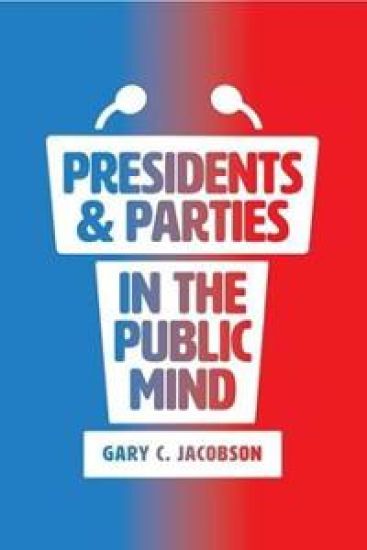
Presidents and Parties in the Public Mind

Presidents and Parties in the Public Mind

Gary C. Jacobson

University of Chicago Press
2019
sidottu
How is Donald Trump's presidency likely to affect the reputation and popular standing of the Republican Party? Profoundly, according to Gary C. Jacobson. From Harry S. Truman to Barack Obama, every postwar president has powerfully shaped Americans' feelings, positive or negative, about their party. The effect is pervasive, influencing the parties' reputations for competence, their perceived principles, and their appeal as objects of personal identification. It is also enduring, as presidents' successes and failures continue to influence how we see their parties well beyond their time in office. With Presidents and Parties in the Public Mind, Gary C. Jacobson draws on survey data from the past seven administrations to show that the expansion of the executive branch in the twentieth century that gave presidents a greater role in national government also gave them an enlarged public presence, magnifying their role as the parties' public voice and face. As American politics has become increasingly nationalized and president-centered over the past few decades, the president's responsibility for the party's image and status has continued to increase dramatically. Jacobson concludes by looking at the most recent presidents' effects on our growing partisan polarization, analyzing Obama's contribution to this process and speculating about Trump's potential for amplifying the widening demographic and cultural divide.
Presidents and Parties in the Public Mind

Presidents and Parties in the Public Mind

Gary C. Jacobson

University of Chicago Press
2019
pokkari
How is Donald Trump’s presidency likely to affect the reputation and popular standing of the Republican Party? Profoundly, according to Gary C. Jacobson. From Harry S. Truman to Barack Obama, every postwar president has powerfully shaped Americans’ feelings, positive or negative, about their party. The effect is pervasive, influencing the parties’ reputations for competence, their perceived principles, and their appeal as objects of personal identification. It is also enduring, as presidents’ successes and failures continue to influence how we see their parties well beyond their time in office. With Presidents and Parties in the Public Mind, Gary C. Jacobson draws on survey data from the past seven administrations to show that the expansion of the executive branch in the twentieth century that gave presidents a greater role in national government also gave them an enlarged public presence, magnifying their role as the parties’ public voice and face. As American politics has become increasingly nationalized and president-centered over the past few decades, the president’s responsibility for the party’s image and status has continued to increase dramatically. Jacobson concludes by looking at the most recent presidents’ effects on our growing partisan polarization, analyzing Obama’s contribution to this process and speculating about Trump’s potential for amplifying the widening demographic and cultural divide.
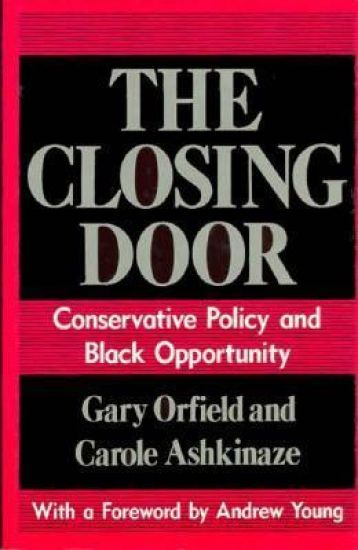
The Closing Door

The Closing Door

Gary Orfield; Carole Ashkinaze

University of Chicago Press
1991
sidottu
The Closing Door is the first major critique of the effect of conservative policies on urban race and poverty in the 1980s. Atlanta, with its booming economy, strong elected black leadership, and many highly educated blacks, seemed to be the perfect site for those policies and market solutions to prove themselves. Unfortunately, not only did expected economic opportunity fail to materialize but many of the hard-won gains of the civil rights movement were lost. Orfield and Ashkinaze painstakingly analyze the evidence from Atlanta to show why black opportunity deteriorated over the 1980s and outline possible remedies for the damage inflicted by the Reagan and Bush administrations. "The Closing Door is a crucial breath of fresh air ...an important and timely text which will help to alter the 'underclass' debate in favor of reconsidering race-specific policies. Orfield and Ashkinaze construct a convincing argument with which those who favor 'race-neutrality' will have to contend. In readable prose they make a compelling case that economic growth is not enough."--Preston H. Smith II, Transition
The Closing Door

The Closing Door

Gary Orfield; Carole Ashkinaze

University of Chicago Press
1993
nidottu
The Closing Door is the first major critique of the effect of conservative policies on urban race and poverty in the 1980s. Atlanta, with its booming economy, strong elected black leadership, and many highly educated blacks, seemed to be the perfect site for those policies and market solutions to prove themselves. Unfortunately, not only did expected economic opportunity fail to materialize but many of the hard-won gains of the civil rights movement were lost. Orfield and Ashkinaze painstakingly analyze the evidence from Atlanta to show why black opportunity deteriorated over the 1980s and outline possible remedies for the damage inflicted by the Reagan and Bush administrations."The Closing Door is a crucial breath of fresh air . . . an important and timely text which will help to alter the 'underclass' debate in favor of reconsidering race-specific policies. Orfield and Ashkinaze construct a convincing argument with which those who favor 'race-neutrality' will have to contend. In readable prose they make a compelling case that economic growth is not enough."—Preston H. Smith II, Transition
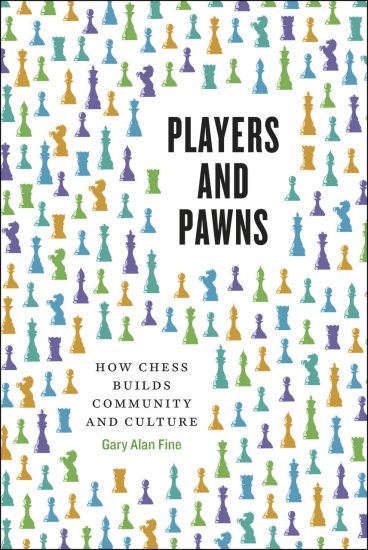
Players and Pawns

Players and Pawns

Gary Alan Fine

University of Chicago Press
2019
nidottu
A chess match seems as solitary an endeavor as there is in sports: two minds, on their own, in fierce opposition. In contrast, Gary Alan Fine argues that chess is a social duet: two players in silent dialogue who always take each other into account in their play. Surrounding that one-on-one contest is a community life that can be nearly as dramatic and intense as the across-the-board confrontation. Fine has spent years immersed in the communities of amateur and professional chess players, and with Players and Pawns he takes readers deep inside them, revealing a complex, brilliant, feisty world of commitment and conflict. Within their community, chess players find both support and challenges, all amid a shared interest in and love of the long-standing traditions of the game, traditions that help chess players build a communal identity. Full of idiosyncratic characters and dramatic gameplay, Players and Pawns is a celebration of the fascinating world of serious chess.
The Philosophy of Improvisation

The Philosophy of Improvisation

Gary Peters

University of Chicago Press
2009
sidottu
Improvisation is usually either lionized as an ecstatic experience of being in the moment or disparaged as the thoughtless recycling of cliches. Eschewing both of these orthodoxies, "The Philosophy of Improvisation" ranges across the arts - from music to theater, dance to comedy - and considers the improvised dimension of philosophy itself in order to elaborate an innovative concept of improvisation. Gary Peters turns to many of the major thinkers within continental philosophy - including Heidegger, Nietzsche, Adorno, Kant, Benjamin, and Deleuze - offering readings of their reflections on improvisation and exploring improvisational elements within their thinking. Peters' wry, humorous style offers an antidote to the frequently overheated celebration of freedom and community that characterizes most writing on the subject. Expanding the field of what counts as improvisation, "The Philosophy of Improvisation" will be welcomed by anyone striving to comprehend the creative process.
The Philosophy of Improvisation

The Philosophy of Improvisation

Gary Peters

University of Chicago Press
2011
nidottu
Improvisation is usually either lionized as an ecstatic experience of being in the moment or disparaged as the thoughtless recycling of cliches. Eschewing both of these orthodoxies, "The Philosophy of Improvisation" ranges across the arts - from music to theater, dance to comedy - and considers the improvised dimension of philosophy itself in order to elaborate an innovative concept of improvisation. Gary Peters turns to many of the major thinkers within continental philosophy - including Heidegger, Nietzsche, Adorno, Kant, Benjamin, and Deleuze - offering readings of their reflections on improvisation and exploring improvisational elements within their thinking. Peters' wry, humorous style offers an antidote to the frequently overheated celebration of freedom and community that characterizes most writing on the subject. Expanding the field of what counts as improvisation, "The Philosophy of Improvisation" will be welcomed by anyone striving to comprehend the creative process.
The Stranger within Your Gates

The Stranger within Your Gates

Gary G. Porton

University of Chicago Press
1994
sidottu
If the people of Israel understood themselves to share a common ancestry as well as a common religion, how could a convert to their faith who did not share their ethnicity fit into the ancient Israelite community? While it is comparatively simple to declare religious beliefs, it is much more difficult to enter a group whose membership is defined in ethnic terms. In showing how the rabbis struggled continually with the dual nature of the Israelite community and the dilemma posed by converts, Gary G. Porton explains aspects of their debates. This text analyzes references to converts in the full corpus of rabbinic literature. The intellectual dilemma in discussions of marriage, religious practice, inheritance of property and much else are explored here. Reviewing the rabbinic literature text by text, Porton exposes the rabbis' frequently ambivalent and ambiguous views. The text focuses upon the opinions of the community into which the convert enters, rather than on the testimony of the convert. By approaching data with various methods, Porton aims to increase the reader's understanding of conversion and the nature of the people of Israel in rabbinic literature.
Beyond Conformity or Rebellion

Beyond Conformity or Rebellion

Gary Schwartz

University of Chicago Press
1987
sidottu
By the late 1970s, drugs, blue jeans, rock and roll, and sexual precocity appeared to be all that remained of the cultural ferment of the 1960s. In this classic new study of high school-aged youth in the eartly 70s, Gary Schwartz reveals subtle yet significant changes in the style of deviance in adolescent culture. He argues that a new sort of peer-group pluralism emerged from the counter-culture movement of the 60s, a deviance defined less by persistent violations of the law than by disengagement from traditional images of success and civic responsibility.
Sect Ideologies and Social Status

Sect Ideologies and Social Status

Gary Schwartz

University of Chicago Press
1970
sidottu
In this penetrating study of urban religion, Gary Schwartz examines the nature of the relationship between religious belief and the social order. He shows how a person's experience in the social hierarchy shapes his response to competing religious ideologies and, in turn, how commitment to a particular sect ideology colors his attitude toward mundane affairs. The author studied and compared a Pentecostal group and a Seventh-day Adventist group in preparation for this work. The question which stimulated the investigation can be stated as a paradox. In the Adventist case, why should persons who firmly believe that God is soon to destroy the world work so diligently and against formidable odds to improve their own secular fortunes? In the Pentecostal case, why should persons who believe that God is available for direct aid in every human contingency not use this power for their own advancement? In theorizing about the relationship between an individual's position in the socioeconomic system and his sect affiliation, Mr. Schwartz asserts that the specifically ideological component of a creed resides in the ways in which believers conceptualize the meaning of secular problems. The study as a whole attempts to reveal what makes a special set of beliefs attractive to a person grappling with certain secular exigencies, and how these beliefs affect his view of secular matters. It develops a model of a religious ideology applicable to any study of the relationship between cultural symbols and social structure.
The Hinge

The Hinge

Gary Alan Fine

University of Chicago Press
2021
sidottu
Most of the time, we believe our daily lives to be governed by structures determined from above: laws that dictate our behavior, companies that pay our wages, even climate patterns that determine what we eat or where we live. In contrast, social organization is often a feature of local organization. While those forces may seem beyond individual grasp, we often come together in small communities to change circumstances that would otherwise flatten us. Challenging traditional sociological models of powerful forces, in The Hinge, Gary Alan Fine emphasizes and describes those meso-level collectives, the organizations that bridge our individual interests and the larger structures that shape our lives. Focusing on “tiny publics,” he describes meso-level social collectives as “hinges”: groups that come together to pursue a shared social goal, bridging the individual and the broader society. Understanding these hinges, Fine argues, is crucial to explaining how societies function, creating links between the micro- and macro-orders of society. He draws on historical cases and fieldwork to illustrate how these hinges work and how to describe them. In The Hinge, Fine has given us powerful new theoretical tools for understanding an essential part of our social worlds.
The Hinge

The Hinge

Gary Alan Fine

University of Chicago Press
2021
nidottu
Most of the time, we believe our daily lives to be governed by structures determined from above: laws that dictate our behavior, companies that pay our wages, even climate patterns that determine what we eat or where we live. In contrast, social organization is often a feature of local organization. While those forces may seem beyond individual grasp, we often come together in small communities to change circumstances that would otherwise flatten us. Challenging traditional sociological models of powerful forces, in The Hinge, Gary Alan Fine emphasizes and describes those meso-level collectives, the organizations that bridge our individual interests and the larger structures that shape our lives. Focusing on “tiny publics,” he describes meso-level social collectives as “hinges”: groups that come together to pursue a shared social goal, bridging the individual and the broader society. Understanding these hinges, Fine argues, is crucial to explaining how societies function, creating links between the micro- and macro-orders of society. He draws on historical cases and fieldwork to illustrate how these hinges work and how to describe them. In The Hinge, Fine has given us powerful new theoretical tools for understanding an essential part of our social worlds.
Archaeologies of Vision

Archaeologies of Vision

Gary Shapiro

University of Chicago Press
2003
sidottu
While many acknowledge that Friedrich Nietzsche and Michel Foucault have redefined our notions of time and history, few recognize the crucial role that "the infinite relation" between seeing and saying (as Foucault put it) plays in their work. Gary Shapiro reveals, for the first time, the full extent of Nietzsche and Foucault's concern with the visual. Shapiro explores the whole range of Foucault's writings on visual art, including the theory of visual resistance, the concept of the phantasm or simulacrum, and his interrogation of the relation of painting, language and power in artists from Bosch to Warhol. Shapiro also shows through an excavation of little-known writings that the visual is a major them in Nietzsche's thought. In addition to explaining the significance of Nietzsche's analysis of Raphael, Durer and Claude Lorrain, he examines the philosopher's understanding of the visual dimension of Greek theatre and Wagnerian opera and offers a powerful new reading of "Thus Spoke Zarathustra". "Archaeologies of Vision" should be a valuable work for all scholars of visual culture as well as for those engaged with continental philosophy.
Archaeologies of Vision

Archaeologies of Vision

Gary Shapiro

University of Chicago Press
2003
nidottu
While many acknowledge that Friedrich Nietzsche and Michel Foucault have redefined our notions of time and history, few recognize the crucial role that "the infinite relation" between seeing and saying (as Foucault put it) plays in their work. Gary Shapiro reveals, for the first time, the full extent of Nietzsche and Foucault's concern with the visual. Shapiro explores the whole range of Foucault's writings on visual art, including the theory of visual resistance, the concept of the phantasm or simulacrum, and his interrogation of the relation of painting, language and power in artists from Bosch to Warhol. Shapiro also shows through an excavation of little-known writings that the visual is a major them in Nietzsche's thought. In addition to explaining the significance of Nietzsche's analysis of Raphael, Durer and Claude Lorrain, he examines the philosopher's understanding of the visual dimension of Greek theatre and Wagnerian opera and offers a powerful new reading of "Thus Spoke Zarathustra". "Archaeologies of Vision" should be a valuable work for all scholars of visual culture as well as for those engaged with continental philosophy.
Improvising Improvisation – From Out of Philosophy, Music, Dance, and Literature
There is an ever-increasing number of books on improvisation, ones that richly recount experiences in the heat of the creative moment, theorize on the essence of improvisation, and offer convincing arguments for improvisation’s impact across a wide range of human activity. This book is nothing like that. In a provocative and at times moving experiment, Gary Peters takes a different approach, turning the philosophy of improvisation upside-down and inside-out. Guided by Kant, Hegel, Heidegger, and especially Deleuze—and exploring a range of artists from Hendrix to Borges—Peters illuminates new fundamentals about what, as an experience, improvisation truly is. As he shows, improvisation isn’t so much a genre, idiom, style, or technique—it’s a predicament we are thrown into, one we find ourselves in. The predicament, he shows, is a complex entwinement of choice and decision. The performativity of choice during improvisation may happen “in the moment,” but it is already determined by an a priori mode of decision. In this way, improvisation happens both within and around the actual moment, negotiating a simultaneous past, present, and future. Examining these and other often ignored dimensions of spontaneous creativity, Peters proposes a consistently challenging and rigorously argued new perspective on improvisation across an extraordinary range of disciplines.
Breakout

Breakout

Gary Stewart

University of Chicago Press
1992
nidottu
Based on exclusive interviews, Breakout tells the often riveting personal stories of fourteen popular musicians--some well known, others not--from Zaire, Ghana, Nigeria and Sierra Leone. The first book on African pop music to look closely at the lives of the musicians themselves, Breakout deals with four African musical genres: soukous, highlife, afro-beat, and palm wine. Amid Africa's deepening economic and political crises of the last two decades, African musicians who developed these genres faced the need to cross cultural boundaries, or "break out," and achieve a hit in the international marketplace. Challenging conventional assumptions, Gary Stewart demonstrates for the first time the true dimensions of this struggle to create music that will qualify as both an authentic cultural expression and an export commodity. From accounts of the outrageous Fela, who snipes at African leaders and recounts his days with Isis in ancient Egypt, to S. E. Rogie, who lurches from the pinnacle of stardom in West Africa to delivering pizzas in California, to Olatunji, who finds new life with the Grateful Dead, these are the stories of Africans straddling traditional life and an encroaching modernity--and also the stories of third world musicians surmounting political and economic chaos at home and carrying their music to a world dominated by Western cultural and economic power.
Fighting Financial Crises

Fighting Financial Crises

Gary B. Gorton; Ellis W. Tallman

University of Chicago Press
2021
nidottu
If you’ve got money in the bank, chances are you’ve never seriously worried about not being able to withdraw it. But there was a time in the United States, an era that ended just over a hundred years ago, when bank customers had to pay close attention to the solvency of the banking system, knowing they might have to rush to retrieve their savings before the bank collapsed. During the National Banking Era (1863–1913), before the establishment of the Federal Reserve, widespread banking panics were indeed rather common. Yet these pre-Fed banking panics, as Gary B. Gorton and Ellis W. Tallman show, bear striking similarities to our recent financial crisis. Fighting Financial Crises thus turns to the past to better understand our uncertain present, investigating how panics during the National Banking Era played out and how they were eventually quelled and prevented. The authors then consider the Fed’s and the SEC’s reactions to the recent crisis, building an informative new perspective on how the modern economy works.
Music in Renaissance Magic

Music in Renaissance Magic

Gary Tomlinson

University of Chicago Press
1994
nidottu
Magic enjoyed a vigorous revival in sixteenth-century Europe, attaining a prestige lost for over a millennium and becoming, for some, a kind of universal philosophy. Renaissance music also suggested a form of universal knowledge through renewed interest in two ancient themes: the Pythagorean and Platonic "harmony of the celestial spheres" and the legendary effects of the music of bards like Orpheus, Arion, and David. In this climate, Renaissance philosophers drew many new and provocative connections between music and the occult sciences. In Music in Renaissance Magic, Gary Tomlinson describes some of these connections and offers a fresh view of the development of early modern thought in Italy. Raising issues essential to postmodern historiography--issues of cultural distance and our relationship to the others who inhabit our constructions of the past --Tomlinson provides a rich store of ideas for students of early modern culture, for musicologists, and for historians of philosophy, science, and religion.