Kirjojen hintavertailu. Mukana 11 487 632 kirjaa ja 12 kauppaa.

Kirjahaku

Etsi kirjoja tekijän nimen, kirjan nimen tai ISBN:n perusteella.

1000 tulosta hakusanalla Jason Powell

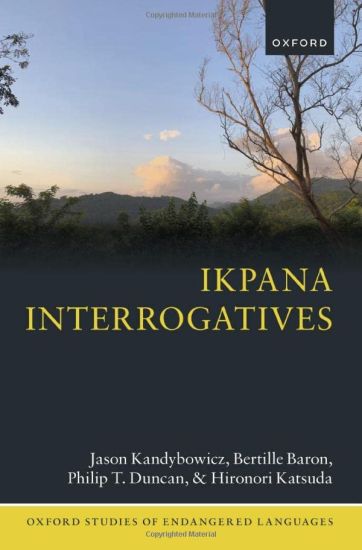
Ikpana Interrogatives

Ikpana Interrogatives

Jason Kandybowicz; Bertille Baron; Philip T. Duncan; Hironori Katsuda

Oxford University Press
2023
sidottu
This book documents the interrogative system of Ikpana, an endangered indigenous Ghana-Togo Mountain language of eastern Ghana also known as Logba. The system is notable in several respects. It exhibits features that buck certain typological trends, act as counterexamples to some claims about language universals, and exemplify fascinating patterns that are either rare or unfamiliar in interrogative systems cross-linguistically. Drawing on original fieldwork and a combination of formal/theoretical, experimental, and comparative methodologies, the book provides a theoretically-informed description and analysis of Ikpana interrogative grammar, encompassing both syntactic and phonological aspects of question formation in the language. The chapters explore a range of phenomena including polar question formation, wh- movement, wh- in-situ, interrogative intonation, and prosody, among others. The authors demonstrate that theoretically-guided language documentation does not only contribute to language description, but can also increase understanding of the human Language Faculty and expand the empirical base of language typologies: bringing formal and theoretical concerns to the fore facilitates richer descriptions of the grammar than purely descriptive approaches allow.
Jerusalem

Jerusalem

Jason Whittaker

Oxford University Press
2022
sidottu
The stanzas beginning, 'And did those feet' are among the most famous works written by the Romantic poet and artist, William Blake. Set to music by Hubert Parry in 1916 and renamed, 'Jerusalem', this hymn has become an emblem of Englishness in the past century, and is regularly invoked at sporting events, public and private ceremonies, and, of course, as part of Last Night of the Proms. Yet when Blake first engraved his lines in his epic work, Milton a Poem, he had been tried for sedition. Likewise, although Parry was commissioned to compose his music as part of the war effort by the organization Fight for Right, he soon removed permission for that group to perform his hymn and instead gave the copyright to the women's suffrage movement. 'Jerusalem', then, is a much more contested vision of England's green and pleasant land than is often assumed. This book traces the history of the poem and the music from Blake's original verses, written in Felpham, via the turmoil of the First and Second World Wars, its recording history in the late twentieth century, and its use in political controversies such as the 2016 Brexit vote. An anthem for both the left and the right, Blake's own vision of what it meant to build Jerusalem in England is both strange and familiar to many who invoke it. As such, this book explores the deep complexities of what Englishness means into the twenty-first century.
Inquiry and Agency

Inquiry and Agency

Jason Baehr

Oxford University Press
2025
sidottu
In Inquiry and Agency, Jason Baehr develops a systematic account of the nature, structure, and evaluative status of intellectual virtues and vices. Drawing on a theory of moral virtue by Robert Adams (2006), Baehr argues that intellectual virtues like curiosity, open-mindedness, and intellectual courage are ways of "excellently being for epistemic goods" that reflect favorably on who we are as persons, and that intellectual vices like dogmatism, narrow-mindedness, and intellectual arrogance are ways of falling short of this standard, ways that contribute negatively to our personal worth. Inquiry and Agency is the most in-depth and sophisticated treatment of intellectual virtues and vices since Linda Zagzebski's pioneering work Virtues of the Mind (1996). While advancing several debates in virtue epistemology, it proposes a model of intellectual virtues and vices that will be accessible to non-experts and useful to researchers in other disciplines. Inquiry and Agency is the product of decades of reflection by a leading figure in the field. It is essential reading for anyone interested in the characterological dimensions of the life of the mind.
Engagements with Aimé Césaire

Engagements with Aimé Césaire

Jason Allen-Paisant

Oxford University Press
2024
sidottu
Aimé Césaire is due a major critical reinterpretation and that is exactly what this book carries out. Through an in-depth grasp of the trajectory and core significance of Césaire's work, Jason Allen-Paisant highlights a set of links it makes between 'spirit,' 'poetry,' and 'knowing'. These explications, setting Césaire's work in relation to a rigorously accounted for set of influences, reframe how we understand his writings, enhancing their philosophical, rather than merely political, aspects. Engagements with Aimé Césaire: Thinking with Spirits is about more than Negritude (which has come to mean something less than a deep poetic sensibility with its own aspirational aesthetics and metaphysics, and rather something more like a fantasy-ridden iteration of pan-Africanism). It shows an Aimé Césaire deeply relevant to today: to the crises of ecological collapse, capitalist dystopias, and ideologies predicated upon fear and the threat of foreigners; and to contemporary chatter around interspecies collaboration and the need to rethink the entrepreneurial subject of Western political thought. Recasting Césaire's work is not just a matter of transforming a significant figure. It is also about rethinking legacies. This book is an engagement in the truest sense--the work of a contemporary Black poet who expounds the ways in which Césaire's work articulates for him a new politics of the self.
The Madman and the Churchrobber

The Madman and the Churchrobber

Jason Peacey

Oxford University Press
2022
sidottu
This microhistory reconstructs and analyses a protracted legal dispute over a small parcel of land called Warrens Court in Nibley, Gloucestershire, which was contested between successive generations of two families from the mid-sixteenth century to the early eighteenth century. Employing a rich cache of archival material, Jason Peacey traces legal contestation over time and through a range of different courts, as well as in Parliament and the public domain, and contends that a microhistorical approach makes it possible to shed valuable light upon the legal and political culture of early modern England, not least by comprehending how certain disputes became protracted and increasingly bitter, and why they fascinated contemporaries. This involves recognising the dynamic of litigation, in terms of how disputes changed over time, and how those involved in myriad lawsuits found legal reasons for prolonging contestation. It also involves exploring litigants' strategies and practices, as well as competing claims about the way in which adversaries behaved, and incompatible expectations of the legal system. Finally, it involves teasing out the structural issues in play, in terms of the social, cultural, and ideological identities of successive generations. Ultimately, this dispute is employed to address important historiographical debates surrounding the nature of civil litigation in early modern England, and to provide new ways of appreciating the nature, severity, and visibility of political and religious conflict in the decades before and after the English Revolution.
Asia's Computer Challenge

Asia's Computer Challenge

Jason Dedrick; Kenneth L. Kraemer

Oxford University Press Inc
1998
sidottu
This book examines the evolution of the computer industry in the Pacific Asia region. It explains the key factors that account for the different levels of success among the nations in the area, and explores the strategic implications for the United States and the Asian Pacific countries as they compete in computers in the emerging network era. This book is intended for academics and computer professionals.
Television and American Culture

Television and American Culture

Jason Mittell

Oxford University Press Inc
2009
nidottu
To understand American popular culture, we need to come to grips with the enormous role that television has played in shaping that culture over the past sixty years. In this timely and provocative book, Jason Mittell provides students with a uniquely thorough look at the medium of television. Exploring television at once as a technological medium, an economic system, a facet of democracy, and a part of everyday life, this landmark text uses numerous sidebars and case studies to demonstrate the past, immediate, and far-reaching effects of American culture on television--and television's influence on American culture. Arranged topically, the book provides a broad historical overview of television while also honing in on such finer points as the formal attributes of its various genres and its role in gender and racial identity formation. Replete with examples, this pedagogically rich text includes many end-of-chapter case studies and narratives with suggestions for further reading--and, appropriately, viewing. Illustrations and photographs--primarily DVD grabs--contextualize historical footage and older television programs that may not be familiar to younger students. A multi-disciplinary approach to American television, Television and American Culture is ideal for an array of intermediate undergraduate- and beginning graduate-level courses, including: * Television Criticism * Television & American Culture * Television & Society * Introduction to Media Studies * American Popular Culture * Radio & TV * History of Mass Communication * Broadcasting & Broadcast Programming For more information about this book, including updates, corrections, links, videos, and teaching resources, visit the companion website at http://tvamericanculture.net.
Brother's Keeper

Brother's Keeper

Jason Parker

Oxford University Press Inc
2008
sidottu
The culmination of West Indian decolonization came at a dangerous moment in the Cold War Caribbean, amid aftershocks of the Cuban Revolution, a wave of Third World nationalism abroad, and civil rights conflicts in the United States. Dozens of countries entered in the atlas in one generation, many of them through bloody clashes. Yet the West Indian passage to independence was peaceful and managed to avoid the heavy-handed American intervention seen elsewhere in the hemisphere, not to mention Vietnam and other parts of the globe. In this book, Jason Parker explains why a policy of American restraint was exercised in the British Caribbean (Jamaica and Trinidad and Tobago), despite the long association of West Indians with black radicalism in the United States. This book closely examines the dynamics of the decolonization of the British West Indies from the 1930s to its Cold War culmination, particularly those surrounding the creation and subsequent implosion of the West Indies Federation. Washington had long sought anticommunist stability and access to strategic assets in the Caribbean. Yet the American ability to pursue these objectives was limited by British sovereignty and West Indian agency. The British wanted to end their responsibility for the colonies while retaining influence there. West Indian nationalists sought an urgent transition from white supremacy and imperial rule, drawing on a transnational "diaspora diplomacy" based in Harlem to do so. The resulting Anglo-American-Caribbean relations swung between the transatlantic special relationship and the trans-Caribbean "protean partnership" of formal and diasporan diplomacy. This study uses archives in six countries to write an international history of these relations. It integrates that history into the tableau of inter-American relations, and explores the relationship between the Cold War and decolonization. In the West Indies, the former first slowed and then accelerated the latter--a process which was already underway, and one whose effects reverberate throughout the Third World into the present day.
Brother's Keeper

Brother's Keeper

Jason Parker

Oxford University Press Inc
2008
nidottu
The culmination of West Indian decolonization came at a dangerous moment in the Cold War Caribbean, amid aftershocks of the Cuban Revolution, a wave of Third World nationalism abroad, and civil rights conflicts in the United States. Dozens of countries entered in the atlas in one generation, many of them through bloody clashes. Yet the West Indian passage to independence was peaceful and managed to avoid the heavy-handed American intervention seen elsewhere in the hemisphere, not to mention Vietnam and other parts of the globe. In this book, Jason Parker explains why a policy of American restraint was exercised in the British Caribbean (Jamaica and Trinidad and Tobago), despite the long association of West Indians with black radicalism in the United States. This book closely examines the dynamics of the decolonization of the British West Indies from the 1930s to its Cold War culmination, particularly those surrounding the creation and subsequent implosion of the West Indies Federation. Washington had long sought anticommunist stability and access to strategic assets in the Caribbean. Yet the American ability to pursue these objectives was limited by British sovereignty and West Indian agency. The British wanted to end their responsibility for the colonies while retaining influence there. West Indian nationalists sought an urgent transition from white supremacy and imperial rule, drawing on a transnational "diaspora diplomacy" based in Harlem to do so. The resulting Anglo-American-Caribbean relations swung between the transatlantic special relationship and the trans-Caribbean "protean partnership" of formal and diasporan diplomacy. This study uses archives in six countries to write an international history of these relations. It integrates that history into the tableau of inter-American relations, and explores the relationship between the Cold War and decolonization. In the West Indies, the former first slowed and then accelerated the latter--a process which was already underway, and one whose effects reverberate throughout the Third World into the present day.
Theological Incorrectness

Theological Incorrectness

Jason Slone

Oxford University Press Inc
2007
nidottu
Why do religious people believe what they shouldn't - not what others think they shouldn't believe, but things that don't accord with their own avowed religious beliefs? Jason Slone terms this phenomenon 'theological incorrectness.' He argues that it exists because the mind is built in such a way that it's natural for us to think divergent thoughts simultaneously. Human minds are great at coming up with innovative ideas that help them make sense of the world, he says, but those ideas do not always jibe with official religious beliefs.
Religion of Fear

Religion of Fear

Jason C Bivins

Oxford University Press Inc
2008
sidottu
Conservative evangelicalism has transformed American politics, working not just through conventional channels, but through subcultures and alternate modes of communication. Within the world of conservative evangelicalism is a "Religion of Fear," a critical impulse that dramatizes cultural and political issues in frightening ways that contrast "orthodox" behaviors and beliefs with those linked to darkness, fear, and demonology. Jason C. Bivins offers close examinations of several popular evangelical cultural creations including the Left Behind novels, church-sponsored Halloween "Hell Houses," Jack Chick's sensational comic tracts, and anti-rock and rap rhetoric and censorship. Bivins depicts these fascinating and often troubling phenomena in vivid detail and shows how they seek to shape evangelical cultural and political identity. Interestingly, he shows that these narratives of fear also reveal a strong attraction to and dependence on the very things that are being forbidden. Bivins also describes the steady normalization of such fear narratives in recent decades, a trend he claims bodes ill for American politics. The Religion of Fear is a significant contribution to our understanding of the new shapes of political religion, of American evangelicalism, of the relation of religion and the media, and of the link between religious pop culture and politics.
A Cognitive-Behavioral Approach to the Beginning of the End of Life

A Cognitive-Behavioral Approach to the Beginning of the End of Life

Jason M. Satterfield

Oxford University Press Inc
2008
nidottu
Individuals with serious and incurable illnesses often require care that goes beyond the body. As they face the challenges of living with and eventually dying from their conditions, they may need to acquire new skills to cope and increase their quality of life. Even those at the beginning of the end of life can take an active role in their treatment. This skill-based program emphasizes flexibility and should be tailored to individual clients. The first module introduces stress management techniques, including cognitive restructuring, relaxation, and problem-focused and emotion-focused coping. The second module targets mood management, with sessions on depression, anxiety, and anger. Social support is addressed in the third module where clients learn communication and conflict resolution skills. Special attention is paid to supporting caregivers and working with medical providers. The fourth module focuses on quality of life and covers symptom management, goal setting, positive psychology, and spiritual issues. An adaptation chapter details how to run the program as a group and discusses other possible formats. Incorporating a wide variety of CBT techniques, this program can benefit patients suffering from a range of chronic and terminal diseases. The corresponding workbook helps clients personalize the content of sessions and practice new skills. The facilitator guide is invaluable to any mental health professional working in a medical or other palliative care setting.
The Monty Hall Problem

The Monty Hall Problem

Jason Rosenhouse

Oxford University Press Inc
2009
sidottu
Mathematicians call it the Monty Hall Problem, and it is one of the most interesting mathematical brain teasers of recent times. Imagine that you face three doors, behind one of which is a prize. You choose one but do not open it. The host--call him Monty Hall--opens a different door, always choosing one he knows to be empty. Left with two doors, will you do better by sticking with your first choice, or by switching to the other remaining door? In this light-hearted yet ultimately serious book, Jason Rosenhouse explores the history of this fascinating puzzle. Using a minimum of mathematics (and none at all for much of the book), he shows how the problem has fascinated philosophers, psychologists, and many others, and examines the many variations that have appeared over the years. As Rosenhouse demonstrates, the Monty Hall Problem illuminates fundamental mathematical issues and has abiding philosophical implications. Perhaps most important, he writes, the problem opens a window on our cognitive difficulties in reasoning about uncertainty.
The Andes

The Andes

Jason Wilson

Oxford University Press
2009
nidottu
The Andes form the backbone of South America. Irradiating from Cuzco--the symbolic "navel" of the indigenous world--the mountain range was home to an extraordinary theocratic empire and civilization, the Incas, who built stone temples, roads, palaces, and forts. The clash between Atahualpa, the last Inca, and the illiterate conquistador Pizarro, between indigenous identity and European mercantile values, has forged Andean culture and history for the last 500 years. Jason Wilson explores the 5,000-mile chain of volcanoes, deep valleys, and upland plains, revealing the Andes' mystery, inaccessibility, and power through the insights of chroniclers, scientists, and modern-day novelists. His account starts at sacred Cuzco and Machu Picchu, moves along imagined Inca routes south to Lake Titicaca, La Paz, Potos , and then follows the Argentine and Chilean Andes to Patagonia. It then moves north through Chimborazo, Quito, and into Colombia, along the Cauca Valley up to Bogot and east to Caracas. Looking at the literature inspired by the Andes as well as its turbulent history, this book brings to life the region's spectacular landscapes and the many ways in which they have been imagined.
The Andes: A Cultural History

The Andes: A Cultural History

Jason Wilson

Oxford University Press
2009
sidottu
The Andes form the backbone of South America. Irradiating from Cuzco--the symbolic "navel" of the indigenous world--the mountain range was home to an extraordinary theocratic empire and civilization, the Incas, who built stone temples, roads, palaces, and forts. The clash between Atahualpa, the last Inca, and the illiterate conquistador Pizarro, between indigenous identity and European mercantile values, has forged Andean culture and history for the last 500 years. Jason Wilson explores the 5,000-mile chain of volcanoes, deep valleys, and upland plains, revealing the Andes' mystery, inaccessibility, and power through the insights of chroniclers, scientists, and modern-day novelists. His account starts at sacred Cuzco and Machu Picchu, moves along imagined Inca routes south to Lake Titicaca, La Paz, Potos , and then follows the Argentine and Chilean Andes to Patagonia. It then moves north through Chimborazo, Quito, and into Colombia, along the Cauca Valley up to Bogot and east to Caracas. Looking at the literature inspired by the Andes as well as its turbulent history, this book brings to life the region's spectacular landscapes and the many ways in which they have been imagined.
Anti-contiguity

Anti-contiguity

Jason Kandybowicz

Oxford University Press Inc
2020
sidottu
A recent wave of research has explored the link between wh- syntax and prosody, breaking with the traditional generative conception of a unidirectional syntax-phonology relationship. In this book, Jason Kandybowicz develops Anti-contiguity Theory as a compelling alternative to Richards' Contiguity Theory to explain the interaction between the distribution of interrogative expressions and the prosodic system of a language. Through original and highly detailed fieldwork on several under-studied West African languages (Krachi, Bono, Wasa, Asante Twi, and Nupe), Kandybowicz presents empirically and theoretically rich analyses bearing directly on a number of important theories of the syntax-prosody interface. His observations and analyses stem from original fieldwork on all five languages and represent some of the first prosodic descriptions of the languages. The book also considers data from thirteen additional typologically diverse languages to demonstrate the theory's reach and extendibility. Against the backdrop of data from eighteen languages, Anti-contiguity offers a new lens on the empirical and theoretical study of wh- prosody.
Anti-contiguity

Anti-contiguity

Jason Kandybowicz

Oxford University Press Inc
2020
nidottu
A recent wave of research has explored the link between wh- syntax and prosody, breaking with the traditional generative conception of a unidirectional syntax-phonology relationship. In this book, Jason Kandybowicz develops Anti-contiguity Theory as a compelling alternative to Richards' Contiguity Theory to explain the interaction between the distribution of interrogative expressions and the prosodic system of a language. Through original and highly detailed fieldwork on several under-studied West African languages (Krachi, Bono, Wasa, Asante Twi, and Nupe), Kandybowicz presents empirically and theoretically rich analyses bearing directly on a number of important theories of the syntax-prosody interface. His observations and analyses stem from original fieldwork on all five languages and represent some of the first prosodic descriptions of the languages. The book also considers data from thirteen additional typologically diverse languages to demonstrate the theory's reach and extendibility. Against the backdrop of data from eighteen languages, Anti-contiguity offers a new lens on the empirical and theoretical study of wh- prosody.
Ennius Noster

Ennius Noster

Jason S. Nethercut

Oxford University Press Inc
2021
sidottu
Consensus holds that Lucretius admired the literary prestige of Homeric epos, the form that Ennius famously introduced to Latin literature. However, some hold that Lucretius disagreed with Ennius' quasi-Pythagorean claim to be Homer reborn, and so uniquely qualified to adapt Homeric poetry to the Latin language. Likewise, received wisdom holds that Lucretius followed in the path of poets writing in the wake of Ennius' Annales, most of whom employed an Ennian style. However, throughout the De Rerum Natura, Lucretius' use of Ennius' Annales as a formal model for a long discursive poem in epic meter was neither inevitable nor predictable, on the one hand, nor meaningful in the simple way that critical consensus has always maintained. Jason Nethercut posits that Lucretius selected Ennius as a model precisely to dismantle the values for which he claimed Ennius stood, including the importance of history as a poetic subject and Rome's historical achievement in particular. As the first book to offer substantial analysis of the relationship between two of the ancient world's most impactful poets, Ennius Noster: Lucretius and the Annales fills an important gap not only in Lucretian scholarship, but also in our understanding of Latin literary history.
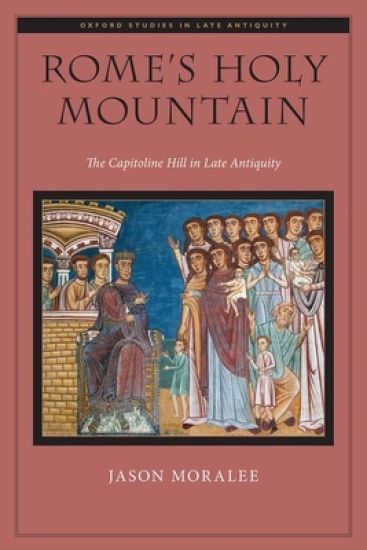
Rome's Holy Mountain

Rome's Holy Mountain

Jason Moralee

Oxford University Press Inc
2021
nidottu
Rome's Capitoline Hill was the smallest of the Seven Hills of Rome. Yet in the long history of the Roman state it was the empire's holy mountain. The hill was the setting of many of Rome's most beloved stories, involving Aeneas, Romulus, Tarpeia, and Manlius. It also held significant monuments, including the Temple of Jupiter Optimus Maximus, a location that marked the spot where Jupiter made the hill his earthly home in the age before humanity. This is the first book that follows the history of the Capitoline Hill into late antiquity and the early middle ages, asking what happened to a holy mountain as the empire that deemed it thus became a Christian republic. This is not a history of the hill's tonnage of marble and gold bedecked monuments, but rather an investigation into how the hill was used, imagined, and known from the third to the seventh centuries CE. During this time, the imperial triumph and other processions to the top of the hill were no longer enacted. But the hill persisted as a densely populated urban zone and continued to supply a bridge to fragmented memories of an increasingly remote past through its toponyms. This book is also about a series of Christian engagements with the Capitoline Hill's different registers of memory, the transmission and dissection of anecdotes, and the invention of alternate understandings of the hill's role in Roman history. What lingered long after the state's disintegration in the fifth century were the hill's associations with the raw power of Rome's empire.
Debating Democracy

Debating Democracy

Jason Brennan; Hélène Landemore

Oxford University Press Inc
2021
sidottu
Around the world, faith in democracy is falling. Russia, Turkey, and Venezuela have moved from flawed democracies to authoritarian regimes. Brexit and the rise of far-right parties show that even stable Western democracies are struggling. Partisanship and mutual distrust are increasing. What, if anything, should we do about these problems? In this accessible work, leading philosophers Jason Brennan and Hélène Landemore debate whether the solution lies in having less democracy or more. Brennan argues that democracy has systematic flaws, and that democracy does not and cannot work the way most of us commonly assume. He argues the best solution is to limit democracy's scope and to experiment with certain voting systems that can overcome democracy's problems. Landemore argues that democracy, defined as a regime that distributes power equally and inclusively, is a better way to generate good governance than oligarchies of knowledge. To her, the crisis of "representative democracy" comes in large part from its glaring democratic deficits. The solution is not just more democracy, but a better kind, which Landemore theorizes as "open democracy."