Philosophers have long been tempted by the idea that objects and properties are abstractions from the facts. But how is this abstraction supposed to go? If the objects and properties aren't 'already' there, how do the facts give rise to them? Jason Turner develops and defends a novel answer to this question: The facts are arranged in a quasi-geometric 'logical space', and objects and properties arise from different quasi-geometric structures in this space.
The goal of inquiry is to acquire knowledge of truths about the world. In this book, Jason Stanley argues that knowing how to do something amounts to knowing a truth about the world. When you learned how to swim, what happened is that you learned some truths about swimming. Knowledge of these truths is what gave you knowledge of how to swim. Something similar occurred with every other activity that you now know how to do, such as riding a bicycle or cooking a meal. Of course, when you learned how to swim, you didn't learn just any truth about swimming. You learned a special kind of truth about swimming, one that answers the question, 'How could you swim?' Know How develops an account of the kinds of answers to questions, knowledge of which explains skilled action. Drawing on work in epistemology, philosophy of mind, ethics, action theory, philosophy of language, linguistic semantics, and cognitive neuroscience, Stanley presents a powerful case that it is our success as inquirers that explains our capacity for skilful engagement with the world.
The goal of inquiry is to acquire knowledge of truths about the world. In this book, Jason Stanley argues that knowing how to do something amounts to knowing a truth about the world. When you learned how to swim, what happened is that you learned some truths about swimming. Knowledge of these truths is what gave you knowledge of how to swim. Something similar occurred with every other activity that you now know how to do, such as riding a bicycle or cooking a meal. Of course, when you learned how to swim, you didn't learn just any truth about swimming. You learned a special kind of truth about swimming, one that answers the question, 'How could you swim?' Know How develops an account of the kinds of answers to questions, knowledge of which explains skilled action. Drawing on work in epistemology, philosophy of mind, ethics, action theory, philosophy of language, linguistic semantics, and cognitive neuroscience, Stanley presents a powerful case that it is our success as inquirers that explains our capacity for skilful engagement with the world.
Why do so many Americans reject the modern theory of evolution? Seeking answers, mathematician Jason Rosenhouse became a regular attendee at creationist conferences and other gatherings. After ten years of attending events like the giant Creation Mega-Conference in Lynchburg, Virginia, and visiting sites like the Creation Museum in Petersburg, Kentucky, and after hundreds of mostly friendly conversations with creationists of varying stripes, he has emerged with a story to tell, a story that goes well beyond the usual stereotypes of Bible-thumping fanatics railing against coldly rational scientists. Through anecdotes, personal reflections, and scientific and philosophical discussion, Rosenhouse presents a more down-to-earth picture of modern creationism and the people who espouse it. He also tells the story of his own nonbeliever's attempt to understand a major aspect of American religion. Forced to wrestle with his views about religion and science, Rosenhouse found himself drawn into a new world of ideas previously unknown to him, arriving at a sharper understanding of the reality of science versus religion disputes, and how these debates look to those beyond the ivory tower.
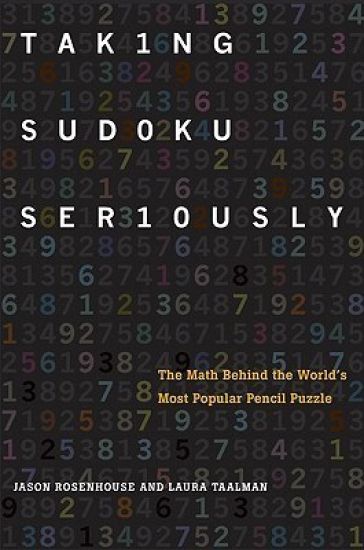
Packed with more than a hundred color illustrations and a wide variety of puzzles and brainteasers, Taking Sudoku 2eriously uses this popular craze as the starting point for a fun-filled introduction to higher mathematics. How many Sudoku solution squares are there? What shapes other than three-by-three blocks can serve as acceptable Sudoku regions? What is the fewest number of starting clues a sound Sudoku puzzle can have? Does solving Sudoku require mathematics? Jason Rosenhouse and Laura Taalman show that answering these questions opens the door to a wealth of interesting mathematics. Indeed, they show that Sudoku puzzles and their variants are a gateway into mathematical thinking generally. Among many topics, the authors look at the notion of a Latin square--an object of long-standing interest to mathematicians--of which Sudoku squares are a special case; discuss how one finds interesting Sudoku puzzles; explore the connections between Sudoku, graph theory, and polynomials; and consider Sudoku extremes, including puzzles with the maximal number of vacant regions, with the minimal number of starting clues, and numerous others. The book concludes with a gallery of novel Sudoku variations--just pure solving fun! Most of the puzzles are original to this volume, and all solutions to the puzzles appear in the back of the book or in the text itself. A math book and a puzzle book, Taking Sudoku Seriously will change the way readers look at Sudoku and mathematics, serving both as an introduction to mathematics for puzzle fans and as an exploration of the intricacies of Sudoku for mathematics buffs.
For more than 1,500 years, the claim that Adam's Fall might be considered 'fortunate' has been Christianity's most controversial and difficult idea. While keepers of the Easter vigil in the fifth century (and later John Milton) praised sin only as a backhanded witness to the ineffability of redemption, modern speculative theodicy came to understand all evil as comprehensible, historically productive, and therefore fortunate, while the romantic poets credited transgression with bolstering individual creativity and spirit. Jason Mahn's compelling study examines Kierkegaard's ''para/orthodixical'' language of human fallibility and Christian sin. Mahn breaks down and reconstructs the concept of the fortunate Fall in Western thought, in context of Kierkegaard's later writings, examining Kierkegaard's blunt critique of Idealism's justification of evil, as well as his playful deconstruction of romantic celebrations of sin. Mahn also argues, though, that Kierkegaard resists the moralization of evil, preferring to consider temptation and sin as determinative dimensions of religious existence. In relation to the assumed ''innocence'' of Christendom's cultured Christians, the self-conscious sinner might be the better religious witness. Although Mahn shows how Kierkegaard finally replaces actual sin with human fragility, temptation, and the possibility of spiritual offense as that which ''happily'' shapes religious faith, he cogently argues that Kierkegaard's understanding of ''fortunate fallibility'' is at least as rhetorically compelling and theologically operative as talk of a fortunate Fall. Mahn's insights into Kierkegaard's playful maneuvers encourages Christian theologians can speak of sin more particularly and peculiarly than in the typical discourses of church and culture.
Historically, Americans have seen libertarians as far outside the mainstream, but with the rise of the Tea Party movement, libertarian principles have risen to the forefront of Republican politics. But libertarianism is more than the philosophy of individual freedom and unfettered markets that Republicans have embraced. Indeed, as Jason Brennan points out, libertarianism is a quite different--and far richer--system of thought than most of us suspect. In this timely new entry in Oxford's acclaimed series What Everyone Needs to Know, Brennan offers a nuanced portrait of libertarianism, proceeding through a series of questions to illuminate the essential elements of libertarianism and the problems the philosophy addresses, including such topics as the Value of Liberty, Human Nature and Ethics, Economic Liberty, Civil Rights, Social Justice and the Poor, Government and Democracy, and Contemporary Politics. Brennan asks the most fundamental and challenging questions: What do Libertarians think liberty is? Do libertarians think everyone should be selfish? Are libertarians just out to protect the interests of big business? What do libertarians think we should do about racial injustice? What would libertarians do about pollution? Are Tea Party activists true libertarians? As he sheds light on libertarian beliefs, Brennan overturns numerous misconceptions. Libertarianism is not about simple-minded paranoia about government, he writes. Rather, it celebrates the ideal of peaceful cooperation among free and equal people. Libertarians believe that the rich always capture political power; they want to minimize the power available to them in order to protect the weak. Brennan argues that libertarians are, in fact, animated by benevolence and a deep concern for the poor. Clear, concise, and incisively written, this volume explains a vitally important philosophy in American history--and a potent force in contemporary politics.
Historically, Americans have seen libertarians as far outside the mainstream, but with the rise of the Tea Party movement, libertarian principles have risen to the forefront of Republican politics. But libertarianism is more than the philosophy of individual freedom and unfettered markets that Republicans have embraced. Indeed, as Jason Brennan points out, libertarianism is a quite different--and far richer--system of thought than most of us suspect. In this timely new entry in Oxford's acclaimed series What Everyone Needs to Know, Brennan offers a nuanced portrait of libertarianism, proceeding through a series of questions to illuminate the essential elements of libertarianism and the problems the philosophy addresses, including such topics as the Value of Liberty, Human Nature and Ethics, Economic Liberty, Civil Rights, Social Justice and the Poor, Government and Democracy, and Contemporary Politics. Brennan asks the most fundamental and challenging questions: What do Libertarians think liberty is? Do libertarians think everyone should be selfish? Are libertarians just out to protect the interests of big business? What do libertarians think we should do about racial injustice? What would libertarians do about pollution? Are Tea Party activists true libertarians? As he sheds light on libertarian beliefs, Brennan overturns numerous misconceptions. Libertarianism is not about simple-minded paranoia about government, he writes. Rather, it celebrates the ideal of peaceful cooperation among free and equal people. Libertarians believe that the rich always capture political power; they want to minimize the power available to them in order to protect the weak. Brennan argues that libertarians are, in fact, animated by benevolence and a deep concern for the poor. Clear, concise, and incisively written, this volume explains a vitally important philosophy in American history--and a potent force in contemporary politics.
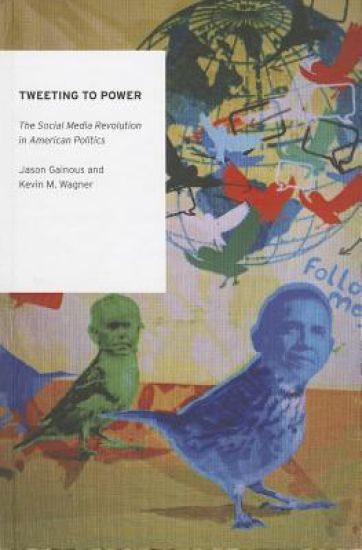
Online social media are changing the face of politics in the United States. Beginning with a strong theoretical foundation grounded in political, communications and psychology literature, Tweeting to Power examines the effect of online social media on how people come to learn, understand and engage in politics. Gainous and Wagner propose that platforms such as Facebook and Twitter offer the opportunity for a new information flow that is no longer being structured and limited by the popular media. Television and newspapers, which were traditionally the sole or primary gatekeeper, can no longer limit or govern what information is exchanged. By lowering the cost of both supplying the information and obtaining it, social networking applications have recreated how, when and where people are informed. To establish this premise, Gainous and Wagner analyze multiple datasets, quantitative and qualitative, exploring and measuring the use of social media by voters and citizens as well as the strategies and approaches adopted by politicians and elected officials. They illustrate how these new and growing online communities are new forums for the exchange of information that is governed by relationships formed and maintained outside traditional media. Using empirical measures, they prove both how candidates utilize Twitter to shape the information voters rely upon and how effective this effort was at garnering votes in the 2010 congressional elections. With both theory and data, Gainous and Wagner show how the social media revolution is creating a new paradigm for political communication and shifting the very foundation of the political process.
Online social media are changing the face of politics in the United States. Beginning with a strong theoretical foundation grounded in political, communications and psychology literature, Tweeting to Power examines the effect of online social media on how people come to learn, understand and engage in politics. Gainous and Wagner propose that platforms such as Facebook and Twitter offer the opportunity for a new information flow that is no longer being structured and limited by the popular media. Television and newspapers, which were traditionally the sole or primary gatekeeper, can no longer limit or govern what information is exchanged. By lowering the cost of both supplying the information and obtaining it, social networking applications have recreated how, when and where people are informed. To establish this premise, Gainous and Wagner analyze multiple datasets, quantitative and qualitative, exploring and measuring the use of social media by voters and citizens as well as the strategies and approaches adopted by politicians and elected officials. They illustrate how these new and growing online communities are new forums for the exchange of information that is governed by relationships formed and maintained outside traditional media. Using empirical measures, they prove both how candidates utilize Twitter to shape the information voters rely upon and how effective this effort was at garnering votes in the 2010 congressional elections. With both theory and data, Gainous and Wagner show how the social media revolution is creating a new paradigm for political communication and shifting the very foundation of the political process.
The COM and CORBA technologies are often pitted against each other, viewed simply as competing architectures for creating distributed solutions. While the most significant difference between COM and CORBA is their support for different operating system platforms, software developers must realize that each technology has its own strengths that clearly differentiate it from the other. In COM and CORBA(r) Side by Side, Jason Pritchard objectively describes when and how developers should use both technologies--together or separately--to maximize the success of their designs. This book helps software practitioners analyze and transcend their personal biases toward COM or CORBA so that they may objectively seek the best implementation strategy. The author helps you cut through vendor marketing hype by presenting a clear, logical formula to help you choose between the two technologies. In short, COM and CORBA(r) Side by Side is an invaluable resource for making informed, critical decisions about using one or both of these technologies in your next project. Other highlights of this book. *Explains why COM and CORBA currently hold dominant positions in the marketplace *Describes an objective strategy for assessing the use of the two architectures on the server *Examines client approaches for each technology, including design issues related to remoting and security *Illustrates how COM and CORBA can be used together, with details on both custom and commercial bridging approaches 0201379457B04062001
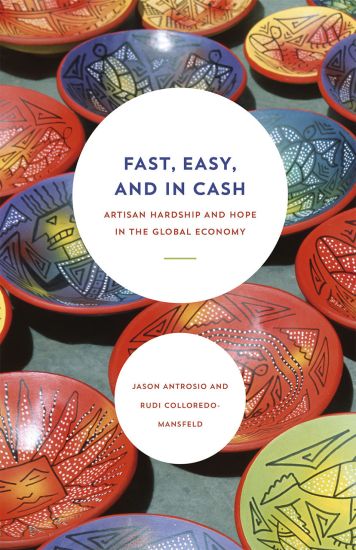
Artisan has recently become a buzzword in the developed world, used for items like cheese, wine, and baskets, as corporations succeed at branding their cheap, mass-produced products with the popular appeal of small-batch, handmade goods. The unforgiving realities of the artisan economy, however, never left the global south, and anthropologists have worried over the fate of these craftspeople as global capitalism has again remade their cultural and economic territory. Yet artisans are proving to be surprisingly vital players in contemporary capitalism, as they interlock innovation and tradition to create effective new forms of entrepreneurship. Based on seven years of extensive research in Colombia and Ecuador, veteran ethnographers Jason Antrosio and Rudi Colloredo-Mansfeld's Fast, Easy, and In Cash explores how small-scale production and global capitalism are not directly opposed, but are rather essential partners in economic development. Antrosio and Colloredo-Mansfeld demonstrate how artisan trades arrive and flourish in modern Latin American communities. In uncertain economic environments, small manufacturers have adapted to excel at home-based production, product design, technological efficiency, and high-risk investments. Illuminating this process are vivid case studies from Ecuador and Colombia: peasant farmers in Tuquerres, Otavalo weavers, Tigua painters, and the t-shirt industry of Atuntaqui. Fast, Easy, and In Cash exposes how these ambitious artisans, far from being holdovers from the past, are crucial for capitalist innovation in their communities and provide indispensable lessons in how we should understand and cultivate local economies in this era of globalization.
Artisan has recently become a buzzword in the developed world, used for items like cheese, wine, and baskets, as corporations succeed at branding their cheap, mass-produced products with the popular appeal of small-batch, handmade goods. The unforgiving realities of the artisan economy, however, never left the global south, and anthropologists have worried over the fate of these craftspeople as global capitalism has again remade their cultural and economic territory. Yet artisans are proving to be surprisingly vital players in contemporary capitalism, as they interlock innovation and tradition to create effective new forms of entrepreneurship. Based on seven years of extensive research in Colombia and Ecuador, veteran ethnographers Jason Antrosio and Rudi Colloredo-Mansfeld's Fast, Easy, and In Cash explores how small-scale production and global capitalism are not directly opposed, but are rather essential partners in economic development. Antrosio and Colloredo-Mansfeld demonstrate how artisan trades arrive and flourish in modern Latin American communities. In uncertain economic environments, small manufacturers have adapted to excel at home-based production, product design, technological efficiency, and high-risk investments. Illuminating this process are vivid case studies from Ecuador and Colombia: peasant farmers in Tuquerres, Otavalo weavers, Tigua painters, and the t-shirt industry of Atuntaqui. Fast, Easy, and In Cash exposes how these ambitious artisans, far from being holdovers from the past, are crucial for capitalist innovation in their communities and provide indispensable lessons in how we should understand and cultivate local economies in this era of globalization.
Why do people smoke? Taking a unique approach to this question, Jason Hughes moves beyond the usual focus on biological addiction to demonstrate how sociocultural and personal understandings of smoking crucially affect the way people experience it. Hughes begins by tracing the transformations of tobacco and its use over time, from its role as a hallucinogen in Native American shamanistic ritual to its use as a prophylactic against the plague and a cure for cancer by early Europeans, and finally to the current view of smoking as a global pandemic. He then analyzes tobacco from the perspective of the individual user, exploring how its consumption relates to issues of identity and life changes. Comparing sociocultural and personal experiences, Hughes ultimately asks what the patterns of tobacco use mean for the clinical treatment of smokers and for public policy on smoking. Pointing the way, then, to a more learned and sophisticated understanding of tobacco use, this study should prove to be valuable reading for anyone interested in the history of smoking and the sociology of addiction.
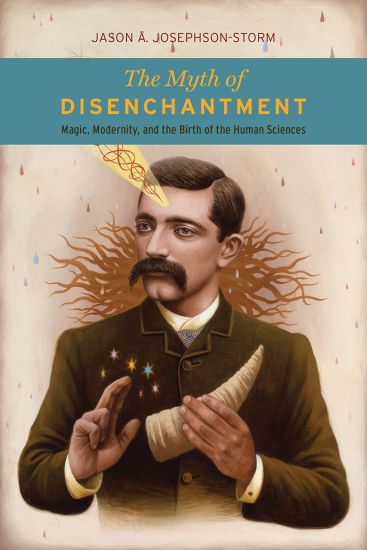
A great many theorists have argued that the defining feature of modernity is that people no longer believe in spirits, myths, or magic. Jason A. Josephson-Storm argues that as broad cultural history goes, this narrative is wrong, as attempts to suppress magic have failed more often than they have succeeded. Even the human sciences have been more enchanted than is commonly supposed. But that raises the question: How did a magical, spiritualist, mesmerized Europe ever convince itself that it was disenchanted? Josephson-Storm traces the history of the myth of disenchantment in the births of philosophy, anthropology, sociology, folklore, psychoanalysis, and religious studies. Ironically, the myth of mythless modernity formed at the very time that Britain, France, and Germany were in the midst of occult and spiritualist revivals. Indeed, Josephson-Storm argues, these disciplines' founding figures were not only aware of, but profoundly enmeshed in, the occult milieu; and it was specifically in response to this burgeoning culture of spirits and magic that they produced notions of a disenchanted world. By providing a novel history of the human sciences and their connection to esotericism, The Myth of Disenchantment dispatches with most widely held accounts of modernity and its break from the premodern past.
Teenage life is tough. You're at the mercy of parents, teachers, and siblings, all of whom insist on continuing to treat you like a kid and refuse to leave you alone. So what do you do when it all gets to be too much? You retreat to your room (and maybe slam the door). Even in our era of Snapchat and hoverboards, bedrooms remain a key part of teenage life, one of the only areas where a teen can exert control and find some privacy. And while these separate bedrooms only became commonplace after World War II, the idea of the teen bedroom has been around for a long time. With Get Out of My Room!, Jason Reid digs into the deep historical roots of the teen bedroom and its surprising cultural power. He starts in the first half of the nineteenth century, when urban-dwelling middle-class families began to consider offering teens their own spaces in the home, and he traces that concept through subsequent decades, as social, economic, cultural, and demographic changes caused it to become more widespread. Along the way, Reid shows us how the teen bedroom, with its stuffed animals, movie posters, AM radios, and other trappings of youthful identity, reflected the growing involvement of young people in American popular culture, and also how teens and parents, in the shadow of ongoing social changes, continually negotiated the boundaries of this intensely personal space. Richly detailed and full of surprising stories and insights, Get Out of My Room! is sure to offer insight and entertainment to anyone with wistful memories of their teenage years. (But little brothers should definitely keep out.)
Through most of its long history, Japan had no concept of what we call "religion." There was no corresponding Japanese word, nor anything close to its meaning. But when American warships appeared off the coast of Japan in 1853 and forced the Japanese government to sign treaties demanding, among other things, freedom of religion, the country has to contend with this Western idea. In this book, Jason Ananda Josephson reveals how Japanese officials invented religion in Japan and traces the sweeping intellectual, legal, and cultural changes that followed. More than a tale of oppression or hegemony, Josephson's account demonstrates that the process of articulating religion offered the Japanese state a valuable opportunity. In addition to carving out space for belief in Christianity and certain forms of Buddhism, Japanese officials excluded Shinto from the category. Instead, they enshrined it as a national ideology while relegating the popular practices of indigenous shamans and female mediums to the category of "superstitions" - and thus beyond the sphere of tolerance. Josephson argues that the invention of religion in Japan was a politically charged, boundary-drawing exercise that not only extensively reclassified the inherited materials of Buddhism, Confucianism, and Shinto to lasting effect, but also reshaped, in subtle but significant ways, our own formulation of the concept of religion today. This ambitious and wide-ranging book contributes an important perspective to broader debates on the nature of religion, the secular, science, and superstition.
Through most of its long history, Japan had no concept of what we call "religion." There was no corresponding Japanese word, nor anything close to its meaning. But when American warships appeared off the coast of Japan in 1853 and forced the Japanese government to sign treaties demanding, among other things, freedom of religion, the country has to contend with this Western idea. In this book, Jason Ananda Josephson reveals how Japanese officials invented religion in Japan and traces the sweeping intellectual, legal, and cultural changes that followed. More than a tale of oppression or hegemony, Josephson's account demonstrates that the process of articulating religion offered the Japanese state a valuable opportunity. In addition to carving out space for belief in Christianity and certain forms of Buddhism, Japanese officials excluded Shinto from the category. Instead, they enshrined it as a national ideology while relegating the popular practices of indigenous shamans and female mediums to the category of "superstitions" - and thus beyond the sphere of tolerance. Josephson argues that the invention of religion in Japan was a politically charged, boundary-drawing exercise that not only extensively reclassified the inherited materials of Buddhism, Confucianism, and Shinto to lasting effect, but also reshaped, in subtle but significant ways, our own formulation of the concept of religion today. This ambitious and wide-ranging book contributes an important perspective to broader debates on the nature of religion, the secular, science, and superstition.
From neighborhoods as large as Chelsea or the Castro, to locales limited to a single club, like The Shamrock in Madison or Sidewinders in Albuquerque, gay areas are becoming normal. Straight people flood in. Gay people flee out. Scholars call this transformation assimilation and some argue that we gay and straight alike are becoming "post gay." Jason Orne argues that rather than post gay, America is becoming "post queer," losing the radical lessons of sex. In Boystown, Orne takes readers on a detailed, lively journey through Chicago's Boystown, which serves as a model for gayborhoods around the country. The neighborhood, he argues, has become an entertainment district a gay Disneyland where people get lost in the magic of the night and where straight white women can "go on safari." In their original form, though, gayborhoods like this one don't celebrate differences; they create them. By fostering a space outside the mainstream, gay spaces allow people to develop an alternative culture a queer culture that celebrates sex. Orne spent three years doing fieldwork in Boystown, searching for ways to ask new questions about the connective power of sex and about what it means to be not just gay, but queer. The result is the striking Boystown, illustrated throughout with street photography by Dylan Stuckey. In the dark backrooms of raunchy clubs where bachelorettes wouldn't dare tread, people are hooking up and forging "naked intimacy." Orne is your tour guide to the real Boystown, then, where sex functions as a vital center and an antidote to assimilation.
From neighborhoods as large as Chelsea or the Castro, to locales limited to a single club, like The Shamrock in Madison or Sidewinders in Albuquerque, gay areas are becoming normal. Straight people flood in. Gay people flee out. Scholars call this transformation assimilation and some argue that we gay and straight alike are becoming "post gay." Jason Orne argues that rather than post gay, America is becoming "post queer," losing the radical lessons of sex. In Boystown, Orne takes readers on a detailed, lively journey through Chicago's Boystown, which serves as a model for gayborhoods around the country. The neighborhood, he argues, has become an entertainment district a gay Disneyland where people get lost in the magic of the night and where straight white women can "go on safari." In their original form, though, gayborhoods like this one don't celebrate differences; they create them. By fostering a space outside the mainstream, gay spaces allow people to develop an alternative culture a queer culture that celebrates sex. Orne spent three years doing fieldwork in Boystown, searching for ways to ask new questions about the connective power of sex and about what it means to be not just gay, but queer. The result is the striking Boystown, illustrated throughout with street photography by Dylan Stuckey. In the dark backrooms of raunchy clubs where bachelorettes wouldn't dare tread, people are hooking up and forging "naked intimacy." Orne is your tour guide to the real Boystown, then, where sex functions as a vital center and an antidote to assimilation.