Kirjojen hintavertailu. Mukana 11 342 296 kirjaa ja 12 kauppaa.

Kirjahaku

Etsi kirjoja tekijän nimen, kirjan nimen tai ISBN:n perusteella.

1000 tulosta hakusanalla John Perry

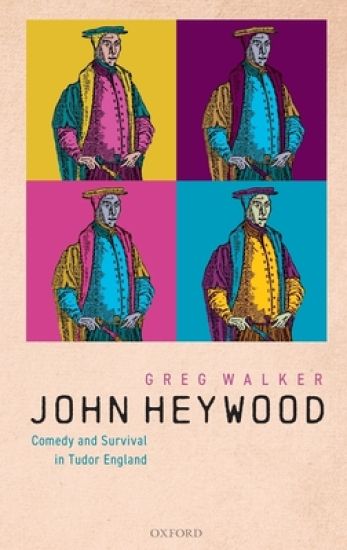
John Heywood

John Heywood

Greg Walker

Oxford University Press
2020
sidottu
John Heywood was an important literary and theatrical pioneer in his own right, but he is also a revealing lens through which to view the wider tumultuous history of the sixteenth century. He was, through the period from the mid-1520s to the 1560s, as near to a celebrity as Tudor England possessed, famed for his 'merry' persona and good humour. But his public image concealed a deeper engagement with religious and political history. Enduringly resistant to extremism, he variously entertained, counselled, and cautioned his readers and audiences through four reigns, finding himself, as regimes changed and religious policies shifted, successively celebrated, marginalised, anathematised, condemned to death, recuperated, and celebrated once more before finally retreating into exile on the Continent in 1564. He produced plays at the courts of Henry VIII, Edward VI, Mary and Elizabeth, performed and taught keyboard music, wrote lyric poetry and songs, and from the mid-sixteenth century turned to collecting and publishing highly successful volumes of proverbs and epigrams for which he was remembered well into the seventeenth century. Each of these works provides a subtle, often courageously critical engagement with the politics of its moment. To study Heywood's career takes us beyond the clichés of popular history, beyond Shakespeare and the Elizabethan playhouses, beyond the canonical Henrician court poets and the writers of the Elizabethan 'Golden Age', beyond even the experiences of the century's chief ministers, intellectuals, and martyrs, to a theatrical and literary world less visible in the conventional sources. It opens a window on a culture in which the actions of monarchs, their councillors, and their victims were witnessed and reflected upon at one remove from the centres of power. And it allows us to re-examine the significance of an individual who deserves our attention, not only for his considerable artistic achievements, but also for the determination with which, often against the odds, he used his talents in pursuit of wider humanist cultural principles for over half a century.
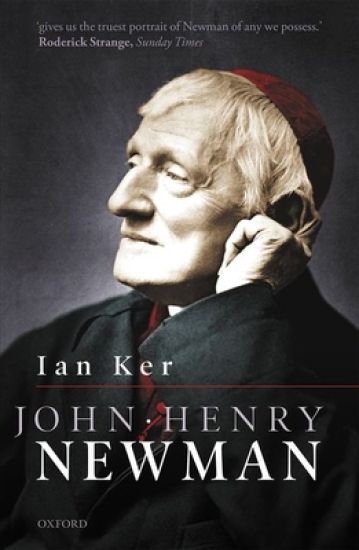
John Henry Newman

John Henry Newman

Ian Ker

Oxford University Press
2019
nidottu
This full-length life of John Henry Newman is the first comprehensive biography of both the man and the thinker and writer. It draws extensively on material from Newman's letters and papers. Newman's character is revealed in its complexity and contrasts: the legendary sadness and sensitivity are placed in their proper perspective by being set against his no less striking qualities of exuberance, humour, and toughness. This book attempts to do justice to the fullness of Newman's achievement and genius: the Victorian 'prophet' or 'sage', who ranks among the major English prose writers; the dominating religious figure of the nineteenth century, who can now be recognised as the forerunner of the Second Vatican Council and the modern ecumenical movement; and finally, the universal Christian thinker, whose significance transcends his culture and time.
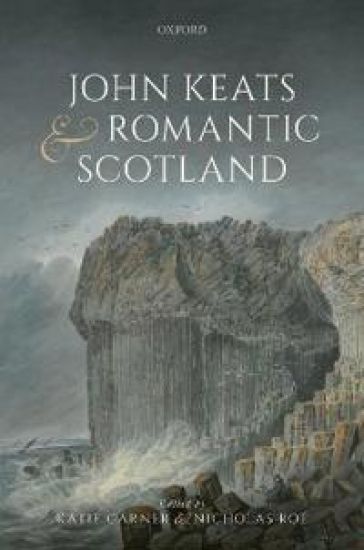
John Keats and Romantic Scotland

John Keats and Romantic Scotland

Oxford University Press
2022
sidottu
Between 22 June and 18 August 1818, John Keats and his friend and collaborator Charles Armitage Brown embarked on an epic walking tour of the English Lake District, South West Scotland, Northern Ireland, the Ayrshire Burns Country, the Scottish Highlands and Western Isles, and the Great Glen north eastwards to Inverness, Beauly, the Black Isle, and Cromarty. During the tour, Keats and Brown both wrote extensive and detailed accounts of their experiences. The twelve new essays in this collection each explore the significance of the 1818 tour for understanding Keats's achievements, ranging across topics such as the contemporary Highland tour; Scottish literature, history, landscape and culture; Romantic responses to Robert Burns's life, works and places; and Keats's health and influence on Scottish artists.
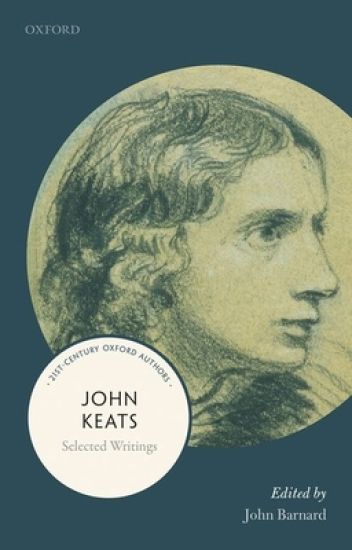
John Keats

John Keats

Oxford University Press
2020
nidottu
This volume in the 21st-Century Oxford Authors series offers students and readers a comprehensive selection of the work of John Keats (1795-1821). Accompanied by full scholarly apparatus, this authoritative edition enables students to study Keats's work afresh, bringing his poetry and letters together in chronological order. The backbone of this volume is provided by the poems published in Keats's lifetime--the three volumes, Poems (1817), Endymion (1818), and Lamia, Isabella, The Eve of St. Agnes, and Other Poems (1820), together with the small number of poems he published elsewhere. But a much larger body of Keats's writing was seen only in manuscript, if at all, by Keats's friends and family--the unpublished poems which include the dream vision, The Fall of Hyperion, his annotations of Shakespeare and Milton, and, above all, his extraordinary letters. These are placed at the date on which they were written or at their probable date. This selection of poems, prose, and letters therefore creates a double time scheme. It places the poetry by which Keats was known to a frequently antagonistic reading public in his lifetime within the extensive biographical context provided by his unpublished poems and letters. This substantial body of manuscript evidence, some of it not discovered until the twentieth-century and none of it known to Keats's reading public, is now part of our understanding of his life and work, and allows us to follow his extraordinary intellectual, emotional, and artistic self-making in the three short years between Poems (1817) and 1820. Explanatory notes and commentary are included to enhance the study, understanding, and enjoyment of these works, and the edition includes an Introduction to the life of Keats, and a Chronology.
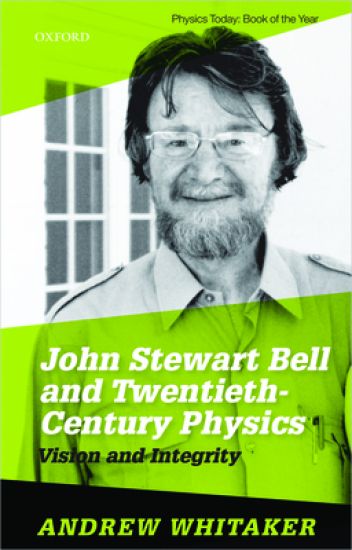
John Stewart Bell and Twentieth Century Physics

John Stewart Bell and Twentieth Century Physics

Andrew Whitaker

Oxford University Press
2020
nidottu
This book gives a readable non-mathematical account of the upbringing, education and academic achievement of John Stewart Bell, the celebrated physicist from Belfast, who was born in 1928. Bell has become famous for what he described as his 'hobby', analysing the fundamental aspects of quantum theory, where he clarified a long-standing debate between the two most important figures of twentieth century physics, Albert Einstein and Niels Bohr, and showed that, contrary to belief over the previous thirty years, quantum theory could be supplemented with extra 'hidden variables'. His crucial 'Bell's Theorem' or 'Bell's Inequalities' demonstrated a contradiction between quantum theory and local causality. This relation has been tested with increasing rigour over the next years, and quantum theory has triumphed. His ideas were also important in the development of quantum information theory, which covers quantum computation, quantum cryptography and quantum teleportation. The book covers his earlier work at Harwell, where he worked on the design of accelerators, making extremely important contributions to the physics of strong focussing. He later moved to CERN in Geneva where he carried out highly significant work in the fields of elementary particles and quantum field theory. It also covers some details of Bell's personal life, including his marriage while he was at Harwell to Mary Ross, who also worked in the physics of accelerators, and also describes his career decade by decade, and sums up his importance to twentieth-century physics.
John of the Cross

John of the Cross

Sam Hole

Oxford University Press
2020
sidottu
Through the 'dark night of the soul' to the depiction of the erotically-charged union of the soul and God, the poetry and prose works of the Spanish friar John of the Cross (1542-1591) offer a striking account of the transformation of the individual in the course of the Christian life. John of the Cross: Desire, Transformation, and Selfhood argues that these writings are animated by John's own creative and subtly conceptualized notion of erotic desire. John's understanding of desire has the potential to enrich recent theological discussion of the subject, but it has been curiously neglected in past scholarship. To correct this lacuna, this study undertakes a detailed historical analysis in three parts. Firstly, it attends to the patristic, medieval, and sixteenth-century Spanish influences on John's writings, showing how John reworks a long tradition of biblical, Christian, and Platonic reflection on the concept. Secondly, it traces the importance of desire through John's writings, demonstrating how he develops the theme through his poetry, his anthropology of the soul, and his account of the spiritual ascent. Thirdly, it explores the reception of his writings in the twentieth century, demonstrating how particular modern philosophical and theological commitments have prevented scholars from recognising the rich and distinctive shape of John's theological vision. John's account of the transformation of the self, with its hopeful vision of the graced transformation of the soul's desires, has significance beyond the constrained modern categories of systematic theology, Christian spirituality, pastoral theology, and mysticism--it is a vision that is worthy of recovery today.
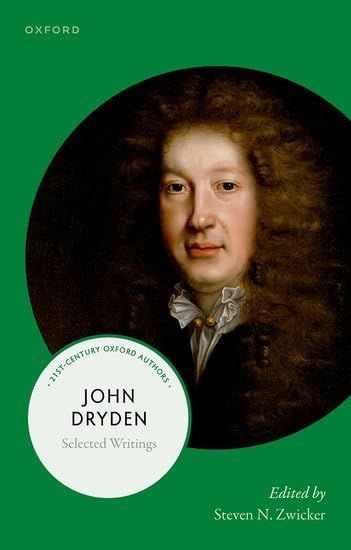
John Dryden

John Dryden

Oxford University Press
2024
nidottu
This volume in the 21st Century Oxford Authors series offers students an authoritative, comprehensive selection of the poetry and prose of John Dryden, the most important poet, dramatist, translator, and literary theorist of the later seventeenth century. He wrote across the tumultuous decades of political and cultural revolution--years stretching from the end of the Cromwellian Protectorate in 1659 through the reign of William III--and he addressed the crucial events of those decades. These were years of unprecedented political revolution, and of a remarkable transformation of English literary culture, with John Dryden at the literary centre. He invented new literary modes including the theatre of spectacle known as heroic drama; he perfected the heroic couplet, a form that became the chief instrument of public poetry; he adapted works of Shakespeare and Milton; he wrote excoriating satire; and he brought the translation of classical poetry to new levels of perfection; and throughout his career he wrote works of literary theory that defined his own practices and the literary ethos of his age. By the time that Dryden died in 1700 he had redefined English literary culture; his work recalled and embodied all the genres and modes of early modern literature and anticipated the brilliance of eighteenth-century satire as performed by Jonathan Swift and Alexander Pope. This edition represents the span of a long career in its remarkable variety. All the genres in which Dryden wrote are represented: panegyrics, lyrics, odes, epigrams, verse epistles, historical poems, commendatory verse, commemorative poems, religious poems, satires, plays, prologues and epilogues, translations, critical prose, dedications, prefaces, biography, and letters. Explanatory notes and commentary enhance the study, understanding, and enjoyment of these works, and the edition includes an Introduction to the life and works of Dryden, and a Chronology.
John Keats and the Perils of Posterity

John Keats and the Perils of Posterity

Nicholas Roe

Oxford University Press
2025
sidottu
This book begins with an account of the disease that killed Keats and contributed to the enduring myth that he was a doomed genius. Newspaper reports of Keats's death and early 'tribute' poems marking his demise form the substance of successive chapters, as do early attempts at researching and writing a biography of him. Keats's would-be biographers included his publisher John Taylor whose biographical endeavours preceded Keats's death, his mentor Leigh Hunt who devoted a chapter to 'Mr. Keats' in his brilliant 1828 book Lord Byron and some of his Contemporaries, and his friend and collaborator Charles Brown whose draft life narrative remains a vital source of information. Poised to emigrate to New Zealand, Brown passed his script and source materials to Richard Monckton Milnes enjoining him to complete the work (Brown conceded that Milnes had an advantage in having not known Keats). This book explores Milnes's efforts and success in publishing his Life, Letters, and Literary Remains of John Keats in 1848 --the first full-scale biography of the poet. Milnes's book has proved a formative and enduring influence for all of Keats's biographers, and the scale and resourcefulness of Milnes's labours are explored in detail. The closing chapters trace the influence of Milnes's book in the later nineteenth century, as new editions and fresh biographies appeared and Keats's reputation grew. The volume devotes many pages to the life experiences of the two women who had been closest to Keats: his sister Fanny and his fiancé Fanny Brawne. It also reflects on the means by which the Keats-Shelley House in Rome, and Keats House in Hampstead, were secured as memorial sites.
John Locke: Locke on Money, Volume I

John Locke: Locke on Money, Volume I

Patrick Hyde Kelly

Oxford University Press
2025
nidottu
Locke on Money presents for the first time the entire body of the philosopher's writings on this important subject (other than Two Treatises of Government). Accurate texts, together with an apparatus listing variant readings and significant manuscript changes, record the evolution of Locke's ideas from the original 1668-74 paper on interest to the three pamphlets on interest and coinage published in the 1690s. The introduction by Patrick Hyde Kelly establishes the wider context of Locke's writings in terms of contemporary debates on these subjects, the economic conditions of the time, and the circumstances of writing and publication. It shows, notably, that Locke's supposed responsibility for the 1696 recoinage is a myth. The account of what Locke derived from Mercantilist writings and of how he reformulated these in accordance with his philosophy illuminates his contribution to the evolution of economics, and will aid reappraisal of Two Treatises. The picture that emerges confirms Locke's status as major economic thinker, contrary to the prevalent view of recent decades. There are two volumes in the present edition. This first volume of Locke on Money contains the frontmatter and the texts of 'The Early Writings on Interest, 1688-74' and 'Some Considerations'.
John Locke: Locke on Money, Volume II

John Locke: Locke on Money, Volume II

Patrick Hyde Kelly

Oxford University Press
2025
nidottu
Locke on Money presents for the first time the entire body of the philosopher's writings on this important subject (other than Two Treatises of Government). Accurate texts, together with an apparatus listing variant readings and significant manuscript changes, record the evolution of Locke's ideas from the original 1668-74 paper on interest to the three pamphlets on interest and coinage published in the 1690s. The introduction by Patrick Hyde Kelly establishes the wider context of Locke's writings in terms of contemporary debates on these subjects, the economic conditions of the time, and the circumstances of writing and publication. It shows, notably, that Locke's supposed responsibility for the 1696 recoinage is a myth. The account of what Locke derived from Mercantilist writings and of how he reformulated these in accordance with his philosophy illuminates his contribution to the evolution of economics, and will aid reappraisal of Two Treatises. The picture that emerges confirms Locke's status as major economic thinker, contrary to the prevalent view of recent decades. There are two volumes in the present edition. This second volume of Locke on Money contains the texts 'Short Observations' and 'Further Considerations', as well as the Appendices and endmatter.
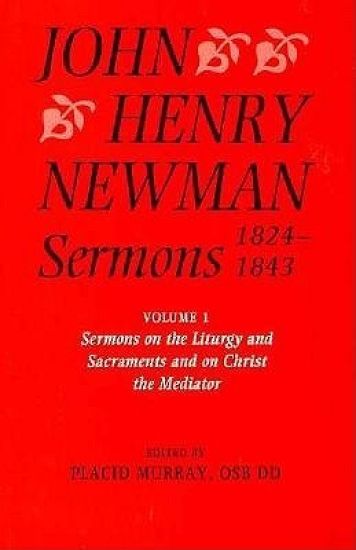
John Henry Newman Sermons 1824-1843: Volume I: Sermons on the Liturgy and Sacraments and on Christ the Mediator
From 1824 to 1843 Newman was an active clergyman of the Church of England; during this time, he entered the pulpit about 1,270 times. Newman published 217 of the sermons which he wrote during these years; a further 246 sermons survive in manuscript in the Archives of the Birmingham Oratory, some only as fragments but the majority as full texts. These sermons will be published in a series of five volumes, the aim being to transcribe them accurately, with sufficient editorial apparatus for the theological development within them to be understood, and their historical situation to be clear. The forty-three sermons contained in Volume I reveal Newman's attitude to his pastoral charge, his theology of liturgy based on the Book of Common Prayer; his gradual acceptance of the doctrine of baptismal regeneration as a substitute for his earlier belief in conversion as understood by the Evangelicals; the eventual supremacy of the Eucharist in his own spiritual life; his growing reserve about preaching on the Atonement; his faith in the divinity of Christ the Mediator; and finally, his understanding of the Church as the remedial and mediatorial kingdom of Christ on earth.
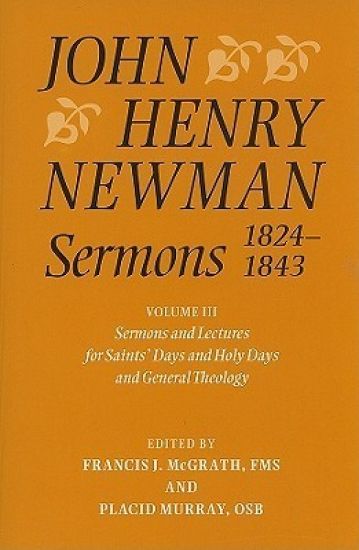
John Henry Newman Sermons 1824-1843
From 1824 to 1843, Newman was an active clergyman of the Church of England. Throughout these twenty years, he entered the pulpit about 1,270 times and wrote about 604 sermons. Of these, he eventually published 217 sermons which he had written and delivered; a further 246 sermons survive in manuscript in the Archives of the Birmingham Oratory, some only as fragments but the majority as full texts. Volume I was published in 1991 and Volume II in 1993. When completed, the series will consist of five volumes. Volume III contains a further fifty hitherto unpublished sermons belonging to this period. There are twenty-five sermons especially composed for Saints' Days and Holy Days and, with one exception, all preached at St Mary the Virgin University Church, Oxford, between 1830 and 1843. Towards the end of 1831, after years of dissatisfaction with his mode of writing and preaching sermons, Newman hit upon a new mode of delivery. There are also twenty-five sermons which Newman categorized as General Theology. They cover such areas as: the Second Coming; the efficacy of prayer; angels; baptismal regeneration; the Trinity, religious mystery; the Creed; and the dogmatic principle. There is also one particular sermon on slavery in which Newman argues that slavery is 'a condition of life ordained by God in the same sense that other conditions of life are'. Since many of these sermons were preached and re-preached several times over this twenty-year period, they are important for an understanding of Newman's theological and spiritual development.