Kirjojen hintavertailu. Mukana 12 016 292 kirjaa ja 12 kauppaa.

Kirjahaku

Etsi kirjoja tekijän nimen, kirjan nimen tai ISBN:n perusteella.

1000 tulosta hakusanalla Maral Atmaca

Moral Psychology

Moral Psychology

Christian B. Miller

Cambridge University Press
2021
pokkari
This Element provides an overview of some of the central issues in contemporary moral psychology. It explores what moral psychology is, whether we are always motivated by self-interest, what good character looks like and whether anyone has it, whether moral judgments always motivate us to act, whether what motivates action is always a desire of some kind, and what the role is of reasoning and deliberation in moral judgment and action. This Element is aimed at a general audience including undergraduate students without an extensive background in philosophy.
Moral Enhancement

Moral Enhancement

Cambridge University Press
2018
pokkari
The papers collected in this volume examine moral enhancement: the idea that we should morally improve people through the manipulation of their biological constitution. Whether moral enhancement is possible or even desirable is highly controversial. Proponents argue that it is necessary if we are to address various social ills and avert catastrophic climate change. Detractors have raised a variety of concerns, some of a practical nature and others of principle. Perhaps most fundamentally, however, the proposal forces us to ask anew what being moral actually means, in order for the idea of moral enhancement to make sense at all. The present collection both addresses these issues and moves the debate beyond its current parameters, bringing together authors with a wide range of perspectives and areas of expertise. Chapters variously draw on experimental psychology, social philosophy, pragmatism, Kantian and Aristotelian moral philosophy, and the ethics of care, sex, and psychedelics.
Moral Reasoning About Human Welfare in Adolescents and Adults

Moral Reasoning About Human Welfare in Adolescents and Adults

Audun Dahl; Matthew Gingo; Kevin Uttich; Elliot Turiel

John Wiley Sons Inc
2018
nidottu
The value of human life is a significant moral value for most people. Yet, past research has devoted little attention to the development of moral reasoning about the value of life. The present studies investigated how adolescents and adults reason about the value of life in the context of so-called trolley car situations. These situations, adopted from philosophy, involve the option of sacrificing the life of one person to save five others. Based on past developmental research, we expected that individuals would reason about distinct and sometimes conflicting considerations regarding the value of life. This approach contrasted with past research on adults' responses to trolley car situations, which has been taken to show that most moral evaluations are based not on reasoning but on affective, automatic reactions. In Study 1, 288 adolescents and adults were interviewed about trolley car situations designed to examine considerations like the value of human life and the relationship of those at risk with the actors. In Study 2, 144 college studens were interviewed to further examine the roles of those involved. Participants' justifications referred not only to the number of lives saved, but also to other considerations, such as intrinsic rights and personal responsibility for events. Moreover, responses indicated frequent conflicts about standard trolley car situations, counter to the argument that people's evaluations are automatic based soley on a counting of lives saved. The present findings indicated that adolescents and adults reason about, seek to coordinate, distinct moral considerations regarding the value of life.
Moral Responsibility and the Financial Crisis
A look at an economic disaster from a philosophical perspectiveA decade after the financial crisis, this publication considered the event from the standpoint of philosophy. Moral Responsibility and the Financial Crisis is a Midwest Studies in Philosophy volume that applies analytic philosophy to finance. The issue discusses the normative and meta-ethical challenges brought to light by the crisis. It also explores the individual and collective responsibility for the harm caused during the global economic event.
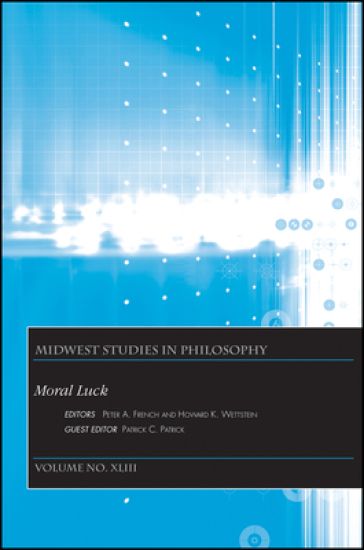
Moral Luck

Moral Luck

John Wiley Sons Inc
2019
nidottu
Many of us are inclined to accept something like the following principle: We can only be properly morally assessed for what is in our control. And yet our ordinary practices seem to frequently violate this principle. The resulting tension, and the attempt to resolve it, is the problem of moral luck. For example, we tend to punish and think worse of the negligent driver who kills a child than we do the equally negligent driver who was lucky there was no child in his path. Thus, the lucky outcomes of our actions do seem to affect the extent to which we hold and are held responsible, but these are not things over which we exercise control. And, as Thomas Nagel famously illustrated in his response to Bernard Williams (the two of which papers form the founding documents of the moral luck debate), the influence of luck is not limited to outcomes. For the circumstances in which we find ourselves and, indeed, our very constitution are also shaped by luck. Since the publication of Williams’ and Nagel’s papers, the existence and breadth of moral luck has been hotly debated. This debate is not a mere intellectual trifle but, as the essays in this volume illustrate, a debate which lies at the heart of free will, responsibility, identity, causation, and self-creation.