Kirjojen hintavertailu. Mukana 11 699 587 kirjaa ja 12 kauppaa.

Kirjahaku

Etsi kirjoja tekijän nimen, kirjan nimen tai ISBN:n perusteella.

1000 tulosta hakusanalla Michelle Mars

Cities and Climate Change

Cities and Climate Change

Michelle Betsill; Harriet Bulkeley

Routledge
2005
nidottu
Climate change is one of the most challenging issues of our time. As key sites in the production and management of emissions of greenhouse gases, cities will be crucial for the implementation of international agreements and national policies on climate change. This book provides a critical analysis of the role of cities in addressing climate change and the prospects for urban sustainability. Cities and Climate Change is the first in-depth analysis of the role of cities in addressing climate change. The book argues that key challenges concerning the resources and powers of local government, as well as conflicts between local goals for economic development and climate change mitigation, have restricted the level of local action on climate change. These findings have significant implications for the prospects of mitigating climate change and achieving urban sustainability. This book provides a valuable interdisciplinary analysis of these issues, and will appeal to students and researchers interested in sustainability at local and global scales.
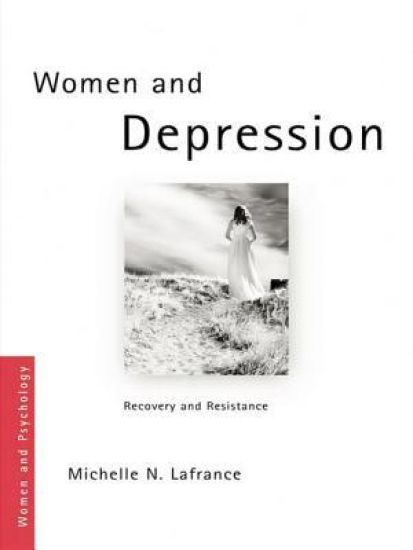
Women and Depression

Women and Depression

Michelle N. Lafrance

Routledge
2008
sidottu
Women and Depression: Recovery and Resistance takes a welcome look at women’s experiences of living well after depression. Lafrance argues that the social construction of femininity is dangerous for women’s health, and ultimately, central to their experiences of depression. Beginning with a critical examination of the ways in which women’s depression is a product of the social, political, and interpersonal realities of their everyday lives, the analysis moves on to explore an often ignored aspect of women’s experience – how women manage to ‘recover’ and be well after depression. The book draws on extensive in-depth interviews with women who have been depressed, as well as on previous research and on analyses of representations of women’s health practices in the media. In this way Lafrance critically examines how women negotiate and actively resist hegemonic discourses of femininity in their struggles to recover from depression and be well. Threaded throughout the analysis is the exploration of a variety of subjects related to women’s distress and health, including:negotiating identity the medicalization of women’s miserywomen’s narratives of resistancethe material and discursive context of women’s self-careIn exploring the taken-for-granted aspects of women’s experiences, Lafrance sheds light on the powerful but often invisible constraints on women’s wellbeing, and the multiple and creative ways in which they resist these constraints in their everyday lives. These insights will be of interest to students and scholars of psychology, sociology, women’s studies, social work, counseling, and nursing.
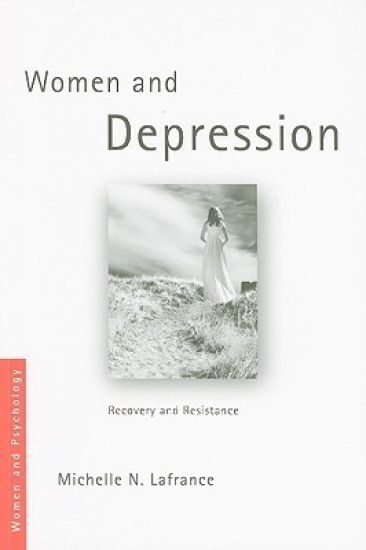
Women and Depression

Women and Depression

Michelle N. Lafrance

Routledge
2008
nidottu
Women and Depression: Recovery and Resistance takes a welcome look at women’s experiences of living well after depression. Lafrance argues that the social construction of femininity is dangerous for women’s health, and ultimately, central to their experiences of depression. Beginning with a critical examination of the ways in which women’s depression is a product of the social, political, and interpersonal realities of their everyday lives, the analysis moves on to explore an often ignored aspect of women’s experience – how women manage to ‘recover’ and be well after depression. The book draws on extensive in-depth interviews with women who have been depressed, as well as on previous research and on analyses of representations of women’s health practices in the media. In this way Lafrance critically examines how women negotiate and actively resist hegemonic discourses of femininity in their struggles to recover from depression and be well. Threaded throughout the analysis is the exploration of a variety of subjects related to women’s distress and health, including:negotiating identity the medicalization of women’s miserywomen’s narratives of resistancethe material and discursive context of women’s self-careIn exploring the taken-for-granted aspects of women’s experiences, Lafrance sheds light on the powerful but often invisible constraints on women’s wellbeing, and the multiple and creative ways in which they resist these constraints in their everyday lives. These insights will be of interest to students and scholars of psychology, sociology, women’s studies, social work, counseling, and nursing.
Beginning Research

Beginning Research

Michelle Lowe

Routledge
2006
sidottu
Researchers in education are interested in the study of learners, teachers, professional support staff, parents and other participants in schools and other educational institutions. To be effective, research needs to be carried out in a systematic way and should contribute to what is known. If you are interested in education research and want to learn how to become an effective researcher, then this step-by-step guide is for you. For many students the first research project is the most daunting but this book will help ensure its success. Beginning Research is a practical toolkit of resources that will enable students to plan, conduct and follow up research effectively. It contains information on the range of methods available to researchers and introduces some of the key concepts associated with education research and the theoretical background against which it currently takes place. Designed for anyone working in an education setting, by reading through each chapter and completing the associated tasks you will be able to work through each stage of the research process. This book is essential reading for students on all education courses who are engaging in research for the first time. It is particularly suitable for foundation degree students, as it acknowledges the constraints placed upon researchers who are also working and offers practical advice for managing the demands of employment, study and carrying out research.
Beginning Research

Beginning Research

Michelle Lowe

Routledge
2006
nidottu
Researchers in education are interested in the study of learners, teachers, professional support staff, parents and other participants in schools and other educational institutions. To be effective, research needs to be carried out in a systematic way and should contribute to what is known. If you are interested in education research and want to learn how to become an effective researcher, then this step-by-step guide is for you. For many students the first research project is the most daunting but this book will help ensure its success. Beginning Research is a practical toolkit of resources that will enable students to plan, conduct and follow up research effectively. It contains information on the range of methods available to researchers and introduces some of the key concepts associated with education research and the theoretical background against which it currently takes place. Designed for anyone working in an education setting, by reading through each chapter and completing the associated tasks you will be able to work through each stage of the research process. This book is essential reading for students on all education courses who are engaging in research for the first time. It is particularly suitable for foundation degree students, as it acknowledges the constraints placed upon researchers who are also working and offers practical advice for managing the demands of employment, study and carrying out research.
The Making of a European Constitution

The Making of a European Constitution

Michelle Everson; Julia Eisner

Routledge Cavendish
2007
sidottu
An original and innovative recasting of constitutionalism, written by acknowledged experts in the field, this empirically grounded and theoretically informed volume addresses the strategies and philosophies that judges and lawyers bring to bear when creating European constitutional jurisprudence; investigating and promoting promotes the sustainability of a theory or praxis of ‘procedural’ constitutionalism.Building upon European and American critical legal scholarship, Michelle Everson and Julia Eisner argue that constitutional adjudication has never been the neutral matter of a mere judicial ‘identification’ of the values, norms and procedures that each society seeks to concretise in its own body of constitutional law. Instead, a ‘mythology’ of comprehensive national constitutional settlement has obscured the primary legal constitutional conundrum that is created by the requirement that a judiciary must always adapt its constitutional jurisprudence to the evolving values that are to be found within any society; but must always, also, maintain the integrity and autonomy of the law itself.European judges and lawyers, having been denied recourse to all forms of constitutional mythology, provide us with an alternative model of constitutionalism; one that does not require a founding myth of constitutional settlement, and one which both secures the autonomy of law, as well as ensures dialogue between law and society. This occurs, however, not through grand theories of ‘constitutional adjudication’ but, as The Making of a European Constitution documents, rather through a practical process.
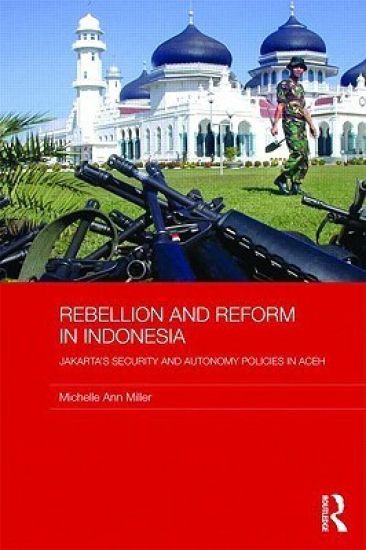
Rebellion and Reform in Indonesia

Rebellion and Reform in Indonesia

Michelle Ann Miller

Routledge
2008
sidottu
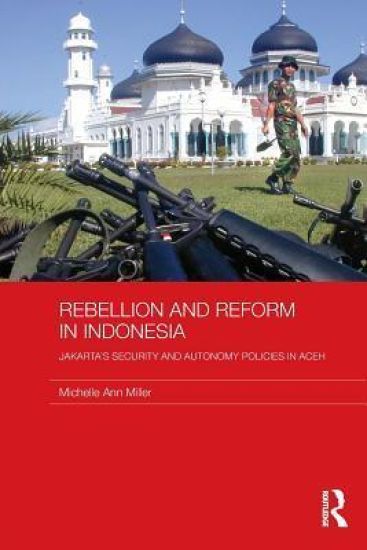
Armed separatist movements in Papua, East Timor and Aceh have been a serious problem for Indonesia's central government. This book examines the policies of successive Indonesian governments to contain secessionist forces, focusing in particular on Jakarta's response towards the armed separatist movement in Aceh. Unlike other studies of separatism in Indonesia, this book concentrates on the responses of the central government rather than looking only at the separatist forces. It shows how successive governments have tried a wide range of approaches including military repression, offers of autonomy, peace talks and a combination of these. It discusses the lessons that have been learned from these different approaches and analyzes the impact of the tsunami, including the successful accommodation of former rebels within an Indonesian devolved state structure and the expanding implementation of Islamic law.
The Politics of Regional Identity

The Politics of Regional Identity

Michelle Pace

Routledge
2007
nidottu
A keen analysis of the impact of European regionalism in the Mediterranean, focusing on the politics of representation and constructions of identity.The Mediterranean - as a region, as an area of EU policy and as a place on the fringe of a rapidly integrating Europe - has been a theoretically under-researched area. Containing empirical research on Greece, Malta and Morocco, this theory-led investigation into the political effects of the Mediterranean's symbolic geography, complements work done on the constitution of entities such as nations, Europe and the West. The Politics of Regional Identity draws on the field of critical IR and critical geopolitics to examine both the theoretical and empirical manifestations of these changing geopolitical images and discourses.This book will be of great interest to all students and scholars of politics, international relations and the European Union.
Saviour Siblings

Saviour Siblings

Michelle Taylor-Sands

Routledge
2013
sidottu
Genetic screening technologies involving pre-implantation genetic diagnosis (PGD) raise particular issues about selective reproduction and the welfare of the child to be born. How does selection impact on the identity of the child who is born? Are children who are selected for a particular purpose harmed or treated as commodities? How far should the state interfere with parents’ reproductive choices?Currently, concerns about the welfare of the child in selective reproduction have focused on the individual interests of the child to be born. This book re-evaluates the welfare of the child through the controversial topic of saviour sibling selection. Drawing on relational feminist and communitarian ethics, Michelle Taylor-Sands argues that the welfare of the child to be born is inextricably linked with the welfare of his/her family. The author proposes a relational model for selective reproduction based on a broad conception of the welfare of the child that includes both individual and collective family interests. By comparing regulation in the UK and Australia, the book maps out how law and policy might support a relational model for saviour sibling selection. With an interdisciplinary focus, Saviour Siblings: A Relational Approach to the Welfare of the Child in Selective Reproduction will be of particular interest to academics and students of bioethics and law as well as practitioners and policymakers concerned with the ethics of selective reproduction.
Postcolonial Pacific Writing

Postcolonial Pacific Writing

Michelle Keown

Routledge
2009
nidottu
This groundbreaking interdisciplinary study focuses on the representation of the body in the work of eight of Polynesia's most significant contemporary writers. Drawing on anthropology, psychoanalysis, philosophy, history and medicine, Postcolonial Pacific Writing develops an innovative postcolonial framework specific to the literatures and cultures of this region.
The Making of a European Constitution

The Making of a European Constitution

Michelle Everson; Julia Eisner

Routledge Cavendish
2009
nidottu
An original and innovative recasting of constitutionalism, written by acknowledged experts in the field, this empirically grounded and theoretically informed volume addresses the strategies and philosophies that judges and lawyers bring to bear when creating European constitutional jurisprudence; investigating and promoting promotes the sustainability of a theory or praxis of ‘procedural’ constitutionalism.Building upon European and American critical legal scholarship, Michelle Everson and Julia Eisner argue that constitutional adjudication has never been the neutral matter of a mere judicial ‘identification’ of the values, norms and procedures that each society seeks to concretise in its own body of constitutional law. Instead, a ‘mythology’ of comprehensive national constitutional settlement has obscured the primary legal constitutional conundrum that is created by the requirement that a judiciary must always adapt its constitutional jurisprudence to the evolving values that are to be found within any society; but must always, also, maintain the integrity and autonomy of the law itself.European judges and lawyers, having been denied recourse to all forms of constitutional mythology, provide us with an alternative model of constitutionalism; one that does not require a founding myth of constitutional settlement, and one which both secures the autonomy of law, as well as ensures dialogue between law and society. This occurs, however, not through grand theories of ‘constitutional adjudication’ but, as The Making of a European Constitution documents, rather through a practical process.
Rebellion and Reform in Indonesia

Rebellion and Reform in Indonesia

Michelle Ann Miller

Routledge
2010
nidottu
Armed separatist movements in Papua, East Timor and Aceh have been a serious problem for Indonesia's central government. This book examines the policies of successive Indonesian governments to contain secessionist forces, focusing in particular on Jakarta's response towards the armed separatist movement in Aceh. Unlike other studies of separatism in Indonesia, this book concentrates on the responses of the central government rather than looking only at the separatist forces. It shows how successive governments have tried a wide range of approaches including military repression, offers of autonomy, peace talks and a combination of these. It discusses the lessons that have been learned from these different approaches and analyzes the impact of the tsunami, including the successful accommodation of former rebels within an Indonesian devolved state structure and the expanding implementation of Islamic law.
Accommodating the Chinese

Accommodating the Chinese

Michelle Campbell Renshaw

Routledge
2013
nidottu
This in-depth comparative study demonstrates that the hospital established in China - its planning and architecture, financing, and all aspects of day-to-day operation - differed from its counterpart at home. These differences were never due to a single, or even dominant cause. They were a result of a complex process involving accommodation, appreciation, negotiation, opportunism and pragmatism.
Brown Gold

Brown Gold

Michelle Martin

Routledge
2012
nidottu
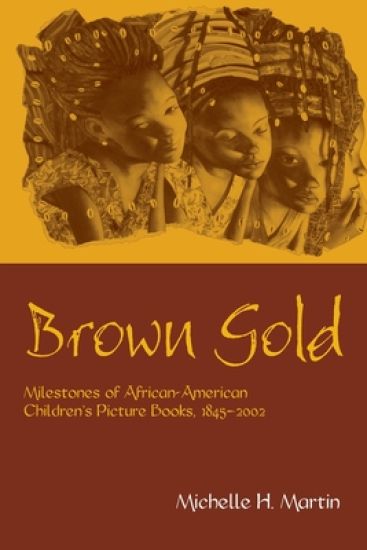
Brown Gold is a compelling history and analysis of African-American children's picturebooks from the mid-nineteenth century to the present. At the turn of the nineteenth century, good children's books about black life were hard to find — if, indeed, young black readers and their parents could even gain entry into the bookstores and libraries. But today, in the "Golden Age" of African-American children's picturebooks, one can find a wealth of titles ranging from Happy to be Nappy to Black is Brown is Tan. In this book, Michelle Martin explores how the genre has evolved from problematic early works such as Epaminondas that were rooted in minstrelsy and stereotype, through the civil rights movement, and onward to contemporary celebrations of blackness. She demonstrates the cultural importance of contemporary favorites through keen historical analysis — scrutinizing the longevity and proliferation of the Coontown series and Ten Little Niggers books, for example — that makes clear how few picturebooks existed in which black children could see themselves and their people positively represented even up until the 1960s. Martin also explores how children's authors and illustrators have addressed major issues in black life and history including racism, the civil rights movement, black feminism, major historical figures, religion, and slavery. Brown Gold adds new depth to the reader's understanding of African-American literature and culture, and illuminates how the round, dynamic characters in these children's novels, novellas, and picturebooks can put a face on the past, a face with which many contemporary readers can identify.
Counselors Working in Family Courts

Counselors Working in Family Courts

Michelle Mitcham

Routledge
2023
sidottu
Conflict Resolution, or Alternative Dispute Resolution, has the potential to be a rich and lucrative niche for counselors who work with families. Michelle Mitcham, a counselor educator with more than 10 years of experience in this unique field, explains the very specific and various roles that professional counselors may take on if they are interested in working in the court system or with clients involved in family forensic matters, especially high-conflict divorce or other high-litigation cases. Each chapter in her book highlights specialized roles counselors may perform for the court as a way to diversify their private practice and create a niche for themselves. The scope of each chapter includes how the counselor works with the parents, the children, and if necessary the lawyers, judges, and courts. The book illuminates how a counselor navigates through the family court system, differentiating the process with each role. Take-away points at the end of each chapter highlight the challenges and opportunities for working under each hat.
Counselors Working in Family Courts

Counselors Working in Family Courts

Michelle Mitcham

Routledge
2023
nidottu
Conflict Resolution, or Alternative Dispute Resolution, has the potential to be a rich and lucrative niche for counselors who work with families. Michelle Mitcham, a counselor educator with more than 10 years of experience in this unique field, explains the very specific and various roles that professional counselors may take on if they are interested in working in the court system or with clients involved in family forensic matters, especially high-conflict divorce or other high-litigation cases. Each chapter in her book highlights specialized roles counselors may perform for the court as a way to diversify their private practice and create a niche for themselves. The scope of each chapter includes how the counselor works with the parents, the children, and if necessary the lawyers, judges, and courts. The book illuminates how a counselor navigates through the family court system, differentiating the process with each role. Take-away points at the end of each chapter highlight the challenges and opportunities for working under each hat.
An Introduction to Nineteenth-Century Art
Using the tools of the "new" art history (feminism, Marxism, social context, etc.) An Introduction to Nineteenth-Century Art offers a richly textured, yet clear and logical, introduction to nineteenth-century art and culture. This textbook will provide readers with a basic historical framework of the period and the critical tools for interpreting and situating new and unfamiliar works of art.Michelle Facos goes beyond existing histories of nineteenth-century art, which often focus solely on France, Britain, and the United States, to incorporate artists and artworks from Scandinavia, Germany, and Eastern Europe.The book expertly balances its coverage of trends and individual artworks: where the salient trends are clear, trend-setting works are highlighted, and the complexity of the period is respected by situating all works in their proper social and historical context. In this way, the student reader achieves a more nuanced understanding of the way in which the story of nineteenth-century art is the story of the ways in which artists and society grappled with the problem of modernity.Key pedagogical features include: Data boxes provide statistics, timelines, charts, and historical information about the period to further situate artworks. Text boxes highlight extracts from original sources, citing the ideas of artists and their contemporaries, including historians, philosophers, critics, and theorists, to place artists and works in the broader context of aesthetic, cultural, intellectual, social, and political conditions in which artists were working. Beautifully illustrated with over 250 color images. Margin notes and glossary definitions. Online resources at www.routledge.com/textbooks/facos with access to a wealth of information, including original documents pertaining to artworks discussed in the textbook, contemporary criticism, timelines and maps to enrich your understanding of the period and allow for further comparison and exploration.Chapters take a thematic approach combined within an overarching chronology and more detailed discussions of individual works are always put in the context of the broader social picture, thus providing students with a sense of art history as a controversial and alive arena of study.Michelle Facos teaches art history at Indiana University, Bloomington. Her research explores the changing relationship between artists and society since the Enlightenment and issues of identity. Prior publications include Nationalism and the Nordic Imagination: Swedish Painting of the 1890s (1998), Art, Culture and National Identity in Fin-de-Siècle Europe, co-edited with Sharon Hirsh (2003), and Symbolist Art in Context (2009).
An Introduction to Nineteenth-Century Art
Using the tools of the "new" art history (feminism, Marxism, social context, etc.) An Introduction to Nineteenth-Century Art offers a richly textured, yet clear and logical, introduction to nineteenth-century art and culture. This textbook will provide readers with a basic historical framework of the period and the critical tools for interpreting and situating new and unfamiliar works of art.Michelle Facos goes beyond existing histories of nineteenth-century art, which often focus solely on France, Britain, and the United States, to incorporate artists and artworks from Scandinavia, Germany, and Eastern Europe.The book expertly balances its coverage of trends and individual artworks: where the salient trends are clear, trend-setting works are highlighted, and the complexity of the period is respected by situating all works in their proper social and historical context. In this way, the student reader achieves a more nuanced understanding of the way in which the story of nineteenth-century art is the story of the ways in which artists and society grappled with the problem of modernity.Key pedagogical features include: Data boxes provide statistics, timelines, charts, and historical information about the period to further situate artworks. Text boxes highlight extracts from original sources, citing the ideas of artists and their contemporaries, including historians, philosophers, critics, and theorists, to place artists and works in the broader context of aesthetic, cultural, intellectual, social, and political conditions in which artists were working. Beautifully illustrated with over 250 color images. Margin notes and glossary definitions. Online resources at www.routledge.com/textbooks/facos with access to a wealth of information, including original documents pertaining to artworks discussed in the textbook, contemporary criticism, timelines and maps to enrich your understanding of the period and allow for further comparison and exploration.Chapters take a thematic approach combined within an overarching chronology and more detailed discussions of individual works are always put in the context of the broader social picture, thus providing students with a sense of art history as a controversial and alive arena of study.Michelle Facos teaches art history at Indiana University, Bloomington. Her research explores the changing relationship between artists and society since the Enlightenment and issues of identity. Prior publications include Nationalism and the Nordic Imagination: Swedish Painting of the 1890s (1998), Art, Culture and National Identity in Fin-de-Siècle Europe, co-edited with Sharon Hirsh (2003), and Symbolist Art in Context (2009).
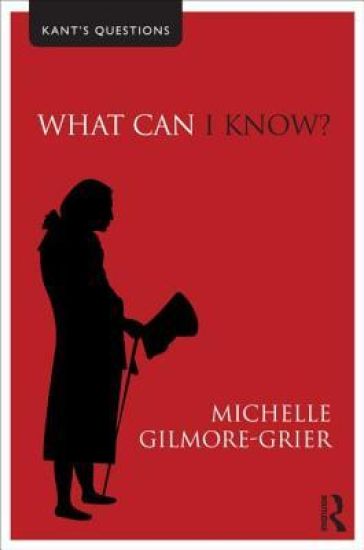
What Can I Know?

What Can I Know?

Michelle Gilmore-Grier

Routledge
2024
sidottu
What can I Know? introduces and assesses what many consider to be the most important of all Kant’s great questions, set out in his Critique of Pure Reason, and one of the most important in philosophy itself: what are the bounds of knowledge? Michelle Grier begins with a helpful survey of the question prior to Kant, in particular the arguments of the rationalists Descartes, Spinoza and Leibniz and the empiricists, above all Hume. She describes, in a clear and engaging style, how Kant attempted to find a middle path between the two and what led to the famous "Copernican turn" in his philosophy. She explains the fundamental theories at the heart of Kant’s epistemology: the distinction between appearances and ‘things in themselves’; the transcendental unity of apperception; and Kant’s arguments concerning space and time.In the second part of the book, Grier introduces the main criticisms of Kant’s philosophy, including those of Hegel and Nietzsche. The final part situates Kant’s epistemology in the context of contemporary philosophical debates including those in cognitive science. These include a priori knowledge, correspondence versus coherentist theories of knowledge, ‘naturalized’ epistemology and perception. Including helpful chapter summaries and guides to further reading, What Can I Know? Is an outstanding introduction to Kant's epistemology and the legacy of Kant's question itself.
What Can I Know?

What Can I Know?

Michelle Gilmore-Grier

Routledge
2024
nidottu
What can I Know? introduces and assesses what many consider to be the most important of all Kant’s great questions, set out in his Critique of Pure Reason, and one of the most important in philosophy itself: what are the bounds of knowledge? Michelle Grier begins with a helpful survey of the question prior to Kant, in particular the arguments of the rationalists Descartes, Spinoza and Leibniz and the empiricists, above all Hume. She describes, in a clear and engaging style, how Kant attempted to find a middle path between the two and what led to the famous "Copernican turn" in his philosophy. She explains the fundamental theories at the heart of Kant’s epistemology: the distinction between appearances and ‘things in themselves’; the transcendental unity of apperception; and Kant’s arguments concerning space and time.In the second part of the book, Grier introduces the main criticisms of Kant’s philosophy, including those of Hegel and Nietzsche. The final part situates Kant’s epistemology in the context of contemporary philosophical debates including those in cognitive science. These include a priori knowledge, correspondence versus coherentist theories of knowledge, ‘naturalized’ epistemology and perception. Including helpful chapter summaries and guides to further reading, What Can I Know? Is an outstanding introduction to Kant's epistemology and the legacy of Kant's question itself.