Kirjojen hintavertailu. Mukana 11 627 484 kirjaa ja 12 kauppaa.

Kirjahaku

Etsi kirjoja tekijän nimen, kirjan nimen tai ISBN:n perusteella.

1000 tulosta hakusanalla Patrizia Zimmermann

Making Words Third Grade

Making Words Third Grade

Patricia Cunningham; Dorothy Hall

Pearson
2008
nidottu
An active and innovative approach to making words that teachers and their students have grown to love is finally here! Based on its highly successful parent text, Phonics They Use, this new grade-level series Making Words offers teachers a fresh multi-level activity and lesson series written for the kindergarten through fifth grade classroom. Pat Cunningham and Dottie Hall present classroom teachers with effective tools for strengthening phonics and spelling skills that encourage students to move beyond learning and into a world of word discovery. Each research-based volume includes a wealth of friendly, hands-on, manipulative activities that guide teachers in teaching the development of words--from phonemic awareness to spelling. In Making Words Third Grade, Pat and Dottie introduce third grade teachers to 70 lessons that teach the homophones, spelling changes, prefixes and suffixes that most third grade curriculums cover. Each Making Words activity contains rhyming words which help children review the more complex vowel patterns. Including homophones, prefixes, suffixes, spelling changes, and complex rhyming patterns allowing third graders at all levels to make progress in their spelling and decoding ability. Making Words Third Grade is the best resource you can have on hand for motivating your students to learn words! Features 70 fun and interactive lessons for building rhyming and decoding skills. Presents a concise method for involving students in the process of identifying homophones, prefixes, and suffixes and how these change the meanings of words in sentences. Promotes student awareness of similarities in words that helps develop writing skills. Includes reproducible letter tiles, record sheets for each lesson, and take-home sheets to copy, cut, and/or laminate. Highlights a list of useful children's books to extend the Making Words lesson.
Making Words Second Grade

Making Words Second Grade

Patricia Cunningham; Dorothy Hall

Pearson
2008
nidottu
An active and innovative approach to making words that teachers and their students have grown to love is finally here! Based on its highly successful parent text, Phonics They Use, this new grade-level series Making Words offers teachers a fresh multi-level activity and lesson series written for the kindergarten through fifth grade classroom. Pat Cunningham and Dottie Hall present classroom teachers with effective tools for strengthening phonics and spelling skills that encourage students to move beyond learning and into a world of word discovery. Each research-based volume includes a wealth of friendly, hands-on, manipulative activities that guide teachers in teaching the development of words--from phonemic awareness to spelling. In Making Words Second Grade, Pat and Dottie introduce second grade teachers to 100 lessons that teach all the phonics, spelling, and phonemic awareness skills included in most second grade curricula. Each Making Words activity leads children through a systematic and sequential phonics curriculum. All lessons include practice with the phonemic awareness skills of segmenting and blending as children stretch out words they are making and blend the letters to make new words. Because teaching children letter-sound relationships is easier than teaching children to actually use these letter-sound relationships, all lessons include a transfer step in which children apply the sounds they are learning to spelling new words. Making Words Second Grade is the best resource you can have on hand for motivating your students to learn words! Features 100 fun and interactive lessons for building phonemic awareness, phonics, and spelling skills. Presents a concise method for involving students in the process of identifying phonological units and patterns within words. Promotes student awareness of similarities in words that helps develop writing skills. Includes reproducible letter tiles, record sheets for each lesson, and take-home sheets to copy, cut, and/or laminate. Highlights a list of useful children's books to extend the Making Words lesson.
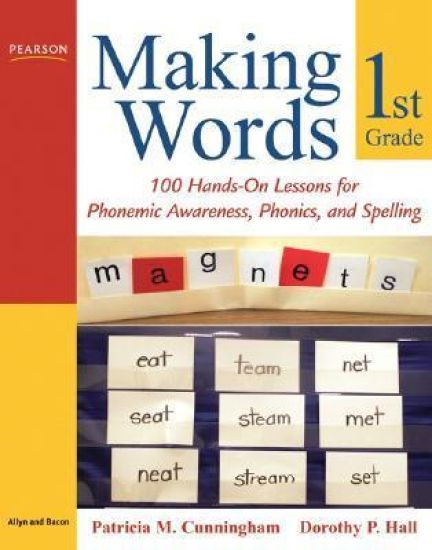
Making Words First Grade

Making Words First Grade

Patricia Cunningham; Dorothy Hall

Pearson
2008
nidottu
An active and innovative approach to making words that teachers and their students have grown to love is finally here! Based on its highly successful parent text, Phonics They Use, this new grade-level series Making Words offers teachers a fresh multi-level activity and lesson series written for the kindergarten through fifth grade classroom. Pat Cunningham and Dottie Hall present classroom teachers with effective tools for strengthening phonics and spelling skills that encourage students to move beyond learning and into a world of word discovery. Each research-based volume includes a wealth of friendly, hands-on, manipulative activities that guide teachers in teaching the development of words--from phonemic awareness to spelling. In Making Words First Grade, Pat and Dottie introduce first grade teachersto100 lessons that teach all the phonics, spelling, and phonemic awareness skills included in most first grade curriculums. Each Making Words activity leads children through a systematic and sequential phonics curriculum. All lessons include practice with the phonemic awareness skills of segmenting and blending as children stretch out words they are making and blend the letters to make new words. Because teaching children letter-sound relationships is easier than teaching children to actually use these letter-sound relationships, all lessons include a transfer step in which children apply the sounds they are learning to spelling new words. Making Words First Grade is the best resource you can have on hand for motivating your students to learn words! Features 100 fun and interactive lessons for building phonemic awareness, phonics, and spelling skills. Presents a concise method for involving students in the process of identifying phonological units and patterns within words. Promotes student awareness of similarities in words that helps develop writing skills. Includes reproducible letter tiles, record sheets for each lesson, and take-home sheets to copy, cut, and/or laminate. Highlights a list of useful children's books to extend the Making Words lesson.
Strategies in Teaching Anthropology

Strategies in Teaching Anthropology

Patricia C. Rice; David W. McCurdy

Pearson College Div
2010
pokkari
Unique in focus and content, Strategies In Teaching Anthropology focuses on the “how” of teaching anthropology across all the major sub-fields--Cultural, Biological, Archaeology, and Linguistics--and their two dimensions: research and applied studies. This text provides a wide array of associated learning outcomes and student activities. In addition, it is a valuable single-source compendium of strategies and teaching “tricks of the trade” from a group of seasoned teaching anthropologists—-working in a variety of teaching settings-—who share their pedagogical techniques, knowledge, and observations. Focused on the applied, “how to do it” side of teaching, this text is designed to fill the gap between students who are taking an anthropology class for the first time, and instructors who know their subject matter in depth. It helps professors who are not sure how to present anthropological subject matter and processes to their students in a way that will capture and relay their own excitement with the subject.
The Flash Press

The Flash Press

Patricia Cline Cohen; Timothy J. Gilfoyle; Helen Lefkowitz Horowitz

University of Chicago Press
2008
nidottu
Obscene, libidinous, loathsome, lascivious. Those were just some of the ways critics described the nineteenth-century weeklies that covered and publicized New York City's extensive sexual underworld. Publications like the "Flash" and the "Whip" - distinguished by a captivating brew of lowbrow humor and titillating gossip about prostitutes, theater denizens, and sporting events - were not the sort generally bound in leather for future reference, and despite their popularity with an enthusiastic readership, they quickly receded into almost complete obscurity. Recently, though, two sizable collections of these papers have resurfaced, and in "The Flash Press" three renowned scholars provide a landmark study of their significance, as well as a wide selection of their ribald articles and illustrations.Including short tales of urban life, editorials on prostitution, and moralizing rants against homosexuality, these selections epitomize a distinct form of urban journalism. Here, in addition to providing a thorough overview of this colorful reportage, its editors, and its audience, the authors examine nineteenth-century ideas of sexuality and freedom that mixed Tom Paine's republicanism with elements of the Marquis de Sade's sexual ideology. They also trace the evolution of censorship and obscenity law, showing how a string of legal battles ultimately led to the demise of the flash papers: editors were hauled into court, sentenced to jail for criminal obscenity and libel, and eventually pushed out of business - but not before they forever changed the debate over public sexuality and freedom of expression in America's most important city.
Presidential Mandates

Presidential Mandates

Patricia Heidotting Conley

University of Chicago Press
2001
nidottu
Presidents have claimed popular mandates for more than 150 years. How can they make such claims when surveys show that voters are uninformed about the issues? In this volume, the author argues that mandates are not mere statements of fact about the preferences of voters. By examining election outcomes from the viewpoints of the politicians, Conley uncovers the inferences and strategies that translate those outcomes into the national policy agenda.
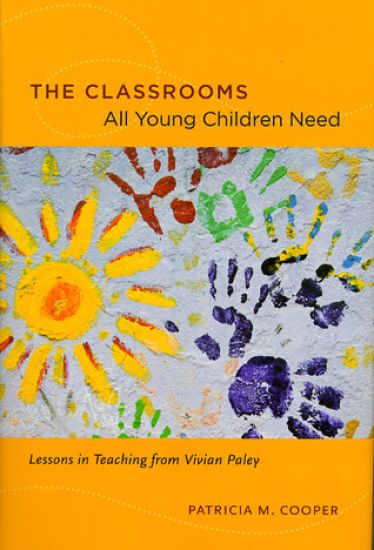
The Classrooms All Young Children Need

The Classrooms All Young Children Need

Patricia M. Cooper

University of Chicago Press
2009
sidottu
Teacher and author Vivian Paley is highly regarded by parents, educators, and other professionals for her original insights into such seemingly everyday issues as play, story, gender, and how young children think. In "The Classrooms All Young Children Need", Patricia M. Cooper takes a synoptic view of Paley's many books and articles, charting the evolution of Paley's thinking while revealing the seminal characteristics of her teaching philosophy. This careful analysis leads Cooper to identify a pedagogical model organized around two complementary principles: a curriculum that promotes play and imagination, and the idea of classrooms as fair places where young children of every color, ability, and disposition are welcome. With timely attention paid to debates about the reduction in time for play in the early childhood classroom, the role of race in education, and No Child Left Behind, "The Classrooms All Young Children Need" will be embraced by anyone tasked with teaching our youngest pupils.
The Classrooms All Young Children Need

The Classrooms All Young Children Need

Patricia M. Cooper

University of Chicago Press
2011
nidottu
Teacher and author Vivian Paley is highly regarded by parents, educators, and other professionals for her original insights into such seemingly everyday issues as play, story, gender, and how young children think. In "The Classrooms All Young Children Need", Patricia M. Cooper takes a synoptic view of Paley's many books and articles, charting the evolution of Paley's thinking while revealing the seminal characteristics of her teaching philosophy. This careful analysis leads Cooper to identify a pedagogical model organized around two complementary principles: a curriculum that promotes play and imagination, and the idea of classrooms as fair places where young children of every color, ability, and disposition are welcome. With timely attention paid to debates about the reduction in time for play in the early childhood classroom, the role of race in education, and No Child Left Behind, "The Classrooms All Young Children Need" will be embraced by anyone tasked with teaching our youngest pupils.
The Common Place of Law

The Common Place of Law

Patricia Ewick; Susan S. Silbey

University of Chicago Press
1998
nidottu
This study explores the different ways people view the law. It identifies three common narratives: one is based on the idea of the law as magisterial and remote; another views the law as a game with rules that can be manipulated to one's advantage; and a third narrative describes the law as an arbitrary power to be actively resisted. Drawing on more than 400 extensive case studies, the text presents individual experiences interwoven with an analysis that charts a coherent theory of legality. It depicts the institution as it is lived: strange and familiar, imperfect and ordinary, and at the centre of daily life.
Cultural Aesthetics

Cultural Aesthetics

Patricia Fumerton

University of Chicago Press
1993
nidottu
A brilliant postmodern critique of Renaissance subjectivity, Cultural Aesthetics explores the simultaneous formation and fragmentation of aristocratic "selfhood" in the late sixteenth and early seventeenth centuries. Patricia Fumerton situates the self within its sumptuous array of "trivial" arts—including the court literatures of chivalric romance, sonnet, and masque and the arts of architecture, miniature painting, stage design, and cuisine. Her integration of historicist and aesthetic perspectives makes this a provocative contribution to the vigorous field of Renaissance cultural studies.
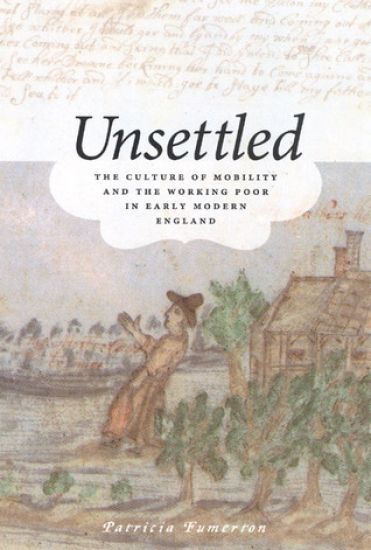
Unsettled

Unsettled

Patricia Fumerton

University of Chicago Press
2005
sidottu
Poor migrants made up a growing class of workers in late sixteenth- and seventeenth-century England. By 1650, half of England's rural population consisted of homeless and itinerant laborers. "Unsettled" is an ambitious attempt to reconstruct the everyday lives of these dispossessed people. Patricia Fumerton offers a portrait of unsettledness in early modern England that includes the homeless and housed alike. Fumerton begins by building on recent studies of vagrancy, poverty, and servants, placing all in the light of a new domestic economy of mobility. She then looks at representations of the vagrant in a variety of pamphlets and literary works of the period. Since seamen were a particularly large and prominent class of mobile wage-laborers in the seventeenth century, Fumerton turns to seamen generally and to an individual poor seaman as a case study of the unsettled subject: Edward Barlow (b. 1642) provides a rare opportunity to see how the laboring poor fashioned themselves because he authored a journal of over 225,000 words and 147 pages of drawings. Barlow's journal, studied extensively here for the first time, vividly charts what he himself termed his "unsettled mind" and the perpetual anxieties of England's working and wayfaring poor.
Unsettled

Unsettled

Patricia Fumerton

University of Chicago Press
2005
nidottu
Poor migrants made up a growing class of workers in late sixteenth- and seventeenth-century England. By 1650, half of England's rural population consisted of homeless and itinerant laborers. "Unsettled" is an ambitious attempt to reconstruct the everyday lives of these dispossessed people. Patricia Fumerton offers a portrait of unsettledness in early modern England that includes the homeless and housed alike. Fumerton begins by building on recent studies of vagrancy, poverty, and servants, placing all in the light of a new domestic economy of mobility. She then looks at representations of the vagrant in a variety of pamphlets and literary works of the period. Since seamen were a particularly large and prominent class of mobile wage-laborers in the seventeenth century, Fumerton turns to seamen generally and to an individual poor seaman as a case study of the unsettled subject: Edward Barlow (b. 1642) provides a rare opportunity to see how the laboring poor fashioned themselves because he authored a journal of over 225,000 words and 147 pages of drawings. Barlow's journal, studied extensively here for the first time, vividly charts what he himself termed his "unsettled mind" and the perpetual anxieties of England's working and wayfaring poor.
Reclaiming Fair Use

Reclaiming Fair Use

Patricia Aufderheide; Peter Jaszi

University of Chicago Press
2018
pokkari
In the increasingly complex and combative arena of copyright in the digital age, record companies sue college students over peer-to-peer music sharing, YouTube removes home movies because of a song playing in the background, and filmmakers are denied a distribution deal when a permissions "I" proves undottable. Analyzing the dampening effect that copyright law can have on scholarship and creativity, Patricia Aufderheide and Peter Jaszi urge us to embrace in response a principle embedded in copyright law itself--fair use. Originally published in 2011, Reclaiming Fair Use challenged the widely held notion that copyright law is obsolete in an age of digital technologies. Beginning with a survey of the contemporary landscape of copyright law, Aufderheide and Jaszi drew on their years of experience advising documentary filmmakers, English teachers, performing arts scholars, and other creative professionals to lay out in detail how the principles of fair use can be employed to avoid copyright violation. Taking stock of the vibrant remix culture that has only burgeoned since the book's original publication, this new edition addresses the expanded reach of fair use--tracking the Twitter hashtag #WTFU (where's the fair use?), the maturing of the transformativeness measure in legal disputes, the ongoing fight against automatic detection software, and the progress and delays of digitization initiatives around the country. Full of no-nonsense advice and practical examples, Reclaiming Fair Use remains essential reading for anyone interested in law, creativity, and the ever-broadening realm of new media.
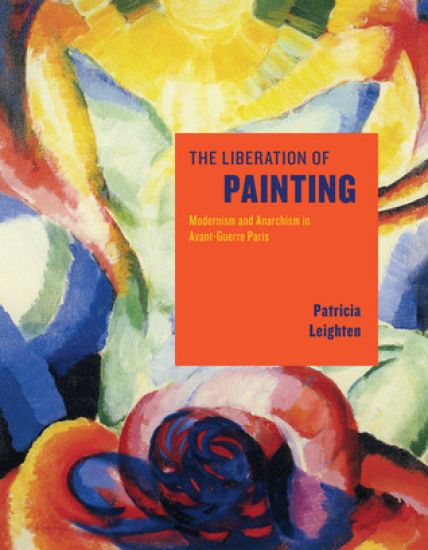
The Liberation of Painting

The Liberation of Painting

Patricia Leighten

University of Chicago Press
2013
sidottu
The years before World War I were a time of profound social and political ferment in Europe that deeply affected the art world. The center of this creative tumult was Paris, where many avant-garde artists sought to transform modern art through their engagement with radical politics. In this lively look at art and anarchism in prewar France, Patricia Leighten argues that anarchist aesthetics and a related politics of form played crucial roles in the development of modern art, only to be suppressed soon after the war and then forgotten. Leighten examines the circle of artists - Pablo Picasso, Juan Gris, Frantisek Kupka, Maurice de Vlaminck, Kees van Dongen, and others - who thought anarchist politics drove the idea of avant-garde art, exploring how their aesthetic choices negotiated the myriad artistic languages operating in the decade before World War I. Whether working on political cartoons or avant-garde abstractions, these artists, she shows, were preoccupied with social criticism. Each sought an appropriate subject, medium, style, and audience based on different conceptions of how art influences society - and their choices constantly shifted as they responded to the dilemmas posed by contradictory anarchist ideas. Packed with illustrations, "The Liberation of Painting" restores revolutionary activism to the broader history of modern art.
Beyond Betrayal

Beyond Betrayal

Patricia Ewick; Marc W. Steinberg

University of Chicago Press
2019
sidottu
In 2002, the national spotlight fell on Boston’s archdiocese, where decades of rampant sexual misconduct from priests—and the church’s systematic cover-ups—were exposed by reporters from the Boston Globe. The sordid and tragic stories of abuse and secrecy led many to leave the church outright and others to rekindle their faith and deny any suggestions of institutional wrongdoing. But a number of Catholics vowed to find a middle ground between these two extremes: keeping their faith while simultaneously working to change the church for the better.Beyond Betrayal charts a nationwide identity shift through the story of one chapter of Voice of the Faithful (VOTF), an organization founded in the scandal’s aftermath. VOTF had three goals: helping survivors of abuse; supporting priests who were either innocent or took risky public stands against the wrongdoers; and pursuing a broad set of structural changes in the church. Patricia Ewick and Marc W. Steinberg follow two years in the life of one of the longest-lived and most active chapters of VOTF, whose thwarted early efforts at ecclesiastical reform led them to realize that before they could change the Catholic Church, they had to change themselves. The shaping of their collective identity is at the heart of Beyond Betrayal, an ethnographic portrait of how one group reimagined their place within an institutional order and forged new ideas of faith in the wake of widespread distrust.
Beyond Betrayal

Beyond Betrayal

Patricia Ewick; Marc W. Steinberg

University of Chicago Press
2019
nidottu
In 2002, the national spotlight fell on Boston’s archdiocese, where decades of rampant sexual misconduct from priests—and the church’s systematic cover-ups—were exposed by reporters from the Boston Globe. The sordid and tragic stories of abuse and secrecy led many to leave the church outright and others to rekindle their faith and deny any suggestions of institutional wrongdoing. But a number of Catholics vowed to find a middle ground between these two extremes: keeping their faith while simultaneously working to change the church for the better.Beyond Betrayal charts a nationwide identity shift through the story of one chapter of Voice of the Faithful (VOTF), an organization founded in the scandal’s aftermath. VOTF had three goals: helping survivors of abuse; supporting priests who were either innocent or took risky public stands against the wrongdoers; and pursuing a broad set of structural changes in the church. Patricia Ewick and Marc W. Steinberg follow two years in the life of one of the longest-lived and most active chapters of VOTF, whose thwarted early efforts at ecclesiastical reform led them to realize that before they could change the Catholic Church, they had to change themselves. The shaping of their collective identity is at the heart of Beyond Betrayal, an ethnographic portrait of how one group reimagined their place within an institutional order and forged new ideas of faith in the wake of widespread distrust.
Shakespeare from the Margins

Shakespeare from the Margins

Patricia Parker

University of Chicago Press
1996
nidottu
In the interpretation of Shakespeare, wordplay has often been considered inconsequential, frequently reduced to a decorative "quibble." But in this book, Patricia Parker argues that attention to Shakespearean wordplay reveals unexpected linkages, not only within and between plays but also between the plays and their contemporary culture. Combining feminist and historical approaches with attention to the "matter" of language as well as of race and gender, Parker's "edification from the margins" illuminates much that has been overlooked, both in Shakespeare and in early modern culture. This book, a re-examination of popular and less familiar texts, is intended for all students of Shakespeare and the early modern period. Patricia Parker is the author of "Inescapable Romance and Literary Fat Ladies: Rhetoric, Gender, Property".
Desire and Truth

Desire and Truth

Patricia Meyer Spacks

University of Chicago Press
1990
sidottu
Desire and Truth offers a major reassessment of the history of eighteenth-century fiction by showing how plot challenges or reinforces conventional categories of passion and rationality. Arguing that fiction creates and conveys its essential truths through plot, Patricia Meyer Spacks demonstrates that eighteenth-century fiction is both profoundly realistic and consistently daring.
Boredom

Boredom

Patricia Meyer Spacks

University of Chicago Press
1995
sidottu
This work offers an explanation of why boredom both haunts and motivates the literary imagination. Moving from Samuel Johnson to Donald Barthelme, from Jane Austen to Anita Brookner, Spacks shows us at last how we arrived in a postmodern world where boredom is the all-encompassing name we give our discontent. Her book aims to provide new insight into the cultural usefulness - and deep interest - of boredom as a state of mind.
Boredom

Boredom

Patricia Meyer Spacks

University of Chicago Press
1996
nidottu
This text offers an explanation of why boredom both haunts and motivates the literary imagination. Moving from Samuel Johnson and Jane Austen to Donald Barthelme and Anita Brookner, the author shows us how we arrived in a postmodern world where boredom is the all-encompassing name we give our discontent.