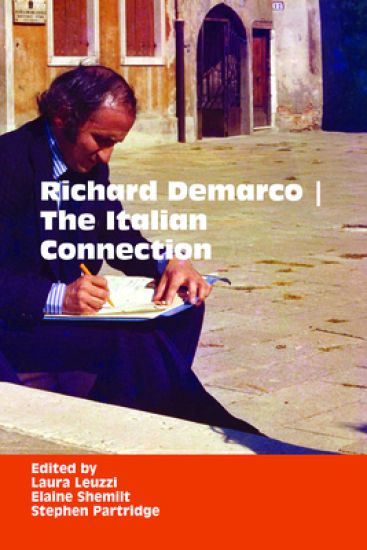
Since the 1960s Richard Demarco has had a pivotal role in the production and promotion of the visual and performing arts in Scotland. The Italo-Scottish artist, cultural entrepreneur and educator has organised and fostered cultural exchanges and collaborations throughout Europe and has been a champion of European culture and the avant-garde in Scotland. Although some research and publications have been devoted to Demarco's endeavours, little is known of the numerous cultural exchanges and collaborations between Italy and Scotland that he initiated and developed in the past fifty years. This gap in the historical canon of knowledge is extraordinary because in the Demarco's archives - a portion of which is at the Scottish National Gallery of Modern Art (SNGMA, (representing activities from 1963 to 1995) and a portion at the Demarco European Art Foundation, Edinburgh - are many traces of exchanges between Italy and Scotland promoted by Demarco as part of his larger European network and contribution to the Edinburgh Festival. These documents include photographs, ephemera, notes, catalogues and artworks that feature events involving relevant Italian or Italian-based artists, producers, performers, directors, critics including: Palma Bucarelli, the Count Panza di Biumo, Giulio Paolini, Jannis Kounellis, Bruno Ceccobelli, Toti Scialoja, Carlo Quartucci and Carla Tatò, Mimmo Rotella, Mario Merz, Fabrizio Plessi, Achille Bonito Oliva, Maria Gloria Conti Bicocchi, Giuseppe Chiari, Guido Sartorelli. This publication is the main outcome of the eponymous research project, Richard Demarco The Italian Connection and uncovers and retraces many stories and reassesses how Demarco promoted Italian visual and performing arts in Scotland and Scottish art in the Italian cultural context.
Richard Mishaan is renowned for his masterly integration of textiles, palettes rich in complementary shades, natural materials forged by artisans, surfaces bedecked with talismanic curios, a strategic sense of when and where to place a mirror, and a deep knowledge of both the fine and decorative arts. His many influences, including his upbringing in Colombia, coupled with his idiosyncratic perspective, explain why his sophisticated clientele return repeatedly as their lives evolve. In Richard Mishaan Design, his working methods are revealed in projects as varied as the conversion of a 400 year old barn in the Hamptons into a warm, inviting family home and the transformation of an ultra modern, glass walled New York City apartment into a comfortable yet sophisticated aerie. Here, too, are show houses, which he uses as experimental laboratories, working out such diverse design ideas as updating legendary designer Renzo Mongiardino’s aesthetic and achieving a chic look on a tight budget. He has also designed rooms in bespoke hotels, ranging from the Rat Pack–influenced Shelborne in Miami to the Tcherassi, a renovated 250 year old mansion in Cartagena, Colombia. With its exceptional variety and wealth of eclectic, inventive ideas, Richard Mishaan Design provides an endless fount of inspiration.
Richard M. Weaver (1910-1963) was one of the leading figures in the post-World War II development of an intellectual, self-conscious conservatism. His thought and his appreciation of liberty were rooted in his understanding of Southern history. He believed that Southern values of religion, work ethic, and family could provide a defense against the totalitarian nihilism of fascist and communist statism. This collection of fourteen essays demonstrates George Core's point that "few writers of the South rival Richard Weaver in comprehensiveness of vision and depth of thought."
Shakespeare’s history play reimagined by Naomi Iizuka. Following the events of the final two years of his life, Richard II interrogates royal power and the forces that threaten it. After banishing his cousin Henry Bolingbroke, Richard begins to lose grip of his throne and strives to find meaning in the churn and chaos of the events unfolding around him. In her new translation, Naomi Iizuka ventures into the mystery of the work, scraping away the layers of received wisdom and cracking the play open for contemporary audiences. This translation of Richard II was written as part of the Oregon Shakespeare Festival’s Play On! project, which commissioned new translations of thirty-nine Shakespeare plays. These translations present work from “The Bard” in language accessible to modern audiences while never losing the beauty of Shakespeare’s verse. Enlisting the talents of a diverse group of contemporary playwrights, screenwriters, and dramaturges from diverse backgrounds, this project reenvisions Shakespeare for the twenty-first century. These volumes make these works available for the first time in print—a new First Folio for a new era.
Playwright Migdalia Cruz breathes new life into Richard III. Nuyorican playwright Migdalia Cruz unpacks and repositions Shakespeare’s Richard III for a twenty-first-century audience. She presents a contemporary English verse translation, faithfully keeping the poetry, the puns, and the politics of the play intact, with a rigorous and in-depth examination of Richard III—the man, the king, the outsider—who is still the only English king to have died in battle. In the Wars of the Roses, his Catholic belief in his country led to his slaughter at Bosworth’s Field by his Protestant rivals. In reimagining this text, Cruz emphasizes Richard III’s outsider status—exacerbated by his severe scoliosis, which twisted his spine—by punctuating the text with punk music from 1970s London. Cruz’s Richard is no one’s fool or lackey. He is a new kind of monarch, whose dark sense of humor and deep sense of purpose leads his charge against the society which never fully accepted him because he looked different. This translation was written as part of the Oregon Shakespeare Festival’s Play On! project, which commissioned new translations of thirty-nine Shakespeare plays. These translations present the work of "The Bard" in language accessible to modern audiences while never losing the beauty of Shakespeare’s verse. These volumes make these works available for the first time in print—a new First Folio for a new era.
Richard Benson, former dean of the Yale School of Art and a MacArthur Foundation Fellow, has been a photographer for more than four decades, but until now his art often took a back seat to his prodigious achievements as a printer and a teacher. This volume presents one hundred photographs by Benson, highlighting the unique properties of his prints and exemplifying his fresh techniques for reproducing them for publication. From direct digital capture through inkjet output, his renowned technical wizardry has yielded unusually vibrant and beguiling colour prints that are at once ultra vivid and utterly natural, like our everyday visual experience. Their uncanny lushness and clarity give voice to Benson's generous, inquisitive eye. An essay by Peter Galassi, Chief Curator of Photography at MoMA, surveys the work, and a text by Benson explains how it was made.