

Kirjahaku
Etsi kirjoja tekijän nimen, kirjan nimen tai ISBN:n perusteella.
1000 tulosta hakusanalla Simone Aliya

Storia D'Una Fanciulla Tradita Da Un Suo Amante
Simone Serdini Forestani
Hutson Street Press
2025
sidottu

Storia D'Una Fanciulla Tradita Da Un Suo Amante
Simone Serdini Forestani
Hutson Street Press
2025
pokkari


Globus Caelestis Cufico-arabicus Veliterni Musei Borgiani
Simone Assemani; Giuseppe Toaldo
Hutson Street Press
2025
sidottu

Globus Caelestis Cufico-arabicus Veliterni Musei Borgiani
Simone Assemani; Giuseppe Toaldo
Hutson Street Press
2025
pokkari
![Simon Portius, Grammatica LinguÃ] GrÃ]cÃ] Vulgaris...](/covers/9781024875997.jpg)
Simon Portius, Grammatica LinguÃ] GrÃ]cÃ] Vulgaris...
Simone Porzio
Hutson Street Press
2025
sidottu
![Simon Portius, Grammatica LinguÃ] GrÃ]cÃ] Vulgaris...](/covers/9781024880311.jpg)
Simon Portius, Grammatica LinguÃ] GrÃ]cÃ] Vulgaris...
Simone Porzio
Hutson Street Press
2025
pokkari

CoDesign: People, Participation, Practice explores the past, present, trends, and future potential of codesign and participatory practices globally. Rooted in participatory design traditions, the book emphasizes the importance of inclusivity in the creation of systems, products, services, and technologies, offering a fresh perspective on codesign’s dynamic, multifaceted nature. Drawing on interviews with leading scholars and real-world case studies, it examines how collaboration among designers, academics, students, and industry partners leads to successful outcomes.The book identifies three core themes – People, Participation, and Practice – each unpacked into subthemes. People focusses on engaging and facilitating stakeholders; Participation explores power dynamics and politics; and Practice addresses how infrastructure constraints – such as time, budget, and context – shape the codesign process. The codesign process is organized into eight phases – funding, arranging, preparing, workshopping, translating, testing, executing, and evaluating – providing a structured framework for understanding how projects unfold. The themes under the core elements – People, Participation, and Practices – serve as adjustable ‘levers’ to address project challenges and guide change. These levers encourage reflection on roles, power dynamics, and decision-making to ensure alignment with goals. CoDesign: People, Participation, Practice concludes with a CoDesign Terminology Toolkit, clarifying essential terms to improve communication and foster understanding across the field.This comprehensive resource serves as a valuable guide for practitioners, students, and researchers, supporting the ongoing development of codesign in an ever-evolving world.

This fascinating book explores the different methodologies, resources and strategies that have been used to study emotion, and identifies emerging trends and research perspectives in the field.Emotion is a subject that has been thoroughly investigated in all fields of social and behavioural sciences. And yet the more we have attempted to individualize emotions and set limits that separate the different types of emotions, the more the subject has resisted these categorizations. Mapping the changes and diverse perspectives in the study of emotion, author Simone Belli explores how a critical psychology of emotion has emerged in order to answer this paradox, examining emotions within a social framework. Divided into five chapters, the book uses interdisciplinary critical approaches to cover everything from the interaction between emotion and language, to emotional contagion such as the spread of fear in a pandemic. There is also a particular focus on emotion analysis in digital environments, which have left a deep mark on our lives from the beginning of this century. Showcasing a selection of important investigations that have dealt with the study of emotions in society, Critical Approaches to the Psychology of Emotion is essential reading for students of critical social psychology, sociolinguistics, sociology, anthropology and philosophy.

This fascinating book explores the different methodologies, resources and strategies that have been used to study emotion, and identifies emerging trends and research perspectives in the field.Emotion is a subject that has been thoroughly investigated in all fields of social and behavioural sciences. And yet the more we have attempted to individualize emotions and set limits that separate the different types of emotions, the more the subject has resisted these categorizations. Mapping the changes and diverse perspectives in the study of emotion, author Simone Belli explores how a critical psychology of emotion has emerged in order to answer this paradox, examining emotions within a social framework. Divided into five chapters, the book uses interdisciplinary critical approaches to cover everything from the interaction between emotion and language, to emotional contagion such as the spread of fear in a pandemic. There is also a particular focus on emotion analysis in digital environments, which have left a deep mark on our lives from the beginning of this century. Showcasing a selection of important investigations that have dealt with the study of emotions in society, Critical Approaches to the Psychology of Emotion is essential reading for students of critical social psychology, sociolinguistics, sociology, anthropology and philosophy.
This textbook is written by well-established anthropology professors for, and with, their undergraduate students. It explores what anthropological thinking is, what anthropological approaches are, and how these are applied in real-world settings. It provides a thorough introduction to key methods, theories and the disciplinary value of contemporary anthropology. This book deliberately steps beyond the standard textbook format. Undergraduate students reveal the processes by which they came to understand and apply anthropological knowledge using everyday experiences and common life events as examples, while also showcasing the practical learning that student authors produced as a result of understanding and operationalising those processes. This fresh take showcases what can be done with anthropological knowledge, not what you can do with anthropology when you’ve achieved the rank of professor. This book is accompanied by practical exercises, and podcasts that relate to each of the chapters. Podcasts extend beyond the textbook as live resources, with episodes on a regular basis. This is an accessible, lively, active text that prepares students to outbound disciplinary knowledge. This unique and engaging textbook will be core reading for undergraduate anthropology students, as well as a source of teaching inspiration for lecturers of undergraduate anthropology units. It would also be a useful text for undergraduate students conducting ethnographic research.
This textbook is written by well-established anthropology professors for, and with, their undergraduate students. It explores what anthropological thinking is, what anthropological approaches are, and how these are applied in real-world settings. It provides a thorough introduction to key methods, theories and the disciplinary value of contemporary anthropology. This book deliberately steps beyond the standard textbook format. Undergraduate students reveal the processes by which they came to understand and apply anthropological knowledge using everyday experiences and common life events as examples, while also showcasing the practical learning that student authors produced as a result of understanding and operationalising those processes. This fresh take showcases what can be done with anthropological knowledge, not what you can do with anthropology when you’ve achieved the rank of professor. This book is accompanied by practical exercises, and podcasts that relate to each of the chapters. Podcasts extend beyond the textbook as live resources, with episodes on a regular basis. This is an accessible, lively, active text that prepares students to outbound disciplinary knowledge. This unique and engaging textbook will be core reading for undergraduate anthropology students, as well as a source of teaching inspiration for lecturers of undergraduate anthropology units. It would also be a useful text for undergraduate students conducting ethnographic research.

Proposing a novel way to look at the consolidation of democratic regimes, this book presents important theoretical and empirical contributions to the study of democratic consolidation, legislative organization, and public opinion.Theoretically, Simone Wegmann brings legislatures into focus as the main body representing both winners and losers of democratic elections. Empirically, Wegmann shows that the degree of policy-making power of opposition players varies considerably between countries. Using survey data from the CSES, the ESS, and the LAPOP and systematically analyzing more than 50 legislatures across the world and the specific rights they grant to opposition players during the policy-making process, Wegmann demonstrates that neglecting the curial role of the legislature in a democratic setting can only lead to an incomplete assessment of the importance of institutions for democratic consolidation.The Power of Opposition will be of great interest to scholars of comparative politics, especially those working on questions related to legislative organization, democratic consolidation, and/or public opinion.
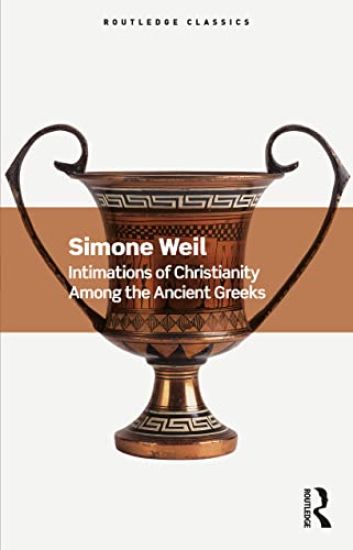
Simone Weil (1909–1943) is one of the most brilliant and unorthodox religious and philosophical minds of the twentieth century. She was also a political activist, worked in the Renault car factory in France in the 1930s and fought briefly as an anarchist in the Spanish Civil War, before her tragic early death in England at the age of thirty-four. Her work spans an astonishing variety of subjects, from ancient Greek philosophy and Christianity to oppression, political freedom and French national identity.Intimations of Christianity Among the Ancient Greeks sees Weil apply her unique and piercing intellect to early Greek thought, where she finds fundamental precursors to Christian religious ideas. She argues, provocatively, that concepts fundamental to Christianity such as incarnation, redemption, suffering and resurrection are Greek as well as Christian and that there is much we can learn, spiritually and philosophically, from their entwinement. This Routledge Classics edition includes a new Foreword by Christopher Hamilton.

Simone Weil (1909–1943) is one of the most brilliant and unorthodox religious and philosophical minds of the twentieth century. She was also a political activist, worked in the Renault car factory in France in the 1930s and fought briefly as an anarchist in the Spanish Civil War, before her tragic early death in England at the age of thirty-four. Her work spans an astonishing variety of subjects, from ancient Greek philosophy and Christianity to oppression, political freedom and French national identity.Intimations of Christianity Among the Ancient Greeks sees Weil apply her unique and piercing intellect to early Greek thought, where she finds fundamental precursors to Christian religious ideas. She argues, provocatively, that concepts fundamental to Christianity such as incarnation, redemption, suffering and resurrection are Greek as well as Christian and that there is much we can learn, spiritually and philosophically, from their entwinement. This Routledge Classics edition includes a new Foreword by Christopher Hamilton.

Black Women’s Stories of Everyday Racism
Simone Drake; James Phelan; Robyn Warhol; Lisa Zunshine
TAYLOR FRANCIS LTD
2024
nidottu
Black Women’s Stories of Everyday Racism puts literary narrative theory to work on an urgent real-world problem. The book calls attention to African American women’s everyday experiences with systemic racism and demonstrates how four types of narrative theory can help generate strategies to explain and dismantle that racism. This volume presents fifteen stories told by eight midwestern African American women about their own experiences with casual and structural racism, followed by four detailed narratological analyses of the stories, each representing a different approach to narrative interpretation. The book makes a case for the need to hear the personal stories of these women and others like them as part of a larger effort to counter the systemic racism that prevails in the United States today.Readers will find that the women’s stories offer powerful evidence that African Americans experience racism as an inescapable part of their day-to-day lives—and sometimes as a force that radically changes their lives. The stories provide experience-based demonstrations of how pervasive systemic racism is and how it perpetuates power differentials that are baked into institutions such as schools, law enforcement, the health care system, and business. Containing countless signs of the stress and trauma that accompany and follow from experiences of racism, the stories reveal evidence of the women’s resilience as well as their unending need for it, as they continue to feel the negative effects of experiences that occurred many years ago. The four interpretive chapters note the complex skill involved in the women’s storytelling. The analyses also point to the overall value of telling these stories: how they are sometimes cathartic for the tellers; how they highlight the importance of listening—and the likelihood of misunderstanding—and how, if they and other stories like them were heard more often, they would be a force to counteract the structural racism they so graphically expose.The Open Access version of this book, available at http://www.taylorfrancis.com, has been made available under a Creative Commons Attribution (CC-BY) 4.0 license.

Black Women’s Stories of Everyday Racism
Simone Drake; James Phelan; Robyn Warhol; Lisa Zunshine
TAYLOR FRANCIS LTD
2024
sidottu
Black Women’s Stories of Everyday Racism puts literary narrative theory to work on an urgent real-world problem. The book calls attention to African American women’s everyday experiences with systemic racism and demonstrates how four types of narrative theory can help generate strategies to explain and dismantle that racism. This volume presents fifteen stories told by eight midwestern African American women about their own experiences with casual and structural racism, followed by four detailed narratological analyses of the stories, each representing a different approach to narrative interpretation. The book makes a case for the need to hear the personal stories of these women and others like them as part of a larger effort to counter the systemic racism that prevails in the United States today.Readers will find that the women’s stories offer powerful evidence that African Americans experience racism as an inescapable part of their day-to-day lives—and sometimes as a force that radically changes their lives. The stories provide experience-based demonstrations of how pervasive systemic racism is and how it perpetuates power differentials that are baked into institutions such as schools, law enforcement, the health care system, and business. Containing countless signs of the stress and trauma that accompany and follow from experiences of racism, the stories reveal evidence of the women’s resilience as well as their unending need for it, as they continue to feel the negative effects of experiences that occurred many years ago. The four interpretive chapters note the complex skill involved in the women’s storytelling. The analyses also point to the overall value of telling these stories: how they are sometimes cathartic for the tellers; how they highlight the importance of listening—and the likelihood of misunderstanding—and how, if they and other stories like them were heard more often, they would be a force to counteract the structural racism they so graphically expose.The Open Access version of this book, available at http://www.taylorfrancis.com, has been made available under a Creative Commons Attribution (CC-BY) 4.0 license.