

Kirjahaku
Etsi kirjoja tekijän nimen, kirjan nimen tai ISBN:n perusteella.
1000 tulosta hakusanalla Sloth Planners


Amazon Animals (National Geographic Kids Readers, Level 3): 100 Fun Facts about Snakes, Sloths, Spiders, and More
Rose Davidson
NATIONAL GEOGRAPHIC KIDS
2023
sidottu
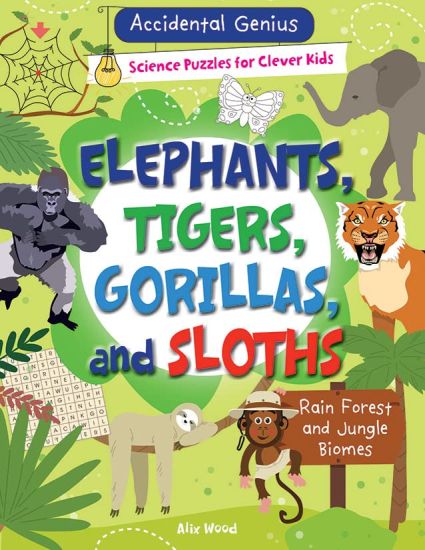
Elephants, Tigers, Gorillas, and Sloths: Rain Forest and Jungle Biomes
Alix Wood
Windmill Books
2023
nidottu
The jungle is an exciting place to visit, and readers are invited to explore jungle and rain forest biomes in this fresh and fun take on a common life science curriculum topic. As readers learn facts about these habitats, they also discover some of the amazing animals who call them home--from huge elephants to dangerous tigers. Colorful illustrations of these animals are included, and they're paired with fun activities that encourage readers to play as they learn. Mazes, matching games, and more fill the pages, and an answer key ensures that readers are able to check their own work.
Elephants, Tigers, Gorillas, and Sloths: Rain Forest and Jungle Biomes
Alix Wood
Windmill Books
2023
sidottu
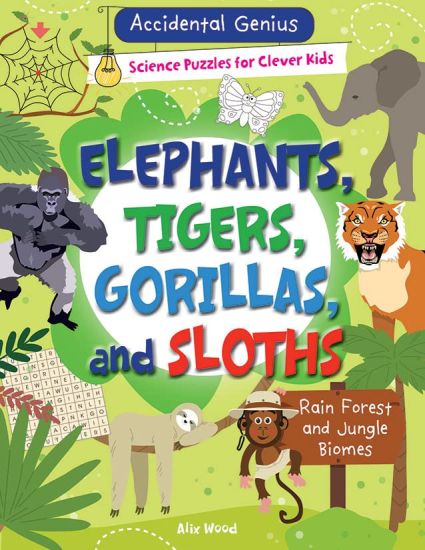
The jungle is an exciting place to visit, and readers are invited to explore jungle and rain forest biomes in this fresh and fun take on a common life science curriculum topic. As readers learn facts about these habitats, they also discover some of the amazing animals who call them home--from huge elephants to dangerous tigers. Colorful illustrations of these animals are included, and they're paired with fun activities that encourage readers to play as they learn. Mazes, matching games, and more fill the pages, and an answer key ensures that readers are able to check their own work.
The Strength of the Strong (1914). By: Jack London: (Short story collections), Includes: - The Strength of the Strong - South of the Slot - The Unpara
Jack London
Createspace Independent Publishing Platform
2017
nidottu
Short story collections Includes: - The Strength of the Strong - South of the Slot - The Unparalleled Invasion - The Enemy of All the World - The Dream of Debs - The Sea-Farmer - Samuel John Griffith "Jack" London (born John Griffith Chaney, January 12, 1876 - November 22, 1916)was an American novelist, journalist, and social activist. John Griffith "Jack" London (born John Griffith Chaney, January 12, 1876 - November 22, 1916)was an American novelist, journalist, and social activist. A pioneer in the then-burgeoning world of commercial magazine fiction, he was one of the first fiction writers to obtain worldwide celebrity and a large fortune from his fiction alone, including science fiction. Some of his most famous works include The Call of the Wild and White Fang, both set in the Klondike Gold Rush, as well as the short stories "To Build a Fire", "An Odyssey of the North", and "Love of Life". He also wrote of the South Pacific in such stories as "The Pearls of Parlay" and "The Heathen", and of the San Francisco Bay area in The Sea Wolf. London was part of the radical literary group "The Crowd" in San Francisco and a passionate advocate of unionization, socialism, and the rights of workers. He wrote several powerful works dealing with these topics, such as his dystopian novel The Iron Heel, his non-fiction expos The People of the Abyss, and The War of the Classes.

Color Me Cute: The World's Cutest Coloring Book Unicorns, Mermaids, Llamas, Sloths and More! For Kids Ages 4-8
Wendi Cocita
Independently Published
2019
nidottu
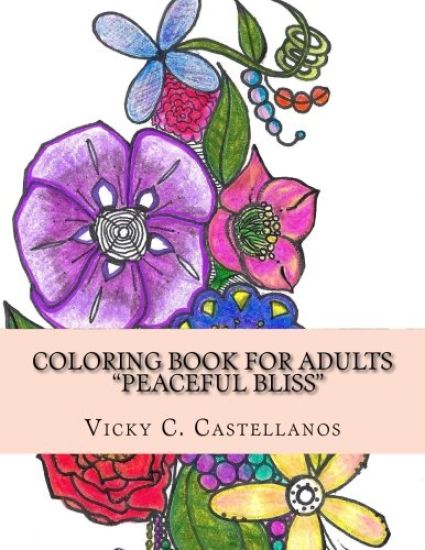
Coloring Book for Adults "Peaceful Bliss": HAND DRAWN Coloring Book for Adults Peaceful Bliss-Therapeutic, Calming, Anti-stress, Mindfulness and Sooth
Vicky C. Castellanos
Createspace Independent Publishing Platform
2017
nidottu
Color "PEACEFUL BLISS" Vol.1 30 pages of Intricate HAND DRAWN Illustrations that will melt your heart and give you hours of peace. Fitting this activity into your life can help reduce everyday stress, boost your energy and mood, and improve your mental and even physical health. Coloring can also improve hand and eye coordination. When you color the pages in this adorable book you will feel a "PEACEFUL BLISS" of soothing relaxation and calming feeling that comes from within.

The Retirement Savings Time Bomb Ticks Louder: How to Avoid Unnecessary Tax Landmines, Defuse the Latest Threats to Your Retirement Savings, and Ignit
Ed Slott
PENGUIN BOOKS
2024
nidottu
"This book is required reading." --Robert Powell, editor of Retirement Daily Whether your retirement dreams are five years away or fifty--the single greatest threat standing in your way is taxes. Unlike losses in the stock market, money lost to taxes never recovers. With untaxed retirement accounts likely to become your largest asset, you face an explosive landscape of costly tax traps, penalties, and a complex maze of rules when it comes time to tap into those savings. Renowned tax advisor Ed Slott returns in The Retirement Savings Time Bomb Ticks Louder with the ultimate guide to reclaim control of your financial future and keep more of your money--no matter what Congress comes up with next. With fully up-to-date information, including SECURE Act 2.0, this book provides an easy-to-follow plan that is an entertaining and informative must-read for any American with a retirement savings account.
This new book by Michael Slote argues that Western philosophy on the whole has overemphasized rational control and autonomy at the expense of the important countervailing value and virtue of receptivity. Recently the ideas of caring and empathy have received a great deal of philosophical and public attention, but both these notions rest on the deeper and broader value of receptivity, and in From Enlightenment to Receptivity, Slote seeks to show that we need to focus more on receptivity if we are to attain a more balanced sense and understanding of what is important to us. Beginning with a critique of Enlightenment thinking that calls into question its denial of any central role to considerations of emotion and empathy, he goes on to show how a greater emphasis on these factors and on the receptivity that underlies them can give us a more realistic, balanced, and sensitive understanding of our core ethical and epistemological values. This means rejecting post-modernism's blanket rejection of reason and of compelling real values and recognizing, rather, that receptivity should play a major role in how we lead our lives as individuals, in how we relate to nature, in how we acquire knowledge about the world, and in how we relate morally and politically with others.
Slote here offers the first full-scale foundational account of virtue ethics to have appeared since the recent revival of interest in the ethics of virtue.
Morals from Motives develops a virtue ethics inspired more by moral sentimentalism than by recently-influential Aristotelianism. It argues that a reconfigured and expanded 'morality of caring' can offer a general account of right and wrong action and also (in its own terms) of social justice, and the book goes on to show how a motive-based 'pure' virtue theory can also help us to understand the nature of human well-being and practical reason.
Morals from Motives develops a virtue ethics inspired more by Hume and Hutcheson's moral sentimentalism than by recently-influential Aristotelianism. It argues that a reconfigured and expanded "morality of caring" can offer a general account of right and wrong action as well as social justice. Expanding the frontiers of ethics, it goes on to show how a motive-based "pure" virtue theory can also help us to understand the nature of human well-being and practical reason.
In Selected Essays Michael Slote collects some of the most important papers of his career, articles that were both influential as well as those that remain relevant to philosophical debates today. The papers range over a number of important topics--not all of them within or having to do with ethics. Three of the papers have to do with ways in which one might fill out or expand upon traditional utilitarian views--while remaining within the utilitarian tradition. Two of the papers focus on free will, and another pair discuss rational choice and argue that traditional views about individual rationality unduly limit our possibilities. The papers outside ethics deal with such topics as counterfactuals; Wittgensteinian accounts of "cluster terms;" some familiar concepts we use that cannot apply to reality; and a paradox about the possibility of circumstances where it is linguistically inappropriate to assert what one believes. In addition to the previously published essays, Slote includes more recent and unpublished papers that deal with the uses of empathy in the context of global issues of justice; the limitations of the "moral reasoning" model of normal moral thinking; and the relevance of empathy to the epistemic ideal of objectivity. The final paper of the volume speaks about recent developments in ethical theory and what they may tell us about the possibilities of future progress or lack of progress in that field.

There has recently been a good deal of interest in moral sentimentalism, but most of that interest has been exclusively either in meta-ethical questions about the meaning of moral terms or in normative issues about benevolence and/or caring and their place in morality. In Moral Sentimentalism Michael Slote attempts to deal with both sorts of issues and to do so, primarily, in terms of the notion or phenomenon of empathy. Hume sought to do something like this over two centuries ago, though he didn't have the term "empathy" and used "sympathy" instead. Slote therefore attempts to give moral sentimentalism a second wind. By relying so systematically on empathy in its account of normative morality and in what it has to say about the meaning of moral vocabulary, Slote offers a unified overall ethical picture that can then be tested against ethical rationalism. Rationalism has recently dominated the scene in ethics, but by showing how sentimentalism can make coherent and intuitive sense of such preferred rationalist notions as autonomy, respect, and justice-and by showing how a sentimentalism based in empathy can deal with ethically significant aspects of the moral life that rationalism tends to ignore or skimp on-Slote hopes a wider and more active debate between rationalism and sentimentalism can be set in motion. There are signs that sentimentalist modes of thought are gaining new footholds on the way ethics is done, and this new book is very hopeful about these possibilities.
In Essays on the History of Ethics Michael Slote collects his essays that deal with aspects of both ancient and modern ethical thought and seek to point out conceptual/normative comparisons and contrasts among different views. Arranged in chronological order of the philosopher under discussion, the relationship between ancient ethical theory and modern moral philosophy is a major theme of several of the papers and, in particular, Plato, Aristotle, Hume, Kant, and/or utilitarianism feature centrally in (most of) the discussions. One essay seeks to show that there are three main ways to conceive the relationship between human well-being and virtue: one is dualistic a la Kant (they are disparate notions); one is the sort of reductionism familiar from the history of utilitarianismm; and one, not previously named by philosophers, is implicit in the approach the Stoics, Plato, and Aristotle take (in their different ways) to the topic of virtue and well-being. Slote names this third approach "elevationism" and argue that it is more promising than either reductionism or dualism. Two of the essays are narrowly focused on Hume's ethics, and one seeks to show that even Kant's opponents have reason to accept a number of important and original Kantian ideas. Finally, the two last essays in the volume talk about ethical thought during the last half of the twentieth century and the first few years of the twenty-first, arguing that the care ethics of Carol Gilligan and Nel Noddings has a distinctive and important contribution to make to ongoing ethical theorizing--and to our understanding of the history of ethics as well.
Annotations to James Joyce's Ulysses
Sam Slote; Marc A. Mamigonian; John Turner
Oxford University Press
2022
sidottu
James Joyce's Ulysses is filled with all sorts of references that can get in the way of many of its readers. This volume, with over 12,000 individual annotations (and more than double the word count of Ulysses itself), explains these references and allusions in a clear and compact manner and is designed to be accessible to novices and scholars alike. The annotations cover the full range of information referenced in Ulysses: a vast array of literary allusions, such as Shakespeare, Aristotle, Dante, Aquinas, slang from various eras and areas, foreign language words and phrases, Hiberno-English expressions, Catholic ritual and theology, Irish histories, Theosophy, Freemasonry, cricket, astronomy, fashion, boxing, heraldry, the symbolism of tattoos, horse racing, advertising slogans, nursery rhymes, superstitions, music-hall songs, references to Dublin topography precise enough for a city directory, and much more besides. The annotations reflect the latest scholarship and have been thoroughly reviewed by an international team of experts. They are designed to be accessible to first-time readers and college students and will also serve as a resource for Joycean specialists. The volume includes contemporaneous maps of Dublin to illustrate the cityscape's relevance to Joyce's novel. Unlike previous volumes of annotations, almost every note includes documentation about sources.
Annotations to James Joyce's Ulysses
Sam Slote; Marc A. Mamigonian; John Turner
Oxford University Press
2024
nidottu
James Joyce's Ulysses is filled with all sorts of references that can get in the way of many of its readers. This volume, with over 12,000 individual annotations (and more than double the word count of Ulysses itself), explains these references and allusions in a clear and compact manner and is designed to be accessible to novices and scholars alike. The annotations cover the full range of information referenced in Ulysses: a vast array of literary allusions, such as Shakespeare, Aristotle, Dante, Aquinas, slang from various eras and areas, foreign language words and phrases, Hiberno-English expressions, Catholic ritual and theology, Irish histories, Theosophy, Freemasonry, cricket, astronomy, fashion, boxing, heraldry, the symbolism of tattoos, horse racing, advertising slogans, nursery rhymes, superstitions, music-hall songs, references to Dublin topography precise enough for a city directory, and much more besides. The annotations reflect the latest scholarship and have been thoroughly reviewed by an international team of experts. They are designed to be accessible to first-time readers and college students and will also serve as a resource for Joycean specialists. The volume includes contemporaneous maps of Dublin to illustrate the cityscape's relevance to Joyce's novel. Unlike previous volumes of annotations, almost every note includes documentation about sources.
Most people think that the difficulty of balancing career and personal/family relationships is the fault of present-day society or is due to their own inadequacies. But in this major new book, eminent moral philosopher Michael Slote argues that the difficulty runs much deeper, that it is due to the essential nature of the divergent goods involved in this kind of choice. He shows more generally that perfect human happiness and perfect virtue are impossible in principle, a view originally enunciated by Isaiah Berlin, but much more thoroughly and synoptically defended here than ever before. Ancient Greek and modern-day Enlightenment thought typically assumed that perfection was possible, and this is also true of Romanticism and of most recent ethical theory. But if, as Slote maintains, imperfection is inevitable, then our inherited categories of virtue and personal good are far too limited and unqualified to allow us to understand and cope with the richer and more complex life that characterizes today's world. And The Impossibility of Perfection argues in particular that we need some new notions, new distinctions, and even new philosophical methods in order to distill some of the ethical insights of recent feminist thought and arrive at a fuller and more realistic picture of ethical phenomena.
Michael Slote argues that emotion is involved in all human thought and action on conceptual grounds, rather than merely being causally connected with other aspects of the mind. This kind of general sentimentalism about the mind goes beyond that advocated by Hume, and the book's main arguments are only partially anticipated in German Romanticism and in the Chinese philosophical tendency to avoid rigid distinctions between thought and emotion. The new sentimentalist philosophy of mind Slote proposes can solve important problems about the nature of belief and action that other approaches -- including Pragmatism -- fail to address. In arguing for the centrality of emotion within philosophy of the mind, A Sentimentalist Theory of the Mind continues the critique of rationalist philosophical views that began with Slote's Moral Sentimentalism (OUP, 2010) and continued in his From Enlightenment to Receptivity (OUP, 2013). This new book also delves into what is distinctive about human minds, arguing that there is a greater variety to ordinary human motives than has been recognized and that emotions play a central role in this complex psychology.