
Kirjahaku
Etsi kirjoja tekijän nimen, kirjan nimen tai ISBN:n perusteella.
1000 tulosta hakusanalla Todd Telander

Interactive music refers to a composition or improvisation in which software interprets live performances to produce music generated or modified by computers. In Composing Interactive Music, Todd Winkler presents both the technical and aesthetic possibilities of this increasingly popular area of computer music. His own numerous compositions have been the laboratory for the research and development that resulted in this book.The author's examples use a graphical programming language called Max. Each example in the text is accompanied by a picture of how it appears on the computer screen. The same examples are included as software on the accompanying CD-ROM, playable on a Macintosh computer with a MIDI keyboard.Although the book is aimed at those interested in writing music and software using Max, the casual reader can learn the basic concepts of interactive composition by just reading the text, without running any software. The book concludes with a discussion of recent multimedia work incorporating projected images and video playback with sound for concert performances and art installations.

In 1924, two uniquely American institutions clashed in northern Indiana: the University of Notre Dame and the Ku Klux Klan. Todd Tucker's book, published for the first time in paperback, Notre Dame vs. The Klan tells the shocking story of the three-day confrontation in the streets of South Bend, Indiana, that would change both institutions forever. When the Ku Klux Klan announced plans to stage a parade and rally in South Bend, hoping to target college campuses for recruitment starting with Notre Dame, a large group of students defied their leaders' pleas to ignore the Klan and remain on campus. Tucker dramatically recounts the events as only a proficient storyteller can. Readers will find themselves drawn into the fray of these tumultuous times. Tucker structures this compelling tale around three individuals: D.C. Stephenson, the leader of the KKK in Indiana, the state with the largest Klan membership in America; Fr. Matthew Walsh, the young and charismatic president of the University of Notre Dame; and a composite of a Notre Dame student at the time, represented by Bill Foohey, who was an actual participant in the clash. This book will appeal not only to Notre Dame fans, but to those interested in South Bend and Indiana history and the history of the Klu Klux Klan, including modern-day Klan violence.

A book for everyone interested in learning how philosophy is done and what it can tell us about who we are.
Both Anglo-American and Continental thinkers have long denied that there can be a coherent moral defense of the poststructuralist politics of Michel Foucault, Gilles Deleuze, and Jean-François Lyotard. For many Anglo-American thinkers, as well as for Critical Theorists such as Habermas, poststructuralism is not coherent enough to defend morally. Alternatively, for Foucault, Deleuze, Lyotard, and their followers, the practice of moral theorizing is passé at best and more likely insidious.Todd May argues both that a moral defense of poststructuralism is necessary and that it is possible. First, he develops a metaethical view of moral theorizing that treats it as a social practice rather than a transcendentally derived guarantee for right action. He then articulates and defends antirepresentationalism, a principle central to poststructuralism. Finally, May offers a version of consequentialism that is consonant both with the principle of antirepresentationalism and with other poststructuralist commitments. In conclusion, he distinguishes morality from an aesthetics of living and shows the role the latter plays for those who embrace antirepresentationalism.

Private Lives in the Public Sphere examines the Bildungsroman in the context of the rapid changes that affected the German literary revolution that made up for its belatedness in its rapidity and scope. The nature and quantity of reading material produced, the social status of the writer, and the reading habits of the public changed dramatically within a few decades. At the beginning of the century the new texts that appeared at the annual book fairs were primarily written in Latin and devoted to theology. By the end of the century the number of new publications each year has increased almost exponentially, with the novel leading the way. This new institution of literature constituted an important part of what Jürgen Habermas has termed the "public sphere," a forum for public debate in which members of the middle class, although still limited in their direct access to political power, could at least begin to articulate their problems and formulate their hopes. The Bildungsroman emerged during this period.This study focuses on moments of literary self-consciousness in the Bildungsroman as reflections on the rapid transformation of the German literary institution. The novels are viewed as examples of what Patricia Waugh has called "metafiction," that is, "fictional writing which self-consciously and systematically draws attention to its status as an artifact in order to pose questions about the relationship between fiction and reality." By concentrating on the interaction between literary form and institutional context in these novels, it becomes possible to mediate between the extremes of those who would view literature as a mere reflection of historical conditions and those who would maintain the purity of the aesthetic object. Literature in this view neither re-creates reality nor does it escape reality; instead, it transforms reality, and the Bildungsroman is the genre that examines this transformation.

Michel Foucault introduced a new form of political thinking and discourse. Rather than seeking to understand the grand unities of state, economy, or exploitation, he tried to discover the micropolitical workings of everyday life that have often founded the greater unities. He was particularly concerned with how we understand ourselves psychologically, and thus with how psychological knowledge developed and came to be accepted as true. In the course of his writings, he developed a genealogy of psychology, an account of psychology as a historically developed practice of power.The problem such an account raises for much of traditional philosophy is that Foucault's critique of psychological concepts is ultimately a critique of the idea of the mind as a politically neutral ontological concept. As such, it renders politically suspect all forms of subjective foundationalism, and the epistemological justification for Foucault's own writings is then called into question. Drawing on the writings of such Anglo-American philosophers as Wilfrid Sellars and Ludwig Wittgenstein, Todd May refutes the idea that Foucault's critiques of knowledge, and especially psychological knowledge, undermine themselves.

The Political Philosophy of Poststructuralist Anarchism
Todd May
Pennsylvania State University Press
1994
pokkari
The political writings of the French poststructuralists have eluded articulation in the broader framework of general political philosophy primarily because of the pervasive tendency to define politics along a single parameter: the balance between state power and individual rights in liberalism and the focus on economic justice as a goal in Marxism. What poststructuralists like Michel Foucault, Gilles Deleuze, and Jean-François Lyotard offer instead is a political philosophy that can be called tactical: it emphasizes that power emerges from many different sources and operates along many different registers. This approach has roots in traditional anarchist thought, which sees the social and political field as a network of intertwined practices with overlapping political effects. The poststructuralist approach, however, eschews two questionable assumptions of anarchism, that human beings have an (essentially benign) essence and that power is always repressive, never productive.After positioning poststructuralist political thought against the background of Marxism and the traditional anarchism of Bakunin, Kropotkin, and Proudhon, Todd May shows what a tactical political philosophy like anarchism looks like shorn of its humanist commitments—namely, a poststructuralist anarchism. The book concludes with a defense, contra Habermas and Critical Theory, of poststructuralist political thought as having a metaethical structure allowing for positive ethical commitments.

French philosophy since World War II has been preoccupied with the issue of difference. Specifically, it has wanted to promote or to leave room for ways of living and of being that differ from those usually seen in contemporary Western society. Given the experience of the Holocaust, the motivation for such a preoccupation is not difficult to see. For some thinkers, especially Jean-Luc Nancy, Jacques Derrida, Emmanuel Levinas, and Gilles Deleuze, this preoccupation has led to a mode of philosophizing that privileges difference as a philosophical category. Nancy privileges difference as a mode of conceiving community, Derrida as a mode of conceiving linguistic meaning, Levinas as a mode of conceiving ethics, and Deleuze as a mode of conceiving ontology.Reconsidering Difference has a twofold task, the primary one critical and the secondary one reconstructive. The critical task is to show that these various privilegings are philosophical failures. They wind up, for reasons unique to each position, endorsing positions that are either incoherent or implausible. Todd May considers the incoherencies of each position and offers an alternative approach. His reconstructive task, which he calls "contingent holism," takes the phenomena under investigation—community, language, ethics, and ontology—and sketches a way of reconceiving them that preserves the motivations of the rejected positions without falling into the problems that beset them.
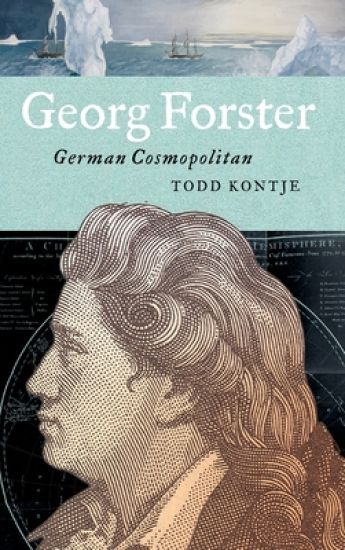
Georg Forster (1754–1794) was famous during his lifetime, notorious after his death, and largely forgotten by the later nineteenth century. Remembered today as the young man who sailed around the world with Captain Cook and as one of the leading figures in the revolutionary Republic of Mainz, Forster was also a prolific writer and translator who left behind two travelogues, a series of essays on diverse topics, and numerous letters. This in-depth look at Forster’s work and life reveals his importance for other writers of the age. Todd Kontje traces the major intellectual themes and challenges found in Forster’s writings, interweaving close textual analysis with his rich but short life. Each chapter engages with themes that reflect the current debates in eighteenth-century literary and cultural studies, including changing notions of authorship, multilingualism, the representation of so-called primitive societies, Enlightenment ideas about race, and early forms of ecological thinking. As Kontje shows, Forster’s peripatetic life, malleable sense of national identity, and fluency in multiple languages contrast with the image of the solitary genius in the “age of Goethe.” In this way, Forster provides a different model of authorship and citizenship better understood in the context of an increasingly globalized world.Compellingly argued and engagingly written, this book restores Forster to his rightful place within the German literary tradition, and in so doing, it urges us to reconsider the age of Goethe as multilingual and malleable, local and cosmopolitan, dynamic and decentered. It will be welcomed by specialists in German studies and the Enlightenment.

Georg Forster (1754–1794) was famous during his lifetime, notorious after his death, and largely forgotten by the later nineteenth century. Remembered today as the young man who sailed around the world with Captain Cook and as one of the leading figures in the revolutionary Republic of Mainz, Forster was also a prolific writer and translator who left behind two travelogues, a series of essays on diverse topics, and numerous letters. This in-depth look at Forster’s work and life reveals his importance for other writers of the age. Todd Kontje traces the major intellectual themes and challenges found in Forster’s writings, interweaving close textual analysis with his rich but short life. Each chapter engages with themes that reflect the current debates in eighteenth-century literary and cultural studies, including changing notions of authorship, multilingualism, the representation of so-called primitive societies, Enlightenment ideas about race, and early forms of ecological thinking. As Kontje shows, Forster’s peripatetic life, malleable sense of national identity, and fluency in multiple languages contrast with the image of the solitary genius in the “age of Goethe.” In this way, Forster provides a different model of authorship and citizenship better understood in the context of an increasingly globalized world.Compellingly argued and engagingly written, this book restores Forster to his rightful place within the German literary tradition, and in so doing, it urges us to reconsider the age of Goethe as multilingual and malleable, local and cosmopolitan, dynamic and decentered. It will be welcomed by specialists in German studies and the Enlightenment.
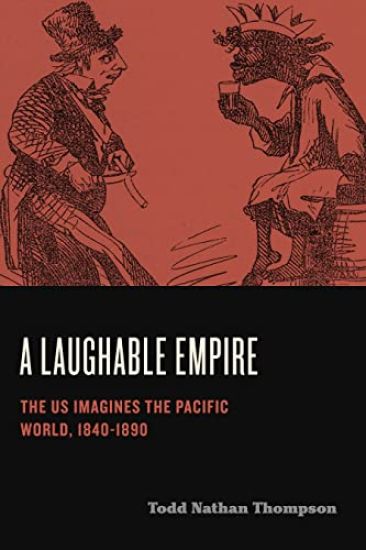
In the nineteenth-century United States, jokes, comic anecdotes, and bons mots about the Pacific Islands and Pacific Islanders tried to make the faraway and unfamiliar either understandable or completely incomprehensible (i.e., “other”) to American readers. A Laughable Empire examines this substantial archival corpus, attempting to make sense of nineteenth-century American humor about Hawai‘i and the rest of the Pacific world.Todd Nathan Thompson collects and interprets these comic, sometimes racist depictions of Pacific culture in nineteenth-century American print culture. Drawing on an archive of almanac and periodical humor, sea yarns, jest books, and literary comedy, Thompson demonstrates how jokes and humor functioned sometimes in the service of and sometimes in resistance to US imperial ambitions. Thompson also includes Indigenous voices and jokes lampooning Americans and their customs to show how humor served as an important cultural contact zone between the United States and the Pacific world. He considers how nineteenth-century Americans and Pacific Islanders alike used humor to employ stereotypes or to question them, to “other” the unknown or to interrogate, laughingly, the process by which “othering” occurs and is disseminated.Incisive and detailed, A Laughable Empire documents American humor about Pacific geography, food, dress, speech, and customs. Thompson sheds new light not only on nineteenth-century America’s imperial ambitions but also on its deep anxieties.
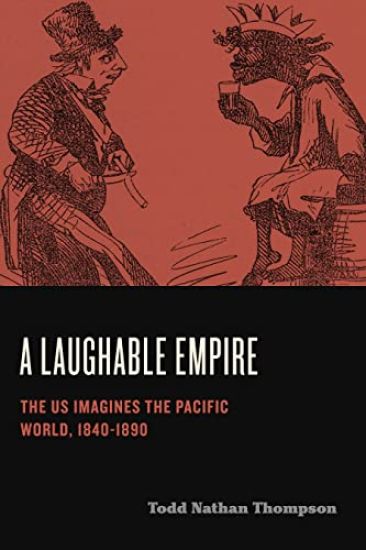
In the nineteenth-century United States, jokes, comic anecdotes, and bons mots about the Pacific Islands and Pacific Islanders tried to make the faraway and unfamiliar either understandable or completely incomprehensible (i.e., “other”) to American readers. A Laughable Empire examines this substantial archival corpus, attempting to make sense of nineteenth-century American humor about Hawai‘i and the rest of the Pacific world.Todd Nathan Thompson collects and interprets these comic, sometimes racist depictions of Pacific culture in nineteenth-century American print culture. Drawing on an archive of almanac and periodical humor, sea yarns, jest books, and literary comedy, Thompson demonstrates how jokes and humor functioned sometimes in the service of and sometimes in resistance to US imperial ambitions. Thompson also includes Indigenous voices and jokes lampooning Americans and their customs to show how humor served as an important cultural contact zone between the United States and the Pacific world. He considers how nineteenth-century Americans and Pacific Islanders alike used humor to employ stereotypes or to question them, to “other” the unknown or to interrogate, laughingly, the process by which “othering” occurs and is disseminated.Incisive and detailed, A Laughable Empire documents American humor about Pacific geography, food, dress, speech, and customs. Thompson sheds new light not only on nineteenth-century America’s imperial ambitions but also on its deep anxieties.
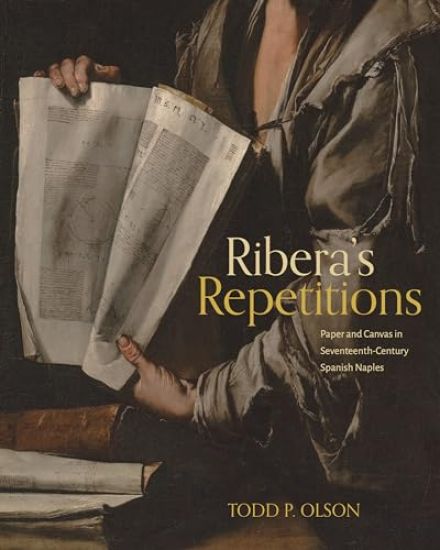
The seventeenth-century Valencian artist Jusepe de Ribera spent most of his career in Spanish Viceregal Naples, where he was known as “Lo Spagnoletto,” or “the Little Spaniard.” Working under the patronage of Spanish viceroys, Ribera held a special position bridging two worlds. In Ribera’s Repetitions, art historian Todd P. Olson sheds new light on the complexity of Ribera’s artwork and artistic methods and their connections to the Spanish imperial project.Drawing from a diverse range of sources, including poetry, literature, natural history, philosophy, and political history, Olson presents Ribera’s work in a broad context. He examines how Ribera’s techniques, including rotation, material decay (through etching), and repetition, influenced the artist’s drawings and paintings. Many of Ribera’s works featured scenes of physical suffering—from Saint Jerome’s corroded skin and the flayed bodies of Saint Bartholomew and Marsyas to the ragged beggar-philosophers and the eviscerated Tityus. But far from being the result of an individual sadistic predilection, Olson argues, Ribera’s art was inflected by the legacies of the Reconquest of Spain and Neapolitan coloniality. Ribera’s material processes and themes were not hermetically sealed in the studio; rather, they were engaged in the global Spanish Empire.Pathbreaking and deeply interdisciplinary, this copiously illustrated book offers art history students and scholars a means to see Ribera’s art anew.

Global Germany Circa 1800 asks two interrelated questions: How did Germans participate in the European conquest of the world, and how were they different from other imperial powers? In other words, what is the relation between the German form of empire, the old Reich, and the modern European empires that emerged in the global age?In this book, Todd Kontje presents a revisionist literary and intellectual history, inviting readers to consider how we might understand “Germany” at the turn of the nineteenth century if we remove the nation-state as the inevitable goal of cultural and political development. Focusing on the pivotal years around 1800, when many of the concepts that define the modern era first came into being, Kontje investigates how thinkers in and around Weimar—from Goethe, Schiller, and Kant to Georg Forster, Heinrich von Kleist, and Alexander von Humboldt—worked within existing political structures to make sense of the region’s place in the world. Ultimately, he reveals how Weimar, a remote artist hub long thought to exemplify the insularity of a soon-to-be-unified nation, was in fact utterly worldly, and in a manner very different from the political capitals of imperial nation-states like London and Paris.Accessible and entertaining, this literary history is essential reading for German studies students and scholars, and it will appeal to audiences in world history, empire studies, intellectual history, and comparative literature.

Intended as a text for master's level students in public administration and public policy, this volume provides an introductory survey of the field that focuses on the structures of operation, management, and environments of modern governments. The contributors address federal, state, and local governments as well as intergovernmental relations, discussing such topics as fiscal management, policy analysis, program evaluation, management and administration, marketing, and the developmental progress of national governments. Their aim throughout is to distill for the reader a solid base of current knowledge about the field of public administration and the challenges it offers to practitioners as we move into the 1990s.The volume begins with an introductory chapter which addresses current and evolving issues in U.S. public administration and demonstrates the ways in which political, social, and economic trends impact upon modern governments and their managers. The functions and structure of the federal bureaucracy and state and local governments are described in detail in two chapters, followed by a chapter by editor Marcia Whicker that explores intergovernmental relations. The contributors then turn to an examination of government operations in the fiscal management, policy analysis, and program evaluation arenas. Three chapters discuss management issues, including organizational theory, leadership, and personnel administration. Finally, the text addresses the use and adaptation of private sector marketing techniques, the developmental progress of national governments, and the evolution of historical/philosophical values that constitute the framework for future governance.
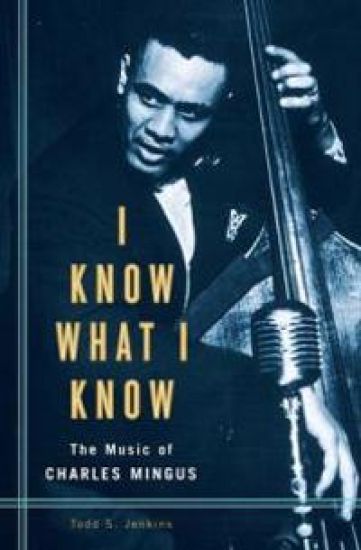
From the mid-1940s until his death in 1979, Charles Mingus created an unparalleled body of recorded work, most of which remains available in the 21st century. While there have been several volumes devoted to Mingus's colorful and tumultuous life, this is the first book in the English language to be devoted fully to his music. General jazz fans as well as musicians and music students who would like a better understanding of Mingus's complex, often difficult music, will find a complete, chronologically arranged, listener's guide to all of his legitimate recordings, from the 78s he recorded in Los Angeles and San Francisco in the mid-1940s, through the legendary albums he made for Columbia, Candid, Atlantic, and his own labels. In the process of providing these in-depth examinations, Jenkins corrects common errors and clears away old misconceptions about certain recordings. His approach will illuminate long-obscure aspects of this imposing and incredibly creative man's contributions to the art of jazz. Touching upon Mingus's many innovations as a jazzman, I Know What I Know explores his advancement of the art of bass playing; his assimilations of Ellington and Monk with ideas leaning toward free jazz; his experiments with ensemble dynamics, instrumentation, and extended form; and his working relationships with partners such as Jaki Byard, Eric Dolphy, Jimmy Knepper, and Dannie Richmond. The book provides a broad, informative overview of Mingus's work without veering into technical musical terminology. Readers without an extensive background in music will thus understand and appreciate the analyses provided, and be able to use them to enhance the experience of listening to the brilliant work of this legendary jazz great.

The challenges that vex the United States today in Iraq, Afghanistan, and elsewhere are not altogether as new and unique as they seem. U.S. involvement in Central America during the 1980s clearly demonstrated the costs, risks, and limits to intervention and the use of force in internal conflicts. Much can be learned today about the nature of irregular warfare from the experiences of the United States and the other protagonists in Central America during the final phase of the Cold War. The U.S. perceived a threat to national security in these wars from determined insurgents with a compelling revolutionary ideology and powerful allies that linked them to other conflicts around the world. This strategy and policy analysis makes a new contribution to irregular warfare theory through an examination of the origins, strategic dynamics, and termination of the Sandinista insurrection in Nicaragua, the decade long counterinsurgency of the Salvadoran government against the FMLN guerrillas, and the concurrent Contra insurgency against the Sandinistas.Many of the lessons about the fundamental and recurring nature of irregular warfare are being rediscovered in the current challenges of radical Islam, Iraq, Afghanistan, and elsewhere, despite the great differences in circumstance, culture, and geography. In the Central American case, three successive Presidents encountered serious domestic controversy over U.S. policies and refrained from sending U.S. combat troops to intervene directly. Most importantly, they prudently heeded warnings that internal wars of all types are rarely subject to military solutions, because their natures are equally and fundamentally political. Greentree presents his argument as a strategy and policy case study of the civil wars in Nicaragua and El Salvador during the final decade of the Cold War. The book comprises an examination of the origins, strategic dynamics, and termination of these wars from the points of view of the main participants—Nicaragua, El Salvador, Cuba, the Soviet Union, and the United States. It also develops a general conceptual framework for understanding the nature of insurgency, counterinsurgency, revolution, and intervention that builds on classic strategic theory and contemporary thought on irregular warfare. From the perspective of global superpower conflict, the wars in Central America were peripheral small wars or low intensity conflicts. However, for the internal protagonists these were total and bloody wars for survival. Involvement in such wars has been cyclical in the U.S. experience, and it is misfortunate, if not tragic, that the greatly similar problems encountered across widely varying circumstances are quickly forgotten.