Kirjojen hintavertailu. Mukana 11 342 296 kirjaa ja 12 kauppaa.

Kirjahaku

Etsi kirjoja tekijän nimen, kirjan nimen tai ISBN:n perusteella.

1000 tulosta hakusanalla William Butler

William of Ockham, Dialogus, Part 2; Part 3 Tract 1
William of Ockham was a medieval English philosopher and theologian (he was born about 1285, perhaps as late as 1288, and died in 1347 or 1348). In 1328 Ockham turned away from 'pure' philosophy and theology to polemic. From that year until the end of his life he worked to overthrow what he saw as the tyranny of Pope John XXII (1316-1334) and of his successors Popes Benedict XII (1334-1342) and Clement VI (1342-1352). This campaign led him into questions of ecclesiology (the study of the nature and structure of the Christian Church, e.g. of the functions and powers of the pope) and political philosophy. The Dialogus purports to be a transcript made by a mature student of lengthy discussions between himself and a university master about the various opinions of the learned on the matters disputed between John XXII and the dissident Franciscans. The student is usually the initiator; he chooses the topics, asks most of the questions and decides when he has heard enough. The master is, so to speak, an expert witness whom the student examines. This volume publishes an edition of two elements of the Dialogus. Part 2 of the Dialogus is not in dialogue form and may not to be the work of Ockham himself. Part 3 is divided into two tracts. Tract 1, which is reproduced in this volume, is on the power of the Pope and clergy. Liberal thinking in modern times builds on certain earlier ancient and medieval political ideas, which Ockham reasserted, defended and helped to perpetuate. Thus there are elements in his ecclesiology and political philosophy that anticipate the views of Locke, Mill, and other modern liberals.
William of Ockham, Dialogus

William of Ockham, Dialogus

Oxford University Press
2019
sidottu
William of Ockham was a medieval English philosopher and theologian (he was born about 1285, perhaps as late as 1288, and died in 1347 or 1348). In 1328 Ockham turned away from 'pure' philosophy and theology to polemic. From that year until the end of his life he worked to overthrow what he saw as the tyranny of Pope John XXII (1316-1334) and of his successors Popes Benedict XII (1334-1342) and Clement VI (1342-1352). This campaign led him into questions of ecclesiology (the study of the nature and structure of the Christian Church, e.g. of the functions and powers of the pope) and political philosophy. The Dialogus purports to be a transcript made by a mature student of lengthy discussions between himself and a university master about the various opinions of the learned on the matters disputed between John XXII and the dissident Franciscans. The student is usually the initiator; he chooses the topics, asks most of the questions and decides when he has heard enough. The master is, so to speak, an expert witness whom the student examines. This volume provides the first critical edition of part 3.2 of the Dialogus and deals with the relation between the empire and the nation-states and engages in the theory of property rights, natural law, and political freedom.
William Of Ockham Dialogus Part 1, Books 1-5
William of Ockham was a leading English philosopher and theologian in the fourteenth century who came into controversy with Pope John XXII. His Dialogus is a survey of a wide range of matters controversial in the Catholic Church in the early fourteenth century. Topics discussed include the concepts of orthodoxy and heresy and the procedures for deciding whether a person is a heretic, the power of the pope within the Church, the power of the Church in relation to secular government, the constitution of the Church, and the constitution of secular government. The Dialogus is an important source of ideas on ecclesiology and political philosophy in the late middle ages. The present volume is concerned with heresy and heretics.
William of Ockham, Dialogus Part 1, Book 6
William Ockham intended the Dialogus to be a thorough examination (a "summa") of the doctrinal and political issues at stake during what in fact became the last major confrontation between Church and State in the waning period of the Western Middle Ages. Part I of the project, entitled “Concerning Heretics”, dealt with the problem of a Pope betraying the main values of his community, and the lengthy Book 6 described the consequent inquisition and punishment. The Dialogus is to Ockham what The Republic is to Plato or the Leviathan to Hobbes. It is one of the great treatises in the history of political thought. Cast in the form of a discussion between a master and a student, while primarily focusing on the concrete events of its time, it enunciates general principles which are easily adaptable to any socio-political situation involving human political interaction.
William of Ockham, Dialogus Part 1, Book 7
The Dialogus became an important reference text during the last two centuries of the Middle Ages, especially in the time of troubles associated with the Great Schism. It was printed twice in the later 15th century. One of its most elegant manuscripts was a text belonging to Pope Sixtus IV. Its ideal of an enlightened papacy ("monarchia de concilio peritorum") did not survive the Reformation, though many of its principles percolated into the writings of political philosophers, contributing along with other sources to the rise of constitutional liberalism and responsible government. This final book of Dialogus, Part I is not only a monument celebrating the possible emergence of cooperative political societies from the rubble of autocracies, but also an indication that Ockham's political orientation was essentially pragmatic.
William of Ockham

William of Ockham

Oxford University Press
2023
sidottu
Theologians and church lawyers in William Ockham's time generally agreed that a pope could become a heretic. According to Ockham, that had happened with Pope John XXII. The first part of Ockham's Dialogue is intended to show that John was a heretic, and to set out what should be done to remove him from the papacy. The relevant questions are discussed in a long conversation between Master and Student in which Ockham's own opinions are not directly stated. In Against John, Ockham makes his views very clear. According to Ockham, no individual or body within the Church is infallible, not even the pope or a general council. Religious error can spread almost throughout the Church. But there will always be a remnant who do not fall into the error. Thus, a dissident individual or minority may be in the right. Among Christians there should therefore be freedom of speech. Any Christian, man or woman, learned or illiterate, can put forward an opinion and argue for it 'a thousand times', in the face of contradiction by the pope himself, without being a heretic, even if the opinion is in truth a heresy. What makes a believer in a heresy a heretic is pertinacity, i.e. unwillingness to listen or unwillingness to change one's mind even if contrary evidence is clearly explained. A clear sign of pertinacity is an attempt to impose error coercively. According to Ockham, Pope John XXII was a heretic, and therefore no longer pope, because he tried to impose heresies coercively.
William Wordsworth: Intensity and Achievement

William Wordsworth: Intensity and Achievement

Thomas McFarland

Clarendon Press
1992
sidottu
This book seeks to isolate the special factors that generate Wordsworth's greatness as a poet. Setting out from a dissatisfaction with the current trend towards New Historicism in Wordsworthian criticism, it endeavours to qualify the social and political bias of that criticism by a renewed assertion of the poetic primacy of the personal and the qualitative. Taking Marjorie Levinson's reading of `Tintern Abbey' as the book's starting point, McFarland sets forth a different way of approaching the poem, and then identifies `intensity' as the secret of Wordsworth's power. The permutations of that quality are illustrated by careful examinations of `Ruth', of the `spots of time', and of `Home at Grasmere', which is revealed as containing the incandescent centre of Wordsworth's values. There follow chapters on Wordsworth's dessication, which is seen as precisely the absence of intensity; and on the aspiration of The Recluse, which is seen to fail largely because the personal intensity necessary to complete the venture had been used up in the opening of `Home at Grasmere'. McFarland then discusses the special way in which Wordsworth assumed the prophetic stance which was essential to his poetic vision and was adopted in the intense personal confidence that he possessed the truth. The book concludes with a reading of The Borderers, not as a successful play but as a disposal chamber for the dark matter of Wordsworth's cosmos; the writing of the play is seen as necessary to clear the way for the purified current of Wordsworthian intensity to flow towards supreme poetic achievement.
William Blake's Writings

William Blake's Writings

William Blake

Oxford University Press
1978
sidottu
Volume 1 and 2 of a two-volume scholarly edition of the writings of William Blake. The edition presents an authoritative text, together with an introduction, commentary notes, and scholarly apparatus.
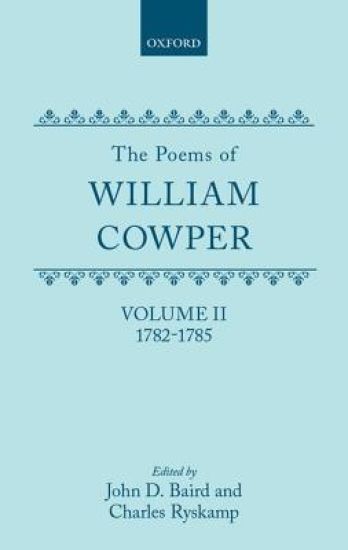
The Poems of William Cowper: Volume II: 1782-1785
This volume includes some of Cowper's finest works, among them such well-known short poems as `The Poplar-Field', `Epitaph on a Hare', `On the Loss of the Royal George' (here restored to the form in which Cowper wrote it, and accompanied by the music for which it was written), and `The Diverting History of John Gilpin' which, two years after its first anonymous publication in a newspaper, suddenly achieved huge popularity in a series of public readings. It also contains Cowper's masterpiece, The Task - one of the most approachable of the great English poems. Cowper's blank verse is a supple instrument, capable of every effect, from the parody-georgic on the growing of cucumbers to the visionary conclusion of Book VI. At the centre of the poem stands the poet himself, presented with wry humour and deep poignancy. The texts are based on manuscripts as well as early editions of the poetry, and are supplied with textual annotation and commentary. In the case of The Task, this is the first fully annotated edition for over a hundred years; its commentary relates the poem to the period in which it was written more fully than any previous edition.