

Kirjahaku
Etsi kirjoja tekijän nimen, kirjan nimen tai ISBN:n perusteella.
1000 tulosta hakusanalla Alessandro Filadelfeo


Adaptive Designs for Sequential Treatment Allocation
Alessandro Baldi Antognini; Alessandra Giovagnoli
CRC Press Inc
2015
sidottu
Adaptive Designs for Sequential Treatment Allocation presents a rigorous theoretical treatment of the results and mathematical foundation of adaptive design theory. The book focuses on designing sequential randomized experiments to compare two or more treatments incorporating information accrued along the way. The authors first introduce the terminology and statistical models most commonly used in comparative experiments. They then illustrate biased coin and urn designs that only take into account past treatment allocations as well as designs that use past data, such as sequential maximum likelihood and various types of doubly adaptive designs. The book also covers multipurpose adaptive experiments involving utilitarian choices and ethical issues. It ends with adaptive methods that include covariates in the design. The appendices present basic tools of optimal design theory and address Bayesian adaptive designs.This book helps readers fully understand the theoretical properties behind various adaptive designs. Readers are then equipped to choose the best design for their experiment.
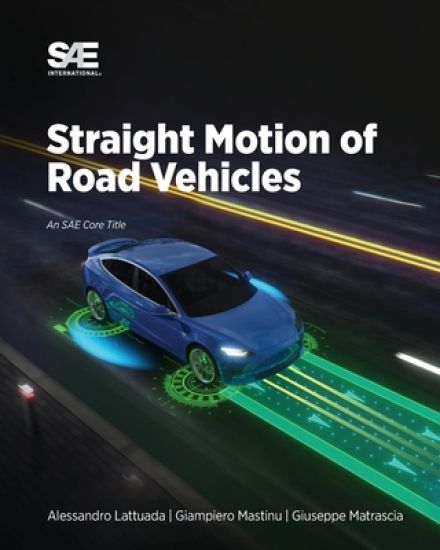
Straight Motion of Road Vehicles explores the straight motion of road vehicles with particular focus on the role played by tires, vehicle suspensions, and road cross slope. The authors consider vehicles currently in production as well as automated vehicles, which are likely to become more prevalent in the future. This work will lead to the production of safer, smarter, and more comfortable vehicles, enabling engineering solutions for vehicles that naturally run straight ahead, saving fuel and minimizing tire wear.

Injection Technologies and Mixture Formation Strategies For Spark Ignition and Dual-Fuel Engines
Alessandro Ferrari; Pietro Pizzo
SAE International
2022
nidottu
Fuel injection systems and performance is fundamental to combustion engine performance in terms of power, noise, efficiency, and exhaust emissions. There is a move toward electric vehicles (EVs) to reduce carbon emissions, but this is unlikely to be a rapid transition, in part due to EV batteries: their size, cost, longevity, and charging capabilities as well as the scarcity of materials to produce them. Until these isssues are resolved, refining the spark-ignited engine is necessary address both sustainability and demand for affordable and reliable mobility. Even under policies oriented to smart sustainable mobility, spark-ignited engines remain strategic, because they can be applied to hybridized EVs or can be fueled with gasoline blended with bioethanol or bio-butanol to drastically reduce particulate matter emissions of direct injection engines in addition to lower CO2 emissions.In this book, Alessandro Ferrari and Pietro Pizzo provide a full review of spark-ignited engine fuel injection systems. The most popular typologies of fuel injection systems are considered, with special focus on state-of-the-art solutions. Dedicated sections on the methods for air mass evaluation, fuel delivery low-pressure modules, and the specific subsystems for idle, cold start, and warm-up control are also included. The authors pay special attention to mixture formation strategies, as they are a fundamental theme for SI engines. An exhaustive overview of fuel injection technologies is provided, and mixture formation strategies for spark ignited combustion engines are considered. Fuel Injection Systems illustrates the performance of these systems and will also serve as a reference for engineers who are active in the aftermarket, offering detailed information on fuel injection system solutions that are mounted in older vehicles.
Souslin Quasi-Orders and Bi-Embeddability of Uncountable Structures
Alessandro Andretta; Luca Motto Ros
AMERICAN MATHEMATICAL SOCIETY
2022
nidottu

On the Nodal Set of Solutions to a Class of Nonlocal Parabolic Equations
Alessandro Audrito; Susanna Terracini
AMERICAN MATHEMATICAL SOCIETY
2024
nidottu

Storia del Calcio Italiano Giornata per Giornata Stagione 1993/94: Serie A, Coppa Italia, Nazionale, Coppe Europee, Mondiali, Europei a cura di Alessandro Calaciura Copyright 2022

Avete mai cercato un abbraccio? un amore vero? Vi siete mai innamorati perdutamente di qualcuno o avete sognato di farlo anche se abita in un pianeta distante, anche se disturba il pensiero della gente? Un percorso poetico quello di Alessandro De Chirico, giovane studente genovese, che vuole insegnare che dove esiste amore e tempo non esiste ne razionalita e neppure la purezza delle nostre azioni. Una sola cosa accomuna gli amori piu belli, la nostra voglia di cambiare, di sognare: le panchine. E' in una panchina che scappa il primo bacio, e da una panchina che, quando sei solo, vorresti cambiare veramente.
Storia del calcio Italiano giornata per giornata dal 1991 ai Mondiali del Qatar 2022. Cronologia: Serie A, Nazionale, Campionati del Mondo, Europei, Coppa Italia, Supercoppa Italiana, Champions League, Coppa delle Coppe, Coppa UEFA, Europa League. A cura di Alessandro Calaciura

"Jet elettrici" e la guida completa ai segreti della piu affascinante disciplina del modellismo dinamico. Oggi la tecnica della ventola intubata ci offre l'opportunita di riprodurre jet a costi accessibili, e la scelta di materiale tecnico per il "modellista ventolaro" e vasta, valida e affidabile, se viene usata con criterio. E per fare un jet ormai non c'e piu bisogno di affrontare grosse spese. Il volume spiega tutto quel che c'e da sapere per scegliere, allestire, far volare e ottimizzare un jet edf, insegna le ecniche di pilotaggio, da consigli e trucchi per ottenere il massimo dal tuo jet. Un libro senza astrusi diagrammi e complicate formule matematiche, ma con dentro tutta l'esperienza e la pratica di un grande aeromodellista: Alessandro Ginestri, noto come Staudacher 300 nella community del Barone Rosso, il piu grande forum italiano di aeromodellismo. Questo libro non e stato scritto da uno scienziato per degli specialisti, ma da un praticone per dei praticanti.


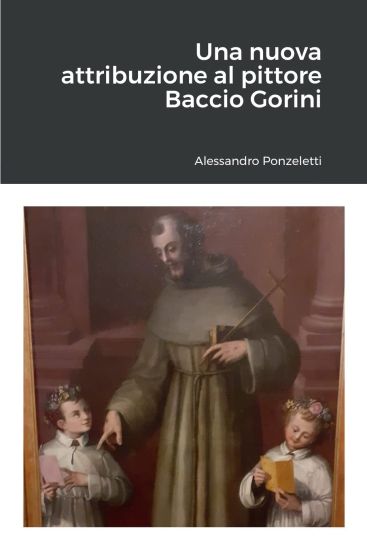
Il fortuito ritrovamento di un'opera tardo manierista nel mercato antiquario italiano porta ad ipotizzare, in assenza di firma e documentazione diretta, un'attribuzione stilistica all'artista fiorentino Bartolomeo Gorini (detto "Baccio"), spostatosi nei primi anni del XVII secolo in Sardegna, a Sassari, divenendo uno dei principali artisti del territorio e formatore della successiva generazione di pittori del nord ovest dell'isola. Nel volume si ricostruisce la possibile storia della nascita e committenza dell'opera.
The concepts of economic backwardness, Asiatic despotism and orientalism have strongly influenced perceptions of modernization, democracy and economic growth over the last three centuries. This book provides an original view of Russian and Asian history that views both in a global perspective. Via this analysis, Alessandro Stanziani opens new dimensions in the study of state formation, the global slave trade, warfare and European and Asian growth. After Oriental Despotism questions conventional oppositions between Europe and Asia. By revisiting the history of Eurasia in this context, the book offers a serious challenge to existing ideas about the aims and goals of economic growth.