Kirjojen hintavertailu. Mukana 11 244 527 kirjaa ja 12 kauppaa.

Kirjahaku

Etsi kirjoja tekijän nimen, kirjan nimen tai ISBN:n perusteella.

1000 tulosta hakusanalla Benedict Boo

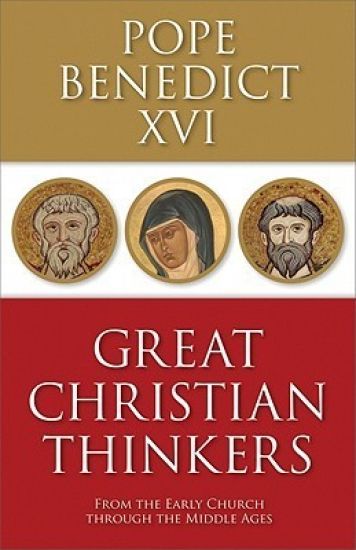
Great Christian Thinkers

Great Christian Thinkers

Benedict XVI

Augsburg Fortress
2011
pokkari
In brief portraits, Pope Benedict XVI offers engaging, perceptive, and edifying sketches of some of the great thinkers and writers of Christianity. Pope Benedict discusses notable theologians from East and West but also many figures whose primary witness was as ascetics, poets, mystics, and missionaries. His pieces are not only illuminating historical sketches but also often surprisingly personal reflective meditations on the perennial changes of theology, spirituality, devotion, and corporate religious lifein short, of thinking about and wrestling daily with the mysteries that envelop all our lives and struggles.Always with an eye to their deepest religious convictions and struggles, the Holy Father presents these great thinkers' importance for the church and for Christian life today.Great Christian Thinkers is an openminded look at the tradition and is written for Catholics and Protestants alike.
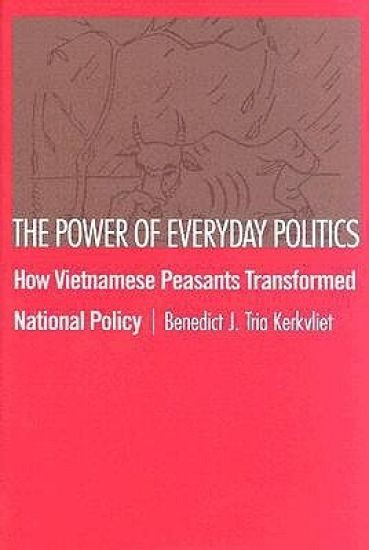
The Power of Everyday Politics

The Power of Everyday Politics

Benedict J. Tria Kerkvliet

Cornell University Press
2005
sidottu
Ordinary people's everyday political behavior can have a huge impact on national policy: that is the central conclusion of this book on Vietnam. In telling the story of collectivized agriculture in that country, Benedict J. Tria Kerkvliet uncovers a history of local resistance to national policy and gives a voice to the villagers who effected change. Not through open opposition but through their everyday political behavior, villagers individually and in small, unorganized groups undermined collective farming and frustrated authorities' efforts to correct the problems. The Power of Everyday Politics is an authoritative account, based on extensive research in Vietnam's National Archives and in the Red River Delta countryside, of the formation of collective farms in northern Vietnam in the late 1950s, their enlargement during wartime in the 1960s and 1970s, and their collapse in the 1980s. As Kerkvliet shows, the Vietnamese government eventually terminated the system, but not for ideological reasons. Rather, collectivization had become hopelessly compromised and was ultimately destroyed largely by the activities of villagers. Decollectivization began locally among villagers themselves; national policy merely followed. The power of everyday politics is not unique to Vietnam, Kerkvliet asserts. He advances a theory explaining how everyday activities that do not conform to the behavior required by authorities may carry considerable political weight.
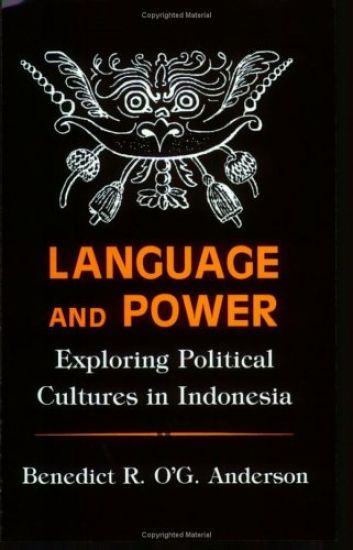
Language and Power

Language and Power

Benedict R. O'G. Anderson

Cornell University Press
1990
pokkari
In this lively book, Benedict R. O'G Anderson explores the cultural and political contradictions that have arisen from two critical facts in Indonesian history—that while the Indonesian nation is young, the Indonesian state is ancient, originating in the early seventeenth-century Dutch conquests; and that contemporary politics are conducted in a new language, Bahasa Indonesia, by peoples (especially the Javanese) whose cultures are rooted in medieval times. Analyzing a spectrum of examples from classical poetry to public monuments and cartoons, Anderson deepens our understanding of the interaction between modern and traditional notions of power, the meditation of power by language, and the development of national consciousness.This volume brings together eight of Anderson's most influential essays written over the past two decades. Most of the essays address aspects of Javanese political culture—from the early nineteenth century, when the Javanese did not yet have words for politics, colonialism, society, or class, through the early nationalism of the 1900s, to the era of independence after World War II, when deep internal tensions exploded into large-scale massacres. In the first group of essays Anderson considers how power was imagined in traditional Javanese society, and how these imaginings shaped Indonesia's modern politics. Other essays focus on the significance of the incongruences between the egalitarian, ironizing national language through which modern Indonesia has been imagined and the powerful influence of the hierarchical, authoritarian Javanese official culture. Finally, two essays on consciousness illuminate the crucial eras before and after the rise of Indonesia's nationalist movement. One reflects on Javanese intellectuals' phantasmagoric efforts to keep imagining "Java" as the island was overrun by colonial capitalism and absorbed into the huge, heterogeneous Netherlands East Indies; the second traces the transition from old culture to new nation through the autobiography of an eminent Javanese first-generation nationalist politician.
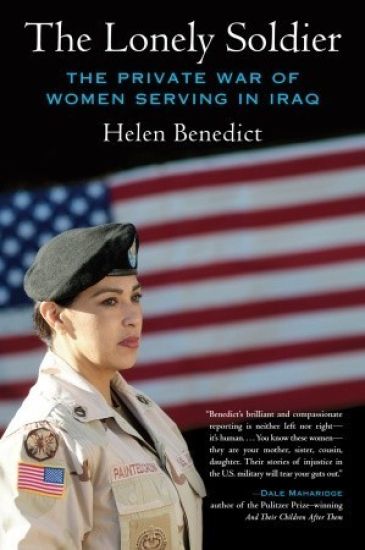
The Lonely Soldier

The Lonely Soldier

Benedict Helen

Beacon Press
2010
pokkari
"The Lonely Soldier"--the inspiration for the documentary "The Invisible War"--vividly tells the stories of five women who fought in Iraq between 2003 and 2006--and of the challenges they faced while fighting a war painfully alone. More American women have fought and died in Iraq than in any war since World War Two, yet as soldiers they are still painfully alone. In Iraq, only one in ten troops is a woman, and she often serves in a unit with few other women or none at all. This isolation, along with the military's deep-seated hostility toward women, causes problems that many female soldiers find as hard to cope with as war itself: degradation, sexual persecution by their comrades, and loneliness, instead of the camaraderie that every soldier depends on for comfort and survival. As one female soldier said, "I ended up waging my own war against an enemy dressed in the same uniform as mine." In "The Lonely Soldier," Benedict tells the stories of five women who fought in Iraq between 2003 and 2006. She follows them from their childhoods to their enlistments, then takes them through their training, to war and home again, all the while setting the war's events in context. We meet Jen, white and from a working-class town in the heartland, who still shakes from her wartime traumas; Abbie, who rebelled against a household of liberal Democrats by enlisting in the National Guard; Mickiela, a Mexican American who grew up with a family entangled in L.A. gangs; Terris, an African American mother from D.C. whose childhood was torn by violence; and Eli PaintedCrow, who joined the military to follow Native American tradition and to escape a life of Faulknerian hardship. Between these stories, Benedict weaves those of the forty other Iraq War veterans she interviewed, illuminating the complex issues of war and misogyny, class, race, homophobia, and post-traumatic stress disorder. Each of these stories is unique, yet collectively they add up to a heartbreaking picture of the sacrifices women soldiers are making for this country. Benedict ends by showing how these women came to face the truth of war and by offering suggestions for how the military can improve conditions for female soldiers-including distributing women more evenly throughout units and rejecting male recruits with records of violence against women. Humanizing, urgent, and powerful, "The Lonely Soldier" is a clarion call for change.
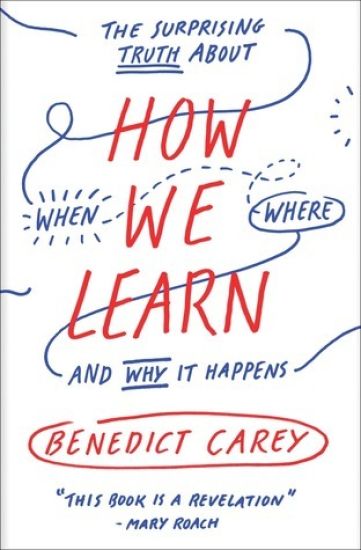
How We Learn: The Surprising Truth about When, Where, and Why It Happens
From an early age, it is drilled into our heads: Restlessness, distraction, and ignorance are the enemies of success. We're told that learning is all self-discipline, that we must confine ourselves to designated study areas, turn off the music, and maintain a strict ritual if we want to ace that test, memorize that presentation, or nail that piano recital.But what if almost everything we were told about learning is wrong? And what if there was a way to achieve more with less effort?In How We Learn, award-winning science reporter Benedict Carey sifts through decades of education research and landmark studies to uncover the truth about how our brains absorb and retain information. What he discovers is that, from the moment we are born, we are all learning quickly, efficiently, and automatically; but in our zeal to systematize the process we have ignored valuable, naturally enjoyable learning tools like forgetting, sleeping, and daydreaming. Is a dedicated desk in a quiet room really the best way to study? Can altering your routine improve your recall? Are there times when distraction is good? Is repetition necessary? Carey's search for answers to these questions yields a wealth of strategies that make learning more a part of our everyday lives-and less of a chore.By road testing many of the counterintuitive techniques described in this book, Carey shows how we can flex the neural muscles that make deep learning possible. Along the way he reveals why teachers should give final exams on the first day of class, why it's wise to interleave subjects and concepts when learning any new skill, and when it's smarter to stay up late prepping for that presentation than to rise early for one last cram session. And if this requires some suspension of disbelief, that's because the research defies what we've been told, throughout our lives, about how best to learn.The brain is not like a muscle, at least not in any straightforward sense. It is something else altogether, sensitive to mood, to timing, to circadian rhythms, as well as to location and environment. It doesn't take orders well, to put it mildly. If the brain is a learning machine, then it is an eccentric one. In How We Learn, Benedict Carey shows us how to exploit its quirks to our advantage.
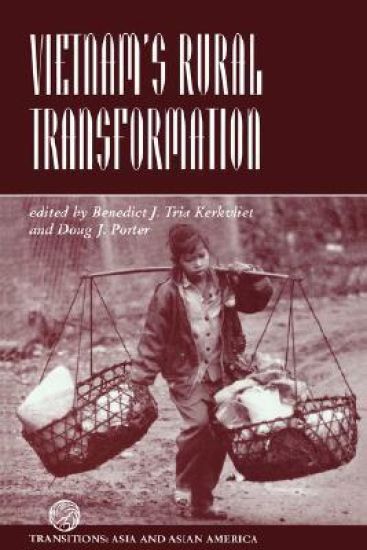
Vietnam's Rural Transformation

Vietnam's Rural Transformation

Benedict J Tria Kerkvliet; Ford Foundation- Martha Uniack; Doug J Porter

Westview Press Inc
1997
nidottu
Since the mid-1980s, Vietnam has experienced remarkable economic, political, and social change. This is the first study in English to focus on rural Vietnam — where nearly 80 per cent of its people live, much of its economic production occurs, and political upheavals earlier this century changed the course of history. Analyzing the impact of economic liberalization on the countryside, the contributors note that despite significant improvements in real income for most rural Vietnamese, poverty is still pronounced and socio-economic inequality appears to be growing. The poorest now appear to have less access to educational and health services. Environmental conditions also pose significant problems. Highlighting the dynamic political scene in Vietnam, the contributors also consider the interplay between national policymaking and local pressures and activity.
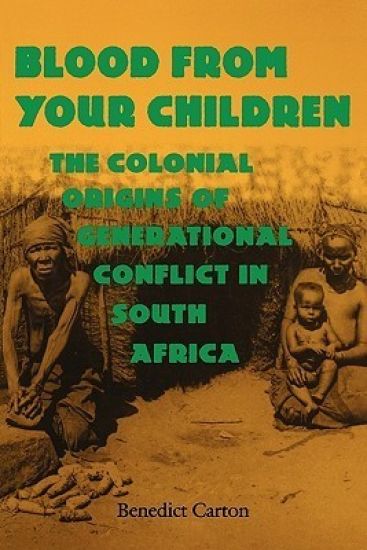
Blood from Your Children

Blood from Your Children

Benedict Carton

University of Virginia Press
2000
nidottu
The South African revolution of the 1990s was predicated on the energy of a youthful black population; one that has been increasingly at odds with its elders since the onset of industrialization in the late-19th-century. This book traces the origins and history of this conflict.
Spiritual Passages

Spiritual Passages

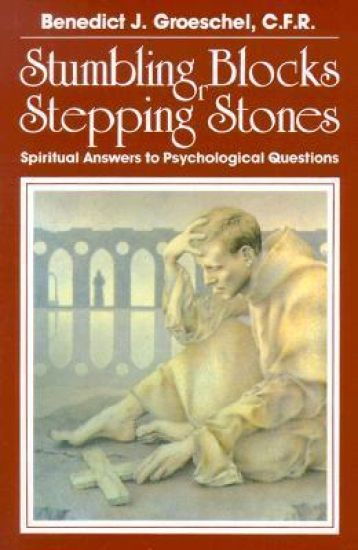
Benedict J. Groeschel

Crossroad Publishing Co ,U.S.
1984
nidottu
From renowned EWTN host and author Benedict Groeschel, this is a profound discussion of the stages of spiritual growth. Of special note is the way Groeschel identifies four distinct approaches to God (as Beauty, Truth, the Good, and the One) and shows how each leads to a different kind of spiritual path or pilgrimage.
Unexplained Fever

Unexplained Fever

Benedict Isaac; Serge Kernbaum; Michael J. Burke

CRC Press Inc
1990
sidottu
This book covers pathophysiology of fever, the general approach to the febrile patient, and offers a systematic, in-depth discussion regarding the differential diagnosis of unexplained fever. The authors define an unexplained fever as a fever which lasts a minimum of 14 days and whose etiology is not known. This one-of-a-kind publication highlights the main causes of fever, specifically infectious diseases, cancer, connective tissue diseases, various rare disorders, plus etiologies which are often ignored. Also, laboratory and medical imaging techniques for diagnosing fevers are included. Written in a comprehensive, unrepetitious style, this "must-have" resource includes such aspects as the history of the fever, a review of published cases, the approach to the patient, and an analytical review. This up-to-date volume is an indispensable guide that should be read by physicians, surgeons, internists, microbiologists and other medical professionals.
The Fate of Rural Hell

The Fate of Rural Hell

Benedict Anderson

Seagull Books London Ltd
2016
nidottu
In 1975, when political scientist Benedict Anderson reached Wat Phai Rong Wua, a massive temple complex in rural Thailand conceived by Buddhist monk Luang Phor Khom, he felt he had wandered into a demented Disneyland. One of the world's most bizarre tourist attractions, Wat Phai Rong Wua was designed as a cautionary museum of sorts; its gruesome statues depict violent and torturous scenes that showcase what hell may be like. Over the next few decades, Anderson, who is best known for his work, Imagined Communities, found himself transfixed by this unusual amalgamation of objects, returning several times to see attractions like the largest metal-cast Buddha figure in the world and the Palace of a Hundred Spires. The concrete statuaries and perverse art in Luang Phor's personal museum of hell included, \u201cside by side, an upright human skeleton in a glass cabinet and a life-size replica of Michelangelo's gigantic nude David, wearing fashionable red underpants from the top of which poked part of a swollen, un-Florentine penis,\u201d alongside dozens of statues of evildoers being ferociously punished in their afterlife. In The Fate of Rural Hell, Anderson unravels the intrigue of this strange setting, endeavoring to discover what compels so many Thai visitors to travel to this popular spectacle and what order, if any, inspired its creation. At the same time, he notes in Wat Phai Rong Wua the unexpected effects of the gradual advance of capitalism into the far reaches of rural Asia. Both a one-of-a-kind travelogue and a penetrating look at the community that sustains it, The Fate of Rural Hell is sure to intrigue and inspire conversation as much as Wat Phai Rong Wua itself.
Atomic Coffin

Atomic Coffin

Benedict Anning

TRANSWORLD PUBLISHERS LTD
2026
sidottu
December 1984. SIS field asset Heidi Sperling [codename Thistle] exfiltrates from East Berlin with the only copy of a critical intelligence coup – a naval log containing a solitary message received from a previously unidentified Soviet Typhoon ballistic missile nuclear submarine. Incredulously – impossibly – it seems the vessel, known only as TK-15, has been sitting motionless and undetected in the waters between Scotland and Iceland for three years. Now NATO needs to be on high alert because that one-word message reads: ACTIVE . . . Picked up from East Germany’s Baltic Coast by the Royal Navy’s hunter-killer submarine HMS Viking, Heidi is thrown into a mission to find and investigate the TK-15, and must confront her own paralytic fear of the ocean’s crushing black depths and HMS Viking’s seemingly hostile crew. When her only apparent ally, Executive Officer Daniel Vickers, disappears as they investigate the TK-15, she realises this modified submarine is far more than a Soviet experiment to gain a strategic upper hand in the nuclear arms race. Here, at the bottom of the ocean, the Soviets have – for good or ill – delved too long and too deep into what lies beneath and woken something far, far worse. As Heidi’s own reality twists around her, as an unknowable force drives the crew to madness and cripples the British submarine's defences. Can Heidi control her own escalating fears and help bring the Soviet craft to the surface? Or will she make the ultimate sacrifice in order to stop the mysterious TK-15 from completing its dark and terrible mission?
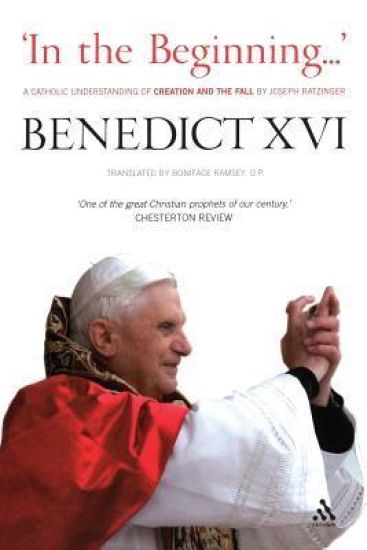
In the Beginning

In the Beginning

Benedict XVI

Burns Oates Ltd
2005
nidottu
These five superb homilles by the newly elected Pope, Benedict XVI, provide a clear and biblically based explanation of the first few chapters of the Bible. Reissued with a new cover and ISBN to celebrate Joseph Ratzinger's election. While the stories of the creation of the world and the fall of humankind have often given rise to conflict - fundamentalists twist them into science and history while rationalists approach them by 'divorcing God from creation' - the Pope presents the Catholic middle ground in explaining the vitality of these early Old Testament writings. Beginning each homily with the selected text from Genesis, the Pope discusses, in turn, God the creator, the meaning of the biblical creation accounts, the creation of human beings, sin and salvation, and the consequences of faith in creation. In the Beginning presents a compelling account of the value of creation for our times.
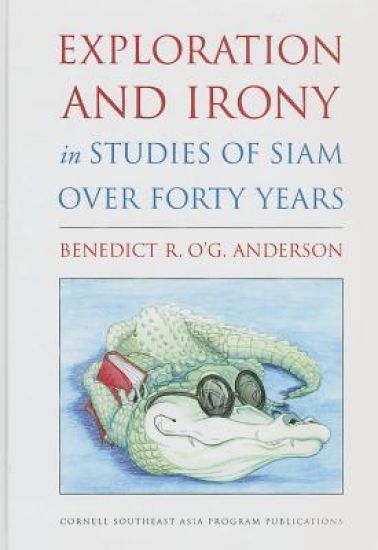
Exploration and Irony in Studies of Siam Over Forty Years

Exploration and Irony in Studies of Siam Over Forty Years

Benedict R. O'G. Anderson

Southeast Asia Program Publications, Cornell University
2014
pokkari
Benedict R. O'G. Anderson is internationally recognized for his groundbreaking work on the politics and cultures of Indonesia, Thailand, and the Philippines. His early studies of Indonesia led to the publication of Imagined Communities: Reflections on the Origin and Spread of Nationalism, a book that profoundly changed the way people understand modern states. Banned from returning to Indonesia after his interpretation of the 1965 coup was published, Anderson shifted his attention to Thailand. This collection of essays gathers in one book Anderson's iconoclastic analyses of Siam (Thailand), its political institutions and bloody upheavals, its literature, authors, and contemporary cinema. The volume begins with the challenging essay "Studies of the Thai State: The State of Thai Studies," followed by chapters that map shifts of power between the Left and Right in Thailand, the role of the monarchy, and the significance of the military. The final essays track Anderson's own evolution as a student of Siam and his growing, more playful interest in billboards, ephemera, and film. Together, these works demonstrate an extraordinary scholar's commitment to exploring Thailand.
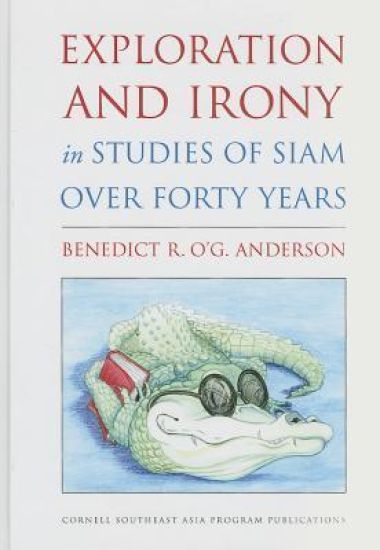
Exploration and Irony in Studies of Siam Over Forty Years

Exploration and Irony in Studies of Siam Over Forty Years

Benedict R. O'G. Anderson

Southeast Asia Program Publications, Cornell University
2014
sidottu
Benedict R. O'G. Anderson is internationally recognized for his groundbreaking work on the politics and cultures of Indonesia, Thailand, and the Philippines. His early studies of Indonesia led to the publication of Imagined Communities: Reflections on the Origin and Spread of Nationalism, a book that profoundly changed the way people understand modern states. Banned from returning to Indonesia after his interpretation of the 1965 coup was published, Anderson shifted his attention to Thailand. This collection of essays gathers in one book Anderson's iconoclastic analyses of Siam (Thailand), its political institutions and bloody upheavals, its literature, authors, and contemporary cinema. The volume begins with the challenging essay "Studies of the Thai State: The State of Thai Studies," followed by chapters that map shifts of power between the Left and Right in Thailand, the role of the monarchy, and the significance of the military. The final essays track Anderson's own evolution as a student of Siam and his growing, more playful interest in billboards, ephemera, and film. Together, these works demonstrate an extraordinary scholar's commitment to exploring Thailand.
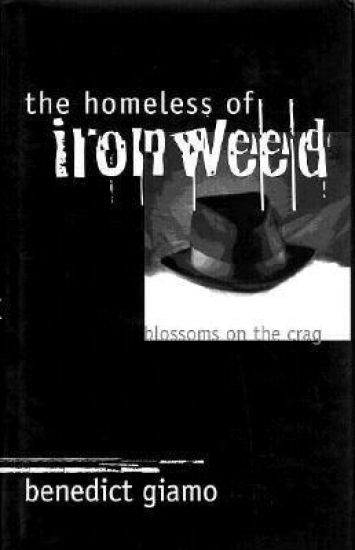
The Homeless of Ironwood

The Homeless of Ironwood

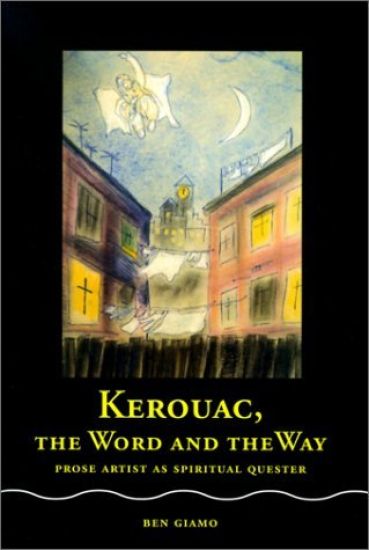
Benedict Giano

University of Iowa Press
1997
sidottu
The Homeless of Ironweed is both a meditation on Kennedy's remarkable novel and a literary and cultural analysis. Benedict Giamo's explorations of the social conditions, cultural meanings, and literary representations of classic and contemporary homelessness in America and abroad inform his understanding of the literary merit and social resonance of Ironweed. Throughout Giamo remains grounded in a close reading of the novel. He moves with great relevance from Dante to Kenneth Burke, from Sartre to Robert Jay Lifton, to locate meaning and value in the lives of Kennedy's characters; by extension, with intelligence and compassion, he regards the lives of the homeless who wander through our streets and shefters today.
Ethics of Health Care

Ethics of Health Care

Benedict M. Ashley; Kevin D. O'Rourke

Georgetown University Press
2002
pokkari
In the wake of the successful cloning of animals and the promises - or fears - of stem cell research, new discoveries in science and medicine need more than ever to be accompanied by careful moral reflection. Contending that concern over the ethical dimensions of these and other like issues are no longer just in the domain of those involved in medical practice, the third edition of "Ethics of Health Care" claims these are vital topics that should matter deeply to all citizens. While stressing the Catholic tradition in health care ethics, "Ethics of Health Care" is ecumenical, incorporating a broader Christian tradition as well as humanistic approaches, and takes as common ground for mutual understanding the Universal Declaration of Human Rights of the United Nations. This new third edition is a response to the many developments in theology and the startlingly rapid changes in the arenas of medicine and health care over the past decade, from the dominance of managed care to increased surgery on an "outpatient" basis; from hospice care for the dying to the increasing use of drugs in the treatment of mental illness. Revised and thoroughly up-to-date, this third edition continues with its valuable teaching aids, including case studies, study questions, chapter summaries, a bibliography, and complete index.