Kirjojen hintavertailu. Mukana 11 342 296 kirjaa ja 12 kauppaa.

Kirjahaku

Etsi kirjoja tekijän nimen, kirjan nimen tai ISBN:n perusteella.

1000 tulosta hakusanalla Claire Oshetsky

Myths And Monsters: A Colouring Book

Myths And Monsters: A Colouring Book

Claire Greenhalgh

Lulu.com
2019
nidottu
A colouring book filled with 25 different illustrations of mythological creatures, cryptids, and monsters. Images include a variety of detail and complexity levels.This book is suitable for all ages but some images may appeal more to older colourists due to the level of detail.Pages are printed with blank backs, so as to prevent colour from bleeding onto other pages.
Leave the Dogs at Home

Leave the Dogs at Home

Claire S. Arbogast

Indiana University Press
2015
pokkari
Claire and Jim were friends, lovers, and sometimes enemies for 27 years. In order to get health insurance, they finally married, calling their anniversary the "It Means Absolutely Nothing" day. Then Jim was diagnosed with cancer. With ever-decreasing odds of survival, punctuated by arcs of false hope, Jim's deteriorating health altered their well-established independence as they became caregiver and patient, sharing intimacy as close as their own breaths. A year and a half into their marriage, Jim died from lung/brain cancer. Sustained by good dogs and gardening through the two years of madness that followed, Claire soldiered through home repairs, career disaster, genealogy quests, and "dating for seniors" trying to build a better life on the debris of her old one. Leave the Dogs at Home maps and plays with the stages of grief. Delightfully confessional, it challenges persistent, yet outdated, societal norms about relationships, and finds relief in whimsy, pop culture, and renewed spirituality.
Threading the Needle

Threading the Needle

Claire Nicholas

INDIANA UNIVERSITY PRESS
2026
sidottu
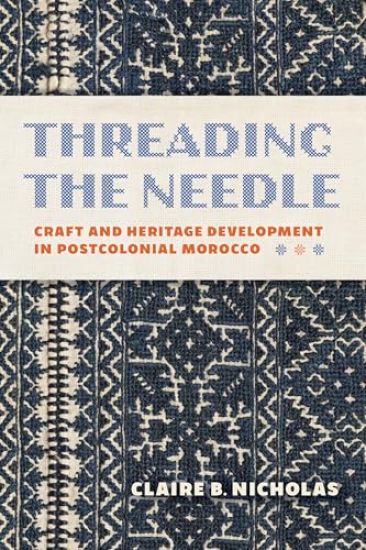
For over a century, French colonial and Moroccan postcolonial state-building efforts have tethered cultural identity to the preservation and "modernization" of artisanal craftwork. Twenty-first-century heritage development initiatives have aimed to turn the "traditional" know-how of skilled textile producers into "modern" knowledge, reeducating, reorganizing, and reorienting artisans with new markets in mind. These efforts obscure artisans' own perspectives on their labor, reducing makers and the iconic embroidered and woven textiles they create to romantic stereotypes about "traditional craft." Threading the Needle seeks to correct these clichés. Drawing on analysis of policy documents and archives, media and heritage representations of craft, and nearly two years of fieldwork, this historically grounded ethnography brings readers into the everyday lives of Moroccan textile artisans and other craft experts. Author Claire B. Nicholas foregrounds the diversity of artisans' voices and experiences as they practice patience (sabr) in learning their trades, managing their lives, and navigating state-led efforts to promote craft heritage. Even as artisans participate in training programs and cooperative forms that resemble those of the colonial era, they accomplish parallel objectives that sustain personal and community values. The result is the continuance of local categories of belonging, authority, and sociality, alongside the extension of state influence over the future of craft. With close attention to the practices and possibilities of living heritage in postcolonial Morocco, Threading the Needle reveals the interwoven relationships between tradition, culture, craft, and political authority.
Threading the Needle

Threading the Needle

Claire Nicholas

INDIANA UNIVERSITY PRESS
2026
pokkari
For over a century, French colonial and Moroccan postcolonial state-building efforts have tethered cultural identity to the preservation and "modernization" of artisanal craftwork. Twenty-first-century heritage development initiatives have aimed to turn the "traditional" know-how of skilled textile producers into "modern" knowledge, reeducating, reorganizing, and reorienting artisans with new markets in mind. These efforts obscure artisans' own perspectives on their labor, reducing makers and the iconic embroidered and woven textiles they create to romantic stereotypes about "traditional craft." Threading the Needle seeks to correct these clichés. Drawing on analysis of policy documents and archives, media and heritage representations of craft, and nearly two years of fieldwork, this historically grounded ethnography brings readers into the everyday lives of Moroccan textile artisans and other craft experts. Author Claire B. Nicholas foregrounds the diversity of artisans' voices and experiences as they practice patience (sabr) in learning their trades, managing their lives, and navigating state-led efforts to promote craft heritage. Even as artisans participate in training programs and cooperative forms that resemble those of the colonial era, they accomplish parallel objectives that sustain personal and community values. The result is the continuance of local categories of belonging, authority, and sociality, alongside the extension of state influence over the future of craft. With close attention to the practices and possibilities of living heritage in postcolonial Morocco, Threading the Needle reveals the interwoven relationships between tradition, culture, craft, and political authority.
Trouble Showed the Way

Trouble Showed the Way

Claire Cone Robertson

Indiana University Press
1997
pokkari
"Robertson's book represents a powerful contribution to African social, economic, and women's history. Highly recommended." —Choice "An important resource for anyone interested in the history of women and trade in modern Kenya. . . ." —International Journal of African Historical Studies " . . . a landmark study, meticulously executed and written. . . . it will have a wide impact on some of the most significant questions facing the disciplines of history, anthropology, political science, and development economics." —Gracia Clark Herskovitz Award-winner Claire Robertson employs a variety of approaches to analyze and weave together this wide-ranging study. Her book provides an extensive case study of historical transformations in gender, agriculture, residence, and civil society. Based on archival documents, library sources (fiction and nonfiction, primary and secondary), surveys and oral histories, participant observation, and quantitative and qualitative analysis, Robertson breaks new ground by focusing on traders in one commodity, dried staples, and comparing and contrasting the evolution of women's trade with men's trade.
Transforming Images

Transforming Images

Claire Farago; Donna Pierce

Pennsylvania State University Press
2006
sidottu
“Style” has been one of the cornerstones not only of the modern discipline of art history but also of social and cultural history. In this volume, the writers consider the inadequacy of the concept of style as essential to a person, people, place, or period. While the subject matter of this book is specific to religious practices and artifacts from New Mexico between the eighteenth and twentieth centuries, the implications of these investigations are far reaching historically, methodologically, and theoretically.The essays collected here explore the Catholic instruments of religious devotion produced in New Mexico from around 1760 until the radical transformation of the tradition in the twentieth century. The writers in this volume make three key arguments. First, they make a case for bringing new theoretical perspectives and research strategies to bear on the New Mexican materials and other colonial contexts. Second, they demonstrate that the New Mexican materials provide an excellent case study for rethinking many of the most fundamental questions in art-historical and anthropological study. Third, the authors collectively argue that the New Mexican images had, and still have, importance to diverse audiences and makers. The distinctiveness of New Mexican santos consists not only in their subjects (which conformed to Catholic Reformation tastes) but also in elements that may appear to have been “merely decorative”: graphically striking and frequently elaborate abstract design motifs and landscape references. Despite their anonymity, the images are, as a group, readily distinguished from local products anywhere else in the Spanish colonial world. This distinctiveness suggests that we should inquire not so much about the individual identities of their makers as about the collective identity of the society and place that produced and used them.
Rewriting Magic

Rewriting Magic

Claire Fanger

Pennsylvania State University Press
2015
sidottu
In Rewriting Magic, Claire Fanger explores a fourteenth-century text called The Flowers of Heavenly Teaching. Written by a Benedictine monk named John of Morigny, the work all but disappeared from the historical record, and it is only now coming to light again in multiple versions and copies. While John’s book largely comprises an extended set of prayers for gaining knowledge, The Flowers of Heavenly Teaching is unusual among prayer books of its time because it includes a visionary autobiography with intimate information about the book’s inspiration and composition. Through the window of this record, we witness how John reconstructs and reconsecrates a condemned liturgy for knowledge acquisition: the ars notoria of Solomon. John’s work was the subject of intense criticism and public scandal, and his book was burned as heretical in 1323. The trauma of these experiences left its imprint on the book, but in unexpected and sometimes baffling ways. Fanger decodes this imprint even as she relays the narrative of how she learned to understand it. In engaging prose, she explores the twin processes of knowledge acquisition in John’s visionary autobiography and her own work of discovery as she reconstructed the background to his extraordinary book. Fanger’s approach to her subject exemplifies innovative historical inquiry, research, and methodology. Part theology, part historical anthropology, part biblio-memoir, Rewriting Magic relates a story that will have deep implications for the study of medieval life, monasticism, prayer, magic, and religion.
Rewriting Magic

Rewriting Magic

Claire Fanger

Pennsylvania State University Press
2017
pokkari
In Rewriting Magic, Claire Fanger explores a fourteenth-century text called The Flowers of Heavenly Teaching. Written by a Benedictine monk named John of Morigny, the work all but disappeared from the historical record, and it is only now coming to light again in multiple versions and copies. While John’s book largely comprises an extended set of prayers for gaining knowledge, The Flowers of Heavenly Teaching is unusual among prayer books of its time because it includes a visionary autobiography with intimate information about the book’s inspiration and composition. Through the window of this record, we witness how John reconstructs and reconsecrates a condemned liturgy for knowledge acquisition: the ars notoria of Solomon. John’s work was the subject of intense criticism and public scandal, and his book was burned as heretical in 1323. The trauma of these experiences left its imprint on the book, but in unexpected and sometimes baffling ways. Fanger decodes this imprint even as she relays the narrative of how she learned to understand it. In engaging prose, she explores the twin processes of knowledge acquisition in John’s visionary autobiography and her own work of discovery as she reconstructed the background to his extraordinary book. Fanger’s approach to her subject exemplifies innovative historical inquiry, research, and methodology. Part theology, part historical anthropology, part biblio-memoir, Rewriting Magic relates a story that will have deep implications for the study of medieval life, monasticism, prayer, magic, and religion.
Profiting from the Plains

Profiting from the Plains

Claire M. Strom

University of Washington Press
2007
pokkari
Profiting from the Plains looks at two inextricably linked historical movements in the United States: the westward expansion of the great Northern Railway and the agricultural development of the northern plains. Claire Strom explores the persistent, idiosyncratic attempts by the Great Northern to boost agricultural production along its rail routes from St. Paul to Seattle between 1878 and 1917. Lacking a federal land grant, the Great Northern could not make money through land sales like other railways. It had to rely on haulage to make a profit, and the greatest potential for increasing haulage lay in farming.The energetic and charismatic owner of the Great Northern Railway, James J. Hill, spearheaded most of the initiatives undertaken by his corporation to boost agricultural production. He tried, often unsuccessfully, to persuade farmers of the profitability of his methods, which were largely based on his personal farming experience. When Hill's initial efforts to increase haulage failed, he shifted his focus to working with outside agencies and institutions, often providing them with the funding to pursue projects he hoped would profit his railroad. At the time, state and federal agencies were also promoting agricultural development through irrigation, conservation, and dryland farming, but their agendas often clashed with those of the Great Northern Railway. Because Hill failed to grasp the extent to which politicians' goals differed from those of the railroad, his use of federal expertise to promote agricultural change often backfired. But despite these obstacles, the railroad magnate ironically remained among the last defenders of the small-scale farmer modeled on Jeffersonian idealism.This fascinating story of railroad politics and development ties into themes of corporate and federal sponsorship, which are increasingly recognized as fundamental to western history. As the first scholarly examination of James J. Hill's agricultural enterprises, Profiting from the Plains makes an important contribution to the biography of the popular and controversial Hill, as well as to western and environmental history.
Profiting from the Plains

Profiting from the Plains

Claire M. Strom

University of Washington Press
2015
sidottu
Profiting from the Plains looks at two inextricably linked historical movements in the United States: the westward expansion of the great Northern Railway and the agricultural development of the northern plains. Claire Strom explores the persistent, idiosyncratic attempts by the Great Northern to boost agricultural production along its rail routes from St. Paul to Seattle between 1878 and 1917. Lacking a federal land grant, the Great Northern could not make money through land sales like other railways. It had to rely on haulage to make a profit, and the greatest potential for increasing haulage lay in farming.The energetic and charismatic owner of the Great Northern Railway, James J. Hill, spearheaded most of the initiatives undertaken by his corporation to boost agricultural production. He tried, often unsuccessfully, to persuade farmers of the profitability of his methods, which were largely based on his personal farming experience. When Hill's initial efforts to increase haulage failed, he shifted his focus to working with outside agencies and institutions, often providing them with the funding to pursue projects he hoped would profit his railroad. At the time, state and federal agencies were also promoting agricultural development through irrigation, conservation, and dryland farming, but their agendas often clashed with those of the Great Northern Railway. Because Hill failed to grasp the extent to which politicians' goals differed from those of the railroad, his use of federal expertise to promote agricultural change often backfired. But despite these obstacles, the railroad magnate ironically remained among the last defenders of the small-scale farmer modeled on Jeffersonian idealism.This fascinating story of railroad politics and development ties into themes of corporate and federal sponsorship, which are increasingly recognized as fundamental to western history. As the first scholarly examination of James J. Hill's agricultural enterprises, Profiting from the Plains makes an important contribution to the biography of the popular and controversial Hill, as well as to western and environmental history.
If You Don't Laugh You'll Cry

If You Don't Laugh You'll Cry

Claire Schmidt

University of Wisconsin Press
2017
sidottu
A deeply humanistic ethnography of prison workers and their dark humorAmerica is fascinated by prisons and prison culture, but few Americans understand what it is like to work in corrections. Claire Schmidt, whose extended family includes three generations of Wisconsin prison workers, introduces readers to penitentiary officers and staff as they share stories, debate the role of corrections in American racial politics and social justice, and talk about the important function of humor in their jobs.In a state that locks up a disproportionate number of men and women of color, white prison workers occupy a complicated social position as representatives of institutional authority and bearers of social stigma. The job, by turns dangerous, dull, or dehumanizing, is aided by a quick wit, comedic timing, and verbal agility. The men and women who do this work rely on storytelling, practical jokes, and sarcasm to bond with each other, build flexible relationships with inmates, and create personal identities that work in and out of prison. Schmidt shows how this humorous occupational culture both upholds and undermines prisons as social institutions.Issues of power and race, as well as sex and gender, infuse Schmidt’s groundbreaking analysis, and she also engages with current scholarship about identity, occupational folklore, and family narrative. This eye-opening, provocative book reveals the invisible culture, beliefs, and aesthetics embedded in workplace humor.
Empathy in Politics and Leadership

Empathy in Politics and Leadership

Claire Yorke

YALE UNIVERSITY PRESS
2025
sidottu
A timely account of empathy, politics, and leadership, showing how greater understanding and connection can foster trust, community, and innovation Empathy has become a cliché of contemporary politics, often espoused but rarely understood. Yet the capacity to understand other worldviews is neither easy nor comfortable. Seeing through others’ eyes requires strength, courage, integrity, and an ability to reason across the harshest political divides—and, in a time of heightened marginalization, disconnection, and polarization, empathy in our leaders and across society is vitally important. Claire Yorke offers the first account of empathy in politics and leadership, drawing on examples from across the world. Including model leaders like Nelson Mandela and Jacinda Ardern, as well as figures on the right such as Donald Trump who mobilize different forms of empathy, Yorke asks what distinguishes empathetic leaders from the rest, and examines why empathy is essential for a more human-centred politics. Demonstrating empathy’s radical potential and disputing its connotations of weakness, this book shows how we can build a political ecosystem that fosters belonging and engagement—and cultivate the necessary dialogue to find common ground.
The Trauma of Burnout: How to Manage Your Nervous System Before It Manages You
Break the cycle of anxiety, trauma, and burnout with the help of this informative tool book, written by a professional trauma therapist and clinical psychologist. "There is only one book on burnout that I will be recommending - this one. We need one in every office and every staff room around the world."―Dr. Julie Smith, bestselling author of Why Has Nobody Told Me This Before Our human nervous system has the power to cope with high stress, but not when it's been ground down by the relentless stimuli of today's world. Over time, these persistent demands leave us burnt out because our nervous system is stuck in survival mode, making it hard to make decisions, rest, solve problems, be mindful, and set boundaries. We slip into autopilot, making us prone to mistakes, and toxic behaviors that impact professional and personal relationships. Trauma of Burnout will help you avoid these vicious cycles by teaching you: -Why stress is different from burnout -How burnout stifles your ability to think clearly -Why you cannot 'think' your way out of it -Cultural beliefs and psychological patterns that cause burnout -How to soothe your nervous system back to full capacity using techniques and compassion. By the end of this book, you will have tools to thrive amidst the challenges of modern life through positive interactions and relationships.
The Emperor's Children

The Emperor's Children

Claire Messud

Knopf Doubleday Publishing Group
2007
nidottu
Three friends on the verge of their thirties--beautiful, sophisticated Marina Thwaite, daughter of a noted journalist; Danielle, a quiet TV producer; and Julius, a cash-poor freelance writer--make their way through New York City, until Marina's idealistic, college-dropout cousin, Bootie, arrives to complicate all of their lives. Reader's Guide available. Reprint. 200,000 first printing.
The Woman Upstairs

The Woman Upstairs

Claire Messud

Knopf Doubleday Publishing Group
2014
nidottu
NATIONAL BESTSELLER - Told with urgency, intimacy, and piercing emotion, this New York Times bestselling novel is the riveting confession of a woman awakened, transformed, and abandoned by a desire for a world beyond her own. A New York Times Book Review Notable Book - A Washington Post Top Ten Book of the Year - A Chicago Tribune Noteworthy Book - A Huffington Post Best Book - A Boston Globe Best Book of the Year - A Kirkus Best Fiction Book - A Goodreads Best Book "Exhilarating... Ingenious... an intricate puzzle of self-belief and self-doubt." --The New York Times Book Review Nora Eldridge is a reliable, but unremarkable, friend and neighbor, always on the fringe of other people's achievements. But the arrival of the Shahid family--dashing Skandar, a Lebanese scholar, glamorous Sirena, an Italian artist, and their son, Reza--draws her into a complex and exciting new world. Nora's happiness pushes her beyond her boundaries, until Sirena's careless ambition leads to a shattering betrayal.