Kirjojen hintavertailu. Mukana 11 717 486 kirjaa ja 12 kauppaa.

Kirjahaku

Etsi kirjoja tekijän nimen, kirjan nimen tai ISBN:n perusteella.

1000 tulosta hakusanalla David B. Chesebrough

The Ethics of Research with Human Subjects

The Ethics of Research with Human Subjects

David B. Resnik

Springer International Publishing AG
2025
sidottu
In The Ethics of Research with Human Subjects, David B. Resnik, PhD/JD, develops and defends an approach to thinking about ethical and policy dilemmas in research with human subjects based on the notion of trust. The book explains why trust is important not only between investigators and research subjects but also between and among other stakeholders involved in the research enterprise, including research staff, sponsors, institutions, communities, oversight committees, government agencies, and the public. Dr. Resnik argues that trust should be viewed as a distinct ethical principle for research with human subjects that complements other principles, such as respect for human dignity, beneficence, non-maleficence, and justice. The book applies the principle of trust to numerous issues, including informed consent, confidentiality/privacy, risk minimization, risk/benefit assessment, payments for participation, protection of vulnerable subjects, experimental design, research integrity, and research oversight. The book also includes discussions of the history of research involving human subjects, moral theories and principles, contemporary cases, and proposed regulatory reforms. This second edition of The Ethics of Research with Human Subjects expands upon and clarifies arguments and ideas discussed in the first edition and includes new material on emerging issues in human research ethics, including community-based research, citizen science research, challenge studies (including COVID-19 experiments), public health research, genomics research, social and behavioral research, xenotransplantation experiments, alternative study designs, and research with people with compromised decisional capacity, employees, and students. The book is of interest to undergraduate and graduate students who are studying ethical and policy issues related to research with human subjects, as well as scientists and scholars who are interested learning more about the issues and thinking about what it means to promote integrity and trust in research with human subjects.

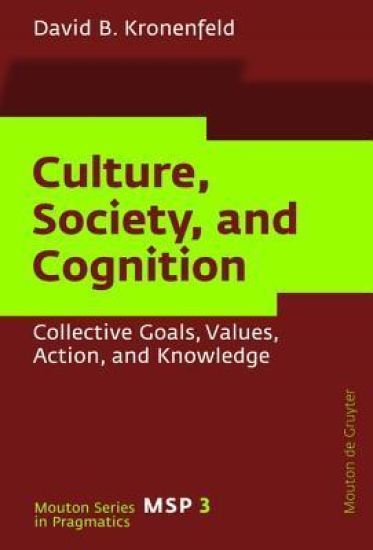
Culture, Society, and Cognition

Culture, Society, and Cognition

David B. Kronenfeld

De Gruyter Mouton
2008
sidottu
This theoretically motivated approach to pragmatics (vs. semantics) produces a radically new view of culture and its role vis-a-vis society. Understanding what words mean in use requires an open-ended recourse to pragmatic cultural knowledge. Cultural knowledge makes up a productive conceptual system. Members of a cultural community share the system but not all of the system's content, making culture a system of parallel distributed cognition. This book presents such a system, and then elaborates a version of "cultural models" that relates actions to goals, values, emotional content, and context, and that allows both systematic generative capacity and systematic variation across cultural and subcultural groups. Such models are offered as the basic units of cultural action. Culture thus conceived is shown as a tool that people use rather than as something deeply internalized in their psyches.
The Making of an Anglo-Jewish Scholar

The Making of an Anglo-Jewish Scholar

David B. Ruderman

De Gruyter
2025
sidottu
This book is a study of the life and thought of the Polish Jew Solomon Yom Tov Bennett (1767-1838), who immigrated to London where he spent the last forty years of his life. In focusing on Bennett’s learned life, it underscores the significance of this singular writer, artist, and public figure, especially his remarkable dual interests in art and thought, his biblical scholarship, his social and intellectual connections with some of the most famous and accomplished Christian intellectuals of London, and his self-determination to complete his life-long ambition of serving Western civilization by correcting and rewriting the entire standard edition of the English Old Testament. Bennett’s Christian associates respected his learning and were willing to accept him as a Jew in their ranks. His integration into the upper echelons of the Christian literary establishment—dukes, jurists, theologians, and other scholars—did not impede his loyalty to his faith. On the contrary, Bennett’s Christian friends made him more Jewish, more convinced of Judaism’s moral force, and more secure in his own skin as a member of a proud minority among Christian elites supposedly liberated, so he hoped, from the dark hostility of the Christian past. His supreme act of translating the Bible constituted the ultimate payback he could offer the altruistic Christians he had met, open to welcoming him not despite his Jewishness but because of it. Bennett’s transformation from a Polish Jewish immigrant to a proud Anglo-Jew exemplifies a unique path of modern Jewish life and self-reflection, one ultimately shaped by the particular ambiance of his newly adopted country.
The Conifers: Genomes, Variation and Evolution

The Conifers: Genomes, Variation and Evolution

David B. Neale; Nicholas C. Wheeler

Springer International Publishing AG
2019
sidottu
This book is the first comprehensive volume on conifers detailing their genomes, variations, and evolution. The book begins with general information about conifers such as taxonomy, geography, reproduction, life history, and social and economic importance. Then topics discussed include the full genome sequence, complex traits, phenotypic and genetic variations, landscape genomics, and forest health and conservation. This book also synthesizes the research included to provide a bigger picture and suggest an evolutionary trajectory. As a large plant family, conifers are an important part of economic botany. The group includes the pines, spruces, firs, larches, yews, junipers, cedars, cypresses, and sequoias. Of the phylum Coniferophyta, conifers typically bear cones and evergreen leaves. Recently, there has been much data available in conifer genomics with the publication of several crop and non-crop genome sequences. In addition to their economic importance,conifers are an important habitat for humans and animals, especially in developing parts of the world. The application of genomics for improving the productivity of conifer crops holds great promise to help provide resources for the most needy in the world.
The Ethics of Research with Human Subjects

The Ethics of Research with Human Subjects

David B. Resnik

Springer International Publishing AG
2018
sidottu
This book provides a framework for approaching ethical and policy dilemmas in research with human subjects from the perspective of trust. It explains how trust is important not only between investigators and subjects but also between and among other stakeholders involved in the research enterprise, including research staff, sponsors, institutions, communities, oversight committees, government agencies, and the general public. The book argues that trust should be viewed as a distinct ethical principle for research with human subjects that complements other principles, such as autonomy, beneficence, non-maleficence, and justice. The book applies the principle of trust to numerous issues, including informed consent, confidentiality, risk minimization, risks and benefits, protection of vulnerable subjects, experimental design, research integrity, and research oversight.This work also includes discussions of the history of research involving human subjects, moral theories and principles,contemporary cases, and proposed regulatory reforms. The book is useful for undergraduate and graduate students studying ethical policy issues related to research with human subjects, as well as for scientists and scholars who are interested in thinking about this topic from the perspective of trust.
The Ethics of Research with Human Subjects

The Ethics of Research with Human Subjects

David B. Resnik

Springer International Publishing AG
2019
nidottu
This book provides a framework for approaching ethical and policy dilemmas in research with human subjects from the perspective of trust. It explains how trust is important not only between investigators and subjects but also between and among other stakeholders involved in the research enterprise, including research staff, sponsors, institutions, communities, oversight committees, government agencies, and the general public. The book argues that trust should be viewed as a distinct ethical principle for research with human subjects that complements other principles, such as autonomy, beneficence, non-maleficence, and justice. The book applies the principle of trust to numerous issues, including informed consent, confidentiality, risk minimization, risks and benefits, protection of vulnerable subjects, experimental design, research integrity, and research oversight.This work also includes discussions of the history of research involving human subjects, moral theories and principles,contemporary cases, and proposed regulatory reforms. The book is useful for undergraduate and graduate students studying ethical policy issues related to research with human subjects, as well as for scientists and scholars who are interested in thinking about this topic from the perspective of trust.
History of the Seventy-Fifth Regiment of Indiana Infantry Voluteers
History of the Seventy-Fifth Regiment of Indiana Infantry Voluteers - its organization, campaigns, and battles, 1862-65 is an unchanged, high-quality reprint of the original edition of 1893. Hansebooks is editor of the literature on different topic areas such as research and science, travel and expeditions, cooking and nutrition, medicine, and other genres. As a publisher we focus on the preservation of historical literature. Many works of historical writers and scientists are available today as antiques only. Hansebooks newly publishes these books and contributes to the preservation of literature which has become rare and historical knowledge for the future.
Evolution of Jaw Mechanisms in Ornithopod Dinosaurs

Evolution of Jaw Mechanisms in Ornithopod Dinosaurs

David B. Weishampel

Springer-Verlag Berlin and Heidelberg GmbH Co. K
1984
nidottu
The Ornithopoda, one of five suborders within the Ornithischia, was originally proposed by Marsh in 1881 to include those bipedal dinosaurs possessing a predentary bone fitted over the rostral end of the mandibles. Ornithopods as recognized today can be further characterized by moderately long facial skele- tons equipped with well-developed, often toothless premaxillae and moderate to large external nares. Maxillary and dentary dentitions vary but usually consist of at least one replacement series beneath the functional set; some have many rows of successional teeth. Tooth morphology suggests ornithopods were suc- cessful herbivores but, as will be discussed, the precise way(s) in which ornitho- pods chewed their food, hence lending important information about their tro- phic position, has not been settled. Postcranially, ornithopods show specializa- tion for bipedality in hindlimb construction and lack well-developed protective structures on their flanks, back, and tail. The Ornithopoda can itself be divided into five families: Fabrosauridae, He- terodontosauridae, Hypsilophodontidae, 19uanodontidae, and Hadrosauridae (subdivided into the subfamilies Hadrosaurinae and Lambeosaurinae). Both fabrosaurids and heterodontosaurids, first known from the Late Triassic and Early Jurassic of Argentina and South Africa, were small animals differing in details of cranial, dental, and appendicular anatomy. Fabrosaurids are be- lieved to represent the basal ornithopod stock (Galton 1972, 1978; Thulborn 1970a, 1972). During the Jurassic, ornithopods underwent major radiations that included the medium- to large-sized Hypsilophodontidae and the large- bodied Iguanodontidae, both of which survived into the Cretaceous.
Perceived Fairness of an Ethnic Validation Procedure

Perceived Fairness of an Ethnic Validation Procedure

David B Oxendine

AV Akademikerverlag
2012
pokkari
Revision with unchanged content. Procedures are used today in all areas of life including business, education, politics and as in this study to determine a group's ethnicity. American Indians are the only ethnic group that must petition to the United States government to validate legally their ethnicity. The current study explores the effects of social exclusion threat negative affect on the evaluated fairness of a procedure that functions to validate ethnic membership using the Dimensional Voice Model (Bane, 1994). Participants consisted of 120 (60 = female, 60 = male) college students. The study design was a 2 (Gender) X 2 (Justification) X 3 (Procedure) factorial between-groups experimental design. Based on social exclusion theory, individuals may experience high levels of negative affect when they perceive a threat of exclusion from a group. It was hypothesized that a procedure designed to validate ethnic mem-bership will result in social exclusion threat negative affect. A procedure designed to validate ethnic membership was hypothesized as being evaluated as un-fair. Of two procedural justi-fi-ca-tions, the Department of Homeland Security (DHS) and the National Science Foun-da-tion (NSF), the National Science Foundation (NSF) justification was hypothesized as being per-ceived fairer.
Understanding High-Dimensional Spaces

Understanding High-Dimensional Spaces

David B. Skillicorn

Springer-Verlag Berlin and Heidelberg GmbH Co. K
2012
nidottu
High-dimensional spaces arise as a way of modelling datasets with many attributes. Such a dataset can be directly represented in a space spanned by its attributes, with each record represented as a point in the space with its position depending on its attribute values. Such spaces are not easy to work with because of their high dimensionality: our intuition about space is not reliable, and measures such as distance do not provide as clear information as we might expect. There are three main areas where complex high dimensionality and large datasets arise naturally: data collected by online retailers, preference sites, and social media sites, and customer relationship databases, where there are large but sparse records available for each individual; data derived from text and speech, where the attributes are words and so the corresponding datasets are wide, and sparse; and data collected for security, defense, law enforcement, and intelligence purposes, where the datasets arelarge and wide. Such datasets are usually understood either by finding the set of clusters they contain or by looking for the outliers, but these strategies conceal subtleties that are often ignored. In this book the author suggests new ways of thinking about high-dimensional spaces using two models: a skeleton that relates the clusters to one another; and boundaries in the empty space between clusters that provide new perspectives on outliers and on outlying regions. The book will be of value to practitioners, graduate students and researchers.
CGM and CGI

CGM and CGI

David B. Arnold; Peter R. Bono

Springer-Verlag Berlin and Heidelberg GmbH Co. K
2011
nidottu
We have written this book principally for users and practitioners of computer graphics. In particular, system designers, independent software vendors, graphics system implementers, and application program developers need to understand the basic standards being put in place at the so-called Virtual Device Interface and how they relate to other industry standards, both formal and de facto. Secondarily, the book has been targetted at technical managers and advanced students who need some understanding of the graphics standards and how they fit together, along with a good overview of the Computer Graphics Interface (CGI) proposal and Computer Graphics Metafile (CGM) standard in particular. Part I, Chapters 1,2, and 3; Part II, Chapters 10 and 11; Part III, Chapters 15, 16, and 17; and some of the Appendices will be of special interest. Finally, these same sections will interest users in government and industry who are responsible for selecting, buying and installing commercial implementations of the standards. The CGM is already a US Federal Information Processing Standard (FIPS 126), and we expect the same status for the CGI when its development is completed and it receives formal approval by the standards-making bodies.