Title: Sketching Rambles in Holland ... With illustrations by the author and Edwin A. Abbey.Publisher: British Library, Historical Print EditionsThe British Library is the national library of the United Kingdom. It is one of the world's largest research libraries holding over 150 million items in all known languages and formats: books, journals, newspapers, sound recordings, patents, maps, stamps, prints and much more. Its collections include around 14 million books, along with substantial additional collections of manuscripts and historical items dating back as far as 300 BC.The GEOGRAPHY & TOPOGRAPHY collection includes books from the British Library digitised by Microsoft. Offering some insights into the study and mapping of the natural world, this collection includes texts on Babylon, the geographies of China, and the medieval Islamic world. Also included are regional geographies and volumes on environmental determinism, topographical analyses of England, China, ancient Jerusalem, and significant tracts of North America. ++++The below data was compiled from various identification fields in the bibliographic record of this title. This data is provided as an additional tool in helping to insure edition identification: ++++ British Library Boughton, George Henry.; Abbey, Edwin Austin.; 1885, 1884]. xvi. 342 p.; 8 . 010271.ee.1.
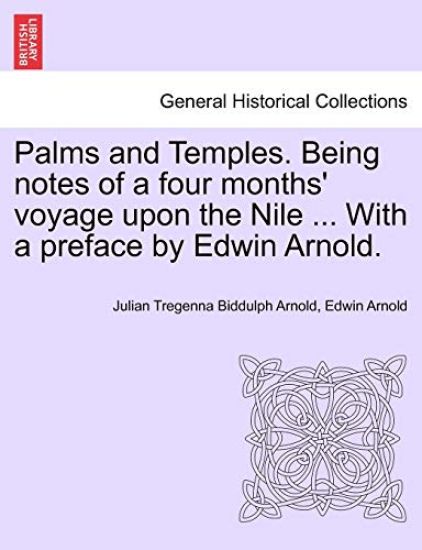
Title: Palms and Temples. Being notes of a four months' voyage upon the Nile ... With a preface by Edwin Arnold.Publisher: British Library, Historical Print EditionsThe British Library is the national library of the United Kingdom. It is one of the world's largest research libraries holding over 150 million items in all known languages and formats: books, journals, newspapers, sound recordings, patents, maps, stamps, prints and much more. Its collections include around 14 million books, along with substantial additional collections of manuscripts and historical items dating back as far as 300 BC.The GENERAL HISTORICAL collection includes books from the British Library digitised by Microsoft. This varied collection includes material that gives readers a 19th century view of the world. Topics include health, education, economics, agriculture, environment, technology, culture, politics, labour and industry, mining, penal policy, and social order. ++++The below data was compiled from various identification fields in the bibliographic record of this title. This data is provided as an additional tool in helping to insure edition identification: ++++ British Library Arnold, Julian Tregenna Biddulph; Arnold, Edwin; 1882. xii. 271 p.; 8 . 10095.f.1.
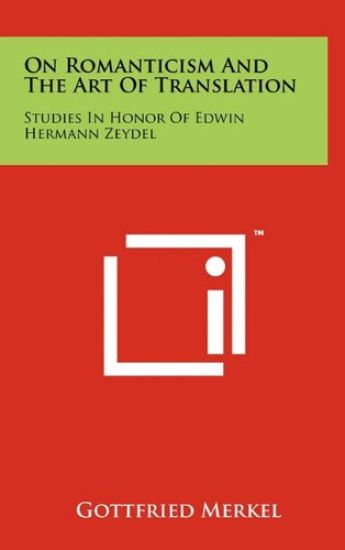
On Romanticism and the Art of Translation: Studies in Honor of Edwin Hermann Zeydel is a collection of essays edited by Gottfried Merkel that celebrates the life and work of Edwin Hermann Zeydel, a prominent scholar of German Romanticism and translation studies. The book includes contributions from scholars in the fields of literature, translation, and philosophy, who explore the intersections between Romanticism and translation, as well as Zeydel's own contributions to the study of these topics.The essays cover a wide range of topics, including the role of translation in the development of Romantic literature, the translation of Romantic texts into different languages, and the philosophical implications of translation. The contributors also examine the influence of Romanticism on translation theory and practice, and the ways in which translation can be seen as a creative act in its own right.Overall, On Romanticism and the Art of Translation offers a rich and varied exploration of the connections between Romanticism and translation, and provides valuable insights into the work of one of the most important scholars in the field.Text Is In English And German.This scarce antiquarian book is a facsimile reprint of the old original and may contain some imperfections such as library marks and notations. Because we believe this work is culturally important, we have made it available as part of our commitment for protecting, preserving, and promoting the world's literature in affordable, high quality, modern editions, that are true to their original work.