Kirjojen hintavertailu. Mukana 11 342 296 kirjaa ja 12 kauppaa.

Kirjahaku

Etsi kirjoja tekijän nimen, kirjan nimen tai ISBN:n perusteella.

1000 tulosta hakusanalla Ernest Hello

Black Manhood in James Baldwin, Ernest J. Gaines, and August Wilson
Challenging the standard portrayals of Black men in African American literature From Frederick Douglass to the present, the preoccupation of black writers with manhood and masculinity is a constant. Black Manhood in James Baldwin, Ernest J. Gaines, and August Wilson explores how in their own work three major African American writers contest classic portrayals of black men in earlier literature, from slave narratives through the great novels of Richard Wright and Ralph Ellison. Keith Clark examines short stories, novels, and plays by Baldwin, Gaines, and Wilson, arguing that since the 1950s the three have interrupted and radically dismantled the constricting literary depictions of black men who equate selfhood with victimization, isolation, and patriarchy. Instead, they have reimagined black men whose identity is grounded in community, camaraderie, and intimacy. Delivering original and startling insights, this book will appeal to scholars and students of African American literature, gender studies, and narratology.
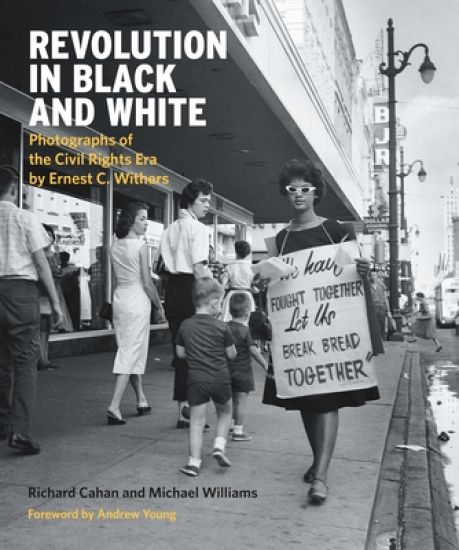
Revolution in Black and White: Photographs of the Civil Rights Era by Ernest Withers
Ernest C. Withers was one of the most prominent African-American photographers of the civil rights era. During the course of his work, he took thousands photographs that document the civil rights movement--from the Emmett Till trial in 1955 to the assassination of Martin Luther King in 1968. What set his work apart was that he goes beyond the political struggles to explain the civil rights movement that changed the country. Withers was primarily a local photographer, working as a freelancer for the Memphis World and Tri-State Defender starting in 1948. His photographs of the everyday world--bridge clubs, funerals, people at work and play, and street life--create a stunning record of what it was like to live in Memphis and the Mid-South. He was also a noted baseball photographer, documenting Negro League baseball in Memphis, and a noted music photographer, taking thousands of photographs of jazz, blues, rock 'n' roll and R&B performers. This book combines this work for the first time and uses first-hand accounts of people who lived in the South to explain these transformative years. The photographs, taken as bare-bones journalism, rises to the level of fine art decades later. They are also important examples of photojournalism, documenting decades of struggle in Memphis and the Mid-South. They serve as an important missing link in the civil rights narrative. In 2010, three years after his death, the Memphis Commercial Appeal newspaper published a series of articles that showed that Withers was a paid informant of the FBI. This book goes beyond the headlines to show how Withers created an essential record for all of us to better understand life in the South during this crucial era.
S.E.E.F.A.R. - Seeking in Ernest the Elevation of Female artists in Research
For centuries, Black Female Artist were scrubbed out of the art fraternity and as such lost fame and more importantly, fortunes by the powers that be at the time. Now, it is up to us, people with a conscience to fix the wrongs of the past. The arts in general and BFAs in particular, as described in this book, benefits not just individuals exposed to it, but the entire society by proving creative avenues to tap into our intellectual strengths and emotional feelings, thus impacting the masses and challenging the status quo. This book features over 500 BFAs or expatriates seeking to elevate the arts in some underdeveloped countries with their expertise, not only as artists themselves but by modeling art for others to learn from them. For reasons such as these, we need to support the arts and BFA artists by purchasing this book at https: //www.lulu.com/spotlight/indiana-robinson The works listed are brought to you by InJa Ink PPP - People, Production, and Promotion, an art collective that aims to feature the artistic and literary works BFAs and other artists as well
The Oral History of Capt. Ernest L. Schwab
A strength of this memoir is in demonstrating the versatility called for in an unrestricted line officer. Captain Schwab was involved in war-fighting, technological research and development, and politico-military affairs. After graduating from the Naval Academy in 1939, he served until 1941 in the battleship USS Pennsylvania (BB-38), which was flagship of the U.S. Fleet. He was a student at Submarine School, July-September 1941, then had wartime duty in submarines: 1941-42 in the USS Marlin (SS-205); 1942-43 in the USS Guardfish (SS-217); 1943-44 in the USS Darter (SS-227); and 1945 in the USS Capitaine (SS-336). He was executive officer and navigator in the Darter during the Battle of Leyte Gulf in October 1944. After the war he served in various billets at the New London Submarine Base, 1946-48, and spent a year, 1948-49, as a student at the Naval War College. From 1949 to 1951 commanded the USS Toro (SS-422) as part of Submarine Development Group Two. He was ashore from 1951 to 1954 in the Bureau of Ships, Washington, D.C., as head of the Underwater Sound Branch, which did research and development work on SOSUS. He commanded the destroyer USS Wedderburn (DD-684), 1954-56. Schwab did postgraduate work from 1956 to 1958 at the Fletcher School of Law and Diplomacy, Tufts University, Medford, Massachusetts, then served in OP-611, the political-military policy division of OpNav, 1958-60. In 1960-61 he was chief of staff to Commander Carrier Division 20 and in 1962-63 commanded the amphibious command ship USS Mount McKinley (AGC-7). In 1963-64 he served in the Office of the Secretary of Defense (International Security Affairs). From 1964 to 1970, first in uniform and then as a State Department civilian, he served in Europe at the headquarters of the North Atlantic Treaty Organization (NATO).
The Reminiscences of Rear Adm. Ernest M. Eller, USN (Ret.), vol. III
In the first of three volumes by a former Director of Naval History, Admiral Eller discusses his boyhood, midshipman years leading to graduation from the Naval Academy in 1925, duty in the battleships USS Utah (BB-31) and USS Texas (BB-35), and the submarine USS S-33 (SS-138). In the 1930s, he served two tours on the faculty of the Naval Academy, where he made the study of leadership a project. A characteristic of this volume is the admiral's ability to place events in the narrative into the broader context of history. For instance, in his discussion of duty with the U.S. Asiatic Fleet, he provides detailed descriptions of various places he visited while on leave in the Far East. In telling of his Utah service, he discusses the ship's role in enhancing fleet antiaircraft gunnery as World War II approached. The focus of nearly all of this second volume of Admiral Eller's oral history is World War II. He began with a tour of duty as an observer with the Royal Navy, including service on board the battlecruiser HMS Hood and battleship HMS Prince of Wales before they fought the German battleship Bismarck. When hostilities began for the United States he was gunnery officer of the aircraft carrier USS Saratoga (CV-3) and was on board when she was torpedoed. In the spring of 1942 he reported to the Pacific Fleet staff of Admiral Chester and served there throughout much of the rest of the war, working mostly in the gunnery section. He was both eyewitness and participant in a great deal of the planning and execution of the South Pacific and Central Pacific campaigns. Besides operating with Admiral Nimitz in Hawaii he made several trips to the forward area to see battle conditions firsthand. At war's end he commanded the attack transport USS Clay (APA-39). In the postwar period he had public information duty in San Francisco and then in the Navy Department in Washington. The concluding portion of Admiral Eller's memoir provides convincing evidence of the versatility that is called for in a Navy unrestricted line officer. Among other things, Eller's skills included use of oral and written communication on behalf of the service, diplomatic and strategic ability in dealing with overseas nations, and seamanship and tactical ability on board ship. What also comes through repeatedly is Eller's proactive nature in getting things going—ranging from trips throughout the Middle East to kick-starting many worthwhile projects concerned with naval history. Perhaps Admiral Eller is best remembered today for his longtime leadership and stewardship as Director of Naval History and Curator in the Office of Chief of Naval Operations, a role he fulfilled from 1956 to 1970. "As the head of the Naval History Division, he was clearly energetic," observes Paul Stillwell in his preface to this final volume. Admiral Eller "not only served as honcho for a wide variety of projects, but also he raised funds and performed hands-on work in many cases of gathering materials, editing manuscripts, and providing answers to the many questions that came to his office. The Navy Museum in the Washington Navy Yard stands as a tangible legacy of Eller's stewardship."
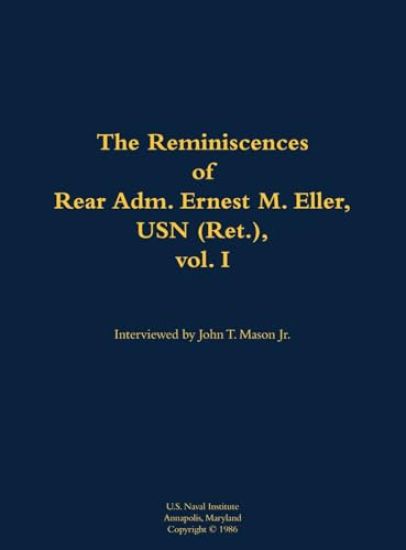
The Reminiscences of Rear Adm. Ernest M. Eller, USN (Ret.), vol. 1
In the first of three volumes by a former Director of Naval History, Admiral Eller discusses his boyhood, midshipman years leading to graduation from the Naval Academy in 1925, duty in the battleships USS Utah (BB-31) and USS Texas (BB-35), and the submarine USS S-33 (SS-138). In the 1930s, he served two tours on the faculty of the Naval Academy, where he made the study of leadership a project. A characteristic of this volume is the admiral's ability to place events in the narrative into the broader context of history. For instance, in his discussion of duty with the U.S. Asiatic Fleet, he provides detailed descriptions of various places he visited while on leave in the Far East. In telling of his Utah service, he discusses the ship's role in enhancing fleet antiaircraft gunnery as World War II approached. The focus of nearly all of this second volume of Admiral Eller's oral history is World War II. He began with a tour of duty as an observer with the Royal Navy, including service on board the battlecruiser HMS Hood and battleship HMS Prince of Wales before they fought the German battleship Bismarck. When hostilities began for the United States he was gunnery officer of the aircraft carrier USS Saratoga (CV-3) and was on board when she was torpedoed. In the spring of 1942 he reported to the Pacific Fleet staff of Admiral Chester and served there throughout much of the rest of the war, working mostly in the gunnery section. He was both eyewitness and participant in a great deal of the planning and execution of the South Pacific and Central Pacific campaigns. Besides operating with Admiral Nimitz in Hawaii he made several trips to the forward area to see battle conditions firsthand. At war's end he commanded the attack transport USS Clay (APA-39). In the postwar period he had public information duty in San Francisco and then in the Navy Department in Washington. The concluding portion of Admiral Eller's memoir provides convincing evidence of the versatility that is called for in a Navy unrestricted line officer. Among other things, Eller's skills included use of oral and written communication on behalf of the service, diplomatic and strategic ability in dealing with overseas nations, and seamanship and tactical ability on board ship. What also comes through repeatedly is Eller's proactive nature in getting things going—ranging from trips throughout the Middle East to kick-starting many worthwhile projects concerned with naval history. Perhaps Admiral Eller is best remembered today for his longtime leadership and stewardship as Director of Naval History and Curator in the Office of Chief of Naval Operations, a role he fulfilled from 1956 to 1970. "As the head of the Naval History Division, he was clearly energetic," observes Paul Stillwell in his preface to this final volume. Admiral Eller "not only served as honcho for a wide variety of projects, but also he raised funds and performed hands-on work in many cases of gathering materials, editing manuscripts, and providing answers to the many questions that came to his office. The Navy Museum in the Washington Navy Yard stands as a tangible legacy of Eller's stewardship."