Kirjojen hintavertailu. Mukana 12 390 323 kirjaa ja 12 kauppaa.

Kirjahaku

Etsi kirjoja tekijän nimen, kirjan nimen tai ISBN:n perusteella.

1000 tulosta hakusanalla F.C. Yee

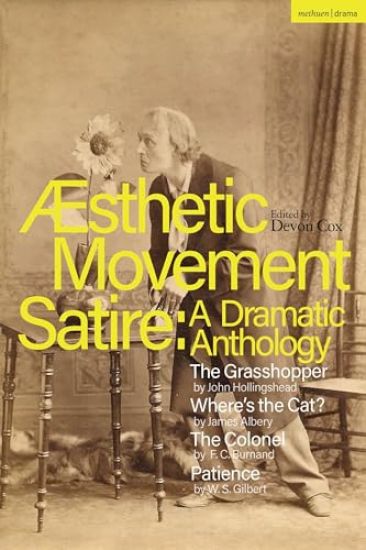
Aesthetic Movement Satire: A Dramatic Anthology

Aesthetic Movement Satire: A Dramatic Anthology

John Hollingshead; James Albery; F.C. Burnand; W.S. Gilbert

BLOOMSBURY PUBLISHING PLC
2024
sidottu
From long-haired ‘Fleshly Poets’ to intense, ‘ultra pre-Raphaelite’ artists, few stylistic movements in the history of art and literature have provoked the imagination and indignation of British playwrights as much as the Aesthetic Movement.During an intense and short-lived period from 1877 to 1881, the London stage saw fierce competition as playwrights and theatre managers raced to capture the zeitgeist, capitalizing on the unorthodox, eccentric and highly theatrical proponents of the Aesthetic Movement. The ‘quite too utterly utter’ Apostles of this new school were satirized to such an extent that the Illustrated London News (1881) complained that the London stage was ‘thickly sown over with a crop of lilies and sunflowers’, with ‘aesthetes in every burlesque and comic opera produced’. This edited volume brings the four key plays satirizing the Aesthetic Movement together for the first time in an easily accessible format, allowing scholars and students to discover their secrets:The Grasshopper by John Hollingshead (Gaiety Theatre, 1877)Where’s The Cat? by James Albery (Criterion, 1880)The Colonel by F.C. Burnand (Prince of Wales’s Theatre, 1881) Patience by W.S. Gilbert (Opera Comique/Savoy, 1881)Including a brief introduction by Dr. Devon Cox, providing background and context to the dynamic, symbiotic relationship between the Aesthetic Movement and the British stage, and complete with biographical notes and an introduction to each play, Aesthetic Movement Satire: A Dramatic Anthology shines a light on this explosive flashpoint in British Theatre
Emblems of Saints

Emblems of Saints

Augustus Jessopp; William Marsh; F C 1796-1872 Husenbeth

Sagwan Press
2018
pokkari
This work has been selected by scholars as being culturally important, and is part of the knowledge base of civilization as we know it. This work was reproduced from the original artifact, and remains as true to the original work as possible. Therefore, you will see the original copyright references, library stamps (as most of these works have been housed in our most important libraries around the world), and other notations in the work.This work is in the public domain in the United States of America, and possibly other nations. Within the United States, you may freely copy and distribute this work, as no entity (individual or corporate) has a copyright on the body of the work.As a reproduction of a historical artifact, this work may contain missing or blurred pages, poor pictures, errant marks, etc. Scholars believe, and we concur, that this work is important enough to be preserved, reproduced, and made generally available to the public. We appreciate your support of the preservation process, and thank you for being an important part of keeping this knowledge alive and relevant.
Structure Determination by X-Ray Crystallography

Structure Determination by X-Ray Crystallography

R.A. Palmer; M.F.C. Ladd

Springer-Verlag New York Inc.
2012
nidottu
X-ray crystallography provides us with the most accurate picture we can get of atomic and molecular structures in crystals. It provides a hard bedrock of structural results in chemistry and in mineralogy. In biology, where the structures are not fully crystalline, it can still provide valuable results and, indeed, the impact here has been revolutionary. It is still an immense field for young workers, and no doubt will provide yet more striking develop­ ments of a major character. It does, however, require a wide range of intellectual application, and a considerable ability in many fields. This book will provide much help. It is a very straightforward and thorough guide to every aspect of the subject. The authors are experienced both as research workers themselves and as teachers of standing, and this is shown in their clarity of exposition. There are plenty of iliustrations and worked examples to aid the student to obtain a real grasp of the subject.
The Letters of the Younger Pliny

The Letters of the Younger Pliny

Pliny The Younger; William Melmoth; F C T Bosanquet

Indoeuropeanpublishing.com
2019
nidottu
Gaius Plinius Caecilius Secundus, born Gaius Caecilius or Gaius Caecilius Cilo (61 - c. 113), better known as Pliny the Younger, was a lawyer, author, and magistrate of Ancient Rome. Pliny's uncle, Pliny the Elder, helped raise and educate him.Pliny the Younger wrote hundreds of letters, of which 247 survive and are of great historical value. Some are addressed to reigning emperors or to notables such as the historian Tacitus. Pliny served as an imperial magistrate under Trajan (reigned 98-117), and his letters to Trajan provide one of the few surviving records of the relationship between the imperial office and provincial governors.Pliny rose through a series of civil and military offices, the cursus honorum. He was a friend of the historian Tacitus and might have employed the biographer Suetonius on his staff. Pliny also came into contact with other well-known men of the period, including the philosophers Artemidorus and Euphrates the Stoic, during his time in Syria.Pliny was by birth of equestrian rank, that is, a member of the aristocratic order of equites (knights), the lower (beneath the senatorial order) of the two Roman aristocratic orders that monopolised senior civil and military offices during the early Empire. His career began at the age of 18 and initially followed a normal equestrian route. But, unlike most equestrians, he achieved entry into the upper order by being elected Quaestor in his late twenties.Pliny was active in the Roman legal system, especially in the sphere of the Roman centumviral court, which dealt with inheritance cases. Later, he was a well-known prosecutor and defender at the trials of a series of provincial governors, including Baebius Massa, governor of Baetica; Marius Priscus, governor of Africa; Gaius Caecilius Classicus, governor of Baetica; and most ironically in light of his later appointment to this province, Gaius Julius Bassus and Varenus Rufus, both governors of Bithynia and Pontus.Pliny's career is commonly considered as a summary of the main Roman public charges and is the best-documented example from this period, offering proof for many aspects of imperial culture. Effectively, Pliny crossed all the principal fields of the organization of the early Roman Empire. It is an achievement for a man to have not only survived the reigns of several disparate emperors, especially the much-detested Domitian, but also to have risen in rank throughout. (wikipedia.org)
The Letters of the Younger Pliny

The Letters of the Younger Pliny

Pliny The Younger; William Melmoth; F C T Bosanquet

Indoeuropeanpublishing.com
2019
sidottu
Gaius Plinius Caecilius Secundus, born Gaius Caecilius or Gaius Caecilius Cilo (61 - c. 113), better known as Pliny the Younger, was a lawyer, author, and magistrate of Ancient Rome. Pliny's uncle, Pliny the Elder, helped raise and educate him.Pliny the Younger wrote hundreds of letters, of which 247 survive and are of great historical value. Some are addressed to reigning emperors or to notables such as the historian Tacitus. Pliny served as an imperial magistrate under Trajan (reigned 98-117), and his letters to Trajan provide one of the few surviving records of the relationship between the imperial office and provincial governors.Pliny rose through a series of civil and military offices, the cursus honorum. He was a friend of the historian Tacitus and might have employed the biographer Suetonius on his staff. Pliny also came into contact with other well-known men of the period, including the philosophers Artemidorus and Euphrates the Stoic, during his time in Syria.Pliny was by birth of equestrian rank, that is, a member of the aristocratic order of equites (knights), the lower (beneath the senatorial order) of the two Roman aristocratic orders that monopolised senior civil and military offices during the early Empire. His career began at the age of 18 and initially followed a normal equestrian route. But, unlike most equestrians, he achieved entry into the upper order by being elected Quaestor in his late twenties.Pliny was active in the Roman legal system, especially in the sphere of the Roman centumviral court, which dealt with inheritance cases. Later, he was a well-known prosecutor and defender at the trials of a series of provincial governors, including Baebius Massa, governor of Baetica; Marius Priscus, governor of Africa; Gaius Caecilius Classicus, governor of Baetica; and most ironically in light of his later appointment to this province, Gaius Julius Bassus and Varenus Rufus, both governors of Bithynia and Pontus.Pliny's career is commonly considered as a summary of the main Roman public charges and is the best-documented example from this period, offering proof for many aspects of imperial culture. Effectively, Pliny crossed all the principal fields of the organization of the early Roman Empire. It is an achievement for a man to have not only survived the reigns of several disparate emperors, especially the much-detested Domitian, but also to have risen in rank throughout. (wikipedia.org)
The Sinaiticus Syriac Gospels

The Sinaiticus Syriac Gospels

Robert L Bensly; J Rendel Harris; F C Burkitt

Independently Published
2024
sidottu
A transcript of the famous Syriac Sinaiticus Palimpsest discovered at "in the Convent of St. Catharine, on Mount Sinai."Also includes an introduction in English which explains the importance of the manuscript, as well as many of the interesting readings contained therein. From the Introduction: "THE manuscript from which this version of the Four Gospels has been transcribed was found by me in the Convent of St Catharine, on Mount Sinai, in the month of February, 1892. It was shown to me by the late Librarian, Galaktion, amongst a number -of other Syriac MSS. and I was attracted by its look of venerable antiquity, also still more by the fact that, as nearly all its leaves were glued together, my eyes were undoubtedly the first which had gazed intelligently on it for centuries. On separating the leaves with my fingers I saw that it was a palimpsest; that the upper, or later writing, was a Martyrology, or collection of lives of women-saints, and that the under, or earlier one, con-tained a good portion of the Synoptic Gospels. This I judged from the titles, and from the initial or final words of the lines which I could decipher along the margins. I therefore resolved, with the help of my sister, Mrs James Young Gibson, to photograph the whole book and thus take a complete copy home to Cambridge. During the process of development the first pages were shown to several Syriac scholars, whose eyes were, like my own, not sufficiently keen to read between the lines of writing in .the photographs; but presently more favour-able specimens appeared, and in the month of July 1892 some of these were deciphered by Professor Bensly and 'by Mr F. C. Burkitt, and were pronounced by them to belong to a version nearly allied to the so-called Curetonian, which has hitherto been known only from a single imperfect copy. It was now apparent that the manuscript was of great importance for Biblical criticism..."Originally published as: THE FOUR GOSPELS IN SYRIACTANSCRIBED FROM THE SINAITIC PALIMPSESTBY THE LATE ROBERT L. BENSLY M.A. Lord ALMONER'S PROFESSOR OF ARABIC IN THE UNIVERSITY OF CAMBRIDGE...
The Three Magical Books of Solomon

The Three Magical Books of Solomon

Aleister Crowley; S L MacGregor Mathers; F C Conybeare

Albatross Publishers
2024
sidottu
2024 Hardcover Reprint of the three Grimoires bound into one volume. This omnibus edition reprints the three great magical works of King Solomon in one volume. The Key of Solomon the King was originally researched and translated by S.L. MacGregor Mathers from ancient manuscripts in the British museums. The work is traditionally divided into two books detailing the Key of King Solomon. The Lesser Key of Solomon 1904], or the Clavicula Salomonis Regis, or Lemegeton, is a compilation of materials and writings from ancient sources making up a text book of magic or "grimoire." Portions of this book can be traced back to the mid-16th to 17th centuries, when occult researchers such as Cornelius Agrippa and Johannes Trithemisus assembled what they discovered during their investigations into ancient texts. The Greater Key 1914] lists and describes a variety of purifications an exorcist should undergo. Instructions are given on clothing, magical devices, and even animal sacrifices. The Testament of Solomon 1898] is attributed to King Solomon of the Old Testament. Written in the first-person narrative, the book tells the story of the creation of the magical ring of King Solomon and how Solomon's ring was used to bind and control demons, including Beelzebub.The manuscripts from which this work was discovered date from the 15th, 16th, and 17th centuries. All were written in Greek. This dating makes most experts believe that the work is medieval. But some scholars argue that it is likely that the work comes from the 5th or 6th centuries. Regardless of the dates, these texts provide an immensely interesting description of how King Solomon tamed various demons to build his temple. The text includes predictions of the coming of Christ, as one demon explains to Solomon that while he may be bound, the only thing that can truly take his power away is the man born from a virgin who will be crucified by the Jews.
Autumn Memories and Other Verses

Autumn Memories and Other Verses

Robert Hall Baynes; John Leighton; E F C Clarke

Hansebooks
2017
pokkari
Autumn Memories and Other Verses is an unchanged, high-quality reprint of the original edition of 1869. Hansebooks is editor of the literature on different topic areas such as research and science, travel and expeditions, cooking and nutrition, medicine, and other genres. As a publisher we focus on the preservation of historical literature. Many works of historical writers and scientists are available today as antiques only. Hansebooks newly publishes these books and contributes to the preservation of literature which has become rare and historical knowledge for the future.
Inorganic Radicals, Metal Complexes and Nonconjugated Carbon Centered Radicals

Inorganic Radicals, Metal Complexes and Nonconjugated Carbon Centered Radicals

A.L.J. Beckwith; R.F.C. Claridge; J.A. Howard

Springer-Verlag Berlin and Heidelberg GmbH Co. K
2007
sidottu
Volume II/26 supplements the previous compilations II/l, II/9 and II/17 of the magnetic properties of free radicals which were published in 1965, 1977–1980 and 1986–90. In the form of books and CD ROM it covers the literature from about 1985 to 2001. Due to the still rapid growth of the field and the necessary inclusion of new subjects the volume is divided into subvolumes which will appear in fast succession. Together with the earlier publications volume II/26 offers an up-to-date and comprehensive survey and collection of structures and data on the important chemical intermediates, namely radicals, polyradicals and related species such as carbenes, nitrenes, etc. As before the species have been grouped according to chemical aspects. The contents of the individual subvolumes are indicated on the inside of the front covers. For each group of substances the literature has been compiled and extracted by experts in the fields. A small overlap between the chapters is intentional and allowsa maximum of coherence and comprehensiveness of the display. For the reader’s convenience an index of substances follows in the last subvolume. Data retrieval is also facilitated by helpful links in the CD ROM version. We wish to thank all the authors for their careful and experienced work and the most agreeable cooperation, the Landolt- Börnstein office, especially Mrs. A.
Stoffaufnahme · Stoffwanderung Wachstum und Bewegungen

Stoffaufnahme · Stoffwanderung Wachstum und Bewegungen

S. Kostytschew; F.A.F.C. Went

Springer-Verlag Berlin and Heidelberg GmbH Co. K
1931
nidottu
Dieser Buchtitel ist Teil des Digitalisierungsprojekts Springer Book Archives mit Publikationen, die seit den Anfängen des Verlags von 1842 erschienen sind. Der Verlag stellt mit diesem Archiv Quellen für die historische wie auch die disziplingeschichtliche Forschung zur Verfügung, die jeweils im historischen Kontext betrachtet werden müssen. Dieser Titel erschien in der Zeit vor 1945 und wird daher in seiner zeittypischen politisch-ideologischen Ausrichtung vom Verlag nicht beworben.
Análise Matemática Para Professores

Análise Matemática Para Professores

Bartolomeu Chindumbo Delfino; Adelino S Morais; Euclides F C Fernando

Novas Edicoes Academicas
2018
pokkari
Este manual resultado da experi ncia dos autores como docentes das cadeiras de An lise Matem tica I e II, Complementos da Matem tica, inclui uma revis o, complementa o e contextualiza o de conte dos que s o abordados em An lise em R. um material de apoio cadeira de "An lise Matem tica I e Complementos da Matem tica" para professores e estudantes de Licenciatura em Ci ncias de Educa o no Curso de Ensino da Matem tica e n o s . Teve como bases os conte dos leccionados pelos autores, mat rias de diferentes livros com ess ncia e base o C lculo, ideias dos artigos cient ficos publicados pelos autores e apresentados como resultados de investiga o durante a forma o P s - Gradual.
Influências da idade e do ambiente na infecção por vírus da dengue

Influências da idade e do ambiente na infecção por vírus da dengue

Daniel Guerreiro Diniz; Cristovam W; Pedro F C Pedro V

Editorial Academica Espanola
2018
pokkari
Influ ncias da idade e do ambiente sobre o curso temporal da infec o pelo v rus da dengue acentuada por anticorpo heter logo em modelo murino: ensaios comportamentais e histopatol gicos. Tomados em conjunto os resultados sugerem que o ambiente enriquecido exacerba a resposta inflamat ria subsequente infec o por dengue acentuada por anticorpo heter logo, e isso est associado sintomas cl nicos mais intensos, maior taxa de mortalidade e ao aumento da expans o de c lulas T. Os ensaios comportamentais e histopatol gicos do presente trabalho permitiram testar e validar novo modelo murino imunocompetente para estudos em DENGUE permitindo testar numerosas hip teses oriundas de estudos epidemiol gicos e in vitro.
Auswirkungen einer Bleibehandlung auf die Nierenfunktion

Auswirkungen einer Bleibehandlung auf die Nierenfunktion

Gilberto Araujo; Ágata Lages Gava; Frederico F C T Freitas

Verlag Unser Wissen
2024
pokkari
Blei ist einer der giftigsten Umweltschadstoffe f r Menschen und andere Tiere. Seine sch dlichen Auswirkungen k nnen die Funktion aller Organe und Systeme beeintr chtigen und h ngen von den Plasmaspiegeln dieses Metalls ab. Derzeit gilt eine Blutkonzentration von etwa 60μg/dL als sicher. Studien haben jedoch gezeigt, dass Plasmakonzentrationen unterhalb dieses biologischen Toleranzindexes sch dliche Auswirkungen auf den Organismus haben. Ziel dieser Studie war es daher, die Auswirkungen der akuten Verabreichung einer niedrigen Bleikonzentration auf die Nierenfunktion zu untersuchen.
Effets du traitement au plomb sur la fonction rénale

Effets du traitement au plomb sur la fonction rénale

Gilberto Araujo; Ágata Lages Gava; Frederico F C T Freitas

Editions Notre Savoir
2024
pokkari
Le plomb est l'un des contaminants environnementaux les plus toxiques pour l'homme et les autres animaux. Ses effets nocifs peuvent affecter le fonctionnement de tous les organes et syst mes et d pendent des niveaux plasmatiques de ce m tal. Actuellement, une concentration sanguine d'environ 60μg/dL est consid r e comme s re. Cependant, des tudes ont montr que les valeurs plasmatiques inf rieures cet indice de tol rance biologique g n rent des effets d l t res sur l'organisme. L'objectif de cette tude tait donc d' valuer les effets de l'administration aigu d'une faible concentration de plomb sur la fonction r nale.
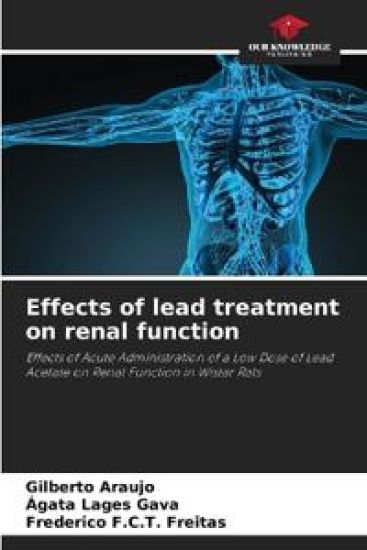
Effects of lead treatment on renal function

Effects of lead treatment on renal function

Gilberto Araujo; Ágata Lages Gava; Frederico F C T Freitas

Our Knowledge Publishing
2024
pokkari
Lead is one of the most toxic environmental contaminants for humans and other animals. Its harmful effects can affect the functioning of all organs and systems and depend on the plasma levels of this metal. Currently, a blood concentration of approximately 60μg/dL is considered safe. However, studies have shown that plasma values below this biological tolerance index generate deleterious effects on the body. Therefore, the aim of this study was to evaluate the effects of acute administration of a low concentration of lead on kidney function.