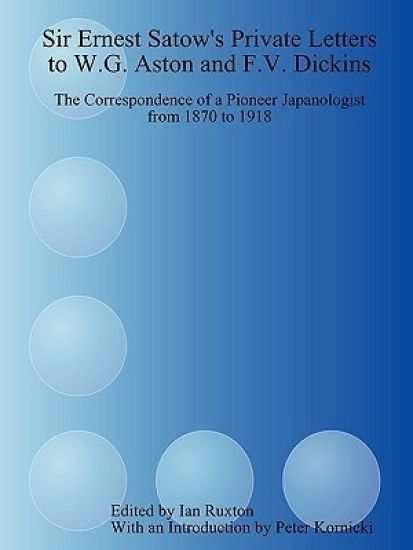
The distinguished British scholar-diplomat Ernest Mason Satow (1843-1929) was one of the most prominent and pre-eminent Japanologists in the Victorian era when the subject was newly created as Japan began to open its doors to foreigners from the mid-1850s. He shared this honour with Basil Hall Chamberlain (1850-1935) and the two addressees of the letters reproduced here by permission of the U.K. National Archives: co-worker William George Aston (1841-1911) and Frederick Victor Dickins (1838-1915). This book is part of a series in which Ian Ruxton is making some of the extensive Satow Papers publicly available for the first time. It includes an introduction by Professor Peter Kornicki of the East Asia Institute at the University of Cambridge, eight black & white illustrations, 166 annotations, two appendices, a select bibliography and a full index for ease of reference. (xvi + 330 pp.) Reasonably priced for students and researchers. Library of Congress Control Number: 2008901176
Th. G. V. Hippel's S mmtliche Werke by Theodor Gottlieb von Hippel. This book is a reproduction of the original book published in 1828 and may have some imperfections such as marks or hand-written notes.
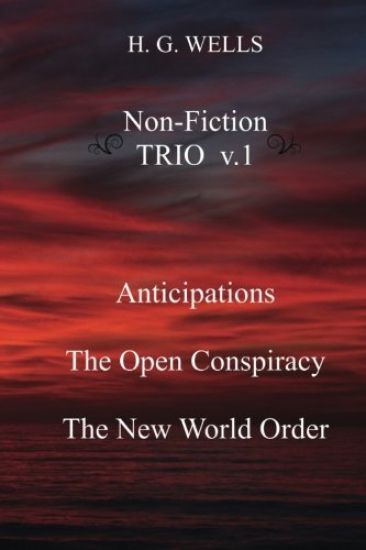
H. G. Wells, a prolific science fiction writer, also wrote many non-fiction works that may be found interesting and/or pertinent for our current times. Could world events be following a script?Volume 1 of this TRIO contains: Anticipations - First serialized in The North American Review, June 1901 with the subtitle: "An Experiment in Prophecy"The Open Conspiracy: Blue Prints for a World Revolution was published in 1928 by H. G. Wells, when he was 62 years old. It was revised and expanded in 1930 with the additional subtitle A Second Version of This Faith of a Modern Man Made More Explicit and Plain. In 1931 a further revised edition appeared titled What Are We to To Do With Our Lives? The final version appeared in 1933 under its original title. Many of its ideas are anticipated in Wells's 1926 novel The World of William Clissold.The book is, in Wells's words, a "scheme to thrust forward and establish a human control over the destinies of life and liberate it from its present dangers, uncertainties and miseries." It proposes that largely as the result of scientific progress, a common vision of a world "politically, socially and economically unified" is emerging among educated and influential people, and that this can be the basis of "a world revolution aiming at universal peace, welfare and happy activity" that can result in the establishment of a "world commonweal." This is to be achieved by "drawing together a proportion of all or nearly all the functional classes in contemporary communities in order to weave the beginnings of a world community out of their selection." This will ultimately "be a world religion." - WikipediaTHE OPEN CONSPIRACY - TABLE OF CONTENTSIntroductionChapter 1> The Present Crisis in Human AffairsChapter 2> The Idea of the Open ConspiracyChapter 3> We Have to Clear and Clean Up Our MindsChapter 4> The Revolution in EducationChapter 5> Religion in the New WorldChapter 6> Modern Religion is ObjectiveChapter 7> What Mankind Has to DoChapter 8> Broad Characteristics Of a Scientific World CommonwealChapter 9> No Stable Utopia Is Now ConceivableChapter 10> The open conspiracy is not to be thought of as a single organization; it is a conception of life out of which efforts, organizations, and new orientations will ariseChapter 11> Forces and Resistances in the Great Modern Communities Now Prevalent, Which Are Antagonistic to The Open Conspiracy. The war with TraditionChapter 12> The Resistances of the Less Industrialized Peoples to the Drive of the Open ConspiracyChapter 13> Resistances and Antagonistic Forces in our Conscious and Unconscious SelvesChapter 14> The Open Conspiracy Begins as a Movement of Discussion, Explanation, and PropagandaChapter 15> Early Constructive Work of the Open ConspiracyChapter 16> Existing and Developing Movements Which Are Contributory to the Open Conspiracy and Which Must Develop a Common Consciousness. The Parable of Provinder IslandChapter 17> The Creative Home, Social Group, and School. The Present Waste of Idealistic WillChapter 18> Progressive Development of the Activities of the Open Conspiracy Into a World Control and Commonweal. The Hazards of the AttemptChapter 19> Human Life in the Coming World CommunityThe New World Order was published in 1940. Wells was 74 years old and wondered whether this New World Order was attainable, how it could be attained, and what sort of world a world at peace will have to be. This masterpiece of speculative theory will appeal to those with an interest in the future of humanity and our roles in society.In this Non-Fiction TRIO, H. G. Wells vision and forethought stand out as an important message for future events as well as current times.
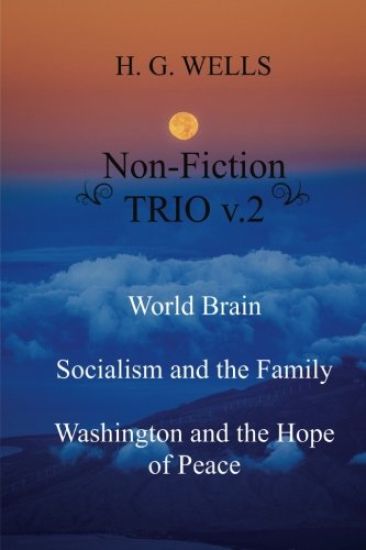
H. G. Wells, a prolific science fiction writer, also wrote many non-fiction works that may be found interesting and/or pertinent for our current times.Could world events be following a script?Volume 2 of this Trio contains: World Brain - Essays and addresses written during 1936-38. Wells vision of a new, free, synthetic, authoritative, permanent World Encyclopaedia that could help world citizens make the best use of universal information resources and make the best contribution to world peace.Socialism and the Family -Two papers written in 1906, detailing the attitude of Modem Socialism to family life.Washington, the Riddle/Hope of Peace -These Twenty-Nine essays were published throughout 1922 as Wells observations during his visit to Washington, DC.In spite of an awareness of possible world catastrophe that underlay much of his earlier writings and flared up again in old age, H. G. Wells was regarded as the chief literary spokesman of the liberal optimism that preceded World War I. No other writer has caught so vividly the energy of this period, its adventurousness, its feeling of release from the conventions of Victorian thought and propriety. Wells's influence was enormous, both on his own generation and on that which immediately followed it. None of his contemporaries did more to encourage revolt against Christian tenets and accepted codes of behaviour, especially as regards sex, in which, both in his books and in his personal life, he was a persistent advocate of an almost complete freedom. Though in many ways hasty, ill-tempered, and contradictory, Wells was undeviating and fearless in his efforts for social equality, world peace, and what he considered to be the future good of humanity.
H. G. Wells, a prolific science fiction writer, also wrote many non-fiction works that may be found interesting and/or pertinent for our current times.Could world events be following a script?TRIO Volume 2 contains: The Fate of Man -originally published 1939"I forget when it was I began to realize that the world as it had been presented to me was not a trustworthy picture of reality, that in effect I was being lied to about life. I began doubting quite early in life. I knew the world was round because everybody told me so. If they had told me the world was cone-shaped or flat, I should have known that with equal conviction-and it was only years afterwards that I realized how difficult it is to prove that the world is a globe.Plainly, it is high time we looked more closely into the causes of these disconcerting frustrations of our recent large, bright anticipations of a world of plenty and expansion. What is the real position of Homo sapiens in relation to his environment? Has he the mastery we assumed he had, or did we make a profound miscalculation of his outlook? Have we been indulging in hopeful assumptions rather than facing the realities of his case?"CONTENTS: INTRODUCTIONPreliminary StatementBiology Invades HistoryHow Species SurviveHistory Becomes EcologyUnion Now?What Is Democracy?Where Is Democracy?What Man Has To LearnSample Of A GenerationEstimating HopeSurvey Of Existing ForcesThe Jewish InfluenceChristendomWhat Is Protestantism?The Nazi ReligionTotalitarianismThe British OligarchyShintoismThe Chinese OutlookSubject PeoplesCommunism And RussiaAmerican MentalityThree Factors In EveryoneSummaryImpossibility Of UtopianismDecadent WorldNotesNew Worlds for Old -originally published 1908Wells advocates the taking over by the government of all public utilities, the heavy taxation of large fortunes, the establishment of a minimum wage, and the assumption by the state of full responsibility for the care of children, including education, and vocational training, for the support of expectant mothers, and aged persons, for attendance upon the sick. Yet he would not do away with the family or with private property, and he believes that the advantages of both these institutions would be much more widely and equally distributed under the system that he proposes than at present...CONTENTS: Introductory RemarksThe Good Will in ManThe Fundamental Idea of SocialismThe First Main Generalization of SocialismThe Second Main Generalization of SocialismThe Spirit of Gain and the Spirit of ServiceWould Socialism Destroy the Home?Would Modern Socialism Abolish All Property?The Middle-Class Man, the Business Man, and SocialismSome Common Objections to SocialismSocialism a Developing DoctrineRevolutionary SocialismAdministrative SocialismConstructive SocialismSome Arguments Ad HominemThe Advancement of SocialismRussia in the Shadows -originally published 1920A series of articles previously printed in The Sunday Express in connection with Wells's second visit to Russia in September and October 1920. Portraying a vivid account of Russian chaos following the first world war, its portrait of Lenin, and its insights into Wells' early opinions of Marx and the future of Russia.Wells portrayed Russia as recovering from a total social collapse, "the completest that has ever happened to any modern social organisation." He minimized the role of the Bolsheviks in the fall of the Russian state, and presented this explanation of their success: "While all the rest of Russia was either apathetic like the peasantry or garrulously at sixes and sevens or given over to violence or fear, the Communists were prepared to act."In an interview with Lenin, the leader and founder of Russian communism. Wells portrays Lenin as a pragmatic leader who "has recently stripped off the last pretence that the Russian revolution is anything more than the inauguration of an age of limitless experiment."
Role des Vers de Terre dans la Formation de la Terre V g tale is an unchanged, high-quality reprint of the original edition of 1882. Hansebooks is editor of the literature on different topic areas such as research and science, travel and expeditions, cooking and nutrition, medicine, and other genres. As a publisher we focus on the preservation of historical literature. Many works of historical writers and scientists are available today as antiques only. Hansebooks newly publishes these books and contributes to the preservation of literature which has become rare and historical knowledge for the future.
ROSKOSHNOE PODAROCHNOE IZDANIE V SHESTI TOMAKh ZNAMENITOGO TRUDA ALEKSANDRY OSIPOVNY ISHIMOVOJ! Izdanie v tvjordom perepljote s shjolkovym pokrytiem i zolotym tisneniem. Zolotoj obrez. Shjolkovaja lenta-ljasse. Plotnaja bumaga, chjotkij, udobnyj dlja chtenija shrift. V oformlenii knigi ispolzovany starinnye gravjury, privodjatsja genealogicheskie dreva russkikh knjazheskikh rodov i tsarstvujuschikh familij. "Vot kak nadobno pisat!" - eto vostorzhennoe vosklitsanie A. S. Pushkina stalo odnim iz pervykh otzyvov na knigu Aleksandry Osipovny Ishimovoj "Istorija Rossii v rasskazakh dlja detej". Masshtabnyj trud pervoj detskoj pisatelnitsy i perevodchitsy vysoko otsenili i kritiki, i uchjonye. "Istorija" g-zhi Ishimovoj - vazhnoe priobretenie dlja russkoj literatury", "chtenie ejo istorii est istinnoe naslazhdenie", "Sochinenie gospozhi Ishimovoj sogreto ljubovju k Otechestvu" - vot lish malaja chast otklikov na pervoe izdanie. Rabotami pisatelnitsy voskhischalis N. V. Gogol, V. F. Odoevskij, P. A. Vjazemskij, F. M. Dostoevskij. "Istorija Rossii v rasskazakh dlja detej" byla udostoena Demidovskoj premii - vysshej rossijskoj negosudarstvennoj nagrady za vydajuschijsja vklad v razvitie nauki (1841) - i tolko pri zhizni pisatelnitsy vyderzhala 6 pereizdanij. Aleksandre Osipovne udalos, kazalos by, nevozmozhnoe: prosto, ponjatno i interesno rasskazat o glavnykh sobytijakh russkoj istorii ot drevnikh slavjan do 1825 goda. Ljogkij, obraznyj jazyk povestvovanija chem-to napominaet stil russkikh skazok, kotoryj tak blizok i ponjaten chitateljam. Neudivitelno, chto "Istorija Rossii v rasskazakh dlja detej" i v nashi dni ostajotsja odnim iz samykh vostrebovannykh izdanij. Kak by ni menjalis s techeniem vremeni vzgljady na proshloe, trud A. O. Ishimovoj vsegda budet tsenen tem, chto probuzhdaet v chitateljakh ljubov i gordost k svoemu Otechestvu.
Si vous regardez autour de vous tous les diff rents types de plantes qui poussent sur la terre, vous pouvez les classer dans l'un des quatre groupes. Ces groupes sont les bryophytes, les pt ridophytes ou plantes sans graines, les gymnospermes et les angiospermes. Le plus complexe de ces groupes est celui des angiospermes ou des plantes fleurs. Les bryophytes sont galement appel es plantes non vasculaires car elles n'ont pas de tissu vasculaire. Les trois autres groupes ont un v ritable tissu vasculaire constitu de tubes qu'ils utilisent pour transporter l'eau, les min raux et les sucres d'un endroit l'autre l'int rieur de la plante. Les mousses, les cornouillers et les h patiques sont des exemples de bryophytes. Cette cat gorie de plantes ne peut pas devenir tr s grande car elle utilise principalement la diffusion simple pour obtenir de l'eau de transport et d'autres mat riaux.