

Kirjahaku
Etsi kirjoja tekijän nimen, kirjan nimen tai ISBN:n perusteella.
1000 tulosta hakusanalla Gerhard Hauser


For forty years, in a variety of books and articles, Gerhard Lenski has become the most influential proponent of ecological and evolutionary explanations of human societies, their development and transformations, from the Stone Age to the present. In his newest book, Lenski offers a succinct but comprehensive statement of the full body of his theory followed by demonstration of how it can be used to generate new and valuable insights when applied to a set of highly diverse issues. These include debates concerning the origin of ancient Israel and its distinctive culture, the rise of the West in the modern era, the highly varied trajectories of development of Third World nations in recent decades, and the failure of Marxist efforts to transform society in the Soviet Union and elsewhere. In the concluding chapter, Lenski discusses a number of other issues and areas where ecological-evolutionary theory may be fruitfully applied in the future.

For forty years, in a variety of books and articles, Gerhard Lenski has become the most influential proponent of ecological and evolutionary explanations of human societies, their development and transformations, from the Stone Age to the present. In his newest book, Lenski offers a succinct but comprehensive statement of the full body of his theory followed by demonstration of how it can be used to generate new and valuable insights when applied to a set of highly diverse issues. These include debates concerning the origin of ancient Israel and its distinctive culture, the rise of the West in the modern era, the highly varied trajectories of development of Third World nations in recent decades, and the failure of Marxist efforts to transform society in the Soviet Union and elsewhere. In the concluding chapter, Lenski discusses a number of other issues and areas where ecological-evolutionary theory may be fruitfully applied in the future.

On Legislatures looks at why people support their individual representatives but continue to criticise the legislative system at every opportunity. Although legislatures exist in every political system and are meant to represent the people, they are generally disparaged because they appear both unrepresentative and indecisive. Gerhard Loewenberg explains this puzzling contradiction by examining what representation means and what it takes for a large number of equally representative members to reach decisions. It also describes the methods for studying legislatures that have been developed in the social sciences in the last half century and shows their importance in democratic societies throughout the world. On Legislatures gets to the heart of the current disconnect between legislatures and the public they are supposed to represent.

On Legislatures looks at why people support their individual representatives but continue to criticise the legislative system at every opportunity. Although legislatures exist in every political system and are meant to represent the people, they are generally disparaged because they appear both unrepresentative and indecisive. Gerhard Loewenberg explains this puzzling contradiction by examining what representation means and what it takes for a large number of equally representative members to reach decisions. It also describes the methods for studying legislatures that have been developed in the social sciences in the last half century and shows their importance in democratic societies throughout the world. On Legislatures gets to the heart of the current disconnect between legislatures and the public they are supposed to represent.


Topics in Multi-User Information Theory presents a review of eleven of the fundamental issues in multi-user information theory. Each chapter is devoted to one particular issue and follows the same structure. Each chapter starts with a problem description and then describes solutions to the problem for general and specific cases.The book uses a tutorial style and the text motivates the reader to study the subject matter further for himself or herself. The organization builds up knowledge from chapter to chapter rather than collecting all closely-related facts in one place.The selection of topics includes:Typical Sequences and Source Coding; Rate-Distortion and Multiple Descriptions.Capacity-Cost.The Slepian-Wolf Problem.The Wyner-Ziv Problem.The Gelfand-Pinsker Problem.The Broadcast Channel.The Multiaccess Channel.The Relay Channel.The Multiple Relay Channel.The Multiaccess Channel with Generalized Feedback.Topics in Multi-User Information Theory provides the reader with a concise overview of the most important topics of source and channel coding. It is an invaluable resource for students and researchers working in information theory and communications.
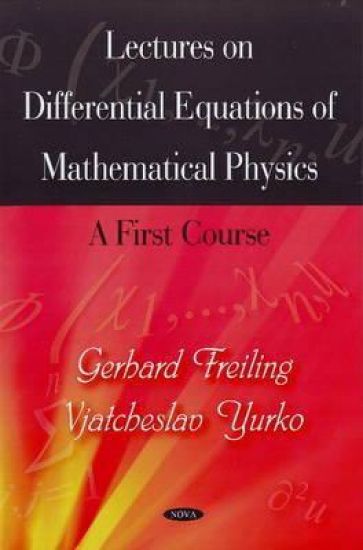
Lectures on Differential Equations of Mathematical Physics
Gerhard Freiling; Vjatcheslav Yurko
Nova Science Publishers Inc
2009
sidottu
The theory of partial differential equations of mathematical physics has been one of the most important fields of study in applied mathematics. This is essentially due to the frequent occurrence of partial differential equations in many branches of natural sciences and engineering. The present lecture notes have been written for the purpose of presenting an approach based mainly on the mathematical problems and their related solutions. The primary concern, therefore, is not with the general theory, but to provide students with the fundamental concepts, the underlying principles, and the techniques and methods of solution of partial differential equations of mathematical physics. One of the authors main goals is to present a fairly elementary and complete introduction to this subject which is suitable for the "first reading" and accessible for students of different specialities. The material in these lecture notes has been developed and extended from a set of lectures given at Saratov State University and reflects partially the research interests of the authors. It is intended for graduate and advanced undergraduate students in applied mathematics, computer sciences, physics, engineering, and other specialities. The prerequisites for its study are a standard basic course in mathematical analysis or advanced calculus, including elementary ordinary differential equations. Although various differential equations and problems considered in these lecture notes are physically motivated, a knowledge of the physics involved is not necessary for understanding the mathematical aspects of the solution of these problems.



![Guide to Captured German Documents [World War II Bibliography]](/covers/9781608880676.jpg)
Guide to Captured German Documents [World War II Bibliography]
Gerhard L Weinberg
Nimble Books
2010
pokkari

Scattering of Electromagnetic Waves by Obstacles
Gerhard Kristensson
SciTech Publishing Inc
2016
sidottu
This book is an introduction to some of the most important properties of electromagnetic waves and their interaction with passive materials and scatterers. The main purpose of the book is to give a theoretical treatment of these scattering phenomena, and to illustrate numerical computations of some canonical scattering problems for different geometries and materials. The scattering theory is also important in the theory of passive antennas, and this book gives several examples on this topic. Topics covered include an introduction to the basic equations used in scattering; the Green functions and dyadics; integral representation of fields; introductory scattering theory; scattering in the time domain; approximations and applications; spherical vector waves; scattering by spherical objects; the null-field approach; and propagation in stratified media. The book is organised along two tracks, which can be studied separately or together. Track 1 material is appropriate for a first reading of the textbook, while Track 2 contains more advanced material suited for the second reading and for reference. Exercises are included for each chapter.


In Jazz Transatlantic, Volume I, renowned scholar Gerhard Kubik takes the reader across the Atlantic from Africa to the Americas and then back in pursuit of the music we call jazz. This first volume explores the term itself and how jazz has been defined and redefined. It also celebrates the phenomena of jazz performance and uncovers hidden gems of jazz history. The volume offers insights gathered during Kubik’s extensive field work and based on in-depth interviews with jazz musicians around the Atlantic world. Languages, world views, beliefs, experiences, attitudes, and commodities all play a role. Kubik reveals what is most important—the expertise of individual musical innovators on both sides of the Atlantic, and hidden relationships in their thoughts.Besides the common African origins of much vocabulary and structure, all the expressions of jazz in Africa share transatlantic family relationships. Within that framework, musicians are creating and re-creating jazz in never-ending contacts and exchanges. The first of two volumes, Jazz Transatlantic, Volume I examines this transatlantic history, sociolinguistics, musicology, and the biographical study of personalities in jazz during the twentieth century. This volume traces the African and African American influences on the creation of the jazz sound and traces specific African traditions as they transform into American jazz. Kubik seeks to describe the constant mixing of sources and traditions, so he includes influences of European music in both volumes. These works will become essential and indelible parts of jazz history.



From her very beginning, the Church has been entrusted with the universal commission to "make disciples of all nations" (Matt 28:19), offering to the entire world the new life and communion with God that is made available in Christ through Baptism and the Christian confession of faith. This charge requires of the Church and her members both an orientation to God and a responsibility for the world—neither can be neglected, as they form an indissoluble relational unity that flows from the person of Christ, the "one mediator between God and men"(1 Tim 2:5). Yet in the current age, the Church appears forced to choose between God and the world, between the identity of the faith and its relevance for modern humanity, between fidelity to Revelation and innovation.In True and False Reform, Gerhard Cardinal Müller seeks to provide an aid for navigating the tensions, confusions, and divisions of this modern crisis, directing our attention to the Church's essence, characteristics, life, and mission—not as one religion among others, but as the site of Christ's saving presence with humanity. It is Christ who is the Church's life and foundation, and Christ, too, who is the source and end of that transformation according to his likeness to which all are called. Müller shows that this universal call to renewal in Christ—in faith, life, and prayer—is the basis of the Church's catholicity, the principal of all true reform, and the impetus for Catholics' journeying together with Christians from other churches and ecclesial communities toward perfect unity in Christ.

21 Self-Limiting Beliefs on Learning a Foreign Language - Smashed
Gerhard Ohrband
Independently Published
2019
nidottu
Most language students believe that all they need to succeed is to have the right app, the right teacher and the possibility to travel abroad. Nothing could be farther away from the truth. Yes, if you want to be able to engage just in small talk, if you want to be able to order food at exotic restaurants or if you just want to flirt on the beach, the above approach is indeed all you need.If, however, your career and - with that - your family's future depend on your mastery of a foreign language, you need to work on your self, too. If you want to be able to use language at a similar level as educated native speakers do, the main hindrance will be your own mind.What are the typical complaints of long-term language learners?I am lazy;I cannot follow through;I do not know how to set priorities;I feel discouraged whenever criticized;I am stuck.All of them have to do with our attitudes, our mindsets and our habits. This book will help you overcome 21 of the most common self-defeating thoughts in language learning.This book is not a systematic guide on how to learn foreign languages on your own. If you are looking for that, my book "The GO Method" will be the right thing for you. If you are a teacher looking for a new system, check out my book "Making language teaching great again - the psychology and quality management of language teaching".About the author: Born in 1979 in Hamburg, Germany, from a German father and a Chilean mother; M.A. in psychology from the University of Hamburg; since 2006 in the Republic of Moldova. Married with children.Psychologist, book author and German language teacher; speaks 21 languages and produces a weekly podcast in each of them