Kirjojen hintavertailu. Mukana 11 717 486 kirjaa ja 12 kauppaa.

Kirjahaku

Etsi kirjoja tekijän nimen, kirjan nimen tai ISBN:n perusteella.

1000 tulosta hakusanalla Gregory

Commodity & Propriety

Commodity & Propriety

Gregory S. Alexander

University of Chicago Press
1998
sidottu
Most people understand property as something that is owned, a means of creating individual wealth. However, in this text a history of the meaning of property, Gregory Alexander uncovers in American legal writing a competing vision of property that has existed alongside the traditional conception. Property, Alexander argues, has also been understood as "proprietary", a mechanism for creating and maintaining a properly-ordered society. This view of property has even operated in periods such as the second half of the 19th century, when market forces seemed to dominate social and legal relationships. In demonstrating how the understanding of property as a private basis for the public good has competed with the better-known market-oriented conception, the author of this book rewrites the history of property, with significant implications for current political debates and recent Supreme Court decisions.
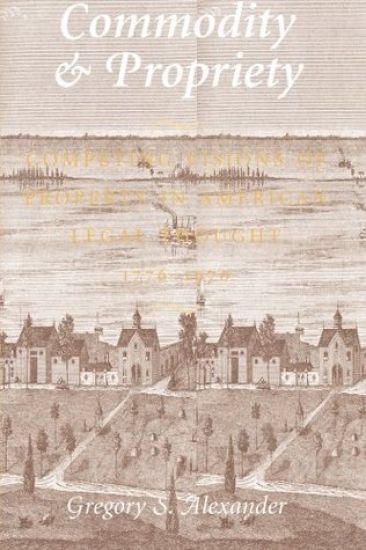
Commodity & Propriety

Commodity & Propriety

Gregory S. Alexander

University of Chicago Press
1999
nidottu
Most people understand property as something that is owned, a means of creating individual wealth. However, in this text a history of the meaning of property, Gregory Alexander uncovers in American legal writing a competing vision of property that has existed alongside the traditional conception. Property, Alexander argues, has also been understood as "proprietary", a mechanism for creating and maintaining a properly-ordered society. This view of property has even operated in periods such as the second half of the 19th century, when market forces seemed to dominate social and legal relationships. In demonstrating how the understanding of property as a private basis for the public good has competed with the better-known market-oriented conception, the author of this book rewrites the history of property, with significant implications for current political debates and recent Supreme Court decisions.
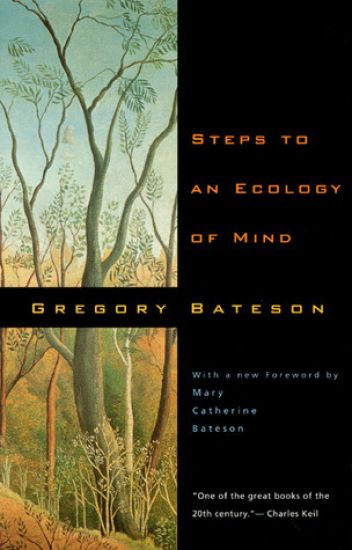
Steps to an Ecology of Mind

Steps to an Ecology of Mind

Gregory Bateson

University of Chicago Press
2000
nidottu
Gregory Bateson was a philosopher, anthropologist, photographer, naturalist, and poet, as well as the husband and collaborator of Margaret Mead. With a new foreword by his daughter Mary Katherine Bateson, this classic anthology of his major work will continue to delight and inform generations of readers. "This collection amounts to a retrospective exhibition of a working life. . . . Bateson has come to this position during a career that carried him not only into anthropology, for which he was first trained, but into psychiatry, genetics, and communication theory. . . . He . . . examines the nature of the mind, seeing it not as a nebulous something, somehow lodged somewhere in the body of each man, but as a network of interactions relating the individual with his society and his species and with the universe at large."—D. W. Harding, New York Review of Books "[Bateson's] view of the world, of science, of culture, and of man is vast and challenging. His efforts at synthesis are tantalizingly and cryptically suggestive. . . .This is a book we should all read and ponder."—Roger Keesing, American Anthropologist
Civic Jazz

Civic Jazz

Gregory Clark

University of Chicago Press
2015
sidottu
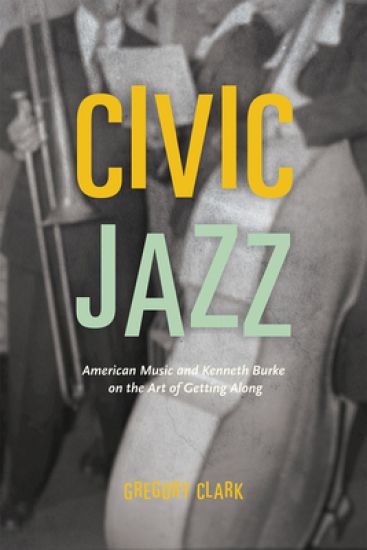
Jazz is born of collaboration, improvisation, and listening. In much the same way, the American democratic experience is rooted in the interaction of individuals. It is these two seemingly disparate, but ultimately thoroughly American, conceits that Gregory Clark examines in Civic Jazz. Melding Kenneth Burke's concept of rhetorical communication and jazz music's aesthetic encounters with a rigorous sort of democracy, this book weaves an innovative argument about how individuals can preserve and improve civic life in a democratic culture. Jazz music, Clark argues, demonstrates how this aesthetic rhetoric of identification can bind people together through their shared experience in a common project. While such shared experience does not demand agreement-indeed, it often has an air of competition-it does align people in practical effort and purpose. Similarly, Clark shows, Burke considered Americans inhabitants of a persistently rhetorical situation, in which each must choose constantly to identify with some and separate from others. Thought-provoking and path-breaking, Clark's harmonic mashup of music and rhetoric will appeal to scholars across disciplines as diverse as political science, performance studies, musicology, and literary criticism.
Civic Jazz

Civic Jazz

Gregory Clark

University of Chicago Press
2015
nidottu
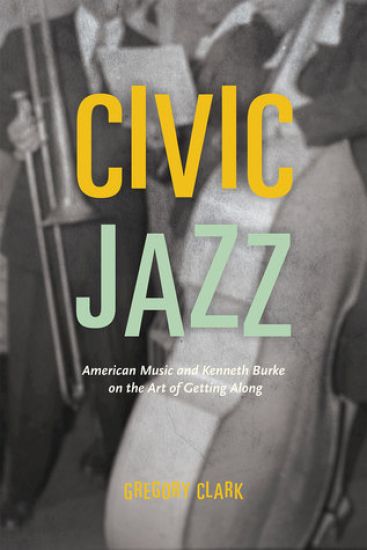
Jazz is born of collaboration, improvisation, and listening. In much the same way, the American democratic experience is rooted in the interaction of individuals. It is these two seemingly disparate, but ultimately thoroughly American, conceits that Gregory Clark examines in Civic Jazz. Melding Kenneth Burke's concept of rhetorical communication and jazz music's aesthetic encounters with a rigorous sort of democracy, this book weaves an innovative argument about how individuals can preserve and improve civic life in a democratic culture. Jazz music, Clark argues, demonstrates how this aesthetic rhetoric of identification can bind people together through their shared experience in a common project. While such shared experience does not demand agreement-indeed, it often has an air of competition-it does align people in practical effort and purpose. Similarly, Clark shows, Burke considered Americans inhabitants of a persistently rhetorical situation, in which each must choose constantly to identify with some and separate from others. Thought-provoking and path-breaking, Clark's harmonic mashup of music and rhetoric will appeal to scholars across disciplines as diverse as political science, performance studies, musicology, and literary criticism.
Tourist Attractions

Tourist Attractions

Gregory Mitchell

University of Chicago Press
2015
sidottu
While much attention has been paid in recent years to heterosexual prostitution and sex tourism in Brazil, gay sex tourism has been almost completely overlooked. In Tourist Attractions, Gregory C. Mitchell presents a pioneering ethnography that focuses on the personal lives and identities of male sex workers who occupy a variety of roles in Brazil's sexual economy. Mitchell takes us into the bath houses of Rio de Janeiro, where rent boys cruise for clients, and to the beaches of Salvador da Bahia, where African American gay men seek out hustlers while exploring cultural heritage tourist sites. His ethnography stretches into the Amazon, where indigenous fantasies are tinged with the erotic at eco-resorts, and into the homes of "kept men," who forge long-term, long-distance, transnational relationships that blur the boundaries of what counts as commercial sex. Mitchell asks how tourists perceive sex workers' performances of Brazilianness, race, and masculinity, and, in turn, how these two groups of men make sense of differing models of racial and sexual identity across cultural boundaries. He proposes that in order to better understand how people experience difference sexually, we reframe prostitution-which Marxist feminists have long conceptualized as sexual labor-as also being a form of performative labor. Tourist Attractions is an exceptional ethnography poised to make an indelible impact in the fields of anthropology, gender, and sexuality, and research on prostitution and tourism.
Tourist Attractions

Tourist Attractions

Gregory Mitchell

University of Chicago Press
2015
nidottu
While much attention has been paid in recent years to heterosexual prostitution and sex tourism in Brazil, gay sex tourism has been almost completely overlooked. In Tourist Attractions, Gregory C. Mitchell presents a pioneering ethnography that focuses on the personal lives and identities of male sex workers who occupy a variety of roles in Brazil's sexual economy. Mitchell takes us into the bath houses of Rio de Janeiro, where rent boys cruise for clients, and to the beaches of Salvador da Bahia, where African American gay men seek out hustlers while exploring cultural heritage tourist sites. His ethnography stretches into the Amazon, where indigenous fantasies are tinged with the erotic at eco-resorts, and into the homes of "kept men," who forge long-term, long-distance, transnational relationships that blur the boundaries of what counts as commercial sex. Mitchell asks how tourists perceive sex workers' performances of Brazilianness, race, and masculinity, and, in turn, how these two groups of men make sense of differing models of racial and sexual identity across cultural boundaries. He proposes that in order to better understand how people experience difference sexually, we reframe prostitution-which Marxist feminists have long conceptualized as sexual labor-as also being a form of performative labor. Tourist Attractions is an exceptional ethnography poised to make an indelible impact in the fields of anthropology, gender, and sexuality, and research on prostitution and tourism.
The Word and Its Witness

The Word and Its Witness

Gregory S. Jackson

University of Chicago Press
2009
sidottu
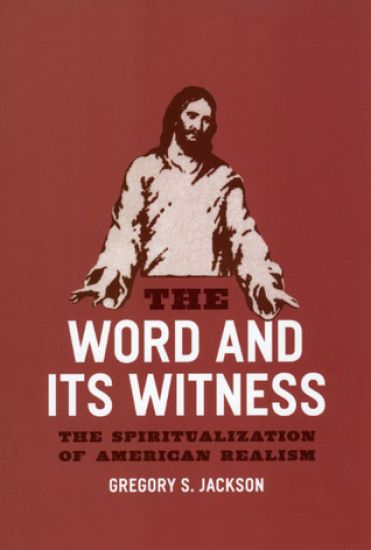
"What would Jesus do?" is now a rhetorical fixture, but the phrase was first popularized in one of the nineteenth century's best-selling novels, "In His Steps". Charles Sheldon's book is part of the vast, but mostly overlooked, history of evangelical culture that began during the Great Awakening. In this ground-breaking study, Gregory S. Jackson reveals the full impact of this tradition by exploring the development of religious media in America.Jackson shows how the homiletic tradition in Protestant sermons provided a foundation for the development of visual and literary realism. Evangelical preachers and writers used vivid language grounded in everyday life to translate abstract concepts like hell into concrete reality - a key influence on realist authors that brought about the more secular forms of the movement we know today. This emphasis on the sensuous also paved the way for Protestantism's embrace of new media, evident in the photographs of Jacob Riis as well as the video game "Left Behind: Eternal Forces".With its remarkable scope and timely insights into the interplay between religion, secularism, and politics, "The Word and Its Witness" will transform the way we understand American realism and American religion.
The Word and Its Witness

The Word and Its Witness

Gregory S. Jackson

University of Chicago Press
2009
nidottu
"What would Jesus do?" is now a rhetorical fixture, but the phrase was first popularized in one of the nineteenth century's best-selling novels, "In His Steps". Charles Sheldon's book is part of the vast, but mostly overlooked, history of evangelical culture that began during the Great Awakening. In this ground-breaking study, Gregory S. Jackson reveals the full impact of this tradition by exploring the development of religious media in America.Jackson shows how the homiletic tradition in Protestant sermons provided a foundation for the development of visual and literary realism. Evangelical preachers and writers used vivid language grounded in everyday life to translate abstract concepts like hell into concrete reality - a key influence on realist authors that brought about the more secular forms of the movement we know today. This emphasis on the sensuous also paved the way for Protestantism's embrace of new media, evident in the photographs of Jacob Riis as well as the video game "Left Behind: Eternal Forces".With its remarkable scope and timely insights into the interplay between religion, secularism, and politics, "The Word and Its Witness" will transform the way we understand American realism and American religion.
Strategic Party Government

Strategic Party Government

Gregory Koger; Matthew J. Lebo

University of Chicago Press
2017
sidottu
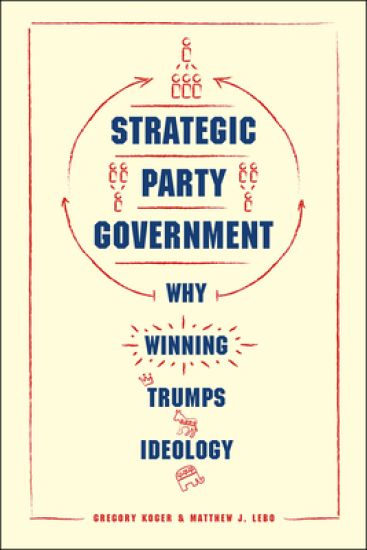
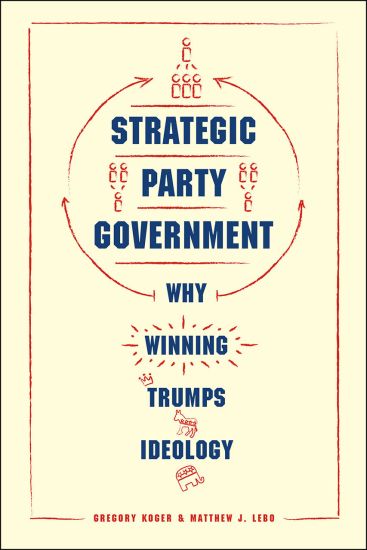
Why is Congress mired in partisan polarization? The conventional answer is that members of Congress and their constituencies fundamentally disagree with one other along ideological lines. But Gregory Koger and Matthew J. Lebo uncover a more compelling reason that today's political leaders devote so much time to conveying their party's positions, even at the expense of basic government functions: Both parties want to win elections. In Strategic Party Government, Koger and Lebo argue that Congress is now primarily a forum for partisan competition. In order to avoid losing, legislators unite behind strong party leaders, even when they do not fully agree with the policies their party is advocating. They do so in the belief that party leaders and voters will reward them for winning or at least trying to win these legislative contests. And as the parties present increasingly united fronts, partisan competition intensifies and pressure continues to mount for a strong party-building strategy despite considerable disagreement within the parties. By bringing this powerful but underappreciated force in American politics to the forefront, Koger and Lebo provide a new interpretation of the problems facing Congress that is certain to reset the agenda for legislative studies.
Strategic Party Government

Strategic Party Government

Gregory Koger; Matthew J. Lebo

University of Chicago Press
2017
nidottu
Why is Congress mired in partisan polarization? The conventional answer is that members of Congress and their constituencies fundamentally disagree with one other along ideological lines. But Gregory Koger and Matthew J. Lebo uncover a more compelling reason that today's political leaders devote so much time to conveying their party's positions, even at the expense of basic government functions: Both parties want to win elections. In Strategic Party Government, Koger and Lebo argue that Congress is now primarily a forum for partisan competition. In order to avoid losing, legislators unite behind strong party leaders, even when they do not fully agree with the policies their party is advocating. They do so in the belief that party leaders and voters will reward them for winning or at least trying to win these legislative contests. And as the parties present increasingly united fronts, partisan competition intensifies and pressure continues to mount for a strong party-building strategy despite considerable disagreement within the parties. By bringing this powerful but underappreciated force in American politics to the forefront, Koger and Lebo provide a new interpretation of the problems facing Congress that is certain to reset the agenda for legislative studies.
Filibustering

Filibustering

Gregory Koger

University of Chicago Press
2010
sidottu
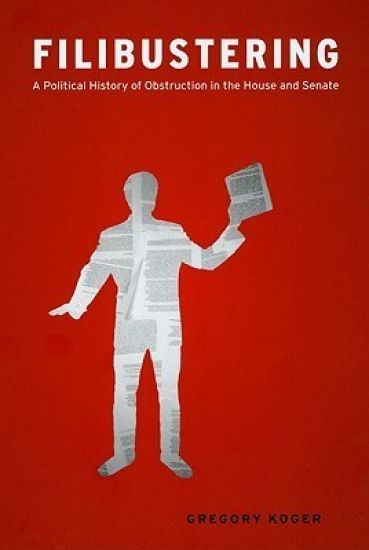
In the modern Congress, one of the highest hurdles for major bills or nominations is gaining the sixty votes necessary to shut off a filibuster in the Senate. But this wasn't always the case. Both citizens and scholars tend to think of the legislative process as a game played by the rules in which votes are the critical commodity - the side that has the most votes wins. In this comprehensive volume, Gregory Koger shows, on the contrary, that filibustering is a game with slippery rules in which legislators who think fast and try hard can triumph over superior numbers. "Filibustering" explains how and why obstruction has been institutionalized in the U.S. Senate over the last fifty years, and how this transformation affects politics and policy making. Koger also traces the lively history of filibustering in the U.S. House during the nineteenth century and measures the effects of filibustering - bills killed, compromises struck, and new issues raised by obstruction. Unparalleled in the depth of its theory and its combination of historical and political analysis, "Filibustering" will be the definitive study of its subject for years to come.
Filibustering

Filibustering

Gregory Koger

University of Chicago Press
2010
nidottu
In the modern Congress, one of the highest hurdles for major bills or nominations is gaining the sixty votes necessary to shut off a filibuster in the Senate. But this wasn't always the case. Both citizens and scholars tend to think of the legislative process as a game played by the rules in which votes are the critical commodity - the side that has the most votes wins. In this comprehensive volume, Gregory Koger shows, on the contrary, that filibustering is a game with slippery rules in which legislators who think fast and try hard can triumph over superior numbers. "Filibustering" explains how and why obstruction has been institutionalized in the U.S. Senate over the last fifty years, and how this transformation affects politics and policy making. Koger also traces the lively history of filibustering in the U.S. House during the nineteenth century and measures the effects of filibustering - bills killed, compromises struck, and new issues raised by obstruction. Unparalleled in the depth of its theory and its combination of historical and political analysis, "Filibustering" will be the definitive study of its subject for years to come.
Deconstruction

Deconstruction

Gregory Jones-Katz

University of Chicago Press
2021
sidottu
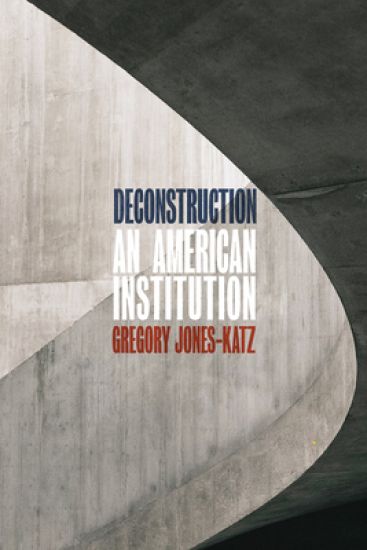
The basic story of the rise, reign, and fall of deconstruction as a literary and philosophical groundswell is well known among scholars. In this intellectual history, Gregory Jones-Katz aims to transform the broader understanding of a movement that has been frequently misunderstood, mischaracterized, and left for dead--even as its principles and influence transformed literary studies and a host of other fields in the humanities. Deconstruction begins well before Jacques Derrida's initial American presentation of his deconstructive work in a famed lecture at Johns Hopkins University in 1966 and continues through several decades of theoretic growth and tumult. While much of the subsequent story remains focused, inevitably, on Yale University and the personalities and curriculum that came to be lumped under the "Yale school" umbrella, Deconstruction makes clear how crucial feminism, queer theory, and gender studies also were to the lifeblood of this mode of thought. Ultimately, Jones-Katz shows that deconstruction in the United States--so often caricatured as a French infection--was truly an American phenomenon, rooted in our preexisting political and intellectual tensions, that eventually came to influence unexpected corners of scholarship, politics, and culture.
Deconstruction

Deconstruction

Gregory Jones-Katz

University of Chicago Press
2021
pokkari
The basic story of the rise, reign, and fall of deconstruction as a literary and philosophical groundswell is well known among scholars. In this intellectual history, Gregory Jones-Katz aims to transform the broader understanding of a movement that has been frequently misunderstood, mischaracterized, and left for dead--even as its principles and influence transformed literary studies and a host of other fields in the humanities. Deconstruction begins well before Jacques Derrida's initial American presentation of his deconstructive work in a famed lecture at Johns Hopkins University in 1966 and continues through several decades of theoretic growth and tumult. While much of the subsequent story remains focused, inevitably, on Yale University and the personalities and curriculum that came to be lumped under the "Yale school" umbrella, Deconstruction makes clear how crucial feminism, queer theory, and gender studies also were to the lifeblood of this mode of thought. Ultimately, Jones-Katz shows that deconstruction in the United States--so often caricatured as a French infection--was truly an American phenomenon, rooted in our preexisting political and intellectual tensions, that eventually came to influence unexpected corners of scholarship, politics, and culture.
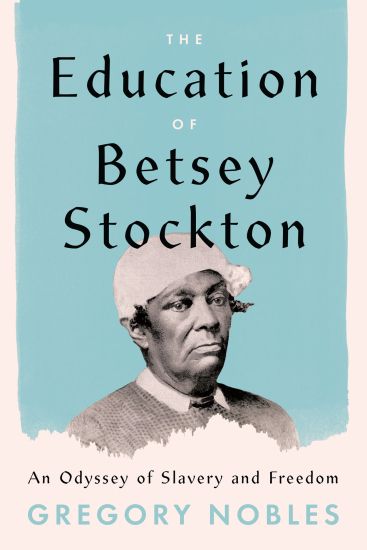
The Education of Betsey Stockton

The Education of Betsey Stockton

Gregory Nobles

THE UNIVERSITY OF CHICAGO PRESS
2022
sidottu
The first full-length biography of an extraordinary woman born into slavery who, through grit and determination, became a historic social and educational leader. The life of Betsey Stockton (ca. 1798-1865) is a remarkable story of a Black woman's journey from slavery to emancipation, from antebellum New Jersey to the Hawai'ian Islands, and from her own self-education to a lifetime of teaching others-all told against the backdrop of the early United States' pervasive racism. It's a compelling chronicle of a critical time in American history and a testament to the courage and commitment of a woman whose persistence grew into a potent form of resistance. When Betsey Stockton was a child, she was "given, as a slave" to the household of Rev. Ashbel Green, a prominent pastor and later the president of what is now Princeton University. Although she never went to school, she devoured the books in Green's library. After being emancipated, she used that education to benefit other people of color, first in Hawai'i as a missionary, then Philadelphia, and, for the last three decades of her life, Princeton-a college town with a genteel veneer that never fully hid its racial hostility. Betsey Stockton became a revered figure in Princeton's sizeable Black population, a founder of religious and educational institutions, and a leader engaged in the day-to-day business of building communities. In this first book-length telling of Betsey Stockton's story, Gregory Nobles illuminates both a woman and her world, following her around the globe, and showing how a determined individual could challenge her society's racial obstacles from the ground up. It's at once a revealing lesson on the struggles of Stockton's times and a fresh inspiration for our own.
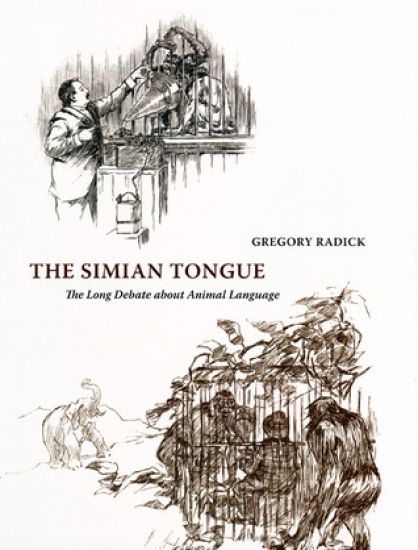
The Simian Tongue

The Simian Tongue

Gregory Radick

University of Chicago Press
2008
sidottu
In the early 1890s, the theory of evolution gained an unexpected ally: the Edison phonograph. An amateur scientist used the new machine - one of the technological wonders of the age - to record monkey calls, play them back to the monkeys, and watch their reactions. From these soon-famous experiments he judged that he had discovered "the simian tongue," made up of words he was beginning to translate, and containing the rudiments from which human language evolved. Yet for most of the next century, the simian tongue and the means for its study existed at the scientific periphery. Both returned to great acclaim only in the early 1980s, after a team of ethologists announced that experimental playback showed certain African monkeys to have rudimentarily meaningful calls. Drawing on newly discovered archival sources and interviews with key scientists, Gregory Radick here reconstructs the remarkable trajectory of a technique invented and reinvented to listen in on primate communication. Richly documented and powerfully argued, "The Simian Tongue" charts the scientific controversies over the evolution of language from Darwin's day to our own, resurrecting the forgotten debts of psychology, anthropology, and other behavioral sciences to the Victorian debate about the animal roots of human language.
Nietzsche, Heidegger, and the Transition to Postmodernity

Nietzsche, Heidegger, and the Transition to Postmodernity

Gregory Bruce Smith

University of Chicago Press
1996
nidottu
Smith argues that, while much of postmodern thought is rooted in Nietzsche and Heidegger, it has ironically attempted, whether unwittingly or by design, to deflect their philosophy back onto a modern path. Other alternative paths emanating from both Nietzschean and Heideggerian thought that might more powerfully speak to postmodern culture have been ignored. Nietzsche and Heidegger, Smith suggests, have made possible a far more revolutionary critique of modernity then even their most ardent postmodern admirers have realized. Smith contends that the influences on the postmodern in the thought of Nietzsche and Heidegger are founded in a new vision of praxis liberated from theory. Ultimately, these philosophers do transcend the nihilism often found in the guise of postmodernism. Their thought is, moreover, consistent with the possibility of limited constitutional government and the rule of law. Smith's book takes a step toward recovering these possibilities and posing the fundamental questions of politics and ethics in ways that have heretofore been closed off by late-modern thought.
Disputed Inheritance

Disputed Inheritance

Gregory Radick

THE UNIVERSITY OF CHICAGO PRESS
2023
sidottu
A root-and-branch rethinking of how history has shaped the science of genetics. In 1900, almost no one had heard of Gregor Mendel. Ten years later, he was famous as the father of a new science of heredity—genetics. Even today, Mendelian ideas serve as a standard point of entry for learning about genes. The message students receive is plain: the twenty-first century owes an enlightened understanding of how biological inheritance really works to the persistence of an intellectual inheritance that traces back to Mendel’s garden. Disputed Inheritance turns that message on its head. As Gregory Radick shows, Mendelian ideas became foundational not because they match reality—little in nature behaves like Mendel’s peas—but because, in England in the early years of the twentieth century, a ferocious debate ended as it did. On one side was the Cambridge biologist William Bateson, who, in Mendel’s name, wanted biology and society reorganized around the recognition that heredity is destiny. On the other side was the Oxford biologist W. F. R. Weldon, who, admiring Mendel's discoveries in a limited way, thought Bateson's "Mendelism" represented a backward step, since it pushed growing knowledge of the modifying role of environments, internal and external, to the margins. Weldon's untimely death in 1906, before he could finish a book setting out his alternative vision, is, Radick suggests, what sealed the Mendelian victory. Bringing together extensive archival research with searching analyses of the nature of science and history, Disputed Inheritance challenges the way we think about genetics and its possibilities, past, present, and future.
Disputed Inheritance

Disputed Inheritance

Gregory Radick

THE UNIVERSITY OF CHICAGO PRESS
2023
nidottu
A root-and-branch rethinking of how history has shaped the science of genetics. In 1900, almost no one had heard of Gregor Mendel. Ten years later, he was famous as the father of a new science of heredity—genetics. Even today, Mendelian ideas serve as a standard point of entry for learning about genes. The message students receive is plain: the twenty-first century owes an enlightened understanding of how biological inheritance really works to the persistence of an intellectual inheritance that traces back to Mendel’s garden. Disputed Inheritance turns that message on its head. As Gregory Radick shows, Mendelian ideas became foundational not because they match reality—little in nature behaves like Mendel’s peas—but because, in England in the early years of the twentieth century, a ferocious debate ended as it did. On one side was the Cambridge biologist William Bateson, who, in Mendel’s name, wanted biology and society reorganized around the recognition that heredity is destiny. On the other side was the Oxford biologist W. F. R. Weldon, who, admiring Mendel's discoveries in a limited way, thought Bateson's "Mendelism" represented a backward step, since it pushed growing knowledge of the modifying role of environments, internal and external, to the margins. Weldon's untimely death in 1906, before he could finish a book setting out his alternative vision, is, Radick suggests, what sealed the Mendelian victory. Bringing together extensive archival research with searching analyses of the nature of science and history, Disputed Inheritance challenges the way we think about genetics and its possibilities, past, present, and future.