Kirjojen hintavertailu. Mukana 11 342 296 kirjaa ja 12 kauppaa.

Kirjahaku

Etsi kirjoja tekijän nimen, kirjan nimen tai ISBN:n perusteella.

1000 tulosta hakusanalla Henry Kitchell Webster

Henry James and the Suspense of Masculinity

Henry James and the Suspense of Masculinity

Leland S. Person

University of Pennsylvania Press
2003
sidottu
Using insights from feminist studies, men's studies, and gay and queer studies, Leland Person examines Henry James's subversion of male identity and the challenges he poses to conventional constructs of heterosexual masculinity. Sexual and gender categories proliferated in the nineteenth and early twentieth centuries, and Person argues that James exploited the taxonomic confusion of the times to experiment with alternative sexual and gender identities. In contrast to scholars who have tried to give a single label to James's sexuality, Person argues that establishing James's gender and sexual identity is less important than examining the novelist's shaping of male characters and his richly metaphorical language as an experiment in gender and sexual theorizing. Just as an author's creations can be animated by his or her own sexuality, Person contends, James's sexuality may be most usefully understood as something primarily aesthetic and textual. As Person shows in chapters devoted to some of this author's best-known novels-Roderick Hudson, The American, The Portrait of a Lady, The Bostonians, The Ambassadors, The Golden Bowl-James conducts a series of experiments in gender/sexual construction and deconstruction. He delights in positioning his male characters so that their gender and sexual orientations are reversed, ambiguous, and even multiple. Ultimately, he keeps male identity in suspense by pluralizing male subjectivity.
Henry the Liberal

Henry the Liberal

Theodore Evergates

University of Pennsylvania Press
2016
sidottu
Over the course of the twelfth century, the county of Champagne grew into one of the wealthiest and most important of French principalities, home to a large and established aristocracy, the site of international trade fairs, and a center for artistic, literary, and intellectual production. It had not always been this way, notes Theodore Evergates, who charts the ascent of Champagne under the rule of Count Henry the Liberal. Tutored in the liberal arts and mentored in the practice of lordship from an early age, Henry commanded the barons and knights of Champagne on the Second Crusade at twenty and succeeded as count of Champagne at twenty-five. Over the next three decades Henry immersed himself in the details of governance, most often in his newly built capital in Troyes, where he resolved disputes, confirmed nonlitigious transactions, and monitored the disposition of his fiefs. He was a powerful presence beyond the county as well, serving in King Louis VII's military ventures and on diplomatic missions to the papacy and the monarchs of England and Germany. Evergates presents a chronicle of the transformation of the lands east of Paris as well as a biography of one of the most engaging princes of twelfth-century France. Count Henry was celebrated for balancing the arts of governance with learning and for his generosity and inquisitive mind, but his enduring achievement, Evergates makes clear, was to transform the county of Champagne into a dynamic principality within the emerging French state.
Henry IV, Part 1

Henry IV, Part 1

William Shakespeare

Modern Library
2009
nidottu
Henry IV sits on a usurped throne, his conscience and his nobles in revolt, while his son Hal is immersed in a self-indulgent life of revelry with the notorious Sir John Falstaff. Shakespeare explores questions of kingship and honor in this masterly mingling of history, comedy, and tragedy. Under the editorial supervision of Jonathan Bate and Eric Rasmussen, two of today's most accomplished Shakespearean scholars, this Modern Library series incorporates definitive texts and authoritative notes from William Shakespeare: Complete Works. Each play includes an Introduction as well as an overview of Shakespeare's theatrical career; commentary on past and current productions based on interviews with leading directors, actors, and designers; scene-by-scene analysis; key facts about the work; a chronology of Shakespeare's life and times; and black-and-white illustrations. Ideal for students, theater professionals, and general readers, these modern and accessible editions from the Royal Shakespeare Company set a new standard in Shakespearean literature for the twenty-first century.
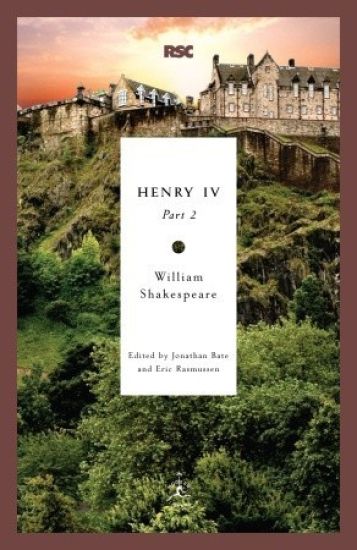
Henry IV, Part 2

Henry IV, Part 2

William Shakespeare

Modern Library
2009
nidottu
After defeat at the Battle of Shrewsbury the rebels regroup. But Prince Hal's reluctance to inherit the crown threatens to destroy the ailing Henry IV's dream of a lasting dynasty. Shakespeare's portrait of the prodigal son's journey from youth to maturity embraces the full panorama of society. Under the editorial supervision of Jonathan Bate and Eric Rasmussen, two of today's most accomplished Shakespearean scholars, this Modern Library series incorporates definitive texts and authoritative notes from William Shakespeare: Complete Works. Each play includes an Introduction as well as an overview of Shakespeare's theatrical career; commentary on past and current productions based on interviews with leading directors, actors, and designers; scene-by-scene analysis; key facts about the work; a chronology of Shakespeare's life and times; and black-and-white illustrations. Ideal for students, theater professionals, and general readers, these modern and accessible editions from the Royal Shakespeare Company set a new standard in Shakespearean literature for the twenty-first century.
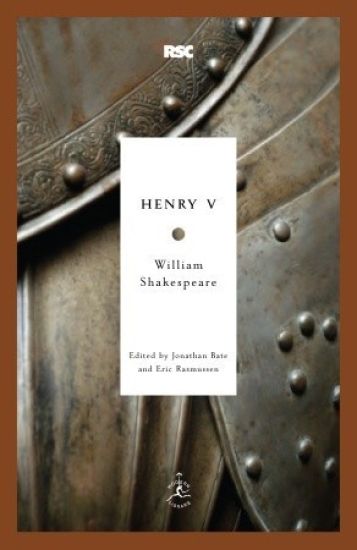
Henry V

Henry V

William Shakespeare

Modern Library
2010
nidottu
With his family's claim to the throne uncertain, Henry seeks to secure his position by turning the country's attention abroad. But when his outnumbered army is trapped at Agincourt, disaster seems inevitable. Shakespeare probes notions of leadership and power in this iconic depiction of England's charismatic warrior king. Under the editorial supervision of Jonathan Bate and Eric Rasmussen, two of today's most accomplished Shakespearean scholars, this Modern Library series incorporates definitive texts and authoritative notes from William Shakespeare: Complete Works. Each play includes an Introduction as well as an overview of Shakespeare's theatrical career; commentary on past and current productions based on interviews with leading directors, actors, and designers; scene-by-scene analysis; key facts about the work; a chronology of Shakespeare's life and times; and black-and-white illustrations. Ideal for students, theater professionals, and general readers, these modern and accessible editions from the Royal Shakespeare Company set a new standard in Shakespearean literature for the twenty-first century.
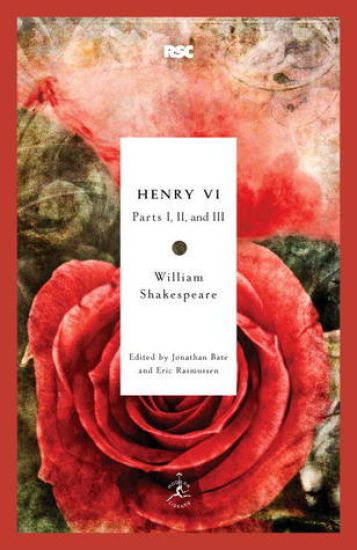
Henry VI: Parts I, II, and III

Henry VI: Parts I, II, and III

William Shakespeare

Modern Library
2012
nidottu
"The gaudy, blabbing and remorseful day Is crept into the bosom of the sea." --Henry VI Eminent Shakespearean scholars Jonathan Bate and Eric Rasmussen provide a fresh new edition of the three-part classic history that revolves around the epic, dynastic Wars of the Roses. THIS VOLUME ALSO INCLUDES MORE THAN A HUNDRED PAGES OF EXCLUSIVE FEATURES: - an original Introduction to Henry VI - incisive scene-by-scene synopses and analyses with vital facts about the work - commentary on past and current productions based on interviews with leading directors, actors, and designers - photographs of key RSC productions - an overview of Shakespeare's theatrical career and chronology of his plays Ideal for students, theater professionals, and general readers, these modern and accessible editions from the Royal Shakespeare Company set a new standard in Shakespearean literature for the twenty-first century.
Henry Adams in Washington

Henry Adams in Washington

Ormond Seavey

University of Virginia Press
2020
sidottu
A descendent of two U.S. presidents and winner of the Pulitzer Prize, Henry Adams enjoyed a very particular place in American life, not least due to his ancestry. Yet despite his prolific writing in the years between 1877 and 1891, when he lived in Washington, D.C., Adams has somehow slipped into the gap between history and literature. In Henry Adams in Washington, Ormond Seavey integrates the diverse aspects of Adams’s writing, arguing for his placement among the major American writers of the nineteenth century.Examining Adams’s nine-volume History, which Seavey argues demands renewed literary attention, as well as his two novels, Democracy and Esther, and his biographies of Albert Gallatin and John Randolph of Roanoke, Seavey shows how Adams reveals his own character and personality in his writings, particularly his fondness for the personal rather than the public sphere. As a historian writing in Washington, D.C., Adams surely encountered the expectation that public life takes precedence over the personal; in the execution of both his historical writing and his novels, however, he dwells instead on the personal costs of public life and the diminishment of public figures who lack a fulfilling personal life. Revealing Adams to be a missing link between the essential American writers in the time of Emerson and the modernist writers of the early twentieth century, Seavey shows his novels to be considerations of contemporary political issues while also recognizing the novelistic dimensions in his history and biographies.
Henry Adams in Washington

Henry Adams in Washington

Ormond Seavey

University of Virginia Press
2020
pokkari
A descendent of two U.S. presidents and winner of the Pulitzer Prize, Henry Adams enjoyed a very particular place in American life, not least due to his ancestry. Yet despite his prolific writing in the years between 1877 and 1891, when he lived in Washington, D.C., Adams has somehow slipped into the gap between history and literature. In Henry Adams in Washington, Ormond Seavey integrates the diverse aspects of Adams’s writing, arguing for his placement among the major American writers of the nineteenth century.Examining Adams’s nine-volume History, which Seavey argues demands renewed literary attention, as well as his two novels, Democracy and Esther, and his biographies of Albert Gallatin and John Randolph of Roanoke, Seavey shows how Adams reveals his own character and personality in his writings, particularly his fondness for the personal rather than the public sphere. As a historian writing in Washington, D.C., Adams surely encountered the expectation that public life takes precedence over the personal; in the execution of both his historical writing and his novels, however, he dwells instead on the personal costs of public life and the diminishment of public figures who lack a fulfilling personal life. Revealing Adams to be a missing link between the essential American writers in the time of Emerson and the modernist writers of the early twentieth century, Seavey shows his novels to be considerations of contemporary political issues while also recognizing the novelistic dimensions in his history and biographies.
Henry's Attic

Henry's Attic

Ford R. Bryan

Wayne State University Press
1970
nidottu
Henry's Attic provides fascinating documentation of some of the one million artifacts in the Henry Ford Museum and Greenfield Village. The items represent both Henry Ford's passion for collecting Americana and the astonishing array of gifts-some of great historic value and others of a distinctly homegrown variety-that account for almost half of the museum's collections. It was the quantity of these gifts and the unusual and even unique nature of many of them that provided the inspiration for this book.Henry Ford Museum and Greenfield Village, which Ford established in Dearborn, Michigan in the late 1920s, was intended to recreate the slow-paced, rural character of America before the advent of the automobile. The purchases he made and the gifts he was given reflect his desire to document and preserve the lifeways of common people and to emphasize middle-class rural history, as represented by the tools of agriculture, industry, and transportation.
Henry's Lieutenants

Henry's Lieutenants

Ford R. Bryan

Wayne State University Press
2003
nidottu
Although Henry Ford gloried in the limelight of highly publicized achievement, he privately admitted, "I don't do so much, I just go around lighting fires under other people." Henry's Lieutenants features biographies of thirty-five "other people" who served Henry Ford in a variety of capacities, and nearly all of whom contributed to his fame. These biographical sketches and career highlights reflect the people of high caliber employed by Henry Ford to accomplish his goals: Harry Bennett, Albert Kahn, Ernest Kanzler, William S. Knudsen, and Charles E. Sorenson, among others. Most were employed by the Ford Motor Company, although a few of them were Ford's personal employees satisfying concurrent needs of a more private nature, including his farming, educational, and sociological ventures. Ford Bryan obtained a considerable amount of the material in this book from the oral reminiscences of the subjects themselves.
Henry Ford

Henry Ford

Samuel S. Marquis

Wayne State University Press
2007
nidottu
Regarded by many automotive historians as the finest and most dispassionate character study of Henry Ford ever written, Henry Ford: An Interpretation has long been out of print and priced out of the reach of many collectors. Published at the height of Ford's success in 1923, the volume was written by the Reverend Samuel S. Marquis, an Episcopalian minister who was also the head of the sociology department at Ford Motor Company. Instead of a history of Ford Motor Company or a simple retelling of Ford's life story, Marquis claims that his collection of essays is intended to analyze the "psychological puzzle such as the unusual mind and personality of Henry Ford presents." In insightful chapters that can be read in any order, Marquis examines Ford's mastery of self-promotion, his invincible reputation, his religious views, and his "elusive" personality. He also considers Ford through the lens of his corporation by commenting on its industrial operations, its charitable causes, and its "executive scrap heap." According to many accounts, Henry Ford was greatly pained by the criticism in some of Marquis's essays, which led him to suppress the wide distribution of the volume. Indeed, so many copies of Henry Ford: An Interpretation were borrowed from the Detroit Public Library and never returned that the library was forced to remove the volume from its shelves. Not surprisingly, the original edition of this book is very expensive and hard to find as a result of these sorts of actions. Ford history enthusiasts as well as readers who are interested in historical biography will be grateful for the reprint of this significant volume.
Henry VI

Henry VI

CRC Press Inc
2001
sidottu
This collection of original essays provides a selection of current criticism on the Henry VI plays. Topics addressed will include feminist commentaries on the play, the principal of unity in the trilogy, the tradition of illumination of the play, textual variations, and finally, anachronism and allegory.
Henry VI

Henry VI

CRC Press Inc
2009
nidottu
This collection of original essays provides a selection of current criticism on the Henry VI plays. Topics addressed will include feminist commentaries on the play, the principal of unity in the trilogy, the tradition of illumination of the play, textual variations, and finally, anachronism and allegory.
Henry James as a Biographer

Henry James as a Biographer

Willie Tolliver

CRC Press Inc
2000
sidottu
This study of Henry James's biographies of Nathaniel Hawthorne and William Wetmore Story offers an argument that he deserves greater recognition for his contributions to the development of biography, based on his implicit theory of biography, found in his critical commentary and on these two complicated and ultimately artistically innovative performances in the genre. Although James maintained an ambivalent relationship to the art of biography, in his reviews, criticism, letters and fiction, he wrote about biography from a core of aesthetic conviction that constitutes an informal poetics. It is necessary thus to scrutinize the ways in which James's theoretical convictions, particularly his insistence on artistic unity, fail him when he writes two biographies himself. Both Hawthorne (1879) and William Wetmore Story and His Friends (1903) fail to cohere in the way traditional biographies achieve unity. Neither work has at its center a dynamic and fully dimensional apprehension of the biographical subject. Instead James violates one of his own essential biographical tenets. He usurps his subject and places himself at the center of what should be a narrative of his subject's life. The results fall short of fully achieved biography, but they do not fall short of literary interest. In order to write these books according to his own genius, James had to reinvent the form. They are rife with innovations, chief among them his great experimentation with narrative point of view, here brought to bear on biography. This concept and others survey the terrain for the important biographical practitioners and theorists who follow him. For this reason, a special place must be found for James in pantheon of experimental biographers.
Henry Irving

Henry Irving

CRC Press Inc
2017
sidottu
Henry Irving (1838-1905), the first actor to be knighted, dominated the theatre in Britain and beyond for over a quarter of a century. As an actor, he was strikingly different with his idiosyncratic pronunciation, his somewhat ungainly physique, and his brilliant psychological portrayals of virtue and villainy. As a director of spectacular, and commercially driven, entertainments, Irving anticipated Hollywood directors from D.W. Griffith to Stephen Spielberg. And as manager of the Lyceum Theatre, where audiences included the leading public figures of the day, he controlled every aspect of the performance. This collection of essays by leading theatre scholars explores each element of Irving's art: his acting, his contribution to the plays he commissioned, his flair for the stage picture, and his ear for incidental music. Like Wagner, Irving was a proponent of a holistic approach to the stage, that is, blending together acting, painting, music, and architecture to create harmonious, balanced, and artistic theatre. Irving emerges not only as the peer of such eminent contemporaries as Tennyson, Sullivan, Shaw, and Burne-Jones, but also as a powerful influence on the twentieth-century theatre.
Henry James - American Writers 4

Henry James - American Writers 4

Edel Leon

UNIVERSITY OF MINNESOTA PRESS
1960
nidottu
Henry James - American Writers 4 was first published in 1960. Minnesota Archive Editions uses digital technology to make long-unavailable books once again accessible, and are published unaltered from the original University of Minnesota Press editions.