Kirjojen hintavertailu. Mukana 12 016 292 kirjaa ja 12 kauppaa.

Kirjahaku

Etsi kirjoja tekijän nimen, kirjan nimen tai ISBN:n perusteella.

1000 tulosta hakusanalla Jim Goodwin

Schooling Jim Crow

Schooling Jim Crow

Jay Winston Driskell Jr.

University of Virginia Press
2019
pokkari
In 1919 the NAACP organized a voting bloc powerful enough to compel the city of Atlanta to budget $1.5 million for the construction of schools for black students. This victory would have been remarkable in any era, but in the context of the Jim Crow South it was revolutionary. Schooling Jim Crow tells the story of this little-known campaign, which happened less than thirteen years after the Atlanta race riot of 1906 and just weeks before a wave of anti-black violence swept the nation in the summer after the end of World War I. Despite the constant threat of violence, Atlanta’s black voters were able to force the city to build five black grammar schools and Booker T. Washington High School, the city’s first publicly funded black high school. Schooling Jim Crow reveals how they did it and why it matters.In this pathbreaking book, Jay Driskell explores the changes in black political consciousness that made the NAACP’s grassroots campaign possible at a time when most black southerners could not vote, let alone demand schools. He reveals how black Atlantans transformed a reactionary politics of respectability into a militant force for change. Contributing to this militancy were understandings of class and gender transformed by decades of racially segregated urban development, the 1906 Atlanta race riot, Georgia’s disfranchisement campaign of 1908, and the upheavals of World War I. On this cultural foundation, black Atlantans built a new urban black politics that would become the model for the NAACP’s political strategy well into the twentieth century.
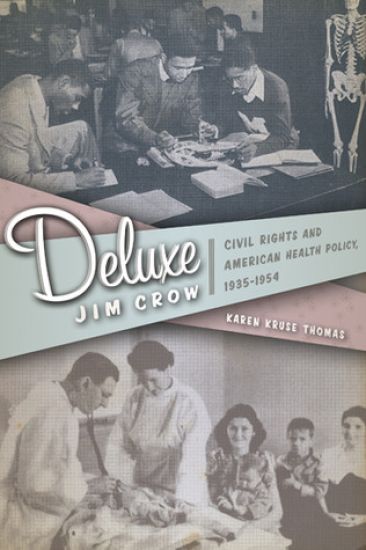
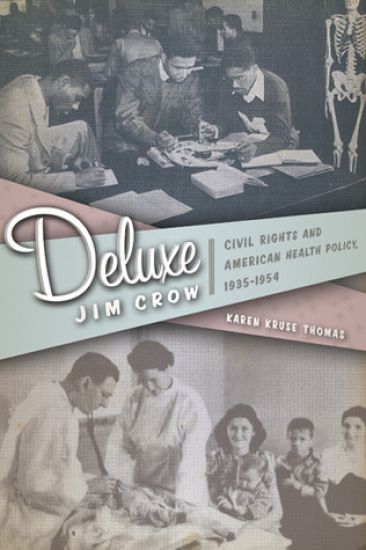
Deluxe Jim Crow

Deluxe Jim Crow

Karen Kruse Thomas

University of Georgia Press
2011
sidottu
Plagued by geographic isolation, poverty, and acute shortages of health professionals and hospital beds, the South was dubbed by Surgeon General Thomas Parran “the nation’s number one health problem.” The improvement of southern, rural, and black health would become a top priority of the U.S. Public Health Service during the Roosevelt and Truman administrations.Karen Kruse Thomas details how NAACP lawsuits pushed southern states to equalize public services and facilities for blacks just as wartime shortages of health personnel and high rates of draft rejections generated broad support for health reform. Southern Democrats leveraged their power in Congress and used the war effort to call for federal aid to uplift the South. The language of regional uplift, Thomas contends, allowed southern liberals to aid blacks while remaining silent on race. Reformers embraced, at least initially, the notion of “deluxe Jim Crow”—support for health care that maintained segregation. Thomas argues that this strategy was, in certain respects, a success, building much-needed hospitals and training more black doctors.By the 1950s, deluxe Jim Crow policy had helped to weaken the legal basis for segregation. Thomas traces this transformation at the national level and in North Carolina, where “deluxe Jim Crow reached its fullest potential.” This dual focus allows her to examine the shifting alliances—between blacks and liberal whites, southerners and northerners, activists and doctors—that drove policy. Deluxe Jim Crow provides insight into a variety of historical debates, including the racial dimensions of state building, the nature of white southern liberalism, and the role of black professionals during the long civil rights movement.
Deluxe Jim Crow

Deluxe Jim Crow

Karen Kruse Thomas

University of Georgia Press
2011
pokkari
Plagued by geographic isolation, poverty, and acute shortages of health professionals and hospital beds, the South was dubbed by Surgeon General Thomas Parran “the nation’s number one health problem.” The improvement of southern, rural, and black health would become a top priority of the U.S. Public Health Service during the Roosevelt and Truman administrations.Karen Kruse Thomas details how NAACP lawsuits pushed southern states to equalize public services and facilities for blacks just as wartime shortages of health personnel and high rates of draft rejections generated broad support for health reform. Southern Democrats leveraged their power in Congress and used the war effort to call for federal aid to uplift the South. The language of regional uplift, Thomas contends, allowed southern liberals to aid blacks while remaining silent on race. Reformers embraced, at least initially, the notion of “deluxe Jim Crow”—support for health care that maintained segregation. Thomas argues that this strategy was, in certain respects, a success, building much-needed hospitals and training more black doctors.By the 1950s, deluxe Jim Crow policy had helped to weaken the legal basis for segregation. Thomas traces this transformation at the national level and in North Carolina, where “deluxe Jim Crow reached its fullest potential.” This dual focus allows her to examine the shifting alliances—between blacks and liberal whites, southerners and northerners, activists and doctors—that drove policy. Deluxe Jim Crow provides insight into a variety of historical debates, including the racial dimensions of state building, the nature of white southern liberalism, and the role of black professionals during the long civil rights movement.
Watching Jim Crow

Watching Jim Crow

Steven D. Classen

Duke University Press
2004
sidottu
In the early 1960s, whenever the Today Show discussed integration, wlbt-tv, the nbc affiliate in Jackson, Mississippi, cut away to local news after announcing that the Today Show content was “network news . . . represent[ing] the views of the northern press.” This was only one part of a larger effort by wlbt and other local stations to keep African Americans and integrationists off Jackson’s television screens. Watching Jim Crow presents the vivid story of the successful struggles of African Americans to achieve representation in the tv programming of Jackson, a city many considered one of the strongest bastions of Jim Crow segregation. Steven D. Classen provides a detailed social history of media activism and communications policy during the civil rights era. He focuses on the years between 1955-when Medgar Evers and the naacp began urging the two local stations, wlbt and wjtv, to stop censoring African Americans and discussions of integration-and 1969, when the U.S. Court of Appeals issued a landmark decision denying wlbt renewal of its operating license. During the 1990s, Classen conducted extensive interviews with more than two dozen African Americans living in Jackson, several of whom, decades earlier, had fought to integrate television programming. He draws on these interviews not only to illuminate their perceptions-of the civil rights movement, what they accomplished, and the present as compared with the past-but also to reveal the inadequate representation of their viewpoints in the legal proceedings surrounding wlbt’s licensing. The story told in Watching Jim Crow has significant implications today, not least because the Telecommunications Act of 1996 effectively undid many of the hard-won reforms achieved by activists-including those whose stories Classen relates here.
Watching Jim Crow

Watching Jim Crow

Steven D. Classen

Duke University Press
2004
pokkari
The story of the successful struggles of African Americans to achieve representation in the TV programming of Jackson, a city many considered one of the strongest bastions of Jim Crow segregation. The 1996 Federal Communications Act then effectively undid many of the reforms achieved by activists.
Mister Jim

Mister Jim

Rutherford G. (Rutherford Montgomery

Hassell Street Press
2021
nidottu
This work has been selected by scholars as being culturally important and is part of the knowledge base of civilization as we know it.This work is in the public domain in the United States of America, and possibly other nations. Within the United States, you may freely copy and distribute this work, as no entity (individual or corporate) has a copyright on the body of the work.Scholars believe, and we concur, that this work is important enough to be preserved, reproduced, and made generally available to the public. To ensure a quality reading experience, this work has been proofread and republished using a format that seamlessly blends the original graphical elements with text in an easy-to-read typeface.We appreciate your support of the preservation process, and thank you for being an important part of keeping this knowledge alive and relevant.
Piccadilly Jim

Piccadilly Jim

P G Wodehouse

Anson Street Press
2025
pokkari
Return to the glittering streets of London with P. G. Wodehouse's "Piccadilly Jim," a sparkling jewel of humorous fiction. This meticulously prepared edition brings back to life a classic satire of upper-class British society, blending witty observations with the charm of a romantic comedy. Set against the backdrop of Piccadilly, this novel offers a delightful escape into a world of eccentric characters and improbable situations. Wodehouse's signature style shines in this tale of mistaken identities and tangled affections. Experience the enduring appeal of British humor at its finest in this timeless story that continues to captivate readers with its clever plot and hilarious dialogue. A must-read for those who appreciate finely crafted comedic fiction and the joy of a well-told tale.This work has been selected by scholars as being culturally important, and is part of the knowledge base of civilization as we know it.This work is in the public domain in the United States of America, and possibly other nations. Within the United States, you may freely copy and distribute this work, as no entity (individual or corporate) has a copyright on the body of the work.Scholars believe, and we concur, that this work is important enough to be preserved, reproduced, and made generally available to the public. We appreciate your support of the preservation process, and thank you for being an important part of keeping this knowledge alive and relevant.