Kirjahaku
Etsi kirjoja tekijän nimen, kirjan nimen tai ISBN:n perusteella.
1000 tulosta hakusanalla John Henry Perry
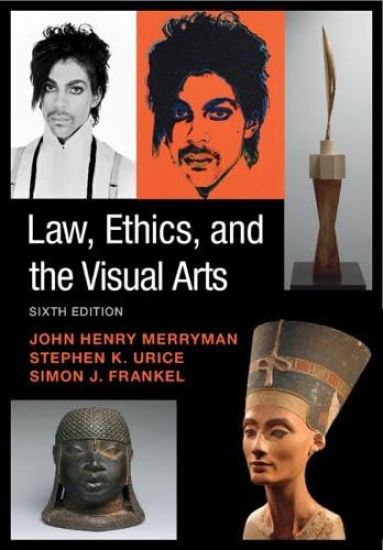
Law, Ethics, and the Visual Arts
John Henry Merryman; Stephen K. Urice; Simon J. Frankel
Cambridge University Press
2025
sidottu
Since its first publication in 1979, Law, Ethics, and the Visual Arts has been the foundational text in the field of art law. This thoroughly reorganized and updated sixth edition takes a fresh look at primary materials and commentary from previous editions, extending the book's analysis with significant changes in format and content to reflect changes in the field. The book has multiple uses and audiences: a text for courses in law schools and graduate programs, a reference work for lawyers and museum professionals, and a lively read - filled with engaging legal stories and colorful anecdotes featuring the broad cast of characters in the art world. Complementing their own observations, the authors include excerpts from judicial opinions, scholarly and popular articles, international treaties, and statutory law. Law, Ethics, and the Visual Arts offers a cornucopia of examples, questions, issues, and lessons for students, artists, dealers, collectors, attorneys, and any reader curious about today's complex world of the visual arts.
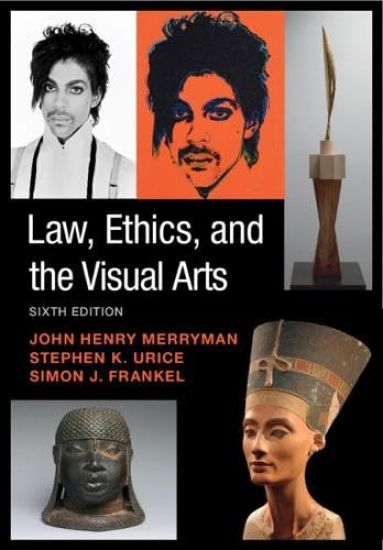
Law, Ethics, and the Visual Arts
John Henry Merryman; Stephen K. Urice; Simon J. Frankel
Cambridge University Press
2025
pokkari
Since its first publication in 1979, Law, Ethics, and the Visual Arts has been the foundational text in the field of art law. This thoroughly reorganized and updated sixth edition takes a fresh look at primary materials and commentary from previous editions, extending the book's analysis with significant changes in format and content to reflect changes in the field. The book has multiple uses and audiences: a text for courses in law schools and graduate programs, a reference work for lawyers and museum professionals, and a lively read - filled with engaging legal stories and colorful anecdotes featuring the broad cast of characters in the art world. Complementing their own observations, the authors include excerpts from judicial opinions, scholarly and popular articles, international treaties, and statutory law. Law, Ethics, and the Visual Arts offers a cornucopia of examples, questions, issues, and lessons for students, artists, dealers, collectors, attorneys, and any reader curious about today's complex world of the visual arts.
John Henry Newman (1801–1890) was a theologian and vicar at the university church in Oxford who became a leading thinker in the Oxford Movement, which sought to return Anglicanism to its Catholic roots. Newman converted to Catholicism in 1845 and became a cardinal in 1879. He published widely during his lifetime; his work included novels, poetry and the famous hymn 'Lead, Kindly Light', but he is most esteemed for his sermons and works of religious thought. This volume, first published in 1870, is an ambitious examination of the logical processes that underpin religious faith. Newman discusses how it is possible to believe what cannot be proven empirically, and postulates that the mind has the facility to bridge the logic gap to allow for humans to believe in things that they do not fully comprehend. A lucid and masterful work which remains relevant to contemporary discussions of faith.

An Essay on the Development of Christian Doctrine
John Henry Newman
Cambridge University Press
2010
pokkari
John Henry Newman (1801–1890) remains one of the best-known and influential English churchmen of the nineteenth century. Ordained as a priest in the Anglican Church in 1825, he converted to Roman Catholicism, being ordained as a priest and later appointed cardinal. His works include Grammar of Assent (1870) and Apologia Pro Vita Sua (1865–1866) as well as this Essay (1845), written in the midst of his own religious transformation. He discusses his theory of the development of Christian dogma: 'from the nature of the human mind, time is necessary for the full comprehension and perfection of great ideas … the longer time and deeper thought for their full elucidation'. By showing how fidelity to timeless truths coexisted in Christianity together with deeper and more developed understanding over time, Newman provides a helpful personal and theological apology for the teaching and practice of Catholicism against its detractors.

John Henry Newman (1801–1890) was an English priest and theologian, whose highly publicised and controversial conversion to Catholicism helped to dispel prejudice towards Catholics in Victorian society. After graduating from Trinity College, Oxford, Newman was ordained as an Anglican deacon in 1824. He gradually became more conservative in his beliefs, becoming a member of the Oxford Movement before converting to Catholicism and being received into the Roman Catholic Church in 1845; he was made a cardinal in 1879. This volume, first published in 1864, contains Newman's classic religious autobiography. Writing in response to a perceived attack on Catholicism by historian and novelist Charles Kingsley, Newman describes his changing religious beliefs between 1833 and 1845 and discusses his spiritual motivations for converting. Newman's emotional sensitivity and clear style ensured the popularity of this volume, which was extremely influential in establishing him as the leading exponent of Catholicism in Victorian England.
Discourses on the Scope and Nature of University Education
John Henry Newman
Cambridge University Press
2010
pokkari
Throughout his career as a theologian, deacon, priest and cardinal, John Henry Newman (1801–1890) remained a committed believer in the value of education. A graduate of Trinity College, Oxford, his own academic experiences shaped his friendships, politics and faith. His Discourses (1852), delivered initially as a series of lectures when he was rector of the newly-established Catholic University of Ireland, inspired a generation of young and talented Catholic scholars. Providing an intelligent but accessible analysis of the relationship between theology and other academic disciplines, the lectures were celebrated in the popular press for dispensing instruction to those who 'had no traditions to guide them in forming a correct estimate of what a university ought to be'. Newman argued that a university should foster the 'diffusion and extension of knowledge' rather than religious or moral training, and that it should prepare students for life in the world.
One of the leading Christian theologians of the nineteenth century, John Henry Newman (1801–90) was already a famous and controversial figure, as the leader of the Oxford Movement, by the time he published these lectures in 1838. He was still a Church of England vicar, but in 1845 he would join the Roman Catholic Church and eventually become a cardinal. The thirteen lectures here, addressing the doctrine of salvation through faith, cover issues of obedience, righteousness, Christ's resurrection, faith as the sole source of justification, the role of rites and works, and that of preaching. Offering a complementary rather than dichotomous interpretation of the competing theological positions, this work reveals the progress of Newman's thinking and reflects his journey towards leaving the Church of England.

Certain Difficulties Felt by Anglicans in Catholic Teaching Considered, Vol. 1
John Henry Newman
BCR (Bibliographical Center for Research)
2010
pokkari

Mediaeval Papal And Ritual Principles (1877)
John Henry Hobart
KESSINGER PUBLISHING, LLC
2009
pokkari

My Daily Meditation For The Circling Year (1914)
John Henry Jowett
KESSINGER PUBLISHING, LLC
2009
nidottu
Notes And Documents Relating To The Family Of Loffroy (1868)
John Henry Lefroy
KESSINGER PUBLISHING, LLC
2009
pokkari