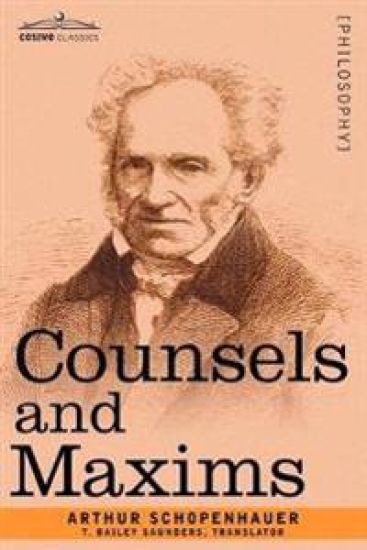
A disciple of Kant and a significant factor in shaping Nietzsche's thinking, Arthur Schopenhauer worked from the foundation that all knowledge derives from our experience of the world but that our experience is necessarily subjective and formed by our own intellect and biases: reality, therefore, is but an extension of our own will. In this essay, translated by THOMAS BAILEY SAUNDERS (1860-1928) and first published in English in the 1890s, Schopenhauer offers his best advice for surviving in the world... and surviving it is, for Schopenhauer was deeply pessimistic of the potential for human happiness, defining the concept chiefly as a "negation of pain." Whether he is limning the inherent loneliness and solitude of all people, even the seemingly most sociable ones, or describing the unstable and transitory nature of all things, the philosopher's basic assumption of human life comes through loud and clear: that it is characterized chiefly by misery. Students of philosophy and of 19th-century intellectualism will find this a fascinating read. We are delighted to publish this classic book as part of our extensive Classic Library collection. Many of the books in our collection have been out of print for decades, and therefore have not been accessible to the general public. The aim of our publishing program is to facilitate rapid access to this vast reservoir of literature, and our view is that this is a significant literary work, which deserves to be brought back into print after many decades. The contents of the vast majority of titles in the Classic Library have been scanned from the original works. To ensure a high quality product, each title has been meticulously hand curated by our staff. Our philosophy has been guided by a desire to provide the reader with a book that is as close as possible to ownership of the original work. We hope that you will enjoy this wonderful classic work, and that for you it becomes an enriching experience.
If the essayistic aphorisms and aphoristic essays of the eight volumes of so-called 'supernotes' which preceded this title are of indeterminate length, then what follows here, dating from 1993, is of an aphoristic purism which allows for little or no deviation from the basic form. One could say that their author had attained to something approximating the light(ness) of Truth at this point, and the result is a vindication not only of what had preceded it, but of his entire philosophical quest to-date. Comprised of 707 maxims which have been given 'a/b' subdivisions, 'Maximum Truth' succeeds in achieving, albeit on a still-far from definitive basis, the sort of metaphysical comprehensiveness towards which John O'Loughlin had been struggling all along. One could say that it signifies a refinement upon the aforementioned 'supernotational' writings; though the tendency to recycle ideas in modified guise, by now a veritable principle of his work, persists here to even greater effect, insofar as it was this technique which made the subsequent attainment of what, punning aside, is in some respects a maximum degree of metaphysical truth truly possible. Following on from the above, however, its companion volume, 'Truthful Maxims', which is also comprised of 707 numbered maxims, was written on a slightly more straightforward, though no less truth-intensive basis, and extends beyond much if not most of the material contained in its precursor. - A Centretruths editorial
This book is about qawa id fiqhiyyah, which are sometimes referred to as legal maxims. In reality, the qawa id play a much wider and more effective role as compared to legal maxims. Islamic law is all about principles and rules; it has been so from the day of its birth. The reason is that principles and rules were laid down by the Qur'an and the Sunnah. A legal system is created, and understood, through principles and rules, that is, the entire edifice of law revolves around principles and rules. Further, concepts, duties and rights emerge from rules and principles, thus, providing the basic elements of which law is made. The relationship between the disciplines of usul al-fiqh and qawa id fiqhiyyah is like the relationship between the two arms of the human body; they cooperate with each other to yield the rules of fiqh. This vital relationship has been kept concealed by separating the two disciplines and by severing the bond between them. This book attempts to uncover this relationship, and to restore the bond. Understanding this relationship will enhance understanding of the discipline of usul al-fiqh as well.
The oldest collection of Legal Maxims that has reached to us is the Risalah 'usul, al-Karkhi (260AH-340AH) By deep study of these 'usul it reveals that they are inclusive of qawa id, dawabit, 'usul, and kulliyat. Some of them have the status of such general kulliyat that can be declared as the collective asset of Islamic Fiqh and some 'usul are such which may be useful in knowing the effective cause of Fiqhi values and to know the solution of Fiqhi problems according to the Hanafi way of proving a thing (istidlal) and the Hanafi style of logical deduction on a legal question (ijtihad) by a learned and enlightened doctor (Mujtahid). Imam al-Karkhi is the author of the first existing book on legal maxims. "...The style of Imam Karkhi is that he states the legal maxim in a small sentence while Imam Nasafi gives brief example. The principle and the example are so concise that a person who is not well-versed in Fiqh he is not in a position to easily get benefit of it. Here it should be remembered that the legal maxims of Imam Karkhi have undergone the process of refinement in the later centuries and almost all the maxims at present are not in their original shape that was given to them by Imam Karkhi. For instance, out of the ninety nine legal maxims given in Al-Majallah only one maxim (article no. 4 of Al-Majallah) is partially stated according to the form of the first maxim of Al-'usul of Imam Karkhi. Otherwise, all the remaining maxims are present in Al-Majallah so far as their meanings are concerned, but the words and statements are not the same which were given to them by Imam Karkhi." Abul Hasan al Karkhi was a Hanafi Faqhi who wrote al Usul (d 340 H). He is among those who is known as al Mujtahidin Fil Masail, He was a contemporary of Imam ibn Majah, Abu Daud, Tirmidhi and Nasai.
Di logos sobre los dos m ximos sistemas del mundo (italiano: Dialogo sopra i due massimi sistemi del mondo Tolemaico, e Coperniciano),1 es un ensayo escrito por Galileo Galilei en el que debate sobre el movimiento del universo en torno al sol.
What Primary Colors by Anonymous did for the Clintons, Schopenhauer's Maxim by Formichella does for the politics of the religious right. Part political intrigue, part fairy tale, and all humor, at its darkest and most noir.