Kirjahaku
Etsi kirjoja tekijän nimen, kirjan nimen tai ISBN:n perusteella.
1000 tulosta hakusanalla Mayer

Global climate change is a topic of continuously growing interest. As more international treaties come into force, media coverage has increased and many universities are now starting to conduct courses specifically on climate change laws and policies. This textbook provides a survey of the international law on climate change, explaining how significant international agreements have sought to promote compliance with general norms of international law. Benoit Mayer provides an account of the rules agreed upon through lengthy negotiations under the United Nations Framework Convention on Climate Change (UNFCCC) and multiple other forums on mitigation, geoengineering, adaptation, loss and damage, and international support. The International Law on Climate Change is suitable for undergraduate and graduate students studying climate, environmental or international law. It is supported by a suite of online resources, available at www.internationalclimatelaw.com, featuring regularly updated lists of complementary materials, weblinks and regular updates for each chapter.
Global climate change is a topic of continuously growing interest. As more international treaties come into force, media coverage has increased and many universities are now starting to conduct courses specifically on climate change laws and policies. This textbook provides a survey of the international law on climate change, explaining how significant international agreements have sought to promote compliance with general norms of international law. Benoit Mayer provides an account of the rules agreed upon through lengthy negotiations under the United Nations Framework Convention on Climate Change (UNFCCC) and multiple other forums on mitigation, geoengineering, adaptation, loss and damage, and international support. The International Law on Climate Change is suitable for undergraduate and graduate students studying climate, environmental or international law. It is supported by a suite of online resources, available at www.internationalclimatelaw.com, featuring regularly updated lists of complementary materials, weblinks and regular updates for each chapter.




On Diabetes And Its Connection With Heart Disease (1888)
Jacques Mayer
KESSINGER PUBLISHING, LLC
2009
pokkari


The financial crisis has exposed severe shortcomings in mainstream monetary economics and modern finance. It is surprising that these shortcomings have not led to a wider debate about the need to overhaul these theories. Instead, mainstream economists have closed ranks to defend existing theories and public authorities have expanded their interference in markets.This book investigates the problems associated with mainstream monetary economics and finance, and proposes alternatives based on the Austrian school of economics. This school emanated from the work of the nineteenth-century Austrian economist Carl Menger and was developed further by Eugen von Böhm-Bawerk, Ludwig von Mises, and Friedrich August von Hayek. In monetary economics, the Austrian school regards the creation of money by banks through credit extension as a key source of economic instability. From this follows the need for a comprehensive reform of our present monetary system. In a new monetary order, money could be issued by both public and private institutions, and there would be no need for fractional reserve banking. Instead of creating money, banks would intermediate it.In finance, the Austrian school rejects the notion of rational expectations and measurable risk. Individuals use their subjective knowledge to gather and evaluate information, and they act in a world of radical uncertainty. Hence, markets are not "efficient" nor can portfolios be built on the basis of known probability distributions of asset prices as described in the modern finance literature.This book explores the need for a new theoretical foundation for asset pricing and investment management that will give practitioners more useful orientation.

It is a startling and somewhat disturbing fact that social work researchers-as well as research psychiatrists and psychologists-have rarely explored the treatment situation from the standpoint of the client. Client and Agency, first published in the 1960s, explores by means of free-fl owing interviews, a close-up picture of the client's experiences at a social work agency.There has been a growing awareness of the importance of consumer opinion in the social services following the wide spread impact of consumer groups, particularly those concerned with educational and medical services. Social work agencies have hesitated, uncertain about the researchers and their methods, and fearful of the outcome. But it is desirable that they incorporate the views of consumer groups because client opinion is one way of checking the effectiveness of their work.The practice of social work requires the application of knowledge derived from a variety of sources and academic disciplines. It is frequently difficult to relate conflicting evidence and diverse theories about human behavior for use in day-to- day work with acutely troubled and deprived people. It points to the need for more extensive studies of both consumers and suppliers of social work services because it raises many pertinent questions. In Client and Agency clients of a Family Welfare Association discuss the kind of help they expect to receive, their impressions of the social worker and the treatment process, and the ways they felt they were helped or not helped.

"From Suburb to Shtetl" is an outstanding ethnography that moves beyond simple demographics. Mayer weaves an intricate tapestry of how family, school, and community leaders influence each other. Whether discussing the role of the rebbe or the matchmaker, those who know these communities will find what he says as relevant today as it was when first penned. This is hardly surprising, for the ultra-Orthodox community takes great pride in not changing, in maintaining itself as it was in Europe despite the allure of modern American society. His discussion of synagogue life is particularly informative and evocative. Those in charge of helping immigrants adopted the path of least resistance, allowing and even encouraging them to retain their identities except for those few aspects that might threaten the country's national interests. The American Orthodox community was tremendously augmented by the arrival from Europe, after World War Two, of thousands of Orthodox Jews who remained devoted to that way of life. Egon Mayer was himself part of a smaller, but significant group of Jews who came to the U.S. and settled mostly in Boro Park in the wake of the 1956 Hungarian Revolution. The interaction between the Hasidim and their less fervent Orthodox counterparts described and analyzed in this volume tells us a great deal about how people negotiate their beliefs, values, and norms when forced into close contact with each other in an urban setting within the larger American culture. By exploring these and many other related issues Mayer has given us the chance to assess and forecast the future of American Jewish life as a whole.
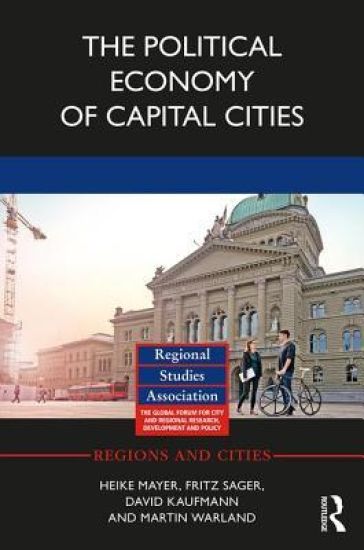
The Political Economy of Capital Cities
Heike Mayer; Fritz Sager; David Kaufmann; Martin Warland
Routledge
2017
sidottu
Capital cities that are not the dominant economic centers of their nations – so-called ‘secondary capital cities’ (SCCs) – tend to be overlooked in the fields of economic geography and political science. Yet, capital cities play an important role in shaping the political, economic, social and cultural identity of a nation. As the seat of power and decision-making, capital cities represent a nation’s identity not only through their symbolic architecture but also through their economies and through the ways in which they position themselves in national urban networks.The Political Economy of Capital Cities aims to address this gap by presenting the dynamics that influence policy and economic development in four in-depth case studies examining the SCCs of Bern, Ottawa, The Hague and Washington, D.C. In contrast to traditional accounts of capital cities, this book conceptualizes the modern national capital as an innovation-driven economy influenced by national, local and regional actors. Nationally, overarching trends in the direction of outsourcing and tertiarization of the public-sector influence the fate of capital cities. Regional policymakers in all four of the highlighted cities leverage the presence of national government agencies and stimulate the economy by way of various locational policy strategies.While accounting for their secondary status, this book illustrates how capital-city actors such as firms, national, regional and local governments, policymakers and planning practitioners are keenly aware of the unique status of their city. The conclusion provides practical recommendations for policymakers in SCCs and highlights ways in which they can help to promote economic development.