The phenomenon of photorefraction was discovered in 1966 in studies of propagation of a fairly powerful laser beam through the electro-optic crys- tals LiNb0 , LiTa0 , and some other compounds. The laser beam illumi- 3 3 nating part of the sample was found to cause a local change in the refrac- tive index of the crystal, thereby leading to distortion of the beam's wave front. The light had deteriorated the initially high optical quality of the crystal, in other words, it had given rise to a nonuniform distribution of the refractive index in the illuminated region. The effect was first called "opti- cal damage". The practical significance of the phenomenon was soon appreciated, applications were proposed, and a . vast amount of activity began. In the years that followed, the phenomenon was termed the "photorefractive ef- fect". Because of the reversible behavior of the refractive index variations due to photorefraction, photorefractive crystals have been regarded as re- cyclable photosensitive media. This became a valuable finding for optical engineers engaged in holography and optical information processing. On the other hand, the research into the nature of the photorefractive effect proved to be of considerable interest to physicists working in the fields of solid-state physics, semiconductors, and coherent optics.
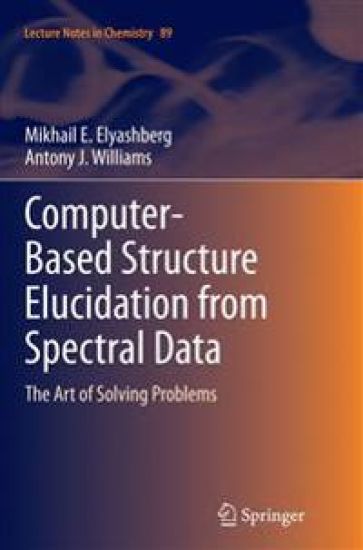
Here, the authors introduce readers to solving molecular structure elucidation problems using the expert system ACD/Structure Elucidator. They explain in detail the concepts of the Computer-Assisted Structure Elucidation (CASE) approach and point out the crucial role of understanding the axiomatic nature of the data used to deduce the structure. Aspects covered include the main blocks of the expert system and essential features of the mathematical algorithms used. Graduate and PhD students as well as practicing chemists are provided with a detailed explanation of the various practical approaches depending on available spectral data peculiarities and the complexity of the unknown structure. This is supported by a large number of real-world completed examples, most of which are related to the structure elucidation of natural product molecules containing unusual skeletons. Dedicated software and further supplementary material are available at www.acdlabs.com/TeachingSE.
This book will be of interest to readers active in the fields of survival analysis, genetics, ecology, biology, demography, reliability and quality control.Since Sir David Cox’s pioneering work in 1972, the proportional hazards model has become the most important model in survival analysis. The success of the Cox model stimulated further studies in semiparametric and nonparametric theories, counting process models, study designs in epidemiology, and the development of many other regression models that could offer more flexible or more suitable approaches in data analysis.Flexible semiparametric regression models are increasingly being used to relate lifetime distributions to time-dependent explanatory variables. Throughout the book, various recent statistical models are developed in close connection with specific data from experimental studies in clinical trials or from observational studies.
Here, the authors introduce readers to solving molecular structure elucidation problems using the expert system ACD/Structure Elucidator. They explain in detail the concepts of the Computer-Assisted Structure Elucidation (CASE) approach and point out the crucial role of understanding the axiomatic nature of the data used to deduce the structure. Aspects covered include the main blocks of the expert system and essential features of the mathematical algorithms used. Graduate and PhD students as well as practicing chemists are provided with a detailed explanation of the various practical approaches depending on available spectral data peculiarities and the complexity of the unknown structure. This is supported by a large number of real-world completed examples, most of which are related to the structure elucidation of natural product molecules containing unusual skeletons. Dedicated software and further supplementary material are available at www.acdlabs.com/TeachingSE.
Die Wanderniere - ein Beitrag zur Pathologie des intraabdominalen Gleichgewichtes ist ein unver nderter, hochwertiger Nachdruck der Originalausgabe aus dem Jahr 1899. Hansebooks ist Herausgeber von Literatur zu unterschiedlichen Themengebieten wie Forschung und Wissenschaft, Reisen und Expeditionen, Kochen und Ern hrung, Medizin und weiteren Genres.Der Schwerpunkt des Verlages liegt auf dem Erhalt historischer Literatur.Viele Werke historischer Schriftsteller und Wissenschaftler sind heute nur noch als Antiquit ten erh ltlich. Hansebooks verlegt diese B cher neu und tr gt damit zum Erhalt selten gewordener Literatur und historischem Wissen auch f r die Zukunft bei.