

Kirjahaku
Etsi kirjoja tekijän nimen, kirjan nimen tai ISBN:n perusteella.
1000 tulosta hakusanalla R. Austin Freeman



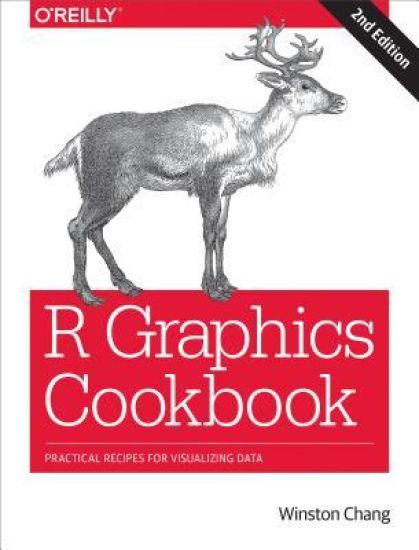
This O’Reilly cookbook provides more than 150 recipes to help scientists, engineers, programmers, and data analysts generate high-quality graphs quickly—without having to comb through all the details of R’s graphing systems. Each recipe tackles a specific problem with a solution you can apply to your own project and includes a discussion of how and why the recipe works. Most of the recipes in this second edition use the updated version of the ggplot2 package, a powerful and flexible way to make graphs in R. You’ll also find expanded content about the visual design of graphics. If you have at least a basic understanding of the R language, you’re ready to get started with this easy-to-use reference. Use R’s default graphics for quick exploration of data Create a variety of bar graphs, line graphs, and scatter plots Summarize data distributions with histograms, density curves, box plots, and more Provide annotations to help viewers interpret data Control the overall appearance of graphics Explore options for using colors in plots Create network graphs, heat maps, and 3D scatter plots Get your data into shape using packages from the tidyverse
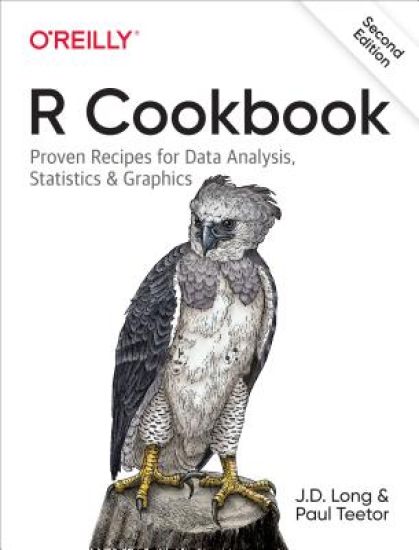
Perform data analysis with R quickly and efficiently with more than 275 practical recipes in this expanded second edition. The R language provides everything you need to do statistical work, but its structure can be difficult to master. These task-oriented recipes make you productive with R immediately. Solutions range from basic tasks to input and output, general statistics, graphics, and linear regression. Each recipe addresses a specific problem and includes a discussion that explains the solution and provides insight into how it works. If you’re a beginner, R Cookbook will help get you started. If you’re an intermediate user, this book will jog your memory and expand your horizons. You’ll get the job done faster and learn more about R in the process. Create vectors, handle variables, and perform basic functions Simplify data input and output Tackle data structures such as matrices, lists, factors, and data frames Work with probability, probability distributions, and random variables Calculate statistics and confidence intervals and perform statistical tests Create a variety of graphic displays Build statistical models with linear regressions and analysis of variance (ANOVA) Explore advanced statistical techniques, such as finding clusters in your data
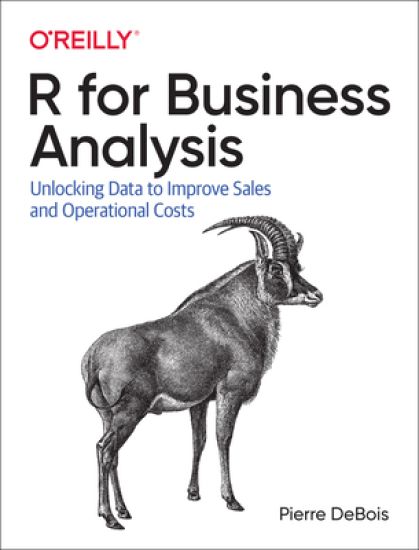
R for Business Analysis
O'Reilly Media, Inc, USA
2020
nidottu
Build quantitative models that will leverage data to improve the performance of your organization's marketing and operations campaigns. In this practical book, author Pierre DeBois shows business analysts how to develop quantitative models using a more business-friendly framework for selecting the right data and analysis models to support business intelligence.Data-driven strategies are at the heart of competitive advantage today. Yet discerning which method of quantitative analysis can be a challenge with so many data types and models available. This guide covers the key frameworks that blend well with business data for advanced analysis. You'll be better informed on choosing models and preliminary machine learning strategies that will help improve products, services, and operations.Explore statistical techniques to establish data relationshipsReview business intelligence research that can be incorporated into machine learning initiativesUnderstand which models are applicable for marketing and operations analysisGain immediate data management steps that can aid marketing and operations strategiesPlan data visualizations to fit each business need being examined
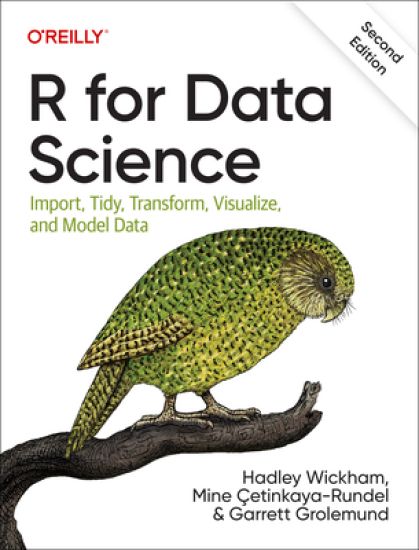
R for Data Science
Hadley Wickham; Mine Cetinkaya-Rundel; Garrett Grolemund
O'Reilly Media
2023
nidottu
Learn how to use R to turn data into insight, knowledge, and understanding. Ideal for current and aspiring data scientists, this book introduces you to doing data science with R and RStudio, as well as the tidyverse-a collection of R packages designed to work together to make data science fast, fluent, and fun. Even if you have no programming experience, this updated edition will have you doing data science quickly. You'll learn how to import, transform, and visualize your data and communicate the results. And you'll get a complete, big-picture understanding of the data science cycle and the basic tools you need to manage the details. Each section in this edition includes exercises to help you practice what you've learned along the way. Updated for the latest tidyverse best practices, new chapters dive deeper into visualization and data wrangling, show you how to get data from spreadsheets, databases, and websites, and help you make the most of new programming tools. You'll learn how to: Visualize-create plots for data exploration and communication of results Transform-discover types of variables and the tools you can use to work with them Import-get data into R and in a form convenient for analysis Program-learn R tools for solving data problems with greater clarity and ease Communicate-integrate prose, code, and results with Quarto
R for Cloud Computing looks at some of the tasks performed by business analysts on the desktop (PC era) and helps the user navigate the wealth of information in R and its 4000 packages as well as transition the same analytics using the cloud. With this information the reader can select both cloud vendors and the sometimes confusing cloud ecosystem as well as the R packages that can help process the analytical tasks with minimum effort, cost and maximum usefulness and customization. The use of Graphical User Interfaces (GUI) and Step by Step screenshot tutorials is emphasized in this book to lessen the famous learning curve in learning R and some of the needless confusion created in cloud computing that hinders its widespread adoption. This will help you kick-start analytics on the cloud including chapters on both cloud computing, R, common tasks performed in analytics including the current focus and scrutiny of Big Data Analytics, setting up and navigating cloud providers.Readers are exposed to a breadth of cloud computing choices and analytics topics without being buried in needless depth. The included references and links allow the reader to pursue business analytics on the cloud easily. It is aimed at practical analytics and is easy to transition from existing analytical set up to the cloud on an open source system based primarily on R.This book is aimed at industry practitioners with basic programming skills and students who want to enter analytics as a profession. Note the scope of the book is neither statistical theory nor graduate level research for statistics, but rather it is for business analytics practitioners. It will also help researchers and academics but at a practical rather than conceptual level.The R statistical software is the fastest growing analytics platform in the world, and is established in both academia and corporations for robustness, reliability and accuracy. The cloud computing paradigm is firmly established as the next generation of computing from microprocessors to desktop PCs to cloud.
R is a powerful and free software system for data analysis and graphics, with over 5,000 add-on packages available. This book introduces R using SAS and SPSS terms with which you are already familiar. It demonstrates which of the add-on packages are most like SAS and SPSS and compares them to R's built-in functions. It steps through over 30 programs written in all three packages, comparing and contrasting the packages' differing approaches. The programs and practice datasets are available for download.The glossary defines over 50 R terms using SAS/SPSS jargon and again using R jargon. The table of contents and the index allow you to find equivalent R functions by looking up both SAS statements and SPSS commands. When finished, you will be able to import data, manage and transform it, create publication quality graphics, and perform basic statistical analyses. This new edition has updated programming, an expanded index, and even more statistical methods covered in over 25 new sections.

R for Business Analytics looks at some of the most common tasks performed by business analysts and helps the user navigate the wealth of information in R and its 4000 packages. With this information the reader can select the packages that can help process the analytical tasks with minimum effort and maximum usefulness. The use of Graphical User Interfaces (GUI) is emphasized in this book to further cut down and bend the famous learning curve in learning R. This book is aimed to help you kick-start with analytics including chapters on data visualization, code examples on web analytics and social media analytics, clustering, regression models, text mining, data mining models and forecasting. The book tries to expose the reader to a breadth of business analytics topics without burying the user in needless depth. The included references and links allow the reader to pursue business analytics topics. This book is aimed at business analysts with basic programming skills for using R for Business Analytics. Note the scope of the book is neither statistical theory nor graduate level research for statistics, but rather it is for business analytics practitioners. Business analytics (BA) refers to the field of exploration and investigation of data generated by businesses. Business Intelligence (BI) is the seamless dissemination of information through the organization, which primarily involves business metrics both past and current for the use of decision support in businesses. Data Mining (DM) is the process of discovering new patterns from large data using algorithms and statistical methods. To differentiate between the three, BI is mostly current reports, BA is models to predict and strategize and DM matches patterns in big data. The R statistical software is the fastest growing analytics platform in the world, and is established in both academia and corporations for robustness, reliability and accuracy. The book utilizes Albert Einstein’s famous remarks on making things as simple as possible, but no simpler. This book will blow the last remaining doubts in your mind about using R in your business environment. Even non-technical users will enjoy the easy-to-use examples. The interviews with creators and corporate users of R make the book very readable. The author firmly believes Isaac Asimov was a better writer in spreading science than any textbook or journal author.

R. N.: My Fifty Years of Professional Nursing
Elizabeth Moorman
Literary Licensing, LLC
2013
nidottu

Rodeo: A Collection of the Tales and Sketches of R. B. Cunninghame Graham
R. B. Cunninghame Graham
Literary Licensing, LLC
2013
nidottu

R&B Songs for Ukulele
Hal Leonard Corporation
2017
nidottu
(Ukulele). Strum & sing 20 R&B classics in arrangements of melody, lyrics and chord diagrams for ukulele in standard G-C-E-A tuning. Songs include: Ain't No Sunshine * Brick House * Heatwave (Love Is like a Heatwave) * I Just Called to Say I Love You * I'll Be There * Just Once * Lean on Me * My Girl * People Get Ready * (Sittin' On) the Dock of the Bay * Stand by Me * What's Love Got to Do with It * You Can't Hurry Love * and more.

The Collection: Original Music by R. James Simmons
R. James Simmons
Createspace Independent Publishing Platform
2014
nidottu