

Kirjahaku
Etsi kirjoja tekijän nimen, kirjan nimen tai ISBN:n perusteella.
1000 tulosta hakusanalla Ray Ellis

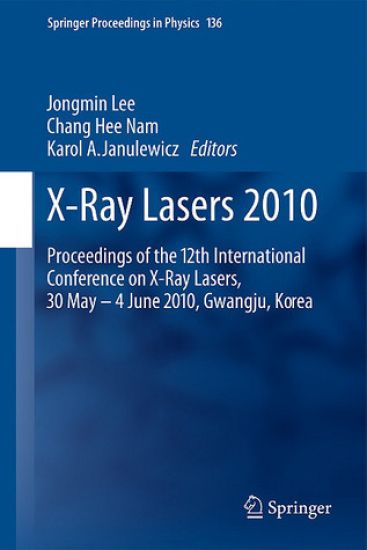
X-Ray Lasers 2010
Springer
2011
sidottu
This book provides a thorough account of the current status of achievements made in the area of soft X-Ray laser source development and of the increasingly diverse applications being demonstrated using such radiation sources. There is significant effort worldwide to develop very bright, short duration radiation sources in the X-Ray spectral region – driven by the multitude of potential applications in all branches of science. This book contains updates on several different approaches for comparative purposes but concentrates on developments in the area of laser-produced plasmas, whereby transient population inversion and gain between ion states is pumped by optical lasers interacting with pre-formed plasmas. Topics covered will include Laser-driven XRLs, Collisional XRLs, Recombination XRLs, Transient Inversion Collisional XRLs, Optical Field Ionization XRLs, Alternative XRL, pumping schemes Theory and simulations of XRL gain media and beam properties High order harmonic sources of XUVradiation, Free-electron lasers and other accelerator based X-Ray sources, X-Ray Laser drives, X-Ray optics and instrumentation Spectroscopy, and other diagnostics of laser media Applications of XRLs.
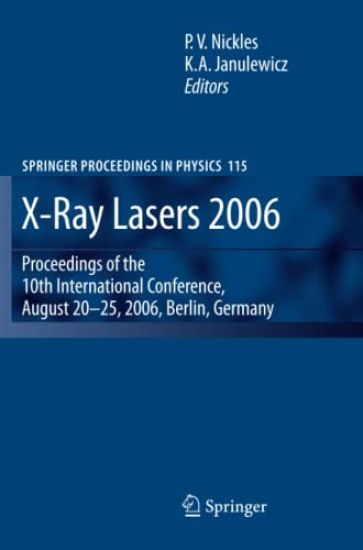
X-Ray Lasers 2006
Springer
2014
nidottu
In summary, we have demonstrated intense x-ray lasing from nickel-like plasmas of Mo, Pd, Ag, and Sn by utilizing a short (8 ps) prepulse irradiating the target at a grazing angle of incidence of 22.5°, i.e., collinear with the 3 J, 8 ps main pulse. Saturated lasing has not been proved yet, but comparison with signal levels achieved in previous work suggests that saturation has well been reached in these experiments. This is supported by the fact that a large range of prepulse energies and time intervals gives rise to intense x-ray lasing, as has been demonstrated in the case of Pd. References 1. Yu.V. Afanas'ev and V.N. Shlyaptsev: 'Formation of a population inversion of transitions in Ne-like ions in steady-state and transient plasmas', Sov. J. Quant. Electron. 19, 1606, 1989. 2. M.P. Kalashnikov et al.: 'Saturated operation of a transient collisional x-ray laser', Phys. Rev. A 57, 4778, 1998; J. Dunn et al.: 'Gain saturation regime for laser-driven tabletop, transient Ni-like ion X-ray lasers', Phys. Rev. Lett. 84, 4834, 2000. 3. V.N. Shlyaptsev et al.: “Numerical study of transient and capillary x-ray lasers and their applications”, Proc. SPIE, Vol. 5197, 221-228, 2003; R. Keenan et al., “Efficient pumping scheme for high-average brightness collisonal x-ray lasers”, ibid., 213-220.
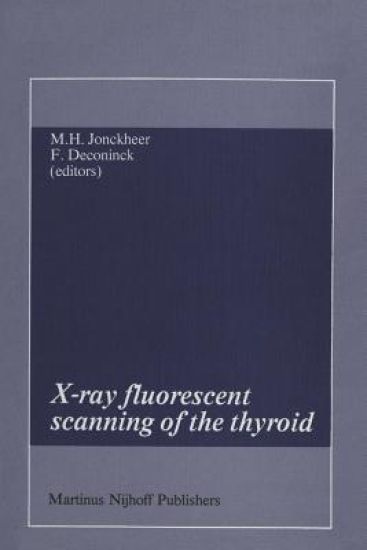
X-ray fluorescent scanning of the thyroid
Springer
2011
nidottu
Just prior to the 1982 Annual Meeting of the European Thyroid Association in Brussels, a number of outstanding experts in the field of X-ray fluorescence gathered at the Academisch Ziekenhuis of the Free University of Brussels in a joint effort to more clearly define the actual place and value of the latest newcomer among the techniques available for the in vivo assessment of thyroid function. It is the merit of Prof. M. Jonckheer to have organised this meeting and to have made available the work presented there to a larger public in the form of this monograph. Both, the meeting and the written accounts thereof are greatly appreciated by all thyroidologists who care for properly defining the genuine value of X-Ray fluorescence in scientific research and in clinical management of thyroid disorder. Three main conclusions can be drawn from the work presented 1. X-ray fluorescence has become a safe, convenient and reliable tool for measuring intrathyroidal iodine stores in vivo with an inter-assay reproducibility estimated at roughly 10% 2. X-ray fluorescence, used by expert hands, is a highly interesting tool to follow changes of intra thyroidal iodine stores in time, subsequent e. g. to the exposure of the thyroid gland to excess iodine 3. In contrast, no definite place of X-ray fluorescence as a technique in routine assessment of thyroid disease is yet at the horizon This latter conclusion may appear somewhat disappointing.
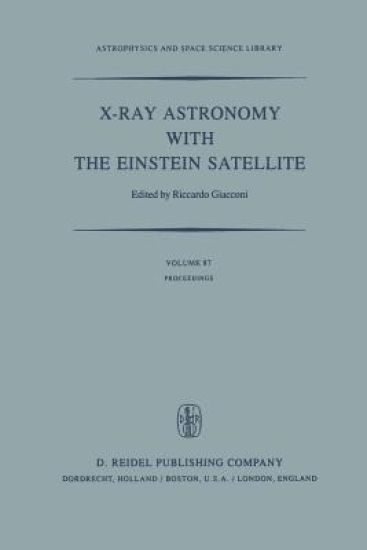
X-Ray Astronomy with the Einstein Satellite
Springer
2011
nidottu
The meeting of the High Energy Astrophysics Division of the American Astronomical Society, held in Cambridge, Massachusetts on January 28- 30, 1980, marks the coming of age of X-ray astronomy. In the 18 years since the discovery of the first extrasolar X-ray source, Sco X-l, the field has experienced an extremely rapid instrumentation development culminating with the launch on November 13, 1978 of the Einstein Observatory (HEAO-2) which first introduced the use of high resolution imaging telescopes to the study of galactic and extragalactic X-ray sources. The Einstein Observatory instruments can detect sources as faint as 10-7 Sco X-lor about 17 magnitudes fainter. The technological developments in the field have been paralleled by a host of new discoveries: in the early 1960's the detection of 9 "X-ray stars", objects 10 times more luminous in X-rays than the Sun and among the brightest stellar objects at all wavelengths; in the late 1960's and early 1970's the discovery of the natureof such systems which were identified as collapsed stars (neutron stars and black holes) in mass exchange binary systems, and the detection of the first few extragalactic sources.
X-Ray Astronomy
Springer
2011
nidottu
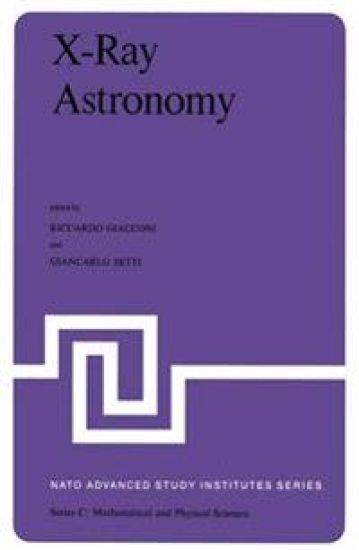
This volume contains a series of lectures presented at the 5th Course of the International School of Astrophysics held in Erice (Sicily) from July 1st to July 14, 1979 at the "E. Majorana" Centre for Scientific Culture. The course was fully supported by a grant from the NATO Advanced Institute Programme. It was attended by about one hundred participants from ten countries. Since the discovery of the first extra-solar X-ray source in the early 1960's, X-ray astronomy has played an increasingly important role in the study of the Universe, bringing new insight to almost every field of modern astrophysics from stellar evolution to cosmology. Generally speaking, this branch of astronomy is concerned with the discovery, classification and study of "hot matter" in the universe, including high energy non-thermal pheno mena. In particular, X-ray observations appear to provide the main, if not the only, probe to inspect regions where collapsed objects are formed, such as the environment of neutron stars and of black holes in the presence of matter accretion onto the objects themselves. It is significant that the first candidate black hole (Cyg X-I) has been primarily singled out by its X-ray emission. In the same context, it is well known that one of the fundamental problems in modern astrophysics is the understanding of the strong activity taking place in galactic nuclei.
X-Ray Binaries and Recycled Pulsars
Springer
2012
nidottu
V. Trimble-Concluding remarks 541 Authors Index 549 Object Index 551 Subject Index 555 List of participants and observers Ali Alpar, M. , Physics Department, Middle East Technical University, Ankara, Turkey Anderson, S. , USA California Institute of Technology, Pasadena CA, Araya, R. A. , The Johns Hopkins University, Deptartment of Physics and Astronomy, Baltimore MD, USA Arons, J. , Department of Astronomy, UC Berkeley, Berkeley CA, USA Backer, D. , Department of Astronomy, UC Berkeley, Berkeley CA, USA Bailyn, C. D. , Center for Astrophysics, Cambridge MA, USA Bandiera, R. , Osservatorio Astrofisico di Arcetri, Firenze, Italy Banit, M. , Astrophysics Department, Columbia University, New York NY, USA Bhattacharya, D. , Astronomical Institute, University of Amsterdam, The Netherlands Blandford, R. , Theoretical Astrophysics, CalTech, Pasadena CA, USA Blondin, J. M. , University of Virginia, Department of Astronomy, Charlottesville VA, USA Cernohorsky, J. , Center for High Energy Astrophysics, Amsterdam, The Netherlands Chanmugam, G. , Louisiana State University, Department of Physics and Astronomy, Ba- ton Rouge LA, USA Cordes, J. , Cornell University Centre for Radiophysics & Space Research, Ithaca NY, USA Dewey, R. , Jet Propulsion Laboratory, CalTech, Pasadena CA, USA Eardley, D. , University of California, Institute for Theoretical Physics, Santa Barbara CA,USA Edberg, T. , University of California, Center for Particle Astrophysics, Berkeley CA, USA Eggleton, P. P. , Institute of Astronomy, Cambridge, United Kingdom Eichler, D.

Publication of this book has been stimulated by 15 performed and duodenal abnormalities thus not years experience with contrast fluid irrigation visualised, occurred frequently. techniques of the small intestine and in particular All too frequently failure to maintain the proper by examinations performed and evaluated by col infusion rate, by many erroneously totally under legues. evaluated, had the result that disturbances in The classification of the X-ray pathology has motility were missed. been arranged to give a more effective application Additional and often too early administration in practice than is usually found in current of water, a measure that is seldom indicated and handbooks. Normally this classification is adapt tends to produce more bad results than good, is ed to that of formal anatomic pathology and quite frequently performed as a sort of panic internal medicine. In this book the classification reaction. The few indications for this procedure is based on the radiological symptomatology. ought to be known and strictly followed, super Thus, often completely unassociated conditions fluous application costs more time and causes are found listed as a possible cause for each unnecessary discomfort for the patient.

X-Ray Astronomy in the Exosat Era
Springer
2011
nidottu
Algol is a triple system containing a 70 hr eclipsing binary (K IV and B8 V) in a 694 day orbit with an A V star. The X-ray emission from this system (Schnopper et al 1976) is thought to be associated with a corona surrounding the lobe filling and synchron ously rotating K IV star. This is based on the similarity of the X-ray spectrum and luminosity of this system to that of the RS CVn binaries which also contain K sub-giants with similar rotation periods and the fact that the luminosity of any coronae surrounding the B8 V and AV companion stars should not be enhanced by rapid rotation (Pallavicini et al 1980, White et al 1980). The Einstein SSS measurement showed the X-ray spectrum to be two component with 6 7 temperatures of 7. 10 K and 3. 10 K (White et al. 1980). As dis cussed by Swank et al. (1981), the problem in understanding stellar coronae in general is how to scale up the solar model to account for the enhanced luminosities. The close to 900 inclination and similar sizes for the Band K stars of 3. 6 and 3. 8 R0 respectively make Algol an ideal candidate for an X-ray eclipse measurement wherein the size of the X-ray emitting coronal structures can be directly measured. In this paper we report a continuous observation through the secondary eclipse of Algol using the EXOSAT Observatory. 2.
The 15th ESLAB symposium was held at the end of June 1981 in Amsterdam with the topic being X-ray astronomy. The aim of this symposium was to bring together the international astrophysical community in order to 1. review the present state of X-ray astronomy in the light of new observations gathered in recent missions and to review data on interesting objects in correlated wavelen8th regions; 2. discuss theoretical models describing the phenomena observed; 3. present ESA's European X-ray Observatory Satellite (EXOSAT) and to discuss future X-ray missions and their associated instrumenta tion. These topics seemed to be so interesting for the scientific community that more than 120 contributions were submitted. Of these, 94 were finally accepted and approximately 200 participants attended the 5-day meeting. The symposium was organised in nine sessions covering the whole field. Every main topic was introduced by a review lecture covering the state of-the-art. The aim of the meeting was to assess the impact of the new X-ray findings on the general astronomical knowled8e. The discussion ranged from non-degenerated stellar X-ray sources and stellar coronae tL supernovae, bursters, globular clusters, normal galaxies and finally to cosmology. In each field the philosophy was to bring together the relevant information obtained in radio, optical and X-ray observations followed by theoretical discussions. A large number of contributed papers were also presented within this framework.
X-Ray Lasers 2008
Springer
2016
nidottu
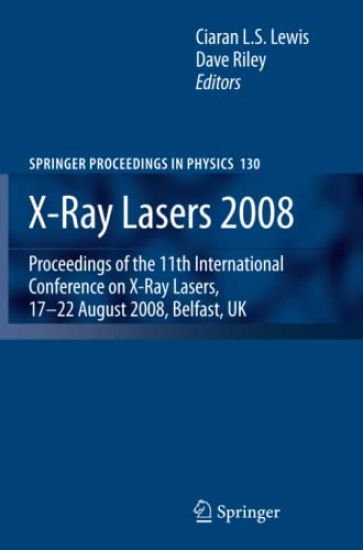
The 11th International Conference on X-Ray Lasers had contributions in the following topical areas: Transient Collisional X-Ray Lasers, Table-Top High Repetition Rate X-Ray Lasers, Optical-Field Ionised (OFI) X-Ray Lasers, Theory and Simulation of X-Ray Lasers, High Order Harmonic Generation, XUV Optics and X-Ray Laser Applications, Capillary Discharge X-Ray Lasers, Alternative Sources of coherent XUV Radiation. The proceedings of this conference constitute a comprehensive source of reference for scientists involved in researching the development and application of coherent X-Ray sources.
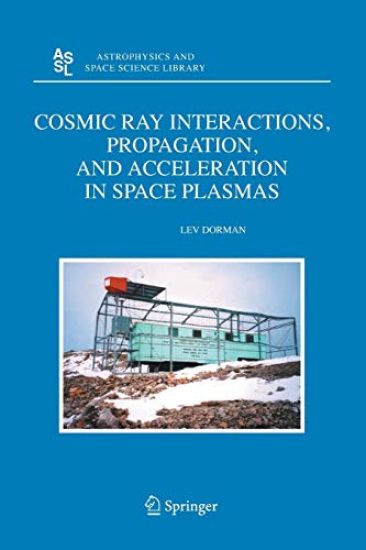
Cosmic Ray Interactions, Propagation, and Acceleration in Space Plasmas
Lev Dorman
Springer
2016
nidottu
xxii CONTENTS In 1957 I was invited to work on special problems in Magnetic Laboratory of the Academy of Sciences of USSR as a Head of Department of Magnetic Hydrodynamics. In few years this Laboratory was transfered into the I. V. Kurchatov Institute of Atomic Energy, and I continued to work in this Institute up to 1965. In parallel I also worked at Moscow State University as Professor in the CR and Space Research Team. I also gave lectures in Irkutsk, Alma-Ata, Nalchik, Tbilisi, Erevan, Samarkand, and others places. Over about 40 years of teaching under my supervision more than hundred graduate students and scientists in USSR and some other countries gained their Ph. D. and several tenths became Doctors of Science. As my hobby I continued to work in CR research, and as Vice-President of All-Union Section of Cosmic Rays and Radiation Belts, took an active part in preparing the Soviet net of CR stations to the IGY (International Geophysical Year, 1957-1958): we equipped all soviet stations in USSR and in Antarctica with standard cubic and semi-cubic muon telescopes and with neutron monitors of IGY (or Simpson’s) type. In connection with preparing for the IQSY (the International Quiet Sun Year, 1964-1965), the soviet net of CR stations was extended about two fold and they were equipped with neutron super-monitors of IQSY type (with an effective surface about 10 times bigger than the previous monitor of IGY type).
X-Ray Lasers 2010
Springer
2016
nidottu
This book provides a thorough account of the current status of achievements made in the area of soft X-Ray laser source development and of the increasingly diverse applications being demonstrated using such radiation sources. There is significant effort worldwide to develop very bright, short duration radiation sources in the X-Ray spectral region – driven by the multitude of potential applications in all branches of science. This book contains updates on several different approaches for comparative purposes but concentrates on developments in the area of laser-produced plasmas, whereby transient population inversion and gain between ion states is pumped by optical lasers interacting with pre-formed plasmas. Topics covered will include Laser-driven XRLs, Collisional XRLs, Recombination XRLs, Transient Inversion Collisional XRLs, Optical Field Ionization XRLs, Alternative XRL, pumping schemes Theory and simulations of XRL gain media and beam properties High order harmonic sources of XUVradiation, Free-electron lasers and other accelerator based X-Ray sources, X-Ray Laser drives, X-Ray optics and instrumentation Spectroscopy, and other diagnostics of laser media Applications of XRLs.
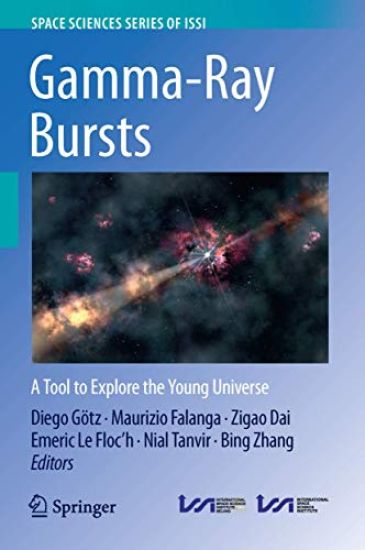
Gamma-Ray Bursts
Springer
2018
sidottu
This topical volume reviews a comprehensive set of problems raised by the use of Gamma Ray Bursts (GRBs) as cosmological probes, as they were addressed and debated during the ISSI-Beijing workshop “Gamma Ray Bursts: A Tool to Explore the Young Universe," which took place from April 13 to 17, 2015, in Beijing. The invited authors represent both the GRB community stricto sensu and the community studying high-redshift galaxies and star formation history. The chapters of the book elucidate the connection between GRBs and the deep universe, stimulating thoughts on how to develop worldwide synergies between high-redshift GRB studies and surveys of the deep universe. Originally published in Space Science Reviews, Volume 202, Issue 1-4, December 2016
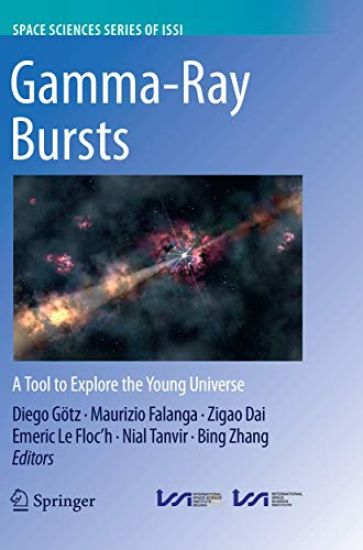
Gamma-Ray Bursts
Springer
2018
nidottu
This topical volume reviews a comprehensive set of problems raised by the use of Gamma Ray Bursts (GRBs) as cosmological probes, as they were addressed and debated during the ISSI-Beijing workshop “Gamma Ray Bursts: A Tool to Explore the Young Universe," which took place from April 13 to 17, 2015, in Beijing. The invited authors represent both the GRB community stricto sensu and the community studying high-redshift galaxies and star formation history. The chapters of the book elucidate the connection between GRBs and the deep universe, stimulating thoughts on how to develop worldwide synergies between high-redshift GRB studies and surveys of the deep universe. Originally published in Space Science Reviews, Volume 202, Issue 1-4, December 2016

Man Ray and Fashion
Stockmans Art Books
2025
nidottu
Man Ray and Fashion was published in addition to the exhibition at MoMu (Fashion Museum Antwerp) in 2023. Man Ray was a widely versatile artist who worked with a range of different media and did not like to be pigeonholed. The way he portrayed women and their clothing continues to influence fashion photographers today. Man Ray used new and unexpected angles, employed artistic staging, and applied such innovative processes as solarization and multiple exposure to his fashion photography. In recent decades, fashion designers continue to find inspiration in his Surrealist imagery. This is most notably true for Belgian designers, with their avant-garde mindset. Completely in line with the concept of Surrealism, these references are often subconscious. Part of Man Ray’s extensive history is brought together in this book alongside contemporary works by the likes of Paul Kooiker, Martin Margiela and Céline (among others).
X-Ray Spectroscopy
In Tech
2012
sidottu
The x-ray is the only invention that became a regular diagnostic tool in hospitals within a week of its first observation by Roentgen in 1895. Even today, x-rays are a great characterization tool at the hands of scientists working in almost every field, such as medicine, physics, material science, space science, chemistry, archeology, and metallurgy. With vast existing applications of x-rays, it is even more surprising that every day people are finding new applications of x-rays or refining the existing techniques. This book consists of selected chapters on the recent applications of x-ray spectroscopy that are of great interest to the scientists and engineers working in the fields of material science, physics, chemistry, astrophysics, astrochemistry, instrumentation, and techniques of x-ray based characterization. The chapters have been grouped into two major sections based upon the techniques and applications. The book covers some basic principles of satellite x-rays as characterization tools for chemical properties and the physics of detectors and x-ray spectrometer. The techniques like EDXRF, WDXRF, EPMA, satellites, micro-beam analysis, particle induced XRF, and matrix effects are discussed. The characterization of thin films and ceramic materials using x-rays is also covered.

X-ray Scattering
IntechOpen
2017
sidottu
X-ray Characterization of Nanostructured Energy Materials by Synchrotron Radiation
IntechOpen
2017
sidottu
Nowadays, nanomaterials are attracting huge attentions not only from a basic research point of view but also for their potential applications. Since finding the structure-property-processing relationships can open new windows in the application of materials, the material characterizations play a crucial role in the research and development of materials science. The increasing demand for energy with the necessity to find alternative renewable and sustainable energy sources leads to the rapid growth in attention to energy materials. In this book, the results of some outstanding researches on synchrotron-based characterization of nanostructured materials related to energy applications are presented.