Kirjojen hintavertailu. Mukana 11 627 374 kirjaa ja 12 kauppaa.

Kirjahaku

Etsi kirjoja tekijän nimen, kirjan nimen tai ISBN:n perusteella.

1000 tulosta hakusanalla Robert A. G. Monks

Trade Liberalization

Trade Liberalization

Robert A. Rogowsky; Linda A. Linkins; Karl S. Tsuji

Praeger Publishers Inc
2001
sidottu
Examining the often-expressed concerns about trade liberalization, the authors assess both the facts and common perceptions underlying the issues. Research shows that some popular concerns about trade are factually based, but others are less well supported or arise from apparent misunderstandings of the way international markets work. This form of presentation both highlights the current divergence of views and demonstrates the extent to which either new research or better public dissemination of existing research might lead toward greater consensus.The authors examine seven often-expressed concerns about trade liberalization to assess both the facts and common perceptions underlying the issues. • Trade's effect on manufacturing jobs • Trade's effect on wage and income inequality • Trade deficits • U.S. economic exposure to foreign-market instability • The threat to sovereignty • Trade's effect on the environment • Health and safetyAfter briefly summarizing the concerns raised in each area, the authors review a large body of recent economic and legal literature. Plain statements by advocates of a particular position on an issue appear alongside discussion of more formal economic or legal analysis of the same issue. This form of presentation both highlights the current divergence of views and demonstrates the extent to which either new research or better public dissemination of existing research might lead toward greater consensus.

Trade Liberalization

Trade Liberalization

Robert A. Rogowsky; Linda A. Linkins; Karl S. Tsuji

Praeger Publishers Inc
2001
nidottu
Examining the often-expressed concerns about trade liberalization, the authors assess both the facts and common perceptions underlying the issues. Research shows that some popular concerns about trade are factually based, but others are less well supported or arise from apparent misunderstandings of the way international markets work. This form of presentation both highlights the current divergence of views and demonstrates the extent to which either new research or better public dissemination of existing research might lead toward greater consensus.The authors examine seven often-expressed concerns about trade liberalization to assess both the facts and common perceptions underlying the issues. • Trade's effect on manufacturing jobs • Trade's effect on wage and income inequality • Trade deficits • U.S. economic exposure to foreign-market instability • The threat to sovereignty • Trade's effect on the environment • Health and safetyAfter briefly summarizing the concerns raised in each area, the authors review a large body of recent economic and legal literature. Plain statements by advocates of a particular position on an issue appear alongside discussion of more formal economic or legal analysis of the same issue. This form of presentation both highlights the current divergence of views and demonstrates the extent to which either new research or better public dissemination of existing research might lead toward greater consensus.

Practicing Sociology

Practicing Sociology

Robert A. Dentler

Praeger Publishers Inc
2001
sidottu
Chronicling the revitalization of the field of applied sociology, Dentler offers an interpretive history of how the field has evolved over the years, how it was transplanted from Europe into the U.S., how and why it declined during the latter years of the 20th century, and its recent rebound. Providing a conceptual and historical framework for the practice of applied sociology, this work profiles a variety of practicing sociologists and offers case studies in the fields of education, organizational development, work and labor, and program evaluation. Students, faculty, and practicing sociologists who wish to better understand the foundations and growth of applied sociology as well as the ways in which they can unify the field around the theoretical resources of symbolic interactionism and its offshoots in participation and client empowerment will find what they need in this accessible and unique text.^IPracticing Sociology^R will instruct faculty and students in the history, traditions, and future prospects of both applied sociology and sociological practice, the social engineering subfields of the more general field of sociology. Degree programs at both the M.A. and B.S. levels continue to spring up at colleges and universities throughout the U.S. and in many countries around the world. This is the first text aimed at the students of these programs, who are preparing to enter such fields as program evaluation, educational planning and program management, organizational development, and labor relations. It is designed to prepare students for careers in applied sociology while providing them with a thorough discussion of the foundations of the field.
Practicing Sociology

Practicing Sociology

Robert A. Dentler

Praeger Publishers Inc
2001
nidottu
Chronicling the revitalization of the field of applied sociology, Dentler offers an interpretive history of how the field has evolved over the years, how it was transplanted from Europe into the U.S., how and why it declined during the latter years of the 20th century, and its recent rebound. Providing a conceptual and historical framework for the practice of applied sociology, this work profiles a variety of practicing sociologists and offers case studies in the fields of education, organizational development, work and labor, and program evaluation. Students, faculty, and practicing sociologists who wish to better understand the foundations and growth of applied sociology as well as the ways in which they can unify the field around the theoretical resources of symbolic interactionism and its offshoots in participation and client empowerment will find what they need in this accessible and unique text.^IPracticing Sociology^R will instruct faculty and students in the history, traditions, and future prospects of both applied sociology and sociological practice, the social engineering subfields of the more general field of sociology. Degree programs at both the M.A. and B.S. levels continue to spring up at colleges and universities throughout the U.S. and in many countries around the world. This is the first text aimed at the students of these programs, who are preparing to enter such fields as program evaluation, educational planning and program management, organizational development, and labor relations. It is designed to prepare students for careers in applied sociology while providing them with a thorough discussion of the foundations of the field.
Journeys Out of the Body

Journeys Out of the Body

Robert A. Monroe

Souvenir Press Ltd
1989
pokkari
When, unpredictably and against his will, Robert Monroe began to have out-of-body experiences, he was frightened and disbelieving. He found that he could leave his physical body to places far removed from the material and spiritual realities of life on earth. He came to inhabit a world unbounded by death or time. As Robert Monroe met many other people who have had similar experiences and read the literature of the East that documents the long history of this phenomenon, his fears were alleviated. His journeys became more frequent and began to change his life. This classic, first-hand account of out-of-body experiences challenges us to revise our ideas about life and death. Robert Monroe's step-by-step instructions invite the reader to initiate their own out-of-body experiences.
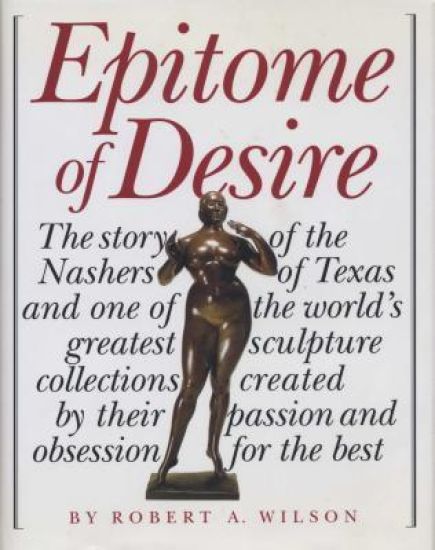
Epitome of Desire

Epitome of Desire

Robert A. Wilson

University of Texas Press
2003
sidottu
This is an American story that reminds us of the possibilities our nation offers. It's the story of the son of a Russian immigrant, Ray Nasher, who was born in Boston, lived in a three-decker house, and graduated from that great democratizer, Boston Latin School. It's the story of his entrepreneurial success in Texas and his marriage to Patsy and their creation, over the course of more than forty years, of one of the greatest sculpture collections of the twentieth century. It's also the story of how that sculpture collection and the Nashers were courted by the most powerful art institutions and their directors-the National Gallery and its director, the late Carter Brown, the Guggenheim and its impresario, Thomas Krens, the Tate in London, and the Dallas Museum of Art. It's the story about how, in the end, Nasher did it his way, buying land next to the Dallas Museum and conceiving there an extraordinary sculpture center, designed by Renzo Piano, the Italian architect of unsurpassed insight into what the museum experience should be. Picasso. Matisse. Giacommetti. Moore. Brancusi. Arp. Gauguin. The giants of the twentieth century form the core of the Nasher Collection. And for Nasher, the pursuit is without end. For him the most important acquisition remains, as it does with all true collectors, the next one. This is a book about art and ambition. And, finally, the triumph of the Nashers' will to create a collection focused only on the best.
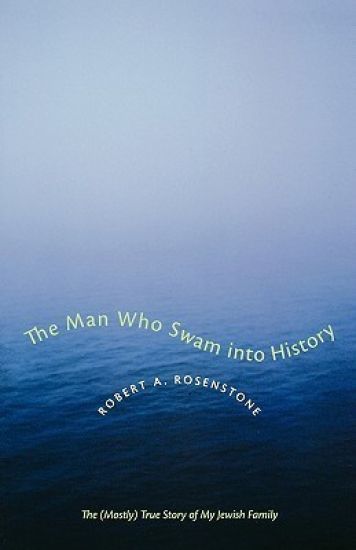
The Man Who Swam Into History

The Man Who Swam Into History

Robert A. Rosenstone

University of Texas Press
2005
pokkari
The story begins with a grandfather who heroically escaped from Russia by swimming the Pruth River to Romania-or did he? Then there are stories of another grandfather who kept a lifelong mistress; grandmothers who were ignored except in the kitchen; migrations legal and illegal from Eastern Europe to Canada to California; racketeers on one side of the family and Communists on the other; and a West Coast adolescence in the McCarthy years. All of these (mostly true) stories form a Jewish family's history, a tale of dislocation and assimilation. But in the hands of award-winning historian Robert Rosenstone, they become much more. The fragments of memory so beautifully preserved in The Man Who Swam into History add unforgettable, human characters to the now familiar story of the Jewish diaspora in the twentieth century. This combination memoir/short story collection recounts the Rosenstone family's passage from Romania to America. Robert Rosenstone tells the story not as a single, linear narrative, but through "tales, sequences, windows, moments, and fragments resurrected from the lives of three generations in my two parental families, set in five countries on two continents over the period of almost a century." This more literary and personal approach allows Rosenstone's relatives to emerge as distinct personalities, voices who quarrel and gossip, share their dreams and fears, and maintain the ties of a loving, if eccentric, family. Among the genre of "coming to America" tales, The Man Who Swam into History is a work of unique vision, one that both records and reconstructs the past even as it continuously-and humorously-questions the truth of its own assertions.
The Karankawa Indians of Texas

The Karankawa Indians of Texas

Robert A. Ricklis

University of Texas Press
1996
pokkari
Popular lore has long depicted the Karankawa Indians as primitive scavengers (perhaps even cannibals) who eked out a meager subsistence from fishing, hunting and gathering on the Texas coastal plains. That caricature, according to Robert Ricklis, hides the reality of a people who were well-adapted to their environment, skillful in using its resources, and successful in maintaining their culture until the arrival of Anglo-American settlers.The Karankawa Indians of Texas is the first modern, well-researched history of the Karankawa from prehistoric times until their extinction in the nineteenth century. Blending archaeological and ethnohistorical data into a lively narrative history, Ricklis reveals the basic lifeway of the Karankawa, a seasonal pattern that took them from large coastal fishing camps in winter to small, dispersed hunting and gathering parties in summer. In a most important finding, he shows how, after initial hostilities, the Karankawa incorporated the Spanish missions into their subsistence pattern during the colonial period and coexisted peacefully with Euroamericans until the arrival of Anglo settlers in the 1820s and 1830s. These findings will be of wide interest to everyone studying the interactions of Native American and European peoples.
Trees of East Texas

Trees of East Texas

Robert A. Vines

University of Texas Press
1977
nidottu
This comprehensive and compact field guide covers the richest plant-life region in the state-the Upper Gulf Coast Prairie, the Post Oak Savannah, and the Pineywoods of east Texas. Eastern, northern, Gulf coast, and western Texas trees occur together in the Big Thicket area of the Pineywoods, where abundant rainfall and mild temperatures also make possible much tropical growth.Trees of East Texas is drawn from Robert A. Vines' monumental Trees, Shrubs, and Woody Vines of the Southwest (University of Texas Press, 1960). Without sacrificing the essential detail of the original work, this guide has been designed to travel info the field for on-the-spot identification. Meant to be carried and consulted, Trees of East Texas is conveniently organized, and virtually every description is accompanied by a finely executed illustration.This book contains new and updated information, and every native and naturalized tree in the area is identified. In addition to the technical descriptions, the author provides, in his "Remarks" sections, common names and fascinating bits of history and lore on each tree cited.
Trees of North Texas

Trees of North Texas

Robert A. Vines

University of Texas Press
1982
nidottu
This comprehensive and compact volume is a field guide to all the native and naturalized trees of the north Texas zone, including the Blackland Prairies, the Cross Timbers region, and both the Rolling and High Plains. Here too is detailed information on the many varieties of trees introduced into the Dallas-Fort Worth region over the twentieth century.Drawn from Robert A. Vines' monumental Trees, Shrubs, and Woody Vines of the Southwest (University of Texas Press, 1960), the field guide contains full descriptions of every tree in the area. Its convenient organization makes Trees of North Texas ideal to take into the field for on-the-spot identification, and virtually every description is accompanied by a finely executed illustration. Fascinating bits of history and lore enliven the descriptions throughout.
Trees of Central Texas

Trees of Central Texas

Robert A. Vines

University of Texas Press
1984
pokkari
A comprehensive and compact field guide, Trees of Central Texas introduces 186 species of tree life in Central Texas, an area roughly the region of the Edwards Plateau and bordered by the Balcones Escarpment on the south and east, the Pecos River on the west, and the Texas Plains and the Llano Uplift on the north. From the hardy oaks and rugged mesquites to the graceful willows, cottonwoods, and pecans, the tree life of Central Texas varies as much as the vast and changing land that hosts it. Full descriptions and superb illustrations of all the native and naturalized trees of the region as well as fascinating bits of history and lore make this an essential guide to the wealth of tree life in Central Texas.Drawn from Robert A. Vines' monumental Trees, Shrubs, and Woody Vines of the Southwest (University of Texas Press), Trees of Central Texas combines the essential detail of the larger work with the ease and convenience of a field guide.
Sacred Leaves of Candomblé

Sacred Leaves of Candomblé

Robert A. Voeks

University of Texas Press
1997
pokkari
Winner, Hubert Herring Book Award, Pacific Coast Council on Latin American StudiesCandomblÉ, an African religious and healing tradition that spread to Brazil during the slave trade, relies heavily on the use of plants in its spiritual and medicinal practices. When its African adherents were forcibly transplanted to the New World, they faced the challenge not only of maintaining their culture and beliefs in the face of European domination but also of finding plants with similar properties to the ones they had used in Africa.This book traces the origin, diffusion, medicinal use, and meaning of CandomblÉ's healing pharmacopoeia-the sacred leaves. Robert Voeks examines such topics as the biogeography of Africa and Brazil, the transference-and transformation-of CandomblÉ as its adherents encountered both native South American belief systems and European Christianity, and the African system of medicinal plant classification that allowed CandomblÉ to survive and even thrive in the New World. This research casts new light on topics ranging from the creation of African American cultures to tropical rain forest healing floras.
Beyond Affirmative Action

Beyond Affirmative Action

Robert A. Ibarra

University of Wisconsin Press
2001
nidottu
This work calls for a paradigm shift in US higher education. It introduces a theory of ""multicontextuality"", which proposes that many people learn better when teachers emphasize whole systems of knowledge, and that education should offer and accept many approaches to teaching and learning.
Indian Mounds of Wisconsin

Indian Mounds of Wisconsin

Robert A. Birmingham; Amy L. Rosebrough

University of Wisconsin Press
2017
nidottu
More mounds were built by ancient Native Americans in Wisconsin than in any other region of North America?between 15,000 and 20,000, at least 4,000 of which remain today. Most impressive are the effigy mounds, huge earthworks sculpted in the shapes of thunderbirds, water panthers, and other forms, not found anywhere else in the world in such concentrations. This second edition is updated throughout, incorporating exciting new research and satellite imagery. Written for general readers, it offers a comprehensive overview of these intriguing earthworks.Citing evidence from past excavations, ethnography, the traditions of present-day Native Americans in the Midwest, ground-penetrating radar and LIDAR imaging, and recent findings of other archaeologists, Robert A. Birmingham and Amy L. Rosebrough argue that effigy mound groups are cosmological maps that model belief systems and relations with the spirit world. The authors advocate for their preservation and emphasize that Native peoples consider the mounds sacred places.This edition also includes an expanded list of public parks and preserves where mounds can be respectfully viewed, such as the Kingsley Bend mounds near Wisconsin Dells, an outstanding effigy group maintained by the Ho-Chunk Nation, and the Man Mound Park near Baraboo, the only extant human-shaped effigy mound in the world.
Polyarchy

Polyarchy

Robert A. Dahl

Yale University Press
1972
pokkari
"A tightly woven explanation of the conditions under which cultures that do not tolerate political opposition may be transformed into societies that do."—Foreign Affairs "[Dahl's] analysis is lucid, perceptive, and thorough."—Times Literary Supplement Amidst all the emotional uproar about democracy and the widespread talk of revolution comes this clear call to reason—a mind-stretching book that equips the young and the old suddenly to see an ageless problem of society in a new and exciting way. Everything Dahl says can be applied in a fascinating way to the governing of any human enterprise involving more than one person—whether it is a nation-state, a political party, a business firm, or a university.
Dilemmas of Pluralist Democracy

Dilemmas of Pluralist Democracy

Robert A. Dahl

Yale University Press
1983
pokkari
“Continuing his career-long exploration of modern democracy, Dahl addresses a question that has long vexed students of political theory: the place of independent organizations, associations, or special interest groups within the democratic state.”—The Wilson Quarterly“There is probably no greater expert today on the subject of democratic theory than Dahl….His proposal for an ultimate adoption here of a ‘decentralized socialist economy,’ a system primarily of worker ownership and control of economic production, is daring but rational, reflecting his view that economic inequality seems destined to become the major issue here it historically has been in Europe.”—Library Journal“Dahl reaffirms his commitment to pluralist democracy while attempting to come to terms with some of its defects.”—Laura Greyson, Worldview“Anyone who is interested in these issues and who makes the effort the book requires will come away the better for it. And more. He will receive an explanation for our current difficulties that differs considerably from the explanation for our current difficulties that differs considerably from the explanation offered by the Reagan administration, and a prescription for the future which differs fundamentally from the nostrums emanating from the White House.”—Dennis Carrigan, The (Louisville, Kentucky) Courier-Journal
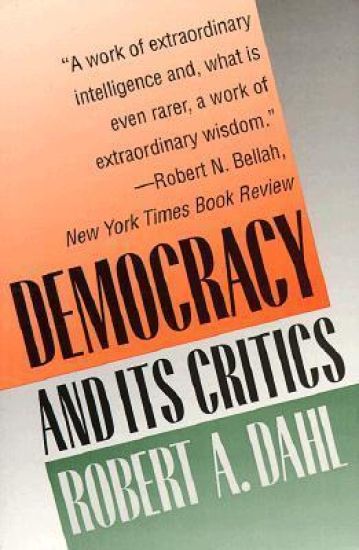
Democracy and Its Critics

Democracy and Its Critics

Robert A. Dahl

Yale University Press
1991
pokkari
In this prize-winning book, one of the most prominent political theorists of our time makes a major statement about what democracy is and why it is important. Robert Dahl examines the most basic assumptions of democratic theory, tests them against the questions raised by its critics, and recasts the theory of democracy into a new and coherent whole. He concludes by discussing the directions in which democracy must move if advanced democratic states are to exist in the future. “When Robert Dahl speaks about democracy, everyone should listen. With Democracy and Its Critics Dahl has produced a work destined to become another classic.”—Lucian W. Pye, American Political Science Review“In this magisterial work [Dahl]… describe[s] what democracy means…; why our own democracy is still deeply flawed; and how we could reform it…. A work of extraordinary intelligence and, what is even rarer, a work of extraordinary wisdom.”—Robert N. Bellah, New York Times Book ReviewRobert A. Dahl, Sterling Professor of Political Science Emeritus at Yale Universtiy, is also the author of Who Governs?, After the Revolution?, Polyarchy, and Dilemmas of Pluralist Democracy, all available from Yale University Press.
Sickness and Healing

Sickness and Healing

Robert A. Hahn

Yale University Press
1996
pokkari
The ways in which people respond to sickness differ greatly from society to society. In this book anthropologist and epidemiologist Robert A. Hahn examines how Western and non-Western cultures influence the definition, experience, and treatment of sickness.Hahn begins by developing a definition of sickness that is based on the patient's perception of suffering and disturbance rather than on the physician's assessment of biomedical signs. After reviewing the principal theories that account for the forms of sickness and healing found in different historical and cultural situations, he explores the relevance of both anthropological and epidemiological approaches to sickness, focusing on the persistent gap between white and black infant mortality in the United States. Hahn then describes contemporary Western medicine as it might be seen by a visiting foreign anthropologist. He delineates the culture of Western medicine and portrays the world of one physician at work, traces the evolution of obstetrics since 1903 by analyzing the principal textbook—Williams Obstetrics—through its first eighteen editions, and explores the gulf between physicians and their patients by examining the accounts of physicians who have written about their own illnesses. He concludes by proposing ways in which some of the ills of contemporary Western medicine might be remedied by applying anthropological principles to medical training and practice.
Restoring North America's Birds

Restoring North America's Birds

Robert A. Askins

Yale University Press
2002
pokkari
This accessible book draws on recent research on bird species and their habitats to explain how basic principles of bird ecology and landscape ecology can help us create scientifically sound plans for protecting and restoring the rich diversity of North American birds. This edition includes an afterword that reviews noteworthy literature that has appeared since the first edition was completed in 1999. This new material—on such key issues as the importance of preserving large expanses of natural habitat, the importance of maintaining early successional habitats, and the habitat requirements of neotropical migrants—shows how the research on landscape ecology of birds has shaped conservation policy more rapidly than most would have predicted.Praise for the earlier edition: "This book is first-rate—very broad in scope and appeal, readable, and truly integrative in its coverage of landscape ecology and its implications for avian conservation biology. . . . It will be of significant interest to researchers and students of conservation biology, ornithology and ecology; land managers; conservation agencies; and anyone with an interest in protecting the rich avian diversity of North America."—Trevor E. Pitcher, American Scientist "This wonderful book . . . is especially relevant for conservation biologists from all walks of life."—Kathryn E. Sieving, Auk "An enjoyable read for anyone, from the amateur birder to the professional scientist."—J. Michael Reed, Ecology