Kirjojen hintavertailu. Mukana 11 717 486 kirjaa ja 12 kauppaa.

Kirjahaku

Etsi kirjoja tekijän nimen, kirjan nimen tai ISBN:n perusteella.

1000 tulosta hakusanalla Rodney a. Nobles

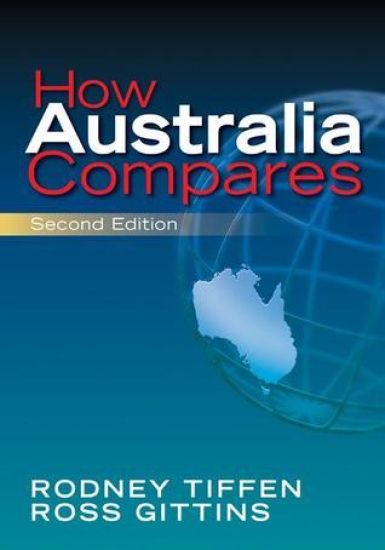
How Australia Compares

How Australia Compares

Rodney Tiffen; Ross Gittins

Cambridge University Press
2009
pokkari
How Australia Compares is a handy reference that compares Australia with seventeen other developed countries across a wide range of social, economic and political dimensions. Whenever possible, it gives not only snapshot comparisons from the present, but charts trends over recent decades or even longer. Encyclopaedic in scope, it provides statistics for a huge range of human activity, from taxation to traffic accidents, homicide rates to health expenditure, interest rates to internet usage. This new edition is fully revised and updated, and features two new chapters: The Howard Impact and The Search for Scoreboards. New sections include obesity, advertising, broadband internet access, childcare and corruption. Information is highly accessible with double-page spreads for each topic. Tables and graphs are presented on one page, and clear explanation and analysis on the facing page. In each discussion the focus is to put the Australian experience into international perspective, drawing out the implications for the nation's performance, policies and prospects.
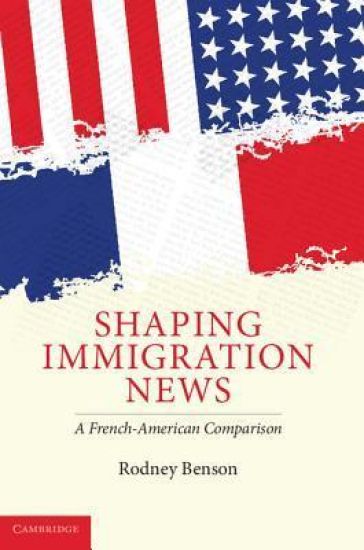
Shaping Immigration News

Shaping Immigration News

Rodney Benson

Cambridge University Press
2014
pokkari
This book offers a comprehensive portrait of French and American journalists in action as they grapple with how to report and comment on one of the most important issues of our era. Drawing on interviews with leading journalists and analyses of an extensive sample of newspaper and television coverage since the early 1970s, Rodney Benson shows how the immigration debate has become increasingly focused on the dramatic, emotion-laden frames of humanitarianism and public order. In both countries, less commercialized media tend to offer the most in-depth, multi-perspective and critical news. Benson challenges classic liberalism's assumptions about state intervention's chilling effects on the press, suggests costs as well as benefits to the current vogue in personalized narrative news, and calls attention to journalistic practices that can help empower civil society. This book offers new theories and methods for sociologists and media scholars and fresh insights for journalists, policy makers and concerned citizens.
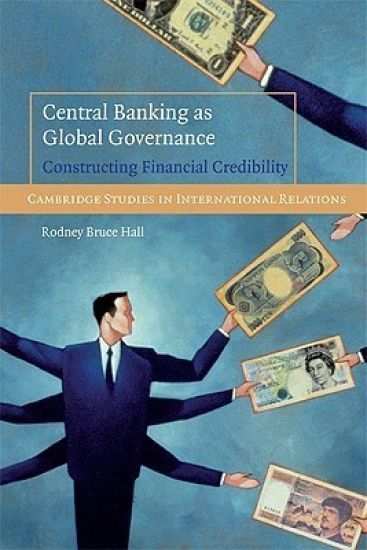
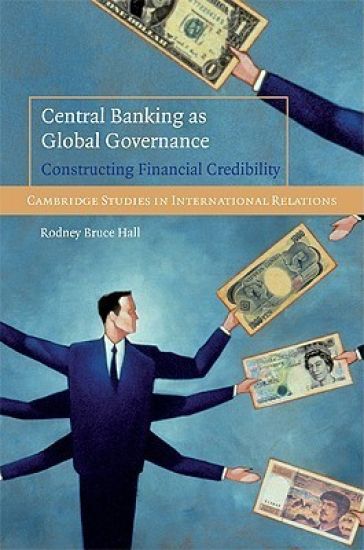
Central Banking as Global Governance

Central Banking as Global Governance

Rodney Bruce Hall

Cambridge University Press
2008
pokkari
Money is a social convention, but with what social consequences? In this innovative study, Rodney Bruce Hall argues that those who govern the parameters of money's creation, its destruction, and its valuation are responsible for the governance of international finance. The volume is an analysis of central banking as global governance, employing the institutional philosophy of John Searle as a theoretical basis for exploring the consequences of money as a social institution, and the social relations of credit and debt. While previous studies in this field have made forays into the political economy of monetary institutions, this book breaks new ground by offering a constructivist social analysis that identifies the mechanisms of governance as social rather than material processes. The volume will therefore be of great interest to a wide range of scholars and students, particularly those with an interest in international relations, international finance and international political economy.
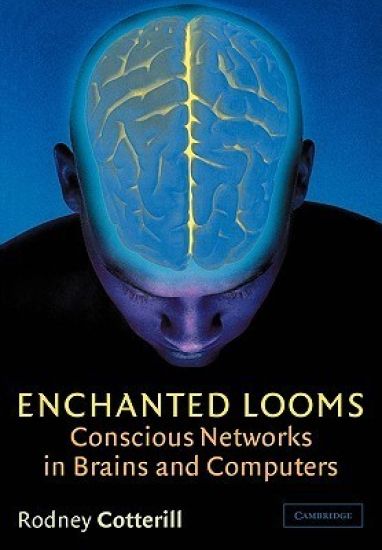
Enchanted Looms

Enchanted Looms

Rodney Cotterill

Cambridge University Press
2000
pokkari
The title of this book was inspired by a passage in Charles Sherrington’s Man on his Nature. When that famous physiologist died in 1952, the prospects for a scientific explanation of consciousness seemed remote. Enchanted Looms shows how the situation has changed dramatically, and provides what is probably the most wide-ranging account of the phenomenon ever written. Rodney Cotterill bridges the gap between the bottom-up approach to understanding consciousness, anchored in the brain’s biochemistry, anatomy and physiology, and the top-down strategy, which concerns itself with behaviour and the nervous system’s interaction with the environment. The author argues that an explanation of consciousness is now at hand, and extends the discussion to include intelligence and creativity. This beautifully written and illustrated book will be valued for its easy access to one of science’s last great challenges. It will change forever our view of consciousness, and our concept of the human being.
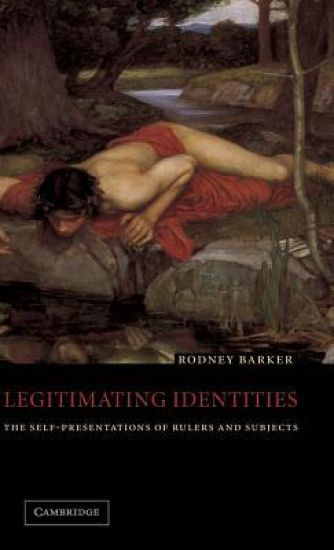
Legitimating Identities

Legitimating Identities

Rodney Barker

Cambridge University Press
2001
sidottu
Rulers of all kinds, from feudal monarchs to democratic presidents and prime ministers, justify themselves to themselves through a variety of rituals, rhetoric, and dramatisations, using everything from architecture and coinage to etiquette and portraiture. This kind of legitimation - self-legitimation - has been overlooked in an age which is concerned principally with how government can be justified in the eyes of its citizens. In this book, Rodney Barker argues that at least as much time is spent by rulers legitimating themselves in their own eyes, and cultivating their own sense of identity, as is spent in trying to convince ordinary subjects. Once this dimension of ruling is taken into account, a far fuller understanding can be gained of what rulers are doing when they rule. It can also open the way to a more complete grasp of what subjects are doing, both when they obey and when they rebel.
Racial Diversity and Social Capital

Racial Diversity and Social Capital

Rodney E. Hero

Cambridge University Press
2007
sidottu
Race and racial diversity are important aspects of America and have been shown to substantially affect social relations and the political system, often in ways inconsistent with the values of equality. However, greater civic association and a general sense of community, embodied in the concept of social capital, are said to have tremendous beneficial effects and profoundly influence American society. This 2007 study juxtaposes and critically assesses two bodies of research that have reached different conclusions on these issues. Is America's legacy of racial inequality an 'evil twin' of the benefits of social capital? By analysing the social outcomes for racial minorities, in addition to other dimensions of American politics, the author shows that the impact of racial diversity consistently outweighs that of social capital.
Shaping Immigration News

Shaping Immigration News

Rodney Benson

Cambridge University Press
2013
sidottu
This book offers a comprehensive portrait of French and American journalists in action as they grapple with how to report and comment on one of the most important issues of our era. Drawing on interviews with leading journalists and analyses of an extensive sample of newspaper and television coverage since the early 1970s, Rodney Benson shows how the immigration debate has become increasingly focused on the dramatic, emotion-laden frames of humanitarianism and public order. In both countries, less commercialized media tend to offer the most in-depth, multi-perspective and critical news. Benson challenges classic liberalism's assumptions about state intervention's chilling effects on the press, suggests costs as well as benefits to the current vogue in personalized narrative news, and calls attention to journalistic practices that can help empower civil society. This book offers new theories and methods for sociologists and media scholars and fresh insights for journalists, policy makers and concerned citizens.
Central Banking as Global Governance

Central Banking as Global Governance

Rodney Bruce Hall

Cambridge University Press
2008
sidottu
Money is a social convention, but with what social consequences? In this innovative study, Rodney Bruce Hall argues that those who govern the parameters of money's creation, its destruction, and its valuation are responsible for the governance of international finance. The volume is an analysis of central banking as global governance, employing the institutional philosophy of John Searle as a theoretical basis for exploring the consequences of money as a social institution, and the social relations of credit and debt. While previous studies in this field have made forays into the political economy of monetary institutions, this book breaks new ground by offering a constructivist social analysis that identifies the mechanisms of governance as social rather than material processes. The volume will therefore be of great interest to a wide range of scholars and students, particularly those with an interest in international relations, international finance and international political economy.
Time to Die

Time to Die

Rodney Syme

Melbourne University Press
2017
nidottu
Medical science now allows us to live longer than ever before. So living with pain and dying well have become major concerns for the general community, health practitioners, church groups and politicians. Should these issues be decided in private by individuals or must we legislate ethical guidelines? Rodney Syme has been an advocate for medically assisted dying for more than twenty years. In Time to Die he reflects on those living and dying in pain and shares their stories. Syme makes a powerful case for extending the right to die to those whose suffering is unbearable.
Village Prodigies

Village Prodigies

Rodney Jones

HOUGHTON MIFFLIN
2017
nidottu
"A novel in language as dense and lush and beautiful as poetry . . . or] a book of poetry with the vivid characters and the narrative force of a novel? Whatever you care to call it, it's a remarkable achievement." -- Richard Russo, Pulitzer Prize-winning author of Empire FallsVillage Prodigies imagines the town of Cold Springs, Alabama, from 1950 to 2015 and unfurls its narrative reach as six boys--prodigies and swains--grow up and leave the familiarity of home and the rural South.Yet all prodigies, all memories, all stories inevitably loop back. Through a multiplicity of points of view and innovative forms, Rodney Jones plays with the contradictions in our experience of time, creating portals through which we travel between moments and characters, from the interior mind to the most exterior speech, from delusions to rational thought. We experience Alzheimer's and its effect on family, listen to family lore and read family Facebook posts, relive war, and revive half-forgotten folktales and video games. In this deep examination of personal and communal memory, Jones blurs the lines between analog and digital, poetry and prose.
Imaginary Logic

Imaginary Logic

Rodney Jones

HOUGHTON MIFFLIN
2018
pokkari
"It's Jones's age-defying distinction to have mobilized a moral intelligence that's sufficiently vast to contain multitudes."--Washington Post Book World Imaginary Logic is a brilliantly expansive, deeply meditative, and at times wildly imaginative collection of poems that combines Rodney Jones's distinctive storytelling ability, sharp social intelligence, and keen powers of observation in a book that is wistful, satiric, audacious, and remorseless. "The Art of Heaven" opens with a parody of Dante and a down-home, twisted humor that Jones's readers have come to rely on: "In the middle of my life I came to a dark wood, / the smell of barbecue, kids running in the yards. / Not deep depression. This nice hell of suburbs. / Speed bumps. The way things aren't quite paradise." Jones, winner of the National Book Critics Circle Award, is one of America's "best, most generous, and most brilliantly readable poets" (Poetry). Imaginary Logic is the most eloquent expression yet of his rigorous mind, scrupulous eye, and capacious heart. " Jones'] poems are a work of hands, and hands-on. His rich lyric sentences register experience at the full and thus at its high moment of complexity. Like most of the important poets, he's a lapsed pastoralist attempting to restore--no, save--the fallen."--Stanley Plumly
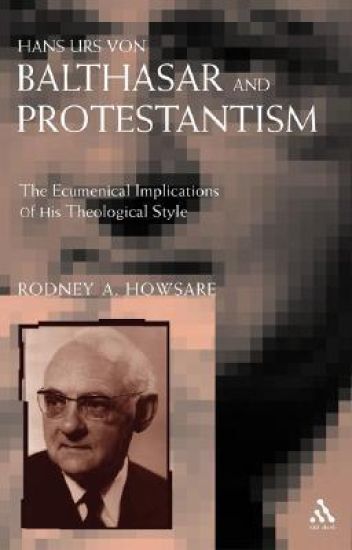
Hans Urs Von Balthasar and Protestantism

Hans Urs Von Balthasar and Protestantism

Rodney Howsare

T. T.Clark Ltd
2005
nidottu
Hans Urs von Balthasar and Protestantism examines Balthasar's engagement with Protestantism, primarily in the persons of Martin Luther and Karl Barth and explores the implications of this engagement for Fundamental Theology. At the very root of Luther's confrontation with the Catholic Church of the late Middle Ages lies his antipathy for Aristotle and for "natural theology". In other words, the Protestant difference has as much to do with its suspicion of the Catholic treatment of faith and reason as it does with the Catholic treatment of faith and works. This is a suspicion that is only exacerbated in Barth's association of the "analogy of being" with the Antichrist. Balthasar takes these criticisms very seriously, and, in addressing them, not only has much of relevance to say about the Catholic-Protestant differences, but also about the Yale-Chicago differences. In short, this study shows how Balthasar's dialogue with Luther and Barth sheds light on the impasse that has arisen between the so-called "correlational" and "revelocentric" schools of contemporary theology. If, indeed, Christ is the "concrete universal," then, it argues, we should not have to decide between the two.
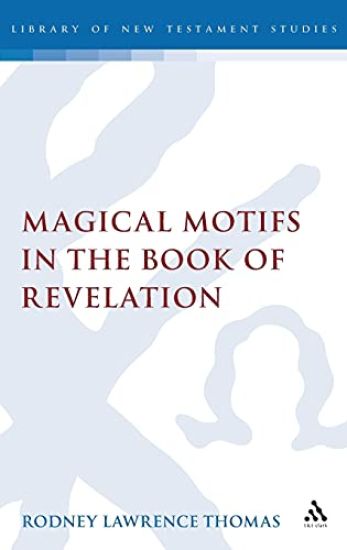
Magical Motifs in the Book of Revelation

Magical Motifs in the Book of Revelation

Rodney Lawrence Thomas

T. T.Clark Ltd
2010
sidottu
Rodney Thomas addresses the question of whether the book of Revelation was written as an ‘anti-magical' polemic and explores the concept and definition of ‘magic' from both modern and first-century standpoints. Thomas presents the first century as a time dominated by belief in spiritual forces and magical activity which the author of Revelation sought to put into proper perspective. This aim was achieved through a variety of highly creative literary techniques which Thomas examines in this book. At times it is possible to argue that unacceptable magical practices are condemned by being labelled as farmakeia. At other times such practices are carefully placed within the context of Israel's ancient enemies. In addition standard polemical material against magical practices Thomas asserts that it is also possible to identify instances where the author of Revelation wholly appropriates imagery commonly associated with ‘magic' and recasts it into a new Christian context. As a result it is possible to view the magical motifs within Revelation as weighty polemic aimed against certain practices and beliefs in the first century.
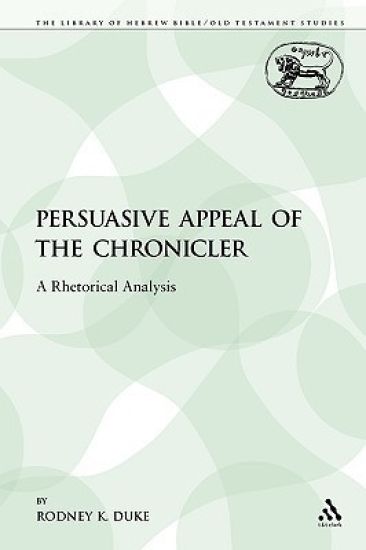
The Persuasive Appeal of the Chronicler

The Persuasive Appeal of the Chronicler

Rodney K. Duke

Continuum International Publishing Group Ltd.
2009
nidottu
Drawing on ancient rhetorical principles, this work brings a novel approach to the exploration of the literary dynamics of the books of Chronicles. Contrary to those who have viewed the Chronicler as ploddy and dull, Duke maintains that the Chronicler understood the historiographical demands of his day. Utilizing traditions, genealogical material, speeches of authoritative characters and paradigmatic portrayal of events and characters, and moving from a cautious inductive presentation of his thesis to a more propositional form of argumentation, the Chronicler retold the story of Israel with skill and artistry.
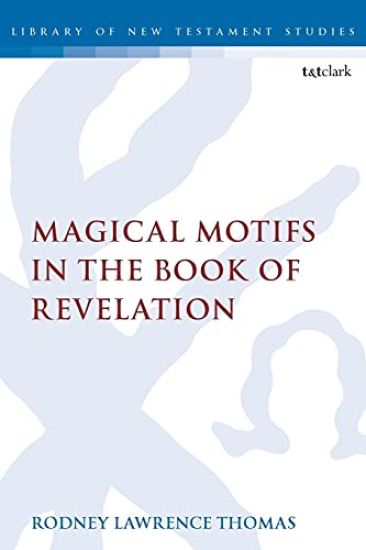
Magical Motifs in the Book of Revelation

Magical Motifs in the Book of Revelation

Rodney Lawrence Thomas

T. T.Clark Ltd
2019
nidottu
Rodney Thomas addresses the question of whether the book of Revelation was written as an ‘anti-magical' polemic and explores the concept and definition of ‘magic' from both modern and first-century standpoints. Thomas presents the first century as a time dominated by belief in spiritual forces and magical activity which the author of Revelation sought to put into proper perspective. This aim was achieved through a variety of highly creative literary techniques which Thomas examines in this book. At times it is possible to argue that unacceptable magical practices are condemned by being labelled as farmakeia. At other times such practices are carefully placed within the context of Israel's ancient enemies. In addition standard polemical material against magical practices Thomas asserts that it is also possible to identify instances where the author of Revelation wholly appropriates imagery commonly associated with ‘magic' and recasts it into a new Christian context. As a result it is possible to view the magical motifs within Revelation as weighty polemic aimed against certain practices and beliefs in the first century.