

Kirjahaku
Etsi kirjoja tekijän nimen, kirjan nimen tai ISBN:n perusteella.
1000 tulosta hakusanalla THOMAS JEFFERSON



A Sketch of the Life, Character, and Public Services of Thomas Jefferson
Antigonos Verlag
2025
sidottu

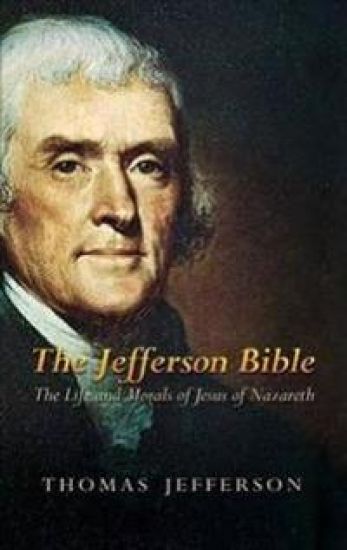
"Question with boldness even the existence of a god," Thomas Jefferson asserted, "because if there be one, he must more approve of the homage of reason than that of blindfolded fear." America's third president regarded Jesus as a moral guide rather than a divinity, and in The Jefferson Bible, he highlights Christ's ethical teachings from the Gospels. Discarding the scriptures' supernatural elements and dogma, this volume reflects the deist view of religion, focusing on Jesus' message of absolute love and service.Jefferson undertook his self-appointed task in 1794, consulting not only the King James Bible but also Greek, French, and Latin versions. He selected verses from the books of Matthew, Mark, Luke, and John, and arranged them in chronological order to form a single narrative. Although Jefferson shared his interpretation with friends and family, he declined to publish it, in keeping with his conviction that religion is a private matter -- and also to avoid providing his political enemies with ammunition. Not until the turn of the twentieth century did the book appear in print, when it became a tradition to present it to new members of Congress. Unique and influential, this volume reflects not only the thinking of one of the nation's most brilliant statesmen, but also the ideology of the Enlightenment era.

Thomas Jefferson is among the most important and controversial of American political thinkers: his influence (libertarian, democratic, participatory, and agrarian-republican) is still felt today. A prolific writer, Jefferson left 18,000 letters, Notes on the State of Virginia, an Autobiography, and numerous other papers. Joyce Appleby and Terence Ball have selected the most important of these for presentation in the Cambridge Texts series: Jefferson’s views on topics such as revolution, self-government, the role of women and African-American and Native Americans emerge to give a fascinating insight into a man who owned slaves, yet advocated the abolition of slavery. The texts are supported by a concise introduction, suggestions for further reading and short biographies of key figures, all providing invaluable assistance to the student encountering the breadth and richness of Jefferson’s thought for the first time.
A definitive compilation of Jeffersonian writings, quotations, and other words of wisdom furnishes hundreds of pronouncements on nearly five hundred different subjects, all organized alphabetically by topic, accompanied by Jefferson's reflections on his contemporaries, his own life, and career, as well as the thoughts of his colleagues on him.
As a law student and young lawyer in the 1760s, Thomas Jefferson began writing abstracts of English common law reports. Even after abandoning his law practice, he continued to rely on his legal commonplace book to document the legal, historical, and philosophical reading that helped shape his new role as a statesman. Indeed, he made entries in the notebook in preparation for his mission to France, as president of the United States, and near the end of his life. This authoritative volume is the first to contain the complete text of Jefferson’s notebook. With more than 900 entries on such thinkers as Beccaria, Montesquieu, and Lord Kames, Jefferson’s Legal Commonplace Book is a fascinating chronicle of the evolution of Jefferson’s searching mind.Jefferson’s abstracts of common law reports, most published here for the first time, indicate his deepening commitment to whig principles and his incisive understanding of the political underpinnings of the law. As his intellectual interests and political aspirations evolved, so too did the content and composition of his notetaking.Unlike the only previous edition of Jefferson’s notebook, published in 1926, this edition features a verified text of Jefferson’s entries and full annotation, including essential information on the authors and books he documents. In addition, the volume includes a substantial introduction that places Jefferson’s text in legal, historical, and biographical context.
The most comprehensive book of quotations by the most quotable Founding FatherMore than any other Founding Father, Thomas Jefferson made his reputation on the brilliance of his writing. John Adams chose the 33-year-old Jefferson to draft the Declaration of Independence largely because of his "masterly Pen." The genius of the Declaration and Jefferson's later writings amply confirmed Adams's judgment. Few writers have said so much on so many subjects—and said it so well—as Jefferson. The Quotable Jefferson—the most comprehensive and authoritative book of Jefferson quotations ever published—demonstrates that as does no other book.Drawing primarily on The Papers of Thomas Jefferson, published by Princeton University Press, John Kaminski has carefully collected and cleverly arranged Jefferson's pronouncements on almost 500 subjects, ranging from the profound and public—the Constitution—to the personal and peculiar—cold water bathing.The Quotable Jefferson is the first book to put Jefferson's words in context with a substantial introduction, a chronology of Jefferson's life, the source of each quotation, an appendix identifying Jefferson's correspondents, and a comprehensive index. The main section of Jefferson quotations, which are arranged alphabetically by topic, is followed by three other fascinating sections of quotations: Jefferson on his contemporaries, his contemporaries on him, and Jefferson on himself.This book will delight the casual reader and browser, but it is also a serious and carefully edited reference work. Whatever the subject, if Jefferson said something memorable about it, you are likely to find it here.
Among the Second Series of The Papers of Thomas Jefferson, this volume has the most detailed coverage of his day-to-day life. These disciplined records of personal expenditures, and of various other daily observations, furnish valuable information about prices and availability of commodities of the period and provide abundant evidence of Jefferson's devotion to a systematic way of living and of his insatiable curiosity. Originally published in 1997. The Princeton Legacy Library uses the latest print-on-demand technology to again make available previously out-of-print books from the distinguished backlist of Princeton University Press. These editions preserve the original texts of these important books while presenting them in durable paperback and hardcover editions. The goal of the Princeton Legacy Library is to vastly increase access to the rich scholarly heritage found in the thousands of books published by Princeton University Press since its founding in 1905.
Among the Second Series of The Papers of Thomas Jefferson, this volume has the most detailed coverage of his day-to-day life. These disciplined records of personal expenditures, and of various other daily observations, furnish valuable information about prices and availability of commodities of the period and provide abundant evidence of Jefferson's devotion to a systematic way of living and of his insatiable curiosity. Originally published in 1997. The Princeton Legacy Library uses the latest print-on-demand technology to again make available previously out-of-print books from the distinguished backlist of Princeton University Press. These editions preserve the original texts of these important books while presenting them in durable paperback and hardcover editions. The goal of the Princeton Legacy Library is to vastly increase access to the rich scholarly heritage found in the thousands of books published by Princeton University Press since its founding in 1905.
"We must reduce our volume to the simple evangelists, select, even from them, the very words only of Jesus. There will be remaining the most sublime and benevolent code of morals which has ever been offered to man."--Thomas Jefferson Featuring an introduction by Forrest Church, this reissue of "The Jefferson Bible" offers extraordinary insight into the logic of Thomas Jefferson and the Gospel of Jesus. Working in the White House in 1804, Jefferson set out to edit the Gospels in order to uncover the essence of true religion in the simple story of the life of Jesus. Jefferson was convinced that the authentic message of Jesus could be found only by extracting from the Gospels Jesus's message of absolute love and service, rather than the miracle of the Annunciation, Virgin Birth, or even the Resurrection. Completed in 1819, this little book is the remarkable result of Jefferson's efforts.
Through substantial selections from Jefferson's writings--including his earliest writings, Notes on Virginia, and key public papers and personal correspondence--this volume traces the development of his thinking on such fundamental issues as republicanism, constitutionalism, slavery, and the separation of religion from politics. Footnotes identify Jefferson's correspondents and provide useful context.
Memoir, Correspondence, and Miscellanies From the Papers of T. Jefferson Volume 1-2
Thomas Jefferson
Hutson Street Press
2025
sidottu
Memoir, Correspondence, and Miscellanies From the Papers of T. Jefferson Volume 1-2
Thomas Jefferson
Hutson Street Press
2025
pokkari
Jefferson's Notes on the State of Virginia; With the Appendixes. to Which Is Subjoined a Sublime and Argumentative Dissertation on Mr. Jefferson's Religious Principles.
Thomas Jefferson
British Library, Historical Print Editions
2011
pokkari
Jefferson's notes on the State of Virginia; With the Appendixes ... To which is subjoined a sublime and argumentative dissertation on Mr. Jefferson's Religious principles [entitled
Thomas Jefferson
British Library, Historical Print Editions
2011
pokkari
Jefferson's Notes on the State of Virginia; With the Appendixes.to Which Is Subjoined a Sublime and Argumentative Dissertation on Mr. Jefferson's Religious Principles [Entitled
Thomas Jefferson
British Library, Historical Print Editions
2011
pokkari

"The Jefferson Bible" or "The Life and Morals of Jesus of Nazareth" as it was originally entitled is an extraction of biblical passages constructed by Thomas Jefferson sometime around 1819. In an 1803 letter Jefferson remarks that he first conceived of the idea of writing his interpretation of the "Christian System" sometime during 1788-89. He first accomplishes it in a more limited fashion in 1804 with "The Philosophy of Jesus of Nazareth" which he describes in an 1813 letter to John Adams as follows: "In extracting the pure principles which Jesus] taught, we should have to strip off the artificial vestments in which they have been muffled by priests, who have travestied them into various forms, as instruments of riches and power to themselves... There will be found remaining the most sublime and benevolent code of morals which has ever been offered to man." The work is notable in the absence of any reference to the supernatural aspects of Jesus' life including the divine birth and the resurrection. According to Jefferson "Jesus did not mean to impose himself on mankind as the son of God" and he believed that "the day would] come when the mystical generation of Jesus, by the supreme being as his father in the womb of a virgin, would] be classed with the fable of the generation of Minerva in the brain of Jupiter." Presented here is the 1904 Government Printing Office edition presented to members of Congress with the original introduction by Cyrus Adler printed on premium acid-free paper.