Kirjojen hintavertailu. Mukana 12 390 323 kirjaa ja 12 kauppaa.

Kirjahaku

Etsi kirjoja tekijän nimen, kirjan nimen tai ISBN:n perusteella.

1000 tulosta hakusanalla Thomas F Staley

A Narrative of the Sufferings of T. F. Palmer and W. Skirving, During a Voyage to New South Wales, 1794, on Board the Suprise Transport. By Thomas Fyshe Palmer, ... The Second Edition
The 18th century was a wealth of knowledge, exploration and rapidly growing technology and expanding record-keeping made possible by advances in the printing press. In its determination to preserve the century of revolution, Gale initiated a revolution of its own: digitization of epic proportions to preserve these invaluable works in the largest archive of its kind. Now for the first time these high-quality digital copies of original 18th century manuscripts are available in print, making them highly accessible to libraries, undergraduate students, and independent scholars.Delve into what it was like to live during the eighteenth century by reading the first-hand accounts of everyday people, including city dwellers and farmers, businessmen and bankers, artisans and merchants, artists and their patrons, politicians and their constituents. Original texts make the American, French, and Industrial revolutions vividly contemporary.++++The below data was compiled from various identification fields in the bibliographic record of this title. This data is provided as an additional tool in helping to insure edition identification: ++++British LibraryN042117Cambridge: printed by Benjamin Flower, for J. Deighton, and J. Nicholson; and sold by J. March, Norwich; J. Abel, Northampton; T. Langdon, Leeds; G. G. and J. Robinson, and T. Conder, London, 1797. 79, 1]p.; 8
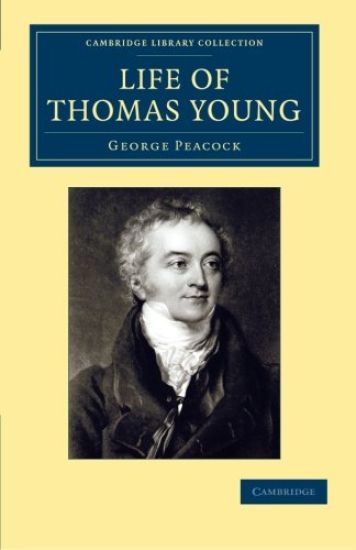
Life of Thomas Young M.D., F.R.S., etc.

Life of Thomas Young M.D., F.R.S., etc.

George Peacock

Cambridge University Press
2013
pokkari
Admired long after his death by the likes of Lord Rayleigh and Einstein, Thomas Young (1773–1829) was the definition of a polymath. By the age of fourteen he was proficient in thirteen languages, including Greek, Hebrew and Persian. After studies in Edinburgh, London, Göttingen and Cambridge he established himself as a physician in London, and over the course of his life made contributions to science, linguistics and music. He was the first to prove that light is a wave rather than molecular, his three-colour theory of vision was confirmed in the twentieth century, and his work in deciphering the Rosetta Stone laid the foundations for its eventual translation. Published in 1855, this engaging biography drew on letters, journals and private papers, taking the mathematician George Peacock (1791–1858) twenty years to complete. It stands as a valuable and affectionate portrait of 'the last man who knew everything'.
The Halliford Edition of the Works of Thomas Love Peacock. Edited by H. F. B. Brett-Smith and C. E. Jones.

The Halliford Edition of the Works of Thomas Love Peacock. Edited by H. F. B. Brett-Smith and C. E. Jones.

Thomas Love Peacock; Herbert Francis Brett Brett-Smith; C E Jones

British Library, Historical Print Editions
2011
pokkari
Title: The Halliford edition of the works of Thomas Love Peacock. Edited by H. F. B. Brett-Smith & C. E. Jones.Publisher: British Library, Historical Print EditionsThe British Library is the national library of the United Kingdom. It is one of the world's largest research libraries holding over 150 million items in all known languages and formats: books, journals, newspapers, sound recordings, patents, maps, stamps, prints and much more. Its collections include around 14 million books, along with substantial additional collections of manuscripts and historical items dating back as far as 300 BC.The FICTION & PROSE LITERATURE collection includes books from the British Library digitised by Microsoft. The collection provides readers with a perspective of the world from some of the 18th and 19th century's most talented writers. Written for a range of audiences, these works are a treasure for any curious reader looking to see the world through the eyes of ages past. Beyond the main body of works the collection also includes song-books, comedy, and works of satire. ++++The below data was compiled from various identification fields in the bibliographic record of this title. This data is provided as an additional tool in helping to insure edition identification: ++++ British Library Peacock, Thomas Love; Brett-Smith, Herbert Francis Brett; Jones, C.E.; null null 12268.f.9.
Wessex Tales, by Thomas Hardy A NOVEL (World's Classics): Wessex tales: that is to say: An imaginative woman, The three strangers, The withered arm, F
Wessex Tales is an 1888 collection of tales written by English novelist and poet Thomas Hardy.In the various short stories, Hardy writes of the true nature of nineteenth century marriage and its inherent restrictions, the use grammar as a diluted form of thought, the disparities created by the role of class status in determining societal rank, the stance of women in society and the severity of even minor diseases causing the rapid onset of fatal symptoms prior to the introduction of sufficient medicinal practices. A focal point of all the short stories is that of social constraints acting to diminish one's contentment in life, necessitating unwanted marriages, repression of true emotion and succumbing to melancholia due to constriction within the confines of 19th century perceived normalcy.Published in 1888, Wessex Tales contained five stories ("The Three Strangers", "The Withered Arm", "Fellow-Townsmen", "Interlopers at the Knap", and "The Distracted Preacher") all published first in periodicals. For the 1896 reprinting, Hardy added "An Imaginative Woman," but in 1912 moved this to another collection, Life's Little Ironies, while at the same time transferring two stories-"A Tradition of Eighteen Hundred and Four" and "The Melancholy Hussar of the German Legion"-from Life's Little Ironies to Wessex Tales Thomas Hardy, OM (2 June 1840 - 11 January 1928) was an English novelist and poet. A Victorian realist in the tradition of George Eliot, he was influenced both in his novels and in his poetry by Romanticism, especially William Wordsworth. 1] Charles Dickens was another important influence. 2] page needed] Like Dickens, he was highly critical of much in Victorian society, though Hardy focused more on a declining rural society. While Hardy wrote poetry throughout his life and regarded himself primarily as a poet, his first collection was not published until 1898. Initially, therefore, he gained fame as the author of novels, including Far from the Madding Crowd (1874), The Mayor of Casterbridge (1886), Tess of the d'Urbervilles (1891), and Jude the Obscure (1895). Hardy's poetry, though prolific, was not as well received during his lifetime. It was rediscovered in the 1950s, when Hardy's poetry had a significant influence on the Movement poets of the 1950s and 1960s, including Philip Larkin.Hardy's first novel, The Poor Man and the Lady, finished by 1867, failed to find a publisher. He then showed it to his mentor and friend, the Victorian poet and novelist, George Meredith, who felt that The Poor Man and the Lady would be too politically controversial and might damage Hardy's ability to publish in the future. So Hardy followed his advice and he did not try further to publish it. Later, he destroyed the manuscript. After he abandoned his first novel, Hardy wrote two new ones that he hoped would have more commercial appeal, Desperate Remedies (1871) and Under the Greenwood Tree (1872), both of which were published anonymously. In 1873 A Pair of Blue Eyes, a novel drawing on Hardy's courtship of his first wife, was published under his own name. The term "cliffhanger" is considered to have originated with the serialised version of this story (which was published in Tinsley's Magazine between September 1872 and July 1873) in which Henry Knight, one of the protagonists, is left literally hanging off a cliff....