Kirjojen hintavertailu. Mukana 11 234 096 kirjaa ja 12 kauppaa.

Kirjahaku

Etsi kirjoja tekijän nimen, kirjan nimen tai ISBN:n perusteella.

1000 tulosta hakusanalla Thomas Witherow

The Papers of Thomas Jefferson, Volume 19

The Papers of Thomas Jefferson, Volume 19

Thomas Jefferson

Princeton University Press
1974
sidottu
Volume 19, covering the final critical weeks of the First Congress, reveals Washington and Jefferson in the closest and most confidential relationship that existed at any time during their official careers. It opens with the proclamation announcing the exact location of the Federal District, an unexplained choice made in the utmost secrecy by the President in consultation with the Secretary of State some weeks before Washington toured the upper Potomac in an ostensible journey to inspect rival sites and to encourage competition for the location of the national capital. It includes the politically related question of the chartering of the Bank of the United States, on which Jefferson delivered his famous opinion challenging its constitutionality. But the conflict with Hamilton over the Bank, important as it was, did not bring the two men on the public stage as contestants. Instead, the first focusing of public attention on the breach in the administration occurred with the publication of Jefferson's report on the whale and cod fisheries. This widely disseminated report is here presented in a context showing that, after Hamilton declined to cooperate in reciprocating the favors France had granted to American trade, Jefferson deliberately and publicly challenged the Hamiltonian opposition. In unusually blunt language, his report called for commercial retaliation against Great Britain, thus causing a sensation both in the ...ministry. This volume shows Jefferson's concern over the growing discontent in the South and West over fiscal and other policies of the national government, his resistance to interested promotion of consular appointments in business circles, his grappling with the political and constitutional questions concerning the admission of Kentucky and Vermont, his involvement in the political consequences of the death of Franklin that affected even the proceedings of the American Philosophical Society, his cautious relationship with Tench Coxe as a source of statistical information which the Secretary of the Treasury failed to supply, and his report to Washington on a judicial appointment that brought on both embarrassment and constitutional questions. Once Congress had dispersed, Jefferson was able to turn his attention to long-neglected private concerns and to the correspondence that gave him most satisfaction, that with the family at Monticello.
The Papers of Thomas Jefferson, Volume 20

The Papers of Thomas Jefferson, Volume 20

Thomas Jefferson

PRINCETON UNIVERSITY PRESS
1982
sidottu
This volume documents exhaustively for the first time Edmond Charles Genet's dramatic challenges to American neutrality and Jefferson's diplomatic and political responses. After welcoming Genet's arrival as the harbinger of closer relations between the American and French republics, Jefferson becomes increasingly distressed by the French minister's defiance of the Washington administration's ban on the outfitting of French privateers in American ports, the enlistment of American citizens in French service, and the exercise of admiralty jurisdiction by French consuls in American ports. Although the Supreme Court declines to advise the executive branch on neutrality questions that Jefferson prepares with the President and the Cabinet, he helps to formulate a set of neutrality rules to meet Genet's challenge.Unable to convince the impetuous French envoy to adopt a more moderate course, Jefferson works in the Cabinet to bring about Genet's recall so as to preserve friendly relations with France and minimize political damage to the Republican party, in which he takes a more active role to prevent the Federalists from capitalizing on Genet's defiance of the President. Grappling with the threat of war with Spain, Jefferson involves himself equivocally in a diplomatically explosive plan by Genet to liberate Louisiana from Spanish rule. In this volume Jefferson also plays a decisive role in resolving a dispute over the design of the Capitol and plans agricultural improvements at Monticello in preparation for his retirement to private life.
The Papers of Thomas Jefferson, Volume 22

The Papers of Thomas Jefferson, Volume 22

Thomas Jefferson

PRINCETON UNIVERSITY PRESS
1986
sidottu
The months covered by this volume illustrate the variety of topics characteristic of the Jefferson Papers. Subjects range from Jefferson's continued overseeing of the planning of the Federal District that became Washington, D.C., to his worries over his debts and his exchange of correspondence with the free black Benjamin Banneker. This period, an unusually significant time for Jefferson as Secretary of State, saw the opening of a new phase of diplomacy. When Jefferson returned to the capital after a stay at Monticello in the fall, the first British minister to the United States had arrived, and the new representative from France had been in the city since August. During this time Jefferson began keeping private notes on important political conversations, notes that he later collected and bound. These notes were published after his death as Jefferson's Anas, a work never closely examined until now and often extended beyond Jefferson's evident intention. Ascertaining that Jefferson collected and intended only those documents from his tenure as Secretary of State to be used to challenge the Federalist interpretation of Washington's administration, the present editors publish the Anas notes not as compiled late in Jefferson's life or as amplified by others, but in chronological order, in the context in which they were written. Also discovered during the preparation of this volume was a new, later date or that portion of Jefferson's famous Espistolary Record written in his own hand.
The Papers of Thomas Jefferson, Volume 24

The Papers of Thomas Jefferson, Volume 24

Thomas Jefferson

Princeton University Press
1990
sidottu
This volume finds Thomas Jefferson grappling with problems arising from the radicalization of the French Revolution in Europe and the polarization of domestic politics in the United States. The overthrow of the French monarchy leads the Secretary of State to suspend debt payments to that nation and to formulate a diplomatic recognition policy that will long guide American diplomacy. After an abortive effort to initiate negotiations with the British minister in Philadelphia on the execution of the Treaty of Paris, Jefferson deflects a British proposal to establish a neutral Indian barrier state in the Northwest Territory. As he awaits the start of negotiations on major diplomatic issues with Spain, he deals with a Spanish effort to incite hostilities between the Southern Indians and the United States. The conflict between Jefferson and Alexander Hamilton reaches a new stage when the Secretary of the Treasury brings the cabinet struggle into full public view with four series of pseudonymous newspaper attacks on Jefferson. In letters to President Washington, Jefferson insists that Hamiltonian policies pose a fundamental threat to American republicanism, and in other documents he sets forth remedies for the defects he sees in Hamilton's system. During this period he also finds time to investigate the ravages of the Hessian fly on American wheat and to make plans to remodel Monticello.
The Papers of Thomas Jefferson, Volume 25

The Papers of Thomas Jefferson, Volume 25

Thomas Jefferson

Princeton University Press
1993
sidottu
The dramatic escalation in the conflict between Thomas Jefferson and Alexander Hamilton to determine the future course of the new American nation is the main theme of this volume. Under pressure from other Republicans, Jefferson decides to continue as Secretary of State instead of retiring to Monticello at the end of President Washington's first term. At the same time he begins to play a more active role as a Republican party leader, involving himself secretly in a major effort by House Republicans to have Hamilton dismissed from office by censuring his management of public finances. France's declaration of war on Great Britain and the Netherlands leads Jefferson into a serious conflict with Hamilton over how to protect American neutrality in the face of the widening European war. After persuading Washington to preserve the treaties of alliance and commerce with France, Jefferson must then confront the first in a series of French violations of American neutrality that will sorely test the relationship between the two republics. Testifying to the catholicity of Jefferson's interests, this volume also deals with his efforts to promote a voyage of western exploration by the noted French botanist Andr Michaux, his observation of the first manned balloon flight in America by the celebrated French aeronaut Jean Pierre Blanchard, and his concern for expediting work on the new national capital.
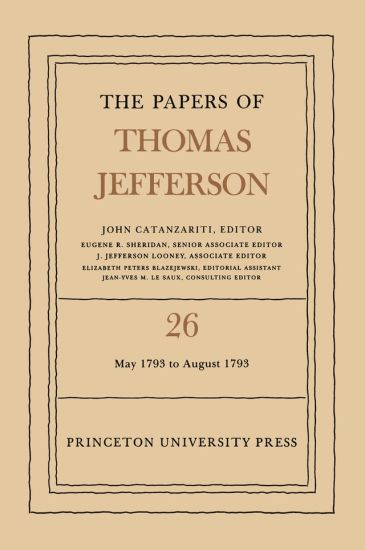
The Papers of Thomas Jefferson, Volume 26

The Papers of Thomas Jefferson, Volume 26

Thomas Jefferson

Princeton University Press
1995
sidottu
This volume documents exhaustively for the first time Edmond Charles Genet's dramatic challenges to American neutrality and Jefferson's diplomatic and political responses. After welcoming Genet's arrival as the harbinger of closer relations between the American and French republics, Jefferson becomes increasingly distressed by the French minister's defiance of the Washington administration's ban on the outfitting of French privateers in American ports, the enlistment of American citizens in French service, and the exercise of admiralty jurisdiction by French consuls in American ports. Although the Supreme Court declines to advise the executive branch on neutrality questions that Jefferson prepares with the President and the Cabinet, he helps to formulate a set of neutrality rules to meet Genet's challenge. Unable to convince the impetuous French envoy to adopt a more moderate course, Jefferson works in the Cabinet to bring about Genet's recall so as to preserve friendly relations with France and minimize political damage to the Republican party, in which he takes a more active role to prevent the Federalists from capitalizing on Genet's defiance of the President. Grappling with the threat of war with Spain, Jefferson involves himself equivocally in a diplomatically explosive plan by Genet to liberate Louisiana from Spanish rule. In this volume Jefferson also plays a decisive role in resolving a dispute over the design of the Capitol and plans agricultural improvements at Monticello in preparation for his retirement to private life.
The Papers of Thomas Jefferson, Volume 27

The Papers of Thomas Jefferson, Volume 27

Thomas Jefferson

Princeton University Press
1997
sidottu
This volume brings to a close Jefferson's increasingly stormy tenure as Secretary of State, documenting, among many things, his epochal duel with Treasury Secretary Alexander Hamilton over the conduct of American foreign policy. Against the background of the deadly yellow fever in Philadelphia, he copes with obstreperous French consuls and informs Edmond Charles Genet that the American government has requested his recall. After resuming his work on the definition of U.S. maritime limits, Jefferson prevails upon President Washington to inform Congress not only of Genet's recall but also of the British refusal to carry out the disputed provisions of the Treaty of Paris. In a final effort to implement his policy of commercial retaliation against Great Britain, Jefferson submits to Congress in December his long-awaited Report on Commerce, vividly detailing the various forms of discrimination imposed on American trade by the British. The volume presents the early and final versions of the in all their textual complexity. Disappointed by Washington's tepid response to his criticisms of Hamilton's fiscal policies, frustrated by the Treasury Secretary's rising influence over American foreign policy, and eager to enjoy uninterruptedly the pleasures of domestic life, Jefferson retires from office on 31 December 1793, determined never again to suffer the torments of public life. Volume 27 contains a supplement that covers some 270 documents for the period 1764-93 that have been found or reclassified since the publication of the last supplement in Volume 15.
The Papers of Thomas Jefferson, Volume 28

The Papers of Thomas Jefferson, Volume 28

Thomas Jefferson

PRINCETON UNIVERSITY PRESS
2000
sidottu
This volume brings Jefferson into retirement after his tenure as Secretary of State and returns him to private life at Monticello. He professes his desire to be free of public responsibilities and live the life of a farmer, spending his time tending to his estates. Turning his attention to the improvement of his farms and finances, Jefferson surveys his fields, experiments with crop rotation, and establishes a nailery on Mulberry Row. He embarks upon an ambitious plan to renovate Monticello, a long-term task that will eventually transform his residence. Although Jefferson is distant from Philadelphia, the seat of the federal government, he is not completely divorced from the politics of the day. His friends, especially James Madison, with whom he exchanges almost sixty letters in the period covered by this volume, keep him fully informed about the efforts of Republican county and town meetings, the Virginia General Assembly, Congress, and the press to counter Federalist policies. An emerging Republican opposition is taking shape in response to the Jay Treaty, and Jefferson is keenly interested in its progress. Although in June, 1795, he claims to have "proscribed newspapers" from Monticello, in fact he never entirely cuts himself off from the world. At the end of that year, he takes pains to ensure that he will have two full sets of Benjamin Franklin Bache's Aurora, the influential Republican newspaper, one set to be held in Philadelphia for binding and one to be sent directly to Monticello.
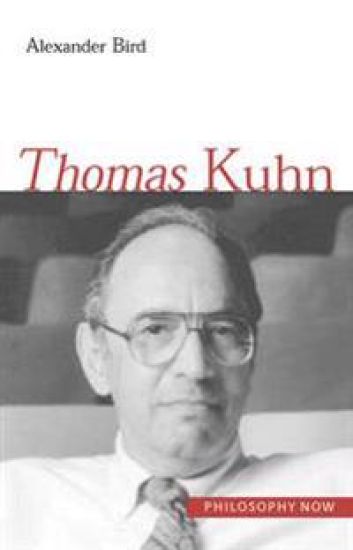
Thomas Kuhn

Thomas Kuhn

Alexander Bird

Princeton University Press
2001
pokkari
Thomas S. Kuhn (1922-1996) transformed the philosophy of science. His seminal 1962 work, The Structure of Scientific Revolutions, sold over one million copies and was translated into more than a dozen languages. It introduced the term "paradigm shift" into the vernacular and remains a fundamental text in the study of the history and philosophy of science. This introduction to Kuhn's ideas situates The Structure of Scientific Revolutions within the development of his thought over time. Alexander Bird explains Kuhn's central distinction between normal and revolutionary science and then examines in detail the role played by the key notion of a paradigm in his account of radical scientific change. The book considers Kuhn's claim that the scientist's world changes when paradigms change and relates this thought to his views on perception, incommensurability, and meaning. The author engages with the main criticisms of Kuhn's philosophy. Examining Kuhn's thought in relation to its historical context as well as other more recent philosophies of science, Alexander Bird argues that Kuhn's thinking betrays a residual commitment to many theses characteristic of the empiricists he set out to challenge. His book concludes by looking at Kuhn's influence on the history and philosophy of science and asks where the field may be heading in the wake of Kuhn's ideas. Accessible to those with little formal philosophy training, this is an assured and engaging read for anyone interested in Kuhn's pivotal ideas.
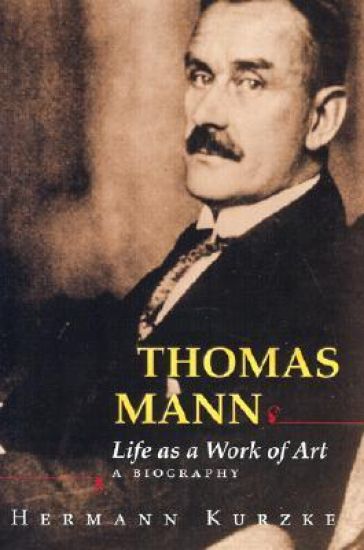
Thomas Mann: Life as a Work of Art: A Biography

Thomas Mann: Life as a Work of Art: A Biography

Hermann Kurzke

PRINCETON UNIVERSITY PRESS
2002
sidottu
This vivid, sometimes tragic, and often humorous literary biography brings to life as never before the extraordinary talent and complex person who was Thomas Mann. Engrossing vignettes enable us to enter Mann's life and work from unique angles. We meet the difficult, even unsavory private man: hypochondriac and nervous, narcissistic and vainglorious, isolated and greedy for love, shy and often ungenerous. But we are also introduced to a man who lived an eventful life, was capable of great kindness, loved dogs, doted on his daughters, and listened to Jack Benny. We experience Mann's tragedy as the quintessential German forced by the rise of National Socialism first into inner exile and then into real exile in Switzerland, Princeton, and California. His letters from this time reveal the torment that exile represented for a writer whose work, indeed whose very self, was inextricably bound up with the German language. The book provides fresh and sometimes startling insights into both famous and little-known episodes in Mann's life and into his writing--the only realm in which he ever felt free. It shows how love, death, religion, and politics were not merely themes in Buddenbrooks, The Magic Mountain, and other works, but were woven into the fabric of his existence and preoccupied him unrelentingly. It also teases out what is known about what Mann considered his celibate homoeroticism and what others have labeled closeted homosexuality. In particular, we learn about his affection for the young man who inspired the character of Tadzio in Death in Venice. And, against the unfocused accusations of anti-Semitism that have been leveled at Mann, the book examines in human detail his relationships with Jewish writers, friends, and family members. This is the richest available portrait of Thomas Mann as man and writer--the place to start for anyone wanting to know anything about his life, work, or times.
The Papers of Thomas Jefferson, Volume 29

The Papers of Thomas Jefferson, Volume 29

Thomas Jefferson

Princeton University Press
2001
sidottu
In the twenty-two months covered by this volume, Jefferson spent most of his time at Monticello, where in his short-lived retirement from office he turned in earnest to the renovation of his residence and described himself as a "monstrous farmer." Yet he narrowly missed being elected George Washington's successor as president and took the oath of office as vice president in March 1797. In early summer he presided over the Senate after President John Adams summoned Congress to deal with the country's worsening relations with France. As the key figure in the growing "Republican quarter," Jefferson collaborated with such allies as James Monroe and James Madison and drafted a petition to the Virginia House of Delegates upholding the right of representatives to communicate freely with their constituents. The unauthorized publication of a letter to Philip Mazzei, in which Jefferson decried the former "Samsons in the field and Solomons in the council" who had been "shorn by the harlot England," made the vice president the uncomfortable target of intense partisan attention. In addition, Luther Martin publicly challenged Jefferson's treatment, in Notes on Virginia, of the famous oration of Logan. Jefferson became president of the American Philosophical Society and presented a paper describing the fossilized remains of the megalonyx, or "great claw." At Monticello he evaluated the merits of threshing machines, corresponded with British agricultural authorities, sought new crops for his rotation schemes, manufactured nails, and entertained family members and visitors.
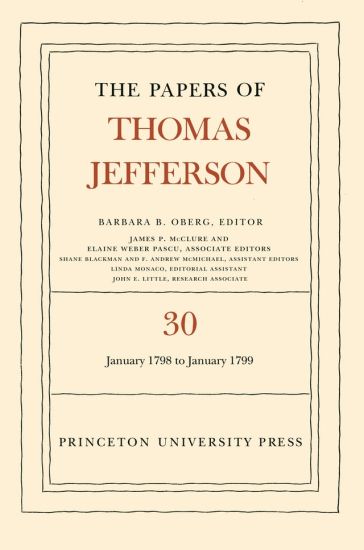
The Papers of Thomas Jefferson, Volume 30

The Papers of Thomas Jefferson, Volume 30

Thomas Jefferson

Princeton University Press
2003
sidottu
During the thirteen months covered by this volume, Thomas Jefferson spent more than half of his time in Philadelphia serving as vice president under President John Adams and presiding over a Senate that was dominated by his political opponents, the Federalists. Debates in Congress took place against a backdrop of bitter partisan rivalry, characterized most famously by the near-brawl on the floor of the House between Matthew Lyon and Roger Griswold. Congress and the nation waited, in a "state of extraordinary suspense," for dispatches from the American envoys in France. When the accounts of the XYZ Affair became public, the nation prepared for war. Two days after the Alien Friends Act was signed into law Jefferson left for Monticello, stopping at Montpelier to convey the latest news to James Madison. Disheartened and frustrated by the Alien and Sedition Acts, Jefferson penned the famous resolutions adopted in November by the Kentucky legislature. He kept his authorship a secret, however, seeking to avoid any appearance of "rashness" by Republicans. This endeavor reflected his struggle to make sense of the political direction of the nation in times he could neither comprehend nor accept. Jefferson continued to engage in scientific pursuits and fulfill his role as a promoter of American science and learning. He was reelected to the presidency of the American Philosophical Society, to which he presented his paper on the moldboard plow. He corresponded on American Indian languages, astronomy, and the Anglo-Saxon language. He longed for Monticello, and, as Jefferson had learned before, his property fell into neglect when he was away on public business. Renovations to the house slowed, supplies for the nailery were disrupted, and he had to arrange for the sale of his crops through intermediaries. With the prices of wheat low, he was drawn back into financial dependence on tobacco.
The Papers of Thomas Jefferson, Volume 31

The Papers of Thomas Jefferson, Volume 31

Thomas Jefferson

Princeton University Press
2004
sidottu
As this volume opens, partisan politics in the United States are building to a crescendo with the approach of the presidential election. Working for a Republican victory, Jefferson consults frequently with Madison, Monroe, and others to achieve favorable results in state elections. He corresponds with controversial journalist James T. Callender. Sifting information from published rumors and private letters, he follows events in Europe, including Bonaparte's unexpected rise to power in France, and sees the value of his tobacco crop plummet as U.S. legislation cuts off the French market. Jefferson grows concerned at Federalist promotion of English common law in American jurisprudence and at proceedings in the Senate against William Duane, printer of the Philadelphia Aurora. Drawing heavily on British legislative practice, however, as well as advice from Virginia, he begins in earnest to compile a manual of parliamentary procedures for the Senate. As president of the American Philosophical Society, Jefferson calls for reform of the United States census. He publishes an appendix to Notes on the State of Virginia defending his account of the Mingo Indian Logan's legendary 1774 speech. And Jefferson consults Joseph Priestley and Pierre Samuel Du Pont de Nemours about the curriculum for a projected new university in Virginia. While continuing the reconstruction of Monticello, he mourns the death of the infant girl of his younger daughter, Mary Jefferson Eppes.
The Papers of Thomas Jefferson, Retirement Series, Volume 1

The Papers of Thomas Jefferson, Retirement Series, Volume 1

Thomas Jefferson

Princeton University Press
2005
sidottu
This volume inaugurates the definitive edition of papers from Thomas Jefferson's retirement. As the volume opens, a new president is installed and Jefferson is anticipating his return to Virginia, where he will pursue a fascinating range of personal and intellectual activities. He prepares for his final departure from Washington by settling accounts and borrowing to pay his creditors. At Monticello he tells of his efforts to restore order at his mismanaged mill complex, breed merino sheep, and otherwise resume full control of his financial and agricultural affairs. Though he is entering retirement, he still has one foot firmly planted in the world of public affairs. He acknowledges a flood of accolades on his retirement and has frequent exchanges with President James Madison. While fielding written requests for money, favors, and advice from a kaleidoscopic array of relatives, acquaintances, strangers, cranks, anonymous writers, and a blackmailer, he maintains a wide and varied correspondence with scientists and scholars on both sides of the Atlantic. The volume's highlights include first-hand accounts of Jefferson's demeanor at his successor's inauguration and one of the most detailed descriptions of life at Monticello by a visitor; Jefferson's recommendations on book purchases to a literary club and a teacher; chemical analyses of tobacco by a French scientist that first isolated nicotine; the earliest descriptions of the death of Meriwether Lewis; one of Jefferson's most eloquent calls for religious tolerance; and his modest assessment of the value of his writings in reply to a printer interested in publishing them.
The Papers of Thomas Jefferson, Volume 32

The Papers of Thomas Jefferson, Volume 32

Thomas Jefferson

PRINCETON UNIVERSITY PRESS
2005
sidottu
"I have sometimes asked myself whether my country is the better for my having lived at all?" Jefferson muses in this volume. His answer: "I do not know that it is." Required by custom to be "entirely passive" during the presidential campaign, Jefferson, at Monticello during the summer of 1800, refrains from answering attacks on his character, responds privately to Benjamin Rush's queries about religion, and learns of rumors of his own death. Yet he is in good health, harvests a bountiful wheat crop, and maintains his belief that the American people will shake off the Federalist thrall. He counsels James Monroe, the governor of Virginia, on the mixture of leniency and firmness to be shown in the wake of the aborted revolt of slaves led by the blacksmith Gabriel. Arriving in Washington in November, Jefferson reports that the election "is the only thing of which any thing is said here." He is aware of Alexander Hamilton's efforts to undermine John Adams, and of desires by some Federalists to give interim executive powers to a president pro tem of the Senate. But the Republicans have made no provision to prevent the tie of electoral votes between Jefferson and Aaron Burr. Jefferson calls Burr's conduct "honorable & decisive" before prospects of intrigue arise as the nation awaits the decision of the House of Representatives. As the volume closes, the election is still unresolved after six long days of balloting by the House.
The Papers of Thomas Jefferson, Retirement Series, Volume 2

The Papers of Thomas Jefferson, Retirement Series, Volume 2

Thomas Jefferson

Princeton University Press
2006
sidottu
The definitive edition of Thomas Jefferson's papers from the end of his presidency until his death continues with Volume Two, which covers the period from 16 November 1809 to 11 August 1810. Both incoming and outgoing letters are included, totaling 518 documents printed in full. General themes include Jefferson's financial troubles, which eventually led him to loan himself a large sum of money he was managing for Tadeusz Kosciuszko; his preparations to face a lawsuit stemming from his decision as president to remove Edward Livingston from a valuable property in New Orleans; other legal complications involving his landholdings and the settlement of estates he had inherited long before; his plans to breed merino sheep and share them gratis with his fellow Virginians; and his ongoing interest in the Republican party's success. Highlights include a long list of books on agriculture that Jefferson probably compiled to guide the Library of Congress in its purchases; descriptions of inventions by Robert Fulton and more obscure figures such as the New Orleans engineer Godefroi Du Jareau; Jefferson's draft letter criticizing the Quakers as unpatriotic, much of which he later deleted; the letter in which he ordered a set of silver tumblers that have become known as the Jefferson Cups; and an important treatise on taxation by the distinguished French political economist Pierre Samuel Du Pont de Nemours, published here for the first time.
The Papers of Thomas Jefferson, Retirement Series, Volume 3

The Papers of Thomas Jefferson, Retirement Series, Volume 3

Thomas Jefferson

Princeton University Press
2007
sidottu
Volume Three of the definitive edition of Thomas Jefferson's papers from the end of his presidency until his death presents 567 documents covering the period from 12 August 1810 to 17 June 1811. Jefferson is now firmly ensconced in retirement at Monticello and Poplar Forest. He is not free from legal and political concerns, however, with the controversy over the 1807 federal seizure of the Batture Sainte Marie at New Orleans looming particularly large. Jefferson prepares for his defense against Edward Livingston's lawsuit by corresponding at length with his counsel and involved public officials, and seeking out documents and legal authorities to vindicate himself. He also seeks to end Philadelphia journalist William Duane's growing estrangement from mainstream Republican politics, lobbies for the appointment of a committed Republican to fill a vacancy on the Supreme Court, and argues with the Rivanna Company over its proposed encroachments on his property. Other highlights are Jefferson's draft constitution for an agricultural society, his astronomical calculations, his notes on plantings at Poplar Forest, and his estimate of the cost of shipping flour. Documents on slaves and slavery include discussions of schemes for colonizing freed slaves in Africa, information on the medical condition of some of Jefferson's slaves, and an account of a visit to Monticello with a distinctly unflattering portrayal of the ex-president's standing in the community and his relations with his slaves.
The Papers of Thomas Jefferson, Volume 33

The Papers of Thomas Jefferson, Volume 33

Thomas Jefferson

PRINCETON UNIVERSITY PRESS
2007
sidottu
Under normal circumstances, Thomas Jefferson would have had more than two months to prepare for his presidency. However, since the House of Representatives finally settled a tied electoral vote only on 17 February 1801, he had two weeks. This book, which covers the two-and-a-half-month period from that day through April 30, is the first of some twenty volumes that will document Jefferson's two terms as President of the United States. Here, Jefferson drafts his Inaugural Address, one of the landmark documents of American history. In this famous speech, delivered before a packed audience in the Senate Chamber on March 4, he condemns "political intolerance" and asserts that "we are all republicans: we are all federalists," while invoking a policy of "friendship with all nations, entangling alliances with none." Jefferson appoints his Cabinet members and deals with the time-consuming process of sifting through the countless appeals and supporting letters of recommendation for government jobs as he seeks to reward loyal Republicans and maintain bipartisan harmony at the same time. Among these letters is one from Catharine Church, who remarks that only women, excluded as they are from political favor or government employment, can be free of "ignorant affectation" and address the president honestly. Jefferson also initiates preparations for a long cruise by a squadron of American warships, with an unstated expectation that their destination will probably be the Barbary Coast of the Mediterranean.