Kirjojen hintavertailu. Mukana 12 009 172 kirjaa ja 12 kauppaa.

Kirjahaku

Etsi kirjoja tekijän nimen, kirjan nimen tai ISBN:n perusteella.

982 tulosta hakusanalla "Vector"

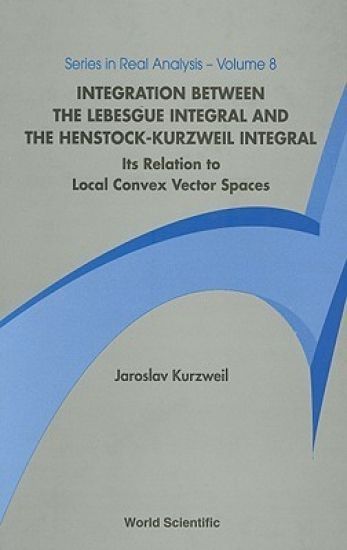
Integration Between The Lebesgue Integral And The Henstock-kurzweil Integral: Its Relation To Local Convex Vector Spaces
The main topics of this book are convergence and topologization. Integration on a compact interval on the real line is treated with Riemannian sums for various integration bases. General results are specified to a spectrum of integrations, including Lebesgue integration, the Denjoy integration in the restricted sense, the integrations introduced by Pfeffer and by Bongiorno, and many others. Morever, some relations between integration and differentiation are made clear.The book is self-contained. It is of interest to specialists in the field of real functions, and it can also be read by students, since only the basics of mathematical analysis and vector spaces are required.

On Representability of *-Regular and Regular Involutive Rings in Endomorphism Rings of Vector Spaces
The origins of von Neumann-regular rings and *-regular rings are the works of John von Neumann and F. J. Murray during the 30ies of the last century. They constitute a connection of the areas of operator theory, ring theory and lattice theory. Starting from this historical origin, one can speculate that von Neumann was inspired by both operator theory and lattice theory to introduce the notion of a *-regular ring: On the one hand, the requirement of positivity of the involution can be seen as the appropriate generalisation of the involution of operator algebras. On the other hand, *-regular rings give rise to a strong class of lattices which are closely connected to operator algebras. This thesis shows that this speculation mighthave some substance, that is, the concept of a *-regular ring indeed gives an adequate axiomatic framework for regular rings of operators, if one is prepared to deal with vector spaces over general involutive skew fields, equipped with a scalar product. The main results of this thesis are that every *-regular ring is representable in this sense, and that every variety of *-regular rings is generated by its simple Artinian members. Furthermore, the thesis deals with the larger class of regular involutive rings and questions of their representability. In the context of rings without involution, Jacobson proved thatrepresentability as subrings of endomorphism rings of vector spaces is captured by primitivity. Dealing with involutive rings, onecan introduce the notion of *-primitivity and representations in terms of bi-vector spaces, as done by Rowen and Wiegandt. Alternatively, one can examine primitive rings endowed with an involution, with the aim to construct an appropriate non-degenerated form on the vector space to capture the involution. In this context, the thesis presents a continuation of previous research of Herrmann, Micol and Niemann. A complete characterisation of representability of regular involutive rings is given.
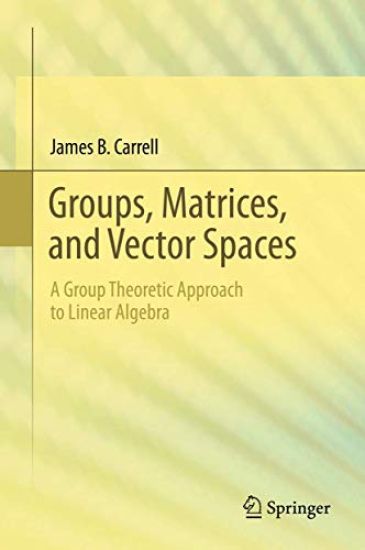
Groups, Matrices, and Vector Spaces

Groups, Matrices, and Vector Spaces

James B. Carrell

Springer-Verlag New York Inc.
2017
sidottu
This unique text provides a geometric approach to group theory and linear algebra, bringing to light the interesting ways in which these subjects interact. Requiring few prerequisites beyond understanding the notion of a proof, the text aims to give students a strong foundation in both geometry and algebra. Starting with preliminaries (relations, elementary combinatorics, and induction), the book then proceeds to the core topics: the elements of the theory of groups and fields (Lagrange's Theorem, cosets, the complex numbers and the prime fields), matrix theory and matrix groups, determinants, vector spaces, linear mappings, eigentheory and diagonalization, Jordan decomposition and normal form, normal matrices, and quadratic forms. The final two chapters consist of a more intensive look at group theory, emphasizing orbit stabilizer methods, and an introduction to linear algebraic groups, which enriches the notion of a matrix group. Applications involving symmetry groups, determinants, linear coding theory and cryptography are interwoven throughout. Each section ends with ample practice problems assisting the reader to better understand the material. Some of the applications are illustrated in the chapter appendices. The author's unique melding of topics evolved from a two semester course that he taught at the University of British Columbia consisting of an undergraduate honors course on abstract linear algebra and a similar course on the theory of groups. The combined content from both makes this rare text ideal for a year-long course, covering more material than most linear algebra texts. It is also optimal for independent study and as a supplementary text for various professional applications. Advanced undergraduate or graduate students in mathematics, physics, computer science and engineering will find this book both useful and enjoyable.
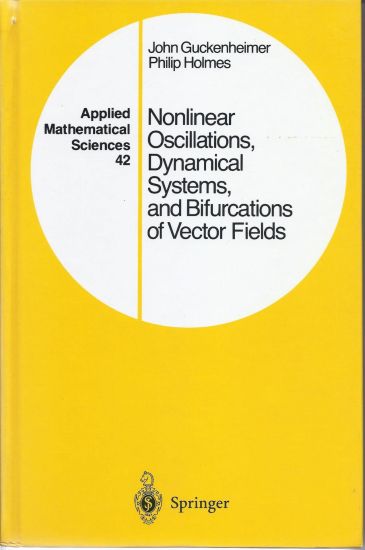
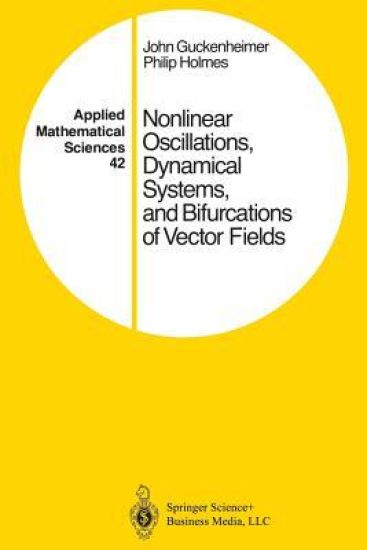
Nonlinear Oscillations, Dynamical Systems, and Bifurcations of Vector Fields

Nonlinear Oscillations, Dynamical Systems, and Bifurcations of Vector Fields

John Guckenheimer; Philip Holmes

Springer-Verlag New York Inc.
1983
sidottu
From the reviews: "This book is concerned with the application of methods from dynamical systems and bifurcation theories to the study of nonlinear oscillations. Chapter 1 provides a review of basic results in the theory of dynamical systems, covering both ordinary differential equations and discrete mappings. Chapter 2 presents 4 examples from nonlinear oscillations. Chapter 3 contains a discussion of the methods of local bifurcation theory for flows and maps, including center manifolds and normal forms. Chapter 4 develops analytical methods of averaging and perturbation theory. Close analysis of geometrically defined two-dimensional maps with complicated invariant sets is discussed in chapter 5. Chapter 6 covers global homoclinic and heteroclinic bifurcations. The final chapter shows how the global bifurcations reappear in degenerate local bifurcations and ends with several more models of physical problems which display these behaviors." #Book Review - Engineering Societies Library, New York#1 "An attempt to make research tools concerning `strange attractors' developed in the last 20 years available to applied scientists and to make clear to research mathematicians the needs in applied works. Emphasis on geometric and topological solutions of differential equations. Applications mainly drawn from nonlinear oscillations." #American Mathematical Monthly#2
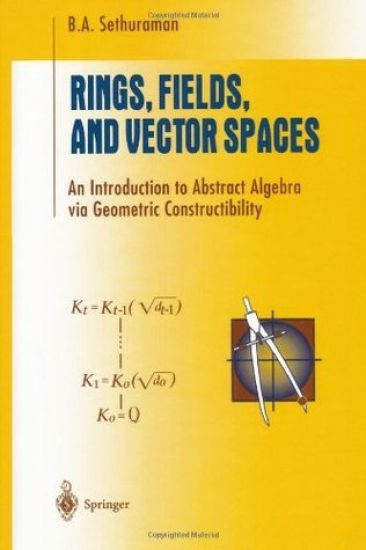
Rings, Fields, and Vector Spaces

Rings, Fields, and Vector Spaces

B.A. Sethuraman

Springer-Verlag New York Inc.
1996
sidottu
This book is an attempt to communicate to undergraduate math­ ematics majors my enjoyment of abstract algebra. It grew out of a course offered at California State University, Northridge, in our teacher preparation program, titled Foundations of Algebra, that was intended to provide an advanced perspective on high-school mathe­ matics. When I first prepared to teach this course, I needed to select a set of topics to cover. The material that I selected would clearly have to have some bearing on school-level mathematics, but at the same time would have to be substantial enough for a university-level course. It would have to be something that would give the students a perspective into abstract mathematics, a feel for the conceptual elegance and grand simplifications brought about by the study of structure. It would have to be of a kind that would enable the stu­ dents to develop their creative powers and their reasoning abilities. And of course, it would all have to fit into a sixteen-week semester. The choice to me was clear: we should study constructibility. The mathematics that leads to the proof of the nontrisectibility of an arbitrary angle is beautiful, it is accessible, and it is worthwhile. Every teacher of mathematics would profit from knowing it. Now that I had decided on the topic, I had to decide on how to develop it. All the students in my course had taken an earlier course . .
Geometry, Algebra, and Trigonometry by Vector Methods

Geometry, Algebra, and Trigonometry by Vector Methods

Arthur Herbert Copeland; Carl B. Allendoerfer

Literary Licensing, LLC
2013
sidottu
""Geometry, Algebra, and Trigonometry by Vector Methods"" is a comprehensive textbook written by Arthur Herbert Copeland. The book is designed to provide students with a thorough understanding of the fundamental concepts of geometry, algebra, and trigonometry using vector methods. The book is divided into three parts, each focusing on one of these subjects.Part one of the book covers the basics of geometry, including points, lines, angles, and polygons. The author uses vector methods to explain these concepts, making it easier for students to visualize and understand them. The section also includes a discussion on vectors and their properties.Part two of the book focuses on algebra, covering topics such as equations, functions, and graphs. The author uses vector methods to explain these concepts as well, making it easier for students to understand the relationship between algebra and geometry.Part three of the book covers trigonometry, including the properties of triangles, trigonometric functions, and identities. The author again uses vector methods to explain these concepts, making it easier for students to visualize and understand them.Throughout the book, the author provides numerous examples and exercises to help students practice and reinforce their understanding of the concepts presented. The book is suitable for students studying geometry, algebra, and trigonometry at the high school or college level.Allendoerfer Mathematics Series.This scarce antiquarian book is a facsimile reprint of the old original and may contain some imperfections such as library marks and notations. Because we believe this work is culturally important, we have made it available as part of our commitment for protecting, preserving, and promoting the world's literature in affordable, high quality, modern editions, that are true to their original work.
Nonlinear Oscillations, Dynamical Systems, and Bifurcations of Vector Fields

Nonlinear Oscillations, Dynamical Systems, and Bifurcations of Vector Fields

John Guckenheimer; Philip Holmes

Springer-Verlag New York Inc.
2013
nidottu
From the reviews: "This book is concerned with the application of methods from dynamical systems and bifurcation theories to the study of nonlinear oscillations. Chapter 1 provides a review of basic results in the theory of dynamical systems, covering both ordinary differential equations and discrete mappings. Chapter 2 presents 4 examples from nonlinear oscillations. Chapter 3 contains a discussion of the methods of local bifurcation theory for flows and maps, including center manifolds and normal forms. Chapter 4 develops analytical methods of averaging and perturbation theory. Close analysis of geometrically defined two-dimensional maps with complicated invariant sets is discussed in chapter 5. Chapter 6 covers global homoclinic and heteroclinic bifurcations. The final chapter shows how the global bifurcations reappear in degenerate local bifurcations and ends with several more models of physical problems which display these behaviors." #Book Review - Engineering Societies Library, New York#1 "An attempt to make research tools concerning `strange attractors' developed in the last 20 years available to applied scientists and to make clear to research mathematicians the needs in applied works. Emphasis on geometric and topological solutions of differential equations. Applications mainly drawn from nonlinear oscillations." #American Mathematical Monthly#2
Groups, Matrices, and Vector Spaces

Groups, Matrices, and Vector Spaces

James B. Carrell

Springer-Verlag New York Inc.
2018
nidottu
This unique text provides a geometric approach to group theory and linear algebra, bringing to light the interesting ways in which these subjects interact. Requiring few prerequisites beyond understanding the notion of a proof, the text aims to give students a strong foundation in both geometry and algebra. Starting with preliminaries (relations, elementary combinatorics, and induction), the book then proceeds to the core topics: the elements of the theory of groups and fields (Lagrange's Theorem, cosets, the complex numbers and the prime fields), matrix theory and matrix groups, determinants, vector spaces, linear mappings, eigentheory and diagonalization, Jordan decomposition and normal form, normal matrices, and quadratic forms. The final two chapters consist of a more intensive look at group theory, emphasizing orbit stabilizer methods, and an introduction to linear algebraic groups, which enriches the notion of a matrix group. Applications involving symmetry groups, determinants, linear coding theory and cryptography are interwoven throughout. Each section ends with ample practice problems assisting the reader to better understand the material. Some of the applications are illustrated in the chapter appendices. The author's unique melding of topics evolved from a two semester course that he taught at the University of British Columbia consisting of an undergraduate honors course on abstract linear algebra and a similar course on the theory of groups. The combined content from both makes this rare text ideal for a year-long course, covering more material than most linear algebra texts. It is also optimal for independent study and as a supplementary text for various professional applications. Advanced undergraduate or graduate students in mathematics, physics, computer science and engineering will find this book both useful and enjoyable.
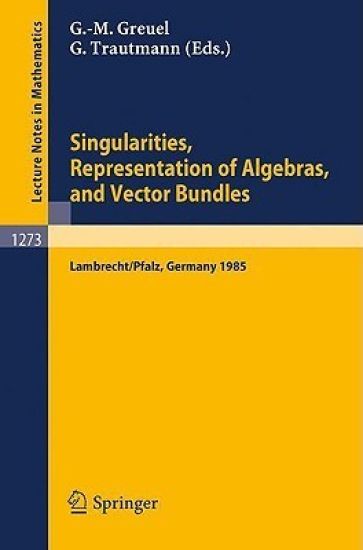
Singularities, Representation of Algebras, and Vector Bundles

Singularities, Representation of Algebras, and Vector Bundles

Springer-Verlag Berlin and Heidelberg GmbH Co. K
1987
nidottu
It is well known that there are close relations between classes of singularities and representation theory via the McKay correspondence and between representation theory and vector bundles on projective spaces via the Bernstein-Gelfand-Gelfand construction. These relations however cannot be considered to be either completely understood or fully exploited. These proceedings document recent developments in the area. The questions and methods of representation theory have applications to singularities and to vector bundles. Representation theory itself, which had primarily developed its methods for Artinian algebras, starts to investigate algebras of higher dimension partly because of these applications. Future research in representation theory may be spurred by the classification of singularities and the highly developed theory of moduli for vector bundles. The volume contains 3 survey articles on the 3 main topics mentioned, stressing their interrelationships, as well as original research papers.
The Effects of Monetary Policy in the US. The Vector Error Correction Model (VECM) compared to the Structural Autoregressive Model (SVAR)
Research Paper (undergraduate) from the year 2017 in the subject Mathematics - Applied Mathematics, grade: 8.5, course: Empirical Econometrics II, language: English, abstract: This paper investigates the effects of monetary policy in the US by comparing a system of equations - estimated from a VECM (vector error correction model) - to a SVAR (structural autoregressive) model. Vector error-correction models are used when there exists long-run equilibrium relation-ships between non-stationary data integrated of the same order. Those models imply that the stationary transformations of the variables adapt to disequilibria between the non-stationary variables in the model. In contrast, SVAR models focus on the contemporaneous interdependence between the variables. The authors apply these two methods on a model with a contractionary monetary policy which affects the short-term interest rate. Following Sims and Zha the authors use a shock to the Treasury Bill rate instead of a shock to the Federal Funds rate. The paper continues as follows. First, a description of the data is given. Secondly, it presents a system of equations built from the LSE approach, aiming at macroeconomic simulations. Thirdly, it compares results obtained from the previous part to those obtained using SVAR impulse response functions (IRFs) identified with sign restrictions. The paper focuses on the impact of the simulated policies or monetary shocks on GDP and its growth rate.
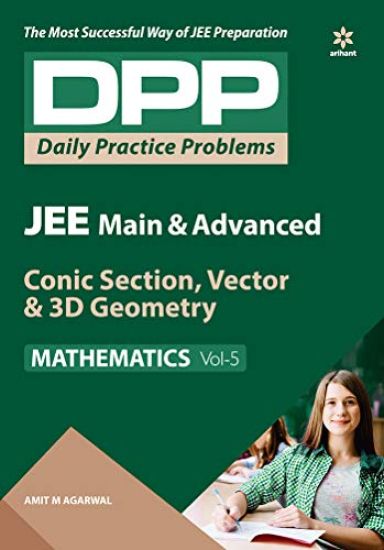
Daily Practice Problems (Dpp) for Jee Main & Advanced - Conic Section, Vector & 3D Geometry Mathematics 2020
JEE Main and Advanced is a matter of well-preparation with proper strategy and daily planning to achieve the right state of mind to be able to tackle any questions asked in the exam. Daily Practice Problems (DPP), a set of 26 books with a unique blend of contents, designed to set the tone for the daily practice of questions from the entire syllabus of PCM for JEE Main and Advanced has been a highly competent source among IIT JEE aspirants for a long time. The present edition of DPP for Conic Section, Vector and 3D Geometry from Mathematics Vol-5 aims to drive daily practice to master the concepts of Parabola, Ellipse, Hyperbola, Vectors and 3D Geometry. Each of these sections is coupled with Revisal Problems, JEE Main and AIEEE Archive, and JEE Advanced and IIT JEE Archive for quick revision and to get the real feel of examination. Moreover, each DPP also accompanies their well-explained solution for self-evaluation. Well-structured with performance-driven resources, it is hoped that this book will maximize the chances of success in JEE Main and Advanced to the greatest.
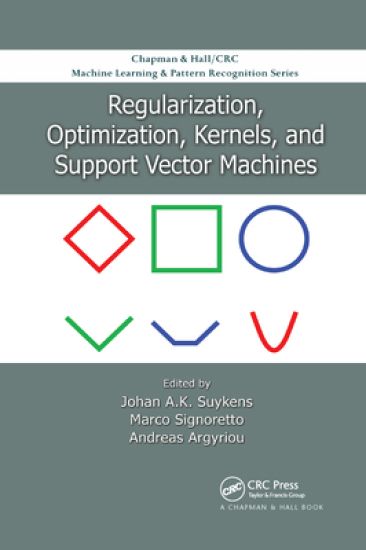
Regularization, Optimization, Kernels, and Support Vector Machines
Regularization, Optimization, Kernels, and Support Vector Machines offers a snapshot of the current state of the art of large-scale machine learning, providing a single multidisciplinary source for the latest research and advances in regularization, sparsity, compressed sensing, convex and large-scale optimization, kernel methods, and support vector machines. Consisting of 21 chapters authored by leading researchers in machine learning, this comprehensive reference:Covers the relationship between support vector machines (SVMs) and the LassoDiscusses multi-layer SVMsExplores nonparametric feature selection, basis pursuit methods, and robust compressive sensingDescribes graph-based regularization methods for single- and multi-task learningConsiders regularized methods for dictionary learning and portfolio selectionAddresses non-negative matrix factorizationExamines low-rank matrix and tensor-based modelsPresents advanced kernel methods for batch and online machine learning, system identification, domain adaptation, and image processingTackles large-scale algorithms including conditional gradient methods, (non-convex) proximal techniques, and stochastic gradient descentRegularization, Optimization, Kernels, and Support Vector Machines is ideal for researchers in machine learning, pattern recognition, data mining, signal processing, statistical learning, and related areas.
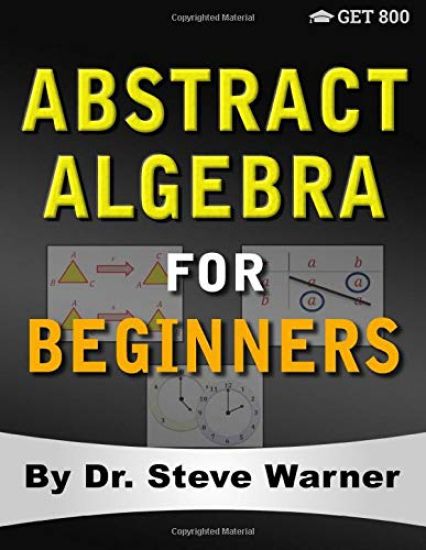
Abstract Algebra for Beginners: A Rigorous Introduction to Groups, Rings, Fields, Vector Spaces, Modules, Substructures, Homomorphisms, Quotients, Per
Abstract Algebra for Beginners consists of a series of basic to intermediate lessons in abstract algebra. In addition, all the proofwriting skills that are essential for advanced study in mathematics are covered and reviewed extensively. Abstract Algebra for Beginners is perfect forprofessors teaching an undergraduate course or basic graduate course in abstract algebra.high school teachers working with advanced math students.students wishing to see the type of mathematics they would be exposed to as a math major.The material in this pure math book includes: 16 lessons consisting of basic to intermediate topics in abstract algebra.A problem set after each lesson arranged by difficulty level.A complete solution guide is included as a downloadable PDF file.Abstract Algebra Book Table Of Contents (Selected) Here's a selection from the table of contents: Introduction Lesson 1 - Sets and SubsetsLesson 2 - Algebraic StructuresLesson 3 - Relations and PartitionsLesson 4 - Functions and EquinumerosityLesson 5 - Number Systems and InductionLesson 6 - SubstructuresLesson 7 - Homomorphisms and IsomorphismsLesson 8 - Number TheoryLesson 9 - Number Theoretic ApplicationsLesson 10 - QuotientsLesson 11 - Structure TheoremsLesson 12 - Permutations and DeterminantsLesson 13 - Sylow Theory and Group ActionsLesson 14 - PolynomialsLesson 15 - Field TheoryLesson 16 - Galois Theory
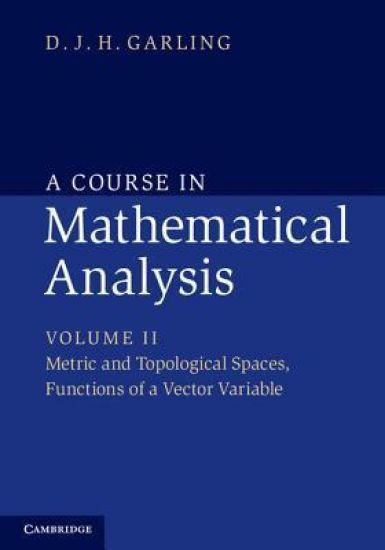
A Course in Mathematical Analysis: Volume 2, Metric and Topological Spaces, Functions of a Vector Variable
The three volumes of A Course in Mathematical Analysis provide a full and detailed account of all those elements of real and complex analysis that an undergraduate mathematics student can expect to encounter in their first two or three years of study. Containing hundreds of exercises, examples and applications, these books will become an invaluable resource for both students and teachers. Volume 1 focuses on the analysis of real-valued functions of a real variable. This second volume goes on to consider metric and topological spaces. Topics such as completeness, compactness and connectedness are developed, with emphasis on their applications to analysis. This leads to the theory of functions of several variables. Differential manifolds in Euclidean space are introduced in a final chapter, which includes an account of Lagrange multipliers and a detailed proof of the divergence theorem. Volume 3 covers complex analysis and the theory of measure and integration.
Regularization, Optimization, Kernels, and Support Vector Machines
Regularization, Optimization, Kernels, and Support Vector Machines offers a snapshot of the current state of the art of large-scale machine learning, providing a single multidisciplinary source for the latest research and advances in regularization, sparsity, compressed sensing, convex and large-scale optimization, kernel methods, and support vector machines. Consisting of 21 chapters authored by leading researchers in machine learning, this comprehensive reference:Covers the relationship between support vector machines (SVMs) and the LassoDiscusses multi-layer SVMsExplores nonparametric feature selection, basis pursuit methods, and robust compressive sensingDescribes graph-based regularization methods for single- and multi-task learningConsiders regularized methods for dictionary learning and portfolio selectionAddresses non-negative matrix factorizationExamines low-rank matrix and tensor-based modelsPresents advanced kernel methods for batch and online machine learning, system identification, domain adaptation, and image processingTackles large-scale algorithms including conditional gradient methods, (non-convex) proximal techniques, and stochastic gradient descentRegularization, Optimization, Kernels, and Support Vector Machines is ideal for researchers in machine learning, pattern recognition, data mining, signal processing, statistical learning, and related areas.
Computational Intelligence And Its Applications: Evolutionary Computation, Fuzzy Logic, Neural Network And Support Vector Machine Techniques
This book focuses on computational intelligence techniques and their applications — fast-growing and promising research topics that have drawn a great deal of attention from researchers over the years. It brings together many different aspects of the current research on intelligence technologies such as neural networks, support vector machines, fuzzy logic and evolutionary computation, and covers a wide range of applications from pattern recognition and system modeling, to intelligent control problems and biomedical applications. Fundamental concepts and essential analysis of various computational techniques are presented to offer a systematic and effective tool for better treatment of different applications, and simulation and experimental results are included to illustrate the design procedure and the effectiveness of the approaches.