Kirjahaku
Etsi kirjoja tekijän nimen, kirjan nimen tai ISBN:n perusteella.
1000 tulosta hakusanalla Blake Bailey


Poetical Sketches By William Blake: Now First Reprinted From The Original Edition Of 1783 (1868)
Richard Herne Shepherd
KESSINGER PUBLISHING, LLC
2008
sidottu
Biblical Tradition in Blake's Early Prophecies
Leslie Tannenbaum
Princeton University Press
2017
pokkari
In a detailed examination of the ways in which Blake's use of biblical tradition gives form and meaning to his early prophetic books, Leslie Tannenbaum shows what Blake meant when he called the Bible the Great Code of Art." Originally published in 1982. The Princeton Legacy Library uses the latest print-on-demand technology to again make available previously out-of-print books from the distinguished backlist of Princeton University Press. These editions preserve the original texts of these important books while presenting them in durable paperback and hardcover editions. The goal of the Princeton Legacy Library is to vastly increase access to the rich scholarly heritage found in the thousands of books published by Princeton University Press since its founding in 1905.

In a controversial examination of the conceptual bases of Blake's myth, Leopold Damrosch argues that his poems contain fundamental contradictions, but that this fact docs not imply philosophical or artistic failure. Originally published in 1981. The Princeton Legacy Library uses the latest print-on-demand technology to again make available previously out-of-print books from the distinguished backlist of Princeton University Press. These editions preserve the original texts of these important books while presenting them in durable paperback and hardcover editions. The goal of the Princeton Legacy Library is to vastly increase access to the rich scholarly heritage found in the thousands of books published by Princeton University Press since its founding in 1905.
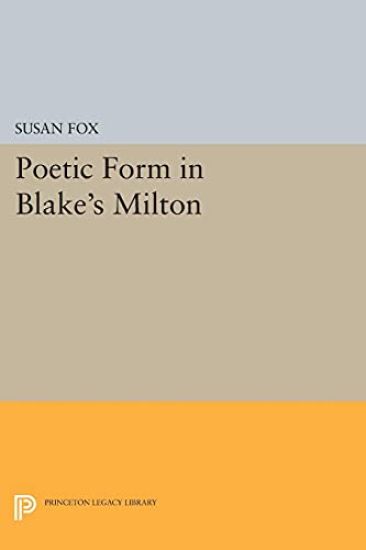
Blake's two finished epics have been widely regarded as combinations of brilliant set pieces which yield to no systematic rhetorical criticism. Susan Fox contests this view, discovering in Milton an elaborate verbal structure that is fully congruent with the poem's philosophy. She has made the first full exposition of the formal principles of a late Blake poem, and it suggests that the late prophecies are as profound in their artistic structures as they are in their thematic ones. The author begins by tracing throughout Blake's poetry the development of the techniques found in Milton. She then provides an analysis in two chapters organized, as she perceives the poem to be, in parallel three-part units. Her examination reveals the exhaustive parallelism of the poem's books, as well as more local devices such as paired stanzas and circular rhetoric. The rhetorical pattern which emerges raises several major thematic issues which are treated in the concluding chapter. In demonstrating the coherence and control of the intricate formal patterns of Milton, this study provides a new measure of Blake's late verbal art. Originally published in 1976. The Princeton Legacy Library uses the latest print-on-demand technology to again make available previously out-of-print books from the distinguished backlist of Princeton University Press. These editions preserve the original texts of these important books while presenting them in durable paperback and hardcover editions. The goal of the Princeton Legacy Library is to vastly increase access to the rich scholarly heritage found in the thousands of books published by Princeton University Press since its founding in 1905.

Biblical Tradition in Blake's Early Prophecies
Leslie Tannenbaum
Princeton University Press
2017
sidottu
In a detailed examination of the ways in which Blake's use of biblical tradition gives form and meaning to his early prophetic books, Leslie Tannenbaum shows what Blake meant when he called the Bible the Great Code of Art." Originally published in 1982. The Princeton Legacy Library uses the latest print-on-demand technology to again make available previously out-of-print books from the distinguished backlist of Princeton University Press. These editions preserve the original texts of these important books while presenting them in durable paperback and hardcover editions. The goal of the Princeton Legacy Library is to vastly increase access to the rich scholarly heritage found in the thousands of books published by Princeton University Press since its founding in 1905.

In a controversial examination of the conceptual bases of Blake's myth, Leopold Damrosch argues that his poems contain fundamental contradictions, but that this fact docs not imply philosophical or artistic failure. Originally published in 1981. The Princeton Legacy Library uses the latest print-on-demand technology to again make available previously out-of-print books from the distinguished backlist of Princeton University Press. These editions preserve the original texts of these important books while presenting them in durable paperback and hardcover editions. The goal of the Princeton Legacy Library is to vastly increase access to the rich scholarly heritage found in the thousands of books published by Princeton University Press since its founding in 1905.

Blake's two finished epics have been widely regarded as combinations of brilliant set pieces which yield to no systematic rhetorical criticism. Susan Fox contests this view, discovering in Milton an elaborate verbal structure that is fully congruent with the poem's philosophy. She has made the first full exposition of the formal principles of a late Blake poem, and it suggests that the late prophecies are as profound in their artistic structures as they are in their thematic ones. The author begins by tracing throughout Blake's poetry the development of the techniques found in Milton. She then provides an analysis in two chapters organized, as she perceives the poem to be, in parallel three-part units. Her examination reveals the exhaustive parallelism of the poem's books, as well as more local devices such as paired stanzas and circular rhetoric. The rhetorical pattern which emerges raises several major thematic issues which are treated in the concluding chapter. In demonstrating the coherence and control of the intricate formal patterns of Milton, this study provides a new measure of Blake's late verbal art. Originally published in 1976. The Princeton Legacy Library uses the latest print-on-demand technology to again make available previously out-of-print books from the distinguished backlist of Princeton University Press. These editions preserve the original texts of these important books while presenting them in durable paperback and hardcover editions. The goal of the Princeton Legacy Library is to vastly increase access to the rich scholarly heritage found in the thousands of books published by Princeton University Press since its founding in 1905.

William Blake is universally acknowledged as an extraordinary artist, poet, and visionary thinker, considered hard to understand due to his complex mythologies. But now, his central thesis that Creativity is Divine can be readily comprehended and employed as never before, through THE WILLIAM BLAKE TAROT OF THE CREATIVE IMAGINATION. In this pocket gallery, Blake's ideas and images become symbolic tools for answering imaginative, spiritual, and personal questions. Unlike textbooks and critical studies, this Tarot deck presents Blake's astounding ideas and images in a manner that is approachable and entertaining. It contains 23 archetypal cards called Triumphs, together with a set of 56 Creative Process cards in four suits named Painting, Science, Music, and Poetry -- which are Blake's four primal expressions of Divine Imagination. Use this portable idea-kit to creatively explore personal and professional issues and discover meaningful insights into life's great mysteries.


This work examines the allusions to Blake throughout Harris's four Hannibal Lecter novels and provides a Blakean reading of the works as a whole, particularly in regard to the character of Lecter and the nature of evil in the world--and to what extent humanity should accept evil. The novels and their film versions reveal that Harris uses Blake to suggest that good and evil are intertwined and coexist, and that it is foolish to try to see them simply as opposing binaries. Refusing to recognize their intertwined relationship leads to imbalance and a negative outcome, as revealed in the fate of Graham in Red Dragon.

A seminal figure in Romantic poetry and visual arts, William Blake continues to influence modern literary criticism. In this book, Blake scholar Hazard Adams presents a selection of essays that span his long career exploring the work and thought of the groundbreaking artist. Topics range from the symbolic form in Blake's poem Jerusalem, the world view of Blake in relation to cultural policy and the notion of contrariety in Blake's writings to the relation of Chinese literary thought to that of the West, the critical work of Northrop Frye and Murray Krieger and the cultural and academic status of the humanities. The essays chart the evolution of Adams' own neo-Blakean literary thought over the past four decades, chronicling an effort to seek not merely a method but a philosophical base for the practice of literary criticism.

Interpreting Blake has always proved challenging. Hermeneutics, as the on-going negotiation between the horizon of expectations and a given text, hinges on the preconceptions that structure thought. The structure, in turn, is derived from myth, a cultural narrative predicated on a particular set of foundational principles, and organized in terms of the resulting symbolic form. The primary impediment to interpreting Blake has been the failure to recognize that he and much of his audience have thought in terms of two radically different myths.In The Evolution of Blake’s Myth, Sheila A. Spector establishes the dimensions of the myth that structures Blake’s thought. In the first of three parts, she uses Jerusalem, Blake’s most complete book, as the basis for extrapolating the components of the consolidated myth. She then traces the chronological development of the myth from its origin in the late 1780s through its crystallization in Milton. Finally, she demonstrates how Blake used the myth hermeneutically, as the horizon of expectations for interpreting not only his own work, but the Bible and the visionary texts of others, as well.

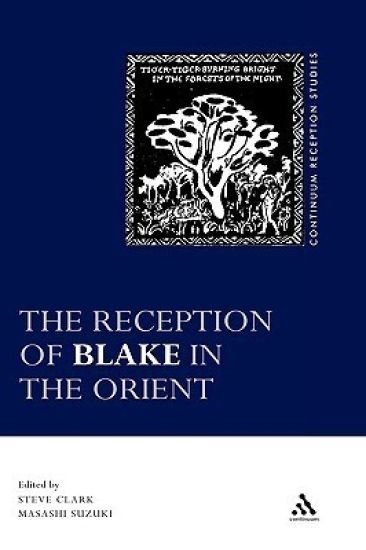
The Reception of Blake in the Orient
Continuum International Publishing Group Ltd.
2008
nidottu
This book focuses attention on the longevity and complexity of Blake's reception in Japan and elsewhere in the East. This book offers a case-study of the way in which the vigorous afterlife of Blake's work has allowed active appropriation of an inspiring presence, rather than passive succumbing to a Eurocentric or Orientalist ideology.This volume brings together research from international scholars focusing attention on the longevity and complexity of Blake's reception in Japan and elsewhere in the East. It is designed as not only a celebration of his art and poetry in new and unexpected contexts but also to contest the intensely nationalistic and parochial Englishness of his work, and in broader terms, the inevitable passivity with which Romanticism (and other Western intellectual movements) have been received in the Orient.
The Reception of Blake in the Orient
BLOOMSBURY PUBLISHING PLC
2006
sidottu
This volume brings together research from international scholars focusing attention on the longevity and complexity of Blake's reception in Japan and elsewhere in the East. It is designed as not only a celebration of his art and poetry in new and unexpected contexts but also to contest the intensely nationalistic and parochial Englishness of his work, and in broader terms, the inevitable passivity with which Romanticism (and other Western intellectual movements) have been received in the Orient.