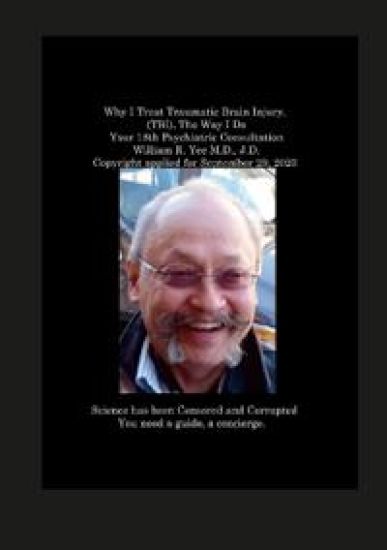
Page 1 The Pervasiveness of Aggression and PTSD Page 6 The Socialization of Aggression Page 8 Failure of frontal lobe functions to socialize aggression is substantial. Page 11 Self-Organizing Systems Page 23 The Number Needed to Treat Page 24 Physiologic Reserves and LD50 Page 20 The Case Against Benzodiazepines Page 35 The Treatment of Active Military Personnel Page 38 Treatment of Schizophrenia in the Military Page 48 Summary of Treatment of PTSD, TBI, Schizophrenia Among Soldiers Dr. Yee is here to do no harm and help if he can. May you live long and well. Thank you for your time. William R. Yee M.D., J.D. Board Certified in Psychiatry Licensed to practice law in Michigan. Practicing General Medicine, Emergency Room Medicine, and Psychiatry since 1972 in Michigan, Indiana, Kentucky, California, and Texas. Be kind and you can be my friend.
Page 1 Introduction Page 4 The Proliferation and Organization of the Brain from Birth to Death Page 7 The Nature of Brain Trauma Page 8 Initial Assessment of Traumatic Brain Injury Page 15 The Trajectory of Traumatic Brain Injury Page 18 Initial Evaluation of Traumatic Brain Injury in the Outpatient Psychiatric Clinic Page 42 Treatment of Traumatic Brain Injury After the Initial Evaluation in the Outpatient Clinic. Page 66 The Clozaril Controversy Page 88 Now let us consider antidepressant medications. Page 89 Let us examine the STAR*D Trial completed in 2006. Page 94 In Summary: Dr. Yee is here to do no harm and help if he can. May you live long and well. Thank you for your time. William R. Yee M.D., J.D. Board Certified in Psychiatry and Licensed to practice law in Michigan. Practicing General Medicine, Emergency Room Medicine, and Psychiatry since 1972 in Michigan, Indiana, Kentucky, California, and Texas. Be kind and you can be my friend.
Tosca Reno, New York Times Best Selling Author, Founder of the Eat Clean(R) Revolution and Gemini Award Winner joins forces with Nathalie Plamondon-Thomas, Founder of the THINK Yourself(R) ACADEMY and Creator of the D.N.A. System, providing you with a Proven System to Reprogram Your Brain for Optimal Wellness. The past decades have borne witness to a dramatic shift in our food landscape. While calories are plentiful in most places on earth, never has there been such illness. While calories are abundant, we are, at the same time, strikingly undernourished. Numerous and varied sweeping diet trends have transformed food into the agent of our demise. Hardly a week goes by without reference to the newest eating trend, super food, calorie/point weight management system. Food has become the enemy. We are gluten sensitive or intolerant. We are lactose intolerant. Peanuts and other foods are now lethal pathogens. Food is suspect. It has become quite complicated to eat let alone Eat Clean(R). This book will explain the myths around the main food groups and allow you to go beyond food. It is no secret that the mind and the body are connected. You will learn the proven system created by Nathalie Plamondon-Thomas that will teach you the neuroscience behind reprogramming your thoughts, which will become your healthy behaviours for life. While we have used food as an excuse long enough in order to explain our lifestyle problems, this book will empower you to take charge, from within yourself. This book will show you how to reprogram your brain to be clean and the proven principles of Eating Clean(R) that will ensure you stay on the right track for good. Tosca Reno has helped millions achieve optimal wellness by solving weight problems, not by diet, but by solving nutrition problems through Eating Clean(R). Our genetics are not our fate as previously thought. You are about to find out how through lifestyle, nutrition and thoughts, we can affect the expression of our genes differently and access optimal wellness.
Garder une trace des id es n cessite plus qu'un simple bloc-notes; tu as besoin d'un syst me qui peut aider mettre en r seau ces id es pour cr er des pens es hautement relatables et rationnelles, tout comme le cerveau.Heureusement, nous sommes au stade de la technologie o des options sont disponibles pour relier nos id es et donner vie nos r ves. C'est ce concept qui est l'origine du d veloppement d'Obsidian pour aider cr er un syst me de gestion de notes flexible pour un usage personnel et commercial.Actuellement, de nombreux programmes de prise de notes sont disponibles, et il y a de fortes chances que tu en utilises d j un.Obsidian est une application de gestion des connaissances unique et tr s efficace. Elle est construite comme un deuxi me cerveau, un lecteur de fichiers bas sur le markdown avec des balises, des plug-ins et des liens retour qui peuvent tre li s tous les fichiers pertinents dans un dossier ou un coffre-fort d sign pour permettre aux utilisateurs d' crire, d' diter et d'interconnecter leurs notes.Ce livre te montre: Pourquoi cela vaut la peine pour toi de migrer vers Obsidian.Pourquoi il ne s'agit pas d'une simple application de prise de notes.Quels sont ses avantages et pourquoi tu devrais t'y int resserComment tirer parti de ses fonctionnalit s uniquesComment pr server ta vie priv eComment t l charger, installer et utiliser Obsidian tape par tape ?Comment cr er ta premi re noteComment cr er facilement une note partir de n'importe quel endroit et de n'importe quel appareil que tu utilises ?Tout sur les liens... et bien d'autres choses encoreLe tout accompagn de plus de 70 captures d' cran pour te guider correctement
The purpose of this text is to reveal that an exact, central science of emotions exists based on a recently designed periodic table of the emotional elements that classifies all known emotions into 25 columns that simulate 25 cortical columns; mapping the general organized operational architecture. Titled the "Columnar Listing for Understanding Emotions" (CLUE)-brain evolves as a higher order of thinking; a progressive behavior educational system to achieve total psychological balance. The CLUE maps the cyclic functional connectivity between 17-25 cortical columns of 17-25 elemental core-actions that evolve(d) 17-25 elemental core-emotions. With children/ancestors acquiring self-consciousness, 17 core-emotions expand(ed) to 25. Serving all ages, this text includes chapters 1-3 for youngsters, chapters 4-13 for students/adults, and chapters 14-15 for research scientists. Both the CLUE abstract (248 words), and manuscript (15,375 words) are included within chapters 14-15. The CLUE-brain reveals the phylogenetic evolution of mankind's emotions, analyzes the evolution of emotion's development through one's life-course, and teaches the unknown study of core-actions/core-emotions, as single units of emotional consciousness that manifest, non-stop our entire life; repeating every moment-to-moment, in our 4-step, core-emotions sequence of: 1. Any CLUE "core-emotion" (CE), 2. Sympathetic CE joy-sadness, 3. CE Self-esteem as pride/power-worthless/powerless, and, 4. CE harmony. This 4-step CE sequence evolved from 1. Any CLUE core-action, 2. Pleasure-pain, 3. Self-preservation, and 4. Homeostasis. In addition, this secret 4-step core-sequence, contains three basic, time-relevant/attention-contingent awakened processes: here-and-now, mechanical attention in "typical evolving cycles", captured attention in "anticipatory typical evolving cycles", and directed attention by conscious will when "upgrading typical evolving cycles". By knowing the 25 core-emotions, the 4-step sequence, and the three types of cycles; any knowledgeable third grader with a CLUE chart, can teach any psychology major the secrets of human behavior; like a child showing Mendeleev's periodic table to Isaac Newton to describe water as H2O. The CLUE reveals 14 Animalia notochord-actions evolved into 14 Animalia core-emotions; 15 core-emotions in Old Mammalia, 16 in Neo Mammalia, 17 by primates, and, 17-25 core-emotions in ancient Homo, when captured attention to one's "self", sparked self-consciousness. For children, the CLUE reveals it takes years to acquire self-consciousness by an accumulative process; captured attention of one's "self" to eight CLUE core-emotions which initiate cognition to discern interior/exterior considerations. The best outcomes to all our actions, are initiated by the proper choice of our step-1 core-emotions within our 4-step core-sequences. The CLUE chart with the core-emotions listed, provides the precise answers in simple terms. At last, kids can fix kids. If scientific terms are needed; then: action potentials by cognitive self-regulated attention-skills, select "central pattern generators" to "pattern-predict" outcomes that modulate attention into attention-trains, creating 25 adaptive core-actions with completed sets of malleable factors, per confluent CLUE column, ameliorating every valence of negative emotions behavior via self-regulation or intervention, so positive valences of unit core-emotion outcomes at harmony, expand core-sequence harmony within subsequent complex behaviors. From top-down and bottom-up: an exact, central, neural science of emotions exists to define one unit core-emotional consciousness, measure emotions value, duplicate research, interface AI with altruism, and provide a robust IES emotions-education system including all malleable factors for intervention's testing, with CLUE on 12 variant Excel spreadsheets for student observation and analysis in alignment with states longitudinal data proce
Notice sur la commune et la paroisse de Brain-sur-l'Authion (Maine-et-Loire); suivie d'un Abrege sur la comptabilite des communes / par l'abbe H. BoutavantDate de l'edition originale: 1909Sujet de l'ouvrage: Brain (France)Ce livre est la reproduction fidele d'une oeuvre publiee avant 1920 et fait partie d'une collection de livres reimprimes a la demande editee par Hachette Livre, dans le cadre d'un partenariat avec la Bibliotheque nationale de France, offrant l'opportunite d'acceder a des ouvrages anciens et souvent rares issus des fonds patrimoniaux de la BnF.Les oeuvres faisant partie de cette collection ont ete numerisees par la BnF et sont presentes sur Gallica, sa bibliotheque numerique.En entreprenant de redonner vie a ces ouvrages au travers d'une collection de livres reimprimes a la demande, nous leur donnons la possibilite de rencontrer un public elargi et participons a la transmission de connaissances et de savoirs parfois difficilement accessibles.Nous avons cherche a concilier la reproduction fidele d'un livre ancien a partir de sa version numerisee avec le souci d'un confort de lecture optimal. Nous esperons que les ouvrages de cette nouvelle collection vous apporteront entiere satisfaction.Pour plus d'informations, rendez-vous sur www.hachettebnf.fr
The 18th century was a wealth of knowledge, exploration and rapidly growing technology and expanding record-keeping made possible by advances in the printing press. In its determination to preserve the century of revolution, Gale initiated a revolution of its own: digitization of epic proportions to preserve these invaluable works in the largest archive of its kind. Now for the first time these high-quality digital copies of original 18th century manuscripts are available in print, making them highly accessible to libraries, undergraduate students, and independent scholars.The Age of Enlightenment profoundly enriched religious and philosophical understanding and continues to influence present-day thinking. Works collected here include masterpieces by David Hume, Immanuel Kant, and Jean-Jacques Rousseau, as well as religious sermons and moral debates on the issues of the day, such as the slave trade. The Age of Reason saw conflict between Protestantism and Catholicism transformed into one between faith and logic -- a debate that continues in the twenty-first century.++++The below data was compiled from various identification fields in the bibliographic record of this title. This data is provided as an additional tool in helping to insure edition identification: ++++British LibraryT053593With a half-title and, after the preliminaries, a leaf of errata. No more published.London: printed for J. Dodsley, 1776. liii, 3],256p., plate; 8
The 20-some stories in this collection are all weird, off-the-wall, out-of-the-envelope, maybe a bit wacky, and in one case, just sorrowful. For example: A serial killer confesses ... and then it gets weird. A sand castle has something weird going on. A weird alternative explanation for UFOs, told by an abductee. A weird story is told from the point of view of a murder weapon. An insurance company that only insures against ... something weird. "Write drunk, edit sober" - Ernest Hemingway Since Jake Devlin doesn't drink (well, one bottle of wine a year), he's written these short stories (from 20 to nearly 6,000 words) by taking out that filter we all have between our brain and our mouth while he writes and then sliding it a little bit back in while he edits. But just a little bit.( Dallas Dalyce takes the filter completely out and leaves it out for her erotic stories.) WARNING: Three of her four stories in this collection should NEVER be read by prudes or minors. Word to the wise, okay?
Faire la distinction entre les d s quilibres chimiques, les troubles c r braux et la d sob issance. Les recherches sugg rent que de plus en plus de comportements sont caus s par le fonctionnement ou le dysfonctionnement du cerveau. Est-ce toutefois l gitime de bl mer le cerveau pour les troubles du comportement ? Comment puis-je savoir quand le cerveau est vraiment responsable ? Dans ce livre, Edward T. Welch examine les probl mes c r braux sous l'angle de l' criture. Il fait la diff rence entre les vrais troubles provenant du cerveau et ceux provenant du coeur. Le fait de comprendre cette distinction est essentiel pour ceux qui sont aux prises avec ces probl mes, mais aussi pour les pasteurs, les conseillers et les amis qui veulent aider ceux qui vivent des luttes personnelles ou qui ont de la difficult g rer leurs responsabilit s. Tout en se concentrant sur certains probl mes communs, le Dr Welch expose toute une s rie d' tapes pratiques pour faire face diff rents types de troubles, de d s quilibres, d'habitudes ou de d pendances.
Brain science in the form of neuroscientific evidence now appears frequently in courtrooms and policy discussions alike. Many legal issues are at stake, such as how to separate the best uses of brain science information from those that are potentially biasing or misleading. It is crucial to evaluate brain science evidence in light of relevant legal standards (such as the Daubert and Frye Rules). Brain Science for Lawyers, Judges, and Policymakers responds to this rapidly changing legal landscape, providing a user-friendly introduction to the fundamentals of neuroscience for lawyers, advocates, judges, legal academics, and policymakers. It features detailed but clear illustrations, as well as a comprehensive and accessible overview of developments in legally relevant neuroscience. Readers will learn brain science terms, how to understand and discuss brain structure and function in legally relevant contexts, and how to avoid over- or under-interpreting neuroscientific evidence. The book begins with a survey of the kinds of litigation, legislation, and regulation where neuroscience is currently being used. It provides accessible descriptions of basic brain anatomy and brain function as well as an overview of how modern technologies can reveal the brain structures and brain functions of individuals. It finishes with cautions and limitations, including timely and thought-provoking observations about where the future of neurolaw might lead. Throughout, the authors offer clear and concise guidance on understanding both the promise and the limitations of using brain science in law and policymaking.
Brain science in the form of neuroscientific evidence now appears frequently in courtrooms and policy discussions alike. Many legal issues are at stake, such as how to separate the best uses of brain science information from those that are potentially biasing or misleading. It is crucial to evaluate brain science evidence in light of relevant legal standards (such as the Daubert and Frye Rules). Brain Science for Lawyers, Judges, and Policymakers responds to this rapidly changing legal landscape, providing a user-friendly introduction to the fundamentals of neuroscience for lawyers, advocates, judges, legal academics, and policymakers. It features detailed but clear illustrations, as well as a comprehensive and accessible overview of developments in legally relevant neuroscience. Readers will learn brain science terms, how to understand and discuss brain structure and function in legally relevant contexts, and how to avoid over- or under-interpreting neuroscientific evidence. The book begins with a survey of the kinds of litigation, legislation, and regulation where neuroscience is currently being used. It provides accessible descriptions of basic brain anatomy and brain function as well as an overview of how modern technologies can reveal the brain structures and brain functions of individuals. It finishes with cautions and limitations, including timely and thought-provoking observations about where the future of neurolaw might lead. Throughout, the authors offer clear and concise guidance on understanding both the promise and the limitations of using brain science in law and policymaking.
This book elucidates the role of brain-gut peptides in neuroendocrine regulation for understanding how these peptides interact with the reproductive neuroendocrine axis and for developing novel therapeutic agents for fertility or contraceptive therapies.
If you have a minute, or if you have an hour. You didn't even know you have an amygdala, or you are neuroscientist. You are not even sure how to pray, or you have prayed for years...If we know someone has a tumor on a lung, we can picture it and pray for healing in that lung.If someone breaks a leg, we can imagine the cast, and pray for healing in that bone.What if we could pray that specifically for someone with anxiety, or ADHD, or resentment, or rage? The purpose of this book is to take you out of the box, to open a new world of praying about one of our least understood parts: our brain. The study of the brain has expanded in recent decades, as has curiosity of prayer and the brain. Now, learn more about both, transform your life, and those that you pray for.