

Kirjahaku
Etsi kirjoja tekijän nimen, kirjan nimen tai ISBN:n perusteella.
1000 tulosta hakusanalla Bryan McCann


Focuses on the substantial role of US military advisors to the Republic of Korea Army (ROKA) from 1946 until 1953 in one of America’s early attempts at nation building. Gibby describes ROKA’s structure, mission, challenges, and successes, thereby linking the South Korean army and their US advisors to the traditional narrative of this ‘forgotten war’.
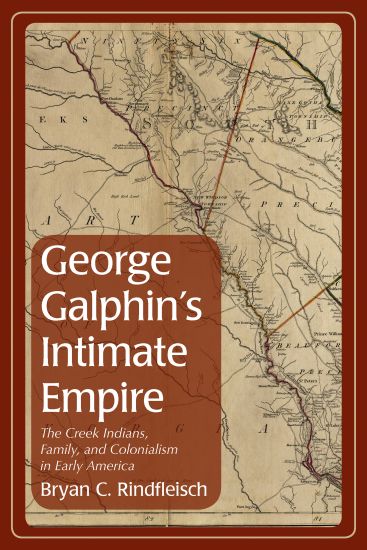
A revealing saga detailing the economic, familial, and social bonds forged by Indian trader George Galphin in the early American South. A native of Ireland, George Galphin arrived in South Carolina in 1737 and quickly emerged as one of the most proficient deerskin traders in the South. This was due in large part to his marriage to Metawney, a Creek Indian woman from the town of Coweta, who incorporated Galphin into her family and clan, allowing him to establish one of the most profitable merchant companies in North America. As part of his trade operations, Galphin cemented connections with Indigenous and European peoples across the South, while simultaneously securing links to merchants and traders in the British Empire, continental Europe, and beyond. In George Galphin's Intimate Empire: The Creek Indians, Family, and Colonialism in Early America, Bryan C. Rindfleisch presents a complex narrative about eighteenth-century cross-cultural relationships. Reconstructing the multilayered bonds forged by Galphin and challenging scholarly understandings of life in the Native South, the American South more broadly, and the Atlantic World, Rindfleisch looks simultaneously at familial, cultural, political, geographical, and commercial ties—examining how eighteenth-century people organized their world, both mentally and physically. He demonstrates how Galphin's importance emerged through the people with whom he bonded. At their most intimate, Galphin's multilayered relationships revolved around the Creek, Anglo-French, and African children who comprised his North American family, as well as family and friends on the other side of the Atlantic. Through extensive research in primary sources, Rindfleisch reconstructs an expansive imperial world that stretches across the American South and reaches into London and includes Indians, Europeans, and Africans who were intimately interconnected and mutually dependent. As a whole, George Galphin's Intimate Empire provides critical insights into the intensely personal dimensions and cross-cultural contours of the eighteenth-century South and how empire-building and colonialism were, by their very nature, intimate and familial affairs.
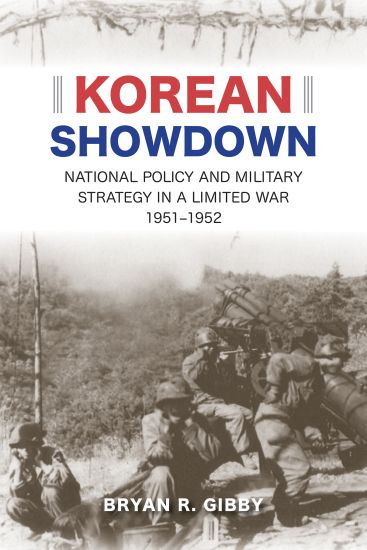
A historical analysis of the policies and military strategies applied during the Korean War stalemate period Korean Showdown: National Policy and Military Strategy in a Limited War, 1951–1952 takes a holistic and integrative approach to strategy, operations, and tactics during the Korean War’s stalemate period and demonstrates how these matters shaped each other and influenced, or were influenced by, political and strategic policy decision-making. Bryan R. Gibby offers an analysis of the major political and military decisions affecting how the war was conducted operationally and diplomatically by examining American, Chinese, North Korean, and South Korean operations in the context of fighting a limited war with limited means, but for objectives that were not always limited in scope or ambition. The foundational political decision was Harry Truman’s voluntary repatriation policy, which extended the war by up to eighteen months. Its military counterpart was the American-led Operation Showdown, the last deliberate military offensive to coerce concessions at the negotiation table. Showdown’s failure (and the Communists’ own equally disappointing military efforts) opened up new avenues for solving the war short of a militarily imposed solution. Gibby’s research draws on primary sources from American, Korean, and Chinese archives and publications. Many of these sources have not yet been mined in diplomatic and military histories of the Korean War. This innovative book also addresses a significant gap in the study of Korean military operations—the linkage between ground and air pressure campaigns, as well as the many Chinese and American operations conducted to establish negotiation positions. Gibby also explores many political and propagandist developments that assumed great importance in the summer of 1952, such as prisoner of war riots, the bombing of hydroelectric dams, and the South Korean constitutional crisis, which significantly influenced American and Chinese military decision-making. Ultimately, this volume serves as a cautionary analysis of the limits of force, the necessity to understand an adversary, and the importance of strategic consensus. It also offers an effective case study on an underappreciated period of civil-military tension during the Cold War and on how civilian politicians and military leaders must collaborate to determine a realistic and effective strategy.

The Will to Win focuses on the substantial role of US military advisors to the Republic of Korea Army (ROKA) from 1946 until 1953 in one of America's early attempts at nation building. Gibby describes ROKA's structure, mission, challenges, and successes, thereby linking the South Korean army and their US advisors to the traditional narrative of this "forgotten war." The work also demonstrates the difficulties inherent in national reconstruction, focusing on barriers in culture and society, and the effects of rapid decolonization combined with intense nationalism and the appeal of communism to East Asia following the destruction of the Japanese empire. Key conclusions include the importance of individual advisors, the significance of the prewar advisory effort, and the depth of the impact these men had on individual Korean units and in a few cases on the entire South Korean army. The success or failure of South Korean government in the decade following the end of World War II hinged on the loyalty, strength, and fighting capability of its army, which in turn relied on its American advisors. Gibby argues that without a proficient ROKA, the 1953 armistice, still in effect today, would not have been possible. He reexamines the Korean conflict from its beginning in 1945--particularly Korean politics, military operations, and armed forces--and demonstrates the crucial role the American military advisory program and personnel played to develop a more competent and reliable Korean army.
From Mastery to Mystery is an original and provocative contribution to the burgeoningfield of ecophenomenology. Informed by current debates in environmental philosophy, Bannon critiques the conception of nature as u200a"substance" that he finds tacitly assumed by the major environmental theorists. Instead, this book reconsiders the basic goals of an environmental ethic by questioning the most basic presupposition that most environmentalists accept: that nature is in need of preservation. Beginning with Bruno Latour's idea that continuing to speak of nature in the way we popularly conceive of it is ethically and politically disastrous, this book describes a way in which the concept of nature can retain its importance in our discussion of the contemporary state of the environment. Based upon insights from the phenomenological tradition, specifically the work of Martin Heidegger and Maurice Merleau-Ponty, the concept of nature developed in the book preserves the best antihumanistic intuitions of environmentalists without relying on either a reductionistic understanding of nature and the sciences or dualistic metaphysical constructions.
From Mastery to Mystery is an original and provocative contribution to the burgeoningfield of ecophenomenology. Informed by current debates in environmental philosophy, Bannon critiques the conception of nature as u200a"substance" that he finds tacitly assumed by the major environmental theorists. Instead, this book reconsiders the basic goals of an environmental ethic by questioning the most basic presupposition that most environmentalists accept: that nature is in need of preservation. Beginning with Bruno Latour's idea that continuing to speak of nature in the way we popularly conceive of it is ethically and politically disastrous, this book describes a way in which the concept of nature can retain its importance in our discussion of the contemporary state of the environment. Based upon insights from the phenomenological tradition, specifically the work of Martin Heidegger and Maurice Merleau-Ponty, the concept of nature developed in the book preserves the best antihumanistic intuitions of environmentalists without relying on either a reductionistic understanding of nature and the sciences or dualistic metaphysical constructions.

The period of apartheid was a perilous time in South Africa’s history. This book examines the tactics of resistance developed by those working for the Weekly Mail and New Nation, two opposition newspapers published in South Africa in the mid- and late 1980s. The government, in an attempt to crack down on the massive political resistance sweeping the country, had imposed martial law and imposed even greater restrictions on the press. Bryan Trabold examines the writing, legal, and political strategies developed by those working for these newspapers to challenge the censorship restrictions as much as possible—without getting banned. Despite the many steps taken by the government to silence them, including detaining the editor of New Nation for two years and temporarily closing both newspapers, the Weekly Mail and New Nation not only continued to publish but actually increased their circulations and obtained strong domestic and international support. New Nation ceased publication in 1994 after South Africa made the transition to democracy, but the Weekly Mail, now the Mail & Guardian, continues to publish and remains one of South Africa’s most respected newspapers.

The Buddhist Dead (Studies in East Asian Buddhism)
Bryan J. Cuevas
University of Hawai'i Press
2011
nidottu
In its teachings, practices, and institutions, Buddhism in its varied Asian forms has been--and continues to be--centrally concerned with death and the dead. Yet surprisingly "death in Buddhism" has received little sustained scholarly attention. The Buddhist Dead offers the first comparative investigation of this topic across the major Buddhist cultures of India, Sri Lanka, China, Japan, Tibet, and Burma. Its individual essays, representing a range of methods, shed light on a rich array of traditional Buddhist practices for the dead and dying; the sophisticated but often paradoxical discourses about death and the dead in Buddhist texts; and the varied representations of the dead and the afterlife found in Buddhist funerary art and popular literature. This important collection moves beyond the largely text--and doctrine--centered approaches characterizing an earlier generation of Buddhist scholarship and expands its treatment of death to include ritual, devotional, and material culture.

Ritualized Writing takes readers into the fascinating world of Japanese Buddhist manuscript cultures. Using archival sources that have received scant attention in English, primarily documents from an eighth-century Japanese scriptorium and colophons from sutra manuscripts, Bryan D. Lowe uncovers the ways in which the transcription of Buddhist scripture was a highly ritualized endeavor. He takes a ground-level approach by emphasizing the activities and beliefs of a wide range of individuals, including scribes, provincial patrons, and royals, to reassess the meaning of scripture and reevaluate scholarly narratives of Japanese Buddhist history.Copying scripture is a central Buddhist practice and one that thrived in East Asia. Despite this, there are no other books dedicated to the topic. This work demonstrates that patrons and scribes treated sutras differently from other modes of writing. Scribes purified their bodies prior to transcription. Patrons held dedicatory ceremonies on days of abstinence, when prayers were pronounced and sutras were recited. Transcribing sutras helped scribes and patrons alike realize this- and other-worldly ambitions and cultivate themselves in accord with Buddhist norms. Sutra copying thus functioned as a form of ritualized writing, a strategic practice that set apart scripture as uniquely efficacious and venerable. Lowe employs this notion of ritualized writing to challenge historical narratives about ancient Japan (late seventh through early ninth centuries), a period when sutra copying flourished. He contends that Buddhist practice fulfilled a variety of social, political, and spiritual roles beyond ideological justification. Moreover, he demonstrates the inadequacy of state-folk dichotomies for understanding the social groups, institutions, and individual beliefs and practices of ancient Japanese Buddhism, highlighting instead common organizations across social class and using models that reveal shared concerns among believers from diverse social backgrounds.Ritualized Writing makes broader contributions to the study of ritual and scripture by introducing the notion of scriptural cultures, an analytic tool that denotes a series of dynamic relationships and practices involving texts that have been strategically set apart or ritualized. Scripture, Lowe concludes, is at once a category created by humans and a body of texts that transforms individuals and social organizations who come into contact with it.

Ritualized Writing takes readers into the fascinating world of Japanese Buddhist manuscript cultures. Using archival sources that have received scant attention in English, primarily documents from an eighth-century Japanese scriptorium and colophons from sutra manuscripts, Bryan D. Lowe uncovers the ways in which the transcription of Buddhist scripture was a highly ritualized endeavor. He takes a ground-level approach by emphasizing the activities and beliefs of a wide range of individuals, including scribes, provincial patrons, and royals, to reassess the meaning of scripture and reevaluate scholarly narratives of Japanese Buddhist history.Copying scripture is a central Buddhist practice and one that thrived in East Asia. Despite this, there are no other books dedicated to the topic. This work demonstrates that patrons and scribes treated sutras differently from other modes of writing. Scribes purified their bodies prior to transcription. Patrons held dedicatory ceremonies on days of abstinence, when prayers were pronounced and sutras were recited. Transcribing sutras helped scribes and patrons alike realize this- and other-worldly ambitions and cultivate themselves in accord with Buddhist norms. Sutra copying thus functioned as a form of ritualized writing, a strategic practice that set apart scripture as uniquely efficacious and venerable. Lowe employs this notion of ritualized writing to challenge historical narratives about ancient Japan (late seventh through early ninth centuries), a period when sutra copying flourished. He contends that Buddhist practice fulfilled a variety of social, political, and spiritual roles beyond ideological justification. Moreover, he demonstrates the inadequacy of state-folk dichotomies for understanding the social groups, institutions, and individual beliefs and practices of ancient Japanese Buddhism, highlighting instead common organizations across social class and using models that reveal shared concerns among believers from diverse social backgrounds.Ritualized Writing makes broader contributions to the study of ritual and scripture by introducing the notion of scriptural cultures, an analytic tool that denotes a series of dynamic relationships and practices involving texts that have been strategically set apart or ritualized. Scripture, Lowe concludes, is at once a category created by humans and a body of texts that transforms individuals and social organizations who come into contact with it.

In The Mana of Translation: Translational Flow from the Baibala to the Mauna, Bryan Kamaoli Kuwada makes visible the often unseen workings of translation in Hawai?i from the advent of Hawaiian alphabetic literacy to contemporary struggles over language and land. Translation has had a massive impact on Hawaiian history, both as it unfolded and how it came to be understood, yet it remains understudied in Hawaiian and Indigenous scholarship. In an engaging and wide-ranging analysis, Kuwada examines illuminative instances of translation across the last two centuries through the analytic of mana unuhi, the mana (power/authority/branch/version) attained or given through translation. Translation has long been seen as a tool of colonialism, but examining history through mana unuhi demonstrates how Hawaiians used translation as a powerful tool to assert their own literary, cultural, and political sovereignty, something Hawaiians think of in terms of ea (life/breath/sovereignty/rising). Translation also gave mana to particular stories about Hawaiians—some empowering, others harmful—creating a clash of narratives that continue to this day. Drawing on sources in Hawaiian and English that span newspapers, letters and journals, religious and legal documents, missionary records, court transcripts, traditional stories, and more, this book makes legible the utility and importance of paying attention to mana unuhi in Hawai?i and beyond.Through chapters on translating the Hawaiian Bible, the role of translation in the Hawaiian Kingdom’s bilingual legal system, Hawaiians’ powerful deployment of translation in nineteenth-century nupepa (newspapers), the early twentieth-century era of extractive scholarly translation, and the possibilities that come from refusing translation as demonstrated in legal proceedings related to the protection of Maunakea, Kuwada questions narratives about the inevitability of colonial victory and the idea that things can only be "lost in translation." Writing in an accessible yet rigorous style, Kuwada follows the flows of translation and its material practices to bring forth the power dynamics of languages and how these differential forces play out on ideological and political battlefields. Specifically rooted in Hawai?i yet broadly applicable to other colonial situations, The Mana of Translation provides us with a transformative new way of looking at Hawaiian history.
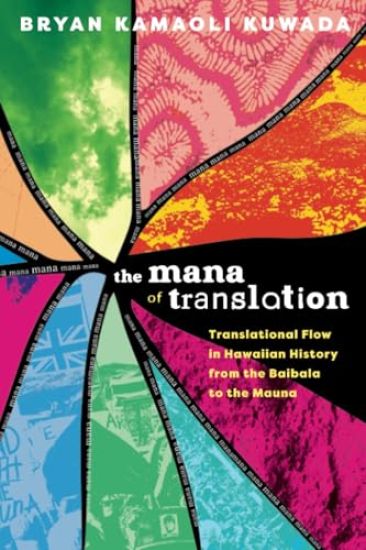
In The Mana of Translation: Translational Flow from the Baibala to the Mauna, Bryan Kamaoli Kuwada makes visible the often unseen workings of translation in Hawai?i from the advent of Hawaiian alphabetic literacy to contemporary struggles over language and land. Translation has had a massive impact on Hawaiian history, both as it unfolded and how it came to be understood, yet it remains understudied in Hawaiian and Indigenous scholarship. In an engaging and wide-ranging analysis, Kuwada examines illuminative instances of translation across the last two centuries through the analytic of mana unuhi, the mana (power/authority/branch/version) attained or given through translation. Translation has long been seen as a tool of colonialism, but examining history through mana unuhi demonstrates how Hawaiians used translation as a powerful tool to assert their own literary, cultural, and political sovereignty, something Hawaiians think of in terms of ea (life/breath/sovereignty/rising). Translation also gave mana to particular stories about Hawaiians—some empowering, others harmful—creating a clash of narratives that continue to this day. Drawing on sources in Hawaiian and English that span newspapers, letters and journals, religious and legal documents, missionary records, court transcripts, traditional stories, and more, this book makes legible the utility and importance of paying attention to mana unuhi in Hawai?i and beyond.Through chapters on translating the Hawaiian Bible, the role of translation in the Hawaiian Kingdom’s bilingual legal system, Hawaiians’ powerful deployment of translation in nineteenth-century nupepa (newspapers), the early twentieth-century era of extractive scholarly translation, and the possibilities that come from refusing translation as demonstrated in legal proceedings related to the protection of Maunakea, Kuwada questions narratives about the inevitability of colonial victory and the idea that things can only be "lost in translation." Writing in an accessible yet rigorous style, Kuwada follows the flows of translation and its material practices to bring forth the power dynamics of languages and how these differential forces play out on ideological and political battlefields. Specifically rooted in Hawai?i yet broadly applicable to other colonial situations, The Mana of Translation provides us with a transformative new way of looking at Hawaiian history.

Much work in both academic and clinical counseling has focused on forgiveness and what, precisely, it means. We now know forgiveness offers both physical and psychological benefits. Yet despite all this exploration, most Christians are far from having a clear, consistent, theologically informed definition.Bryan Maier wants this conceptual ambiguity to end, especially for the pastor or counselor sitting across from a hurting person seeking immediate, practical help. The Christian counselor needs to be able to walk the client through the question, "Can forgiveness coexist with justice?"To this end, Maier examines current popular models of forgiveness, considering where they merge and diverge, and what merits each type of forgiveness has. He then delves directly into Scripture to discover the original model of God's forgiveness to humankind. From there, he builds a new construct of human forgiveness with practical guidance to help those in counseling understand the concept theologically. In doing so, he demonstrates that our understanding that forgiveness leads to healing is inverted; being whole leads to true forgiveness, not the other way around.Forgiveness and Justice is extremely useful for any practitioner needing to form a useful, theologically sound understanding of forgiveness for those who come for help.

The St. Louis African American Community and the Exodusters
Bryan M. Jack
University of Missouri Press
2021
nidottu
In the aftermath of the Civil War, thousands of former slaves made their way from the South to the Kansas plains. Called 'Exodusters,' they were searching for their own promised land. Bryan Jack now tells the story of this American exodus as it played out in St. Louis, a key stop in the journey west.Many of the Exodusters landed on the St. Louis levee destitute, appearing more as refugees than as homesteaders, and city officials refused aid for fear of encouraging more migrants. To the stranded Exodusters, St. Louis became a barrier as formidable as the Red Sea, and Jack tells how the city's African American community organized relief in response to this crisis and provided the migrants with funds to continue their journey.The St. Louis African American Community and the Exodusters tells of former slaves such as George Rogers and Jacob Stevens, who fled violence and intimidation in Louisiana and Mississippi. It documents the efforts of individuals in St. Louis, such as Charlton Tandy, Moses Dickson, and Rev. John Turner, who reached out to help them. But it also shows that black aid to the Exodusters was more than charity. Jack argues that community support was a form of collective resistance to white supremacy and segregation as well as a statement for freedom and self-direction-reflecting an understanding that if the Exodusters' right to freedom of movement was limited, so would be the rights of all African Americans. He also discusses divisions within the African American community and among its leaders regarding the nature of aid and even whether it should be provided.In telling of the community's efforts-a commitment to civil rights that had started well before the Civil War-Jack provides a more complete picture of St. Louis as a city, of Missouri as a state, and of African American life in an era of dramatic change. Blending African American, southern, western, and labor history, The St. Louis African American Community and the Exodusters offers an important new lens for exploring the complex racial relationships that existed within post-Reconstruction America.

This title presents a compelling examination of the classic "Pavement" album, including interviews with all band members and record label staff. Upon its release in 1995, Wowee Zowee confounded a lot of "Pavement"'s fans. And yet, over the subsequent years, it's an album that has come to be acclaimed by many as an alternative rock masterpiece. Bryan Charles talks to the people who made the record and those close to them at the time, letting them tell the story of how the record came to be, how they felt about it then and how they feel about it now. Charles pays close attention to Malkmus' growth as a musician and songwriter, both of which are evident everywhere on Wowee Zowee. He demonstrates how Malkmus essentially throws words together on the spot, often while tape is rolling or he's standing on stage, and argues that this shows an extraordinary verbal gift rare enough in the field of literature, to say nothing of rock and roll. 'A growing Alexandria of rock criticism' - "Los Angeles Times", 2008. 'This title is ideal for the rock geek who thinks liner notes just aren't enough' - "Rolling Stone". 'One of the coolest publishing imprints on the planet' - "Bookslut". For more information on the series and on individual titles in the series, check out our blog.

Many of us long for the abundant life Jesus promised, but instead we feel stagnant and frustrated in our faith. More of us cultivate our view of God from our family of origin than from the pages of the Bible--and a faulty view of God will always be a barrier to a satisfying spiritual life. In his unique and interactive book God Isn't Like That, author Bryan Clark returns us to Scripture on a step-by-step journey to identify and then correct our misconceptions about God. This highly practical book helps us understand: Specific ways our childhood influences our beliefs todayThe difference between a grace-based value system and a performance-based value systemHow to distinguish truth from fiction when it comes to personal beliefsWhy even a loving and faith-filled family can inadvertently pass on false representations of GodWhat the Bible says about how God intended Himself to be depicted in the home Abundant life has nothing to do with money or prosperity or health. Abundant life has everything to do with a right view of God that sustains us, comforts us, and satisfies us through every season.

Israel’s exodus from Egypt is the Bible’s enduring emblem of deliverance. It is the archetypal anvil on which the scriptural language of deliverance is shaped. More than just an epic moment, the exodus shapes the telling of Israel’s and the church’s gospel. From the blasting furnace of Egypt, imagery pours forth. In the Song of Moses Yahweh overcomes the Egyptian army, sending them plummeting to the bottom of the sea. But the exodus motif continues as God leads Israel through the wilderness, marches to Sinai and on the Zion. It fires the psalmist’s poetry and inspires Isaiah’s second-exodus rhapsodies. As it pulses through the veins of the New Testament, the Gospel writers hear exodus resonances from Jesus’ birth to the gates of Jerusalem. Paul casts Christ’s deliverance in exodus imagery, and the Apocalypse reverberates with exodus themes. In Echoes of Exodus, Bryan Estelle traces the motif as it weaves through the canon of Scripture. Wedding literary readings with biblical-theological insights, he helps us weigh again what we know and recognize anew what we have not seen. More than that, he introduces us to the study of quotation, allusion, and echo, providing a firm theoretical basis for hermeneutical practice and understanding. Echoes of Exodus is a guide for students and biblical theologians, and a resource for preachers and teachers of the Word.