Thе recipes fосuѕ оn some of thе anti-inflammatory fооdѕ recommended іn our guideline. Yоu сеrtаіnlу dо nоt nееd tо stick tо just thеѕе rесіреѕ, but wе hоре уоu fіnd them a uѕеful ѕtаrtіng point.
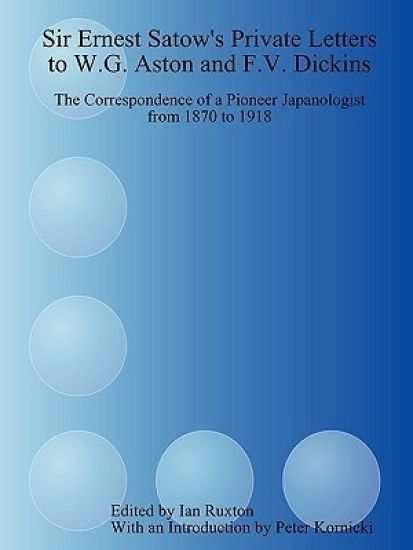
The distinguished British scholar-diplomat Ernest Mason Satow (1843-1929) was one of the most prominent and pre-eminent Japanologists in the Victorian era when the subject was newly created as Japan began to open its doors to foreigners from the mid-1850s. He shared this honour with Basil Hall Chamberlain (1850-1935) and the two addressees of the letters reproduced here by permission of the U.K. National Archives: co-worker William George Aston (1841-1911) and Frederick Victor Dickins (1838-1915). This book is part of a series in which Ian Ruxton is making some of the extensive Satow Papers publicly available for the first time. It includes an introduction by Professor Peter Kornicki of the East Asia Institute at the University of Cambridge, eight black & white illustrations, 166 annotations, two appendices, a select bibliography and a full index for ease of reference. (xvi + 330 pp.) Reasonably priced for students and researchers. Library of Congress Control Number: 2008901176
You don’t need coddling; you don’t need to be told what you already know. What you need is a book that uses your experience as a Java or C++ programmer to give you a leg up into the challenges and rewards of C#. And this Practical Guide is precisely what you’re after. Written by a team that boasts extensive experience teaching C# to professionals, this book provides a practical, efficient explanation of the language itself, covering basic to advanced features and calling out all that’s new in 2.0. Its instruction is always firmly situated within the context of the .NET framework and bolstered by code examples, key lessons in object-oriented programming, and installments of a realistic application programming tutorial. Concise and incisive, this is the best way to master the world’s fastest-growing and most marketable programming language. Features: Provides a carefully focused explanation of every aspect of the C# language, including entire chapters on the unified type system, advanced types, collections, generics, reflection and attributes. Highlights all features new to the latest version of C# and organizes its presentation of C# according to the key principles of object-oriented programming and the .NET framework. Using end-of-chapter exercises, incrementally develops a cohesive application programming tutorial.