Kirjojen hintavertailu. Mukana 12 400 019 kirjaa ja 12 kauppaa.

Kirjahaku

Etsi kirjoja tekijän nimen, kirjan nimen tai ISBN:n perusteella.

1000 tulosta hakusanalla David A. Dethrage

Democracy

Democracy

David A. Moss

The Belknap Press
2019
nidottu
A Foreign Affairs Best Book of the Year“This absolutely splendid book is a triumph on every level. A first-rate history of the United States, it is beautifully written, deeply researched, and filled with entertaining stories. For anyone who wants to see our democracy flourish, this is the book to read.”—Doris Kearns GoodwinTo all who say our democracy is broken—riven by partisanship, undermined by extremism, corrupted by wealth—history offers hope. Democracy’s nineteen cases, honed in David Moss’s popular course at Harvard and taught at the Library of Congress, in state capitols, and at hundreds of high schools across the country, take us from Alexander Hamilton’s debates in the run up to the Constitutional Convention to Citizens United. Each one presents a pivotal moment in U.S. history and raises questions facing key decision makers at the time: Should the delegates support Madison’s proposal for a congressional veto over state laws? Should Lincoln resupply Fort Sumter? Should Florida lawmakers approve or reject the Equal Rights Amendment? Should corporations have a right to free speech? Moss invites us to engage in the passionate debates that are crucial to a healthy society.“Engagingly written, well researched, rich in content and context…Moss believes that fierce political conflicts can be constructive if they are mediated by shared ideals.”—Glenn C. Altschuler, Huffington Post“Gives us the facts of key controversies in our history—from the adoption of the constitution to Citizens United—and invites readers to decide for themselves…A valuable resource for civic education.”—Michael Sandel, author of Justice
The Dynamics of Learning in Early Modern Italy

The Dynamics of Learning in Early Modern Italy

David A. Lines

HARVARD UNIVERSITY PRESS
2023
sidottu
A pathbreaking history of early modern education argues that Europe’s oldest university, often seen as a bastion of traditionalism, was in fact a vibrant site of intellectual innovation and cultural exchange.The University of Bologna was among the premier universities in medieval Europe and an international magnet for students of law. However, a long-standing historiographical tradition holds that Bologna—and Italian university education more broadly—foundered in the early modern period. On this view, Bologna’s curriculum ossified and its prestige crumbled, due at least in part to political and religious pressure from Rome. Meanwhile, new ways of thinking flourished instead in humanist academies, scientific societies, and northern European universities.David Lines offers a powerful counternarrative. While Bologna did decline as a center for the study of law, he argues, the arts and medicine at the university rose to new heights from 1400 to 1750. Archival records show that the curriculum underwent constant revision to incorporate contemporary research and theories, developed by the likes of René Descartes and Isaac Newton. From the humanities to philosophy, astronomy, mathematics, and medicine, teaching became more systematic and less tied to canonical texts and authors. Theology, meanwhile, achieved increasing prominence across the university. Although this religious turn reflected the priorities and values of the Catholic Reformation, it did not halt the creation of new scientific chairs or the discussion of new theories and discoveries. To the contrary, science and theology formed a new alliance at Bologna.The University of Bologna remained a lively hub of cultural exchange in the early modern period, animated by connections not only to local colleges, academies, and libraries, but also to scholars, institutions, and ideas throughout Europe.
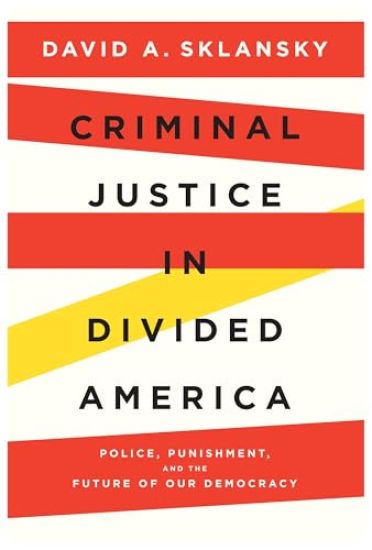
Criminal Justice in Divided America

Criminal Justice in Divided America

David A. Sklansky

HARVARD UNIVERSITY PRESS
2025
sidottu
How a broken criminal justice system has fueled the crisis of American democracy, and how we can address both problems together.American criminal justice is in crisis. Prisons are swollen, confidence in police has plummeted, and race- and class-based biases distort every aspect of the system. American democracy is in crisis, too, as the chasm of loathing and incomprehension that divides political factions grows ever wider and deeper. Legal scholar and former prosecutor David A. Sklansky argues that these crises are deeply intertwined. And if the failures of American criminal justice are near the heart of our political divides, then reforming the system is essential for repairing our democracy.Criminal Justice in Divided America shows how police, courts, and prisons helped to break American democracy and how better approaches to public safety and criminal accountability can help to repair it. Engaging critically with concerns from both the left and the right, Sklansky lays out a clear and deeply researched agenda for reforming police departments, prosecutors’ offices, criminal trials, and punishment. Sklansky seeks pragmatic solutions that take account of political realities: the lofty ideal of empowering “the people” or “the community” can mean little when members of the public or the community disagree. While efforts to “defund” the police have exacerbated political conflicts without addressing the underlying problem of how and when force should be used to protect public safety, reforms aimed at improving police accountability, restraining prosecutorial power, and expanding the role of juries can bring together warring parties who share a concern for justice.Ultimately, Sklansky argues, reform must be rooted in a strong commitment to pluralism—bridging political divides rather than worsening them, strengthening democracy, and securing the broad support that enables durable change.
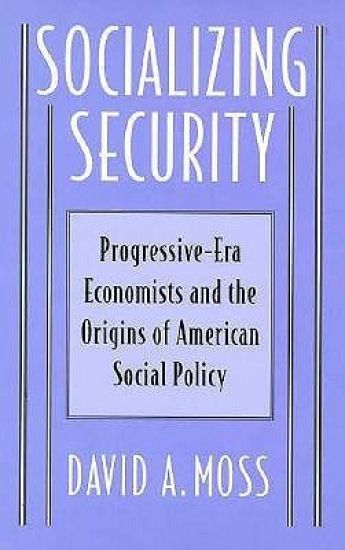
Socializing Security

Socializing Security

David A. Moss

Harvard University Press
1995
sidottu
Socializing Security examines the early movement for worker-security legislation in the United States. It focuses on a group of academic economists who became leading proponents of social insurance and protective labor legislation during the first decades of the twentieth century. These economists—including John R. Commons and Richard T. Ely—founded the American Association for Labor Legislation (AALL). As intellectuals and political activists, they theorized about the social efficiency of security legislation, proposed policies, and drafted model bills. They campaigned vigorously for industrial safety laws, workers’ compensation, unemployment insurance, and compulsory health insurance.The AALL reformers were successful in some of their legislative campaigns, but failed in two of their most important ones, those for unemployment insurance and health insurance. In examining the obstacles that the reformers faced, David Moss highlights a variety of political and institutional constraints, including the constitutional doctrine of federalism and gender-biased judicial decisions.The goal of the AALL reformers, Moss demonstrates, was not to relieve the poor, but rather to prevent workers and their families from falling into poverty as a result of accidents or illness. In favoring security over relief, economists in the progressive era defined and confirmed what has remained, for some eighty years, one of the essential values of American social policy. In concluding, Moss suggests that new policies may now be necessary in an economy in which falling wages and fewer jobs, rather than industrial hazards, are increasingly to blame for the precarious situation of the American worker.
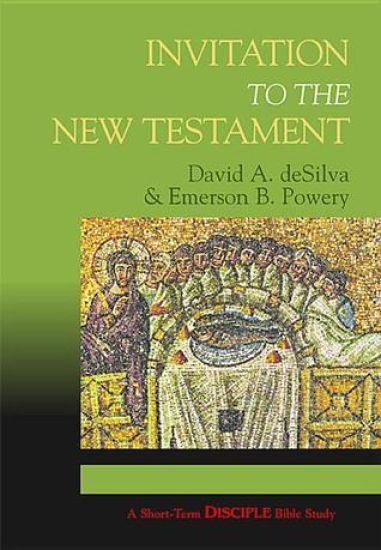
Invitation to the New Testament

Invitation to the New Testament

David A deSilva; Emerson Powery

Abingdon Press
2005
nidottu
Click here to read session one The Leader's Guide provides process guidance for weekly group sessions and understands the role of leader as facilitator of small-group sessions. Procedures for guiding sessions include: directions for using related video segments, and questions for discussion. Invitation To The New Testament8 sessions, 60-90 minutesExperience required: In Depth Explore the writings of the New Testament using the story of Jesus as the starting point. This survey of the testament looks at how the early church took ownership of and was shaped by the story of Jesus and how the church learned how to develop as disciples and create communities of faith. Participants find a deeper conversation with the writers of the NT and a renewal of our commitment to be shaped---personally and communally---by the story of Jesus. In the weekly video segments, listen as scholars fascinate you with facts and information that opens new understanding and enlightenment for your group. In the second video, sit in on a table conversation between guest scholars and debate key issues in the text.Sessions: 1. Jesus Calls Us Into God's Redemption Story2. Jesus Calls Us to a Transformed Life3. Jesus Calls Us to Minister to a Hostile World4. Jesus Calls Us to Complex Communities of Faith5. Jesus Calls Us to Serve One Another6. Jesus Calls Us to a New Relationship With Tradition7. Jesus Calls Us to Live in Light of His Coming Again8. Jesus Calls Us to Experience the Gifts of His Dying and Rising
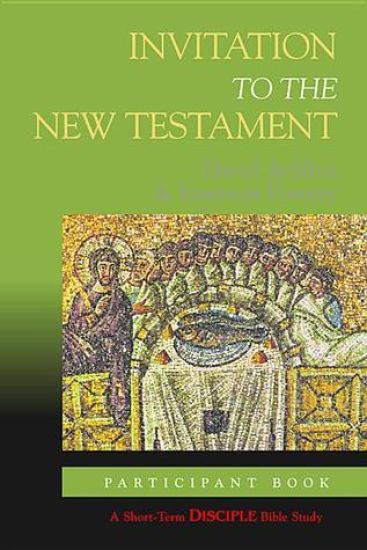
Invitation to the New Testament

Invitation to the New Testament

David A deSilva; Emerson Powery

Abingdon Press
2005
nidottu
Click here to read session one The Participant's Guide guides daily study and preparation for discussion in the weekly group meeting. The expectation for daily study will be no more than thirty minutes. Invitation To The New Testament8 sessions, 60-90 minutesExperience required: In Depth Explore the writings of the New Testament using the story of Jesus as the starting point. This survey of the testament looks at how the early church took ownership of and was shaped by the story of Jesus and how the church learned how to develop as disciples and create communities of faith. Participants find a deeper conversation with the writers of the NT and a renewal of our commitment to be shaped---personally and communally---by the story of Jesus. In the weekly video segments, listen as scholars fascinate you with facts and information that opens new understanding and enlightenment for your group. In the second video, sit in on a table conversation between guest scholars and debate key issues in the text.Sessions: 1. Jesus Calls Us Into God's Redemption Story2. Jesus Calls Us to a Transformed Life3. Jesus Calls Us to Minister to a Hostile World4. Jesus Calls Us to Complex Communities of Faith5. Jesus Calls Us to Serve One Another6. Jesus Calls Us to a New Relationship With Tradition7. Jesus Calls Us to Live in Light of His Coming Again8. Jesus Calls Us to Experience the Gifts of His Dying and Rising
Beyond the Yellow Ribbon

Beyond the Yellow Ribbon

David A. Thompson; Darlene Wetterstrom

Abingdon Press
2009
pokkari
Help bring combat veterans all the way back home. Over a half million combat veterans have returned from Iraq and Afghanistan. With thousands of military personnelstilldeployed, few communitiesescape the direct impact of solders returning from war. Yet their needs and the needs of their families are often hidden in plain sightin our congregations and communities. This book identifies specific needs of veterans and their families and gives creative and practicalways your church can minister to them.It is a must have for anyone serious about giving back to those who have given so much. "You [Thompson and Wetterstrom] are plowing very important ground, and I thank you for the reminder." - author Philip Yancey"
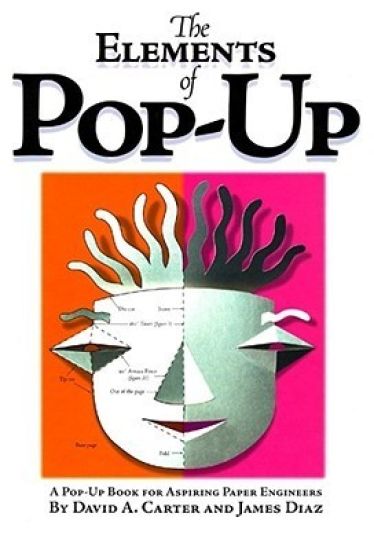
The Elements Of Pop-up

The Elements Of Pop-up

David A. Carter

Simon Schuster
1999
sidottu
Here at last is the definitive book on how to make a pop-up. Every aspect of the creation of a pop-up, known as paper engineering, is clearly and thoroughly covered. All types of parallel folds, angle folds, wheels and pull tabs are accurately detailed verbally and visually, flat and in dimension. Also included is a history of pop-ups and a step-by-step photographic essay on how a pop-up is made from start to finish. This guided tour is perfect for aspiring pop-up creators, paper engineers, students and appreciators of this unique art form.
One Red Dot

One Red Dot

David A Carter

Simon Schuster
2005
nidottu
A Classic Collectible Pop-Up(TM) One Red Dot A Pop-Up Book for Children of All Ages by David A. Carter One Red Dot is a stunning tour de force from David A. Carter, the creator of the bestselling Bugs in a Box(R) books. Each of the ten magnificent pop-up sculptures challenges readers to find the one red dot. From the flip-flop flaps to the whimsical wiggle-wobble widgets, each page is an original piece of artwork to cherish and admire.
Science, Jews, and Secular Culture

Science, Jews, and Secular Culture

David A. Hollinger

Princeton University Press
1998
pokkari
This remarkable group of essays describes the "culture wars" that consolidated a new, secular ethos in mid-twentieth-century American academia and generated the fresh energies needed for a wide range of scientific and cultural enterprises. Focusing on the decades from the 1930s through the 1960s, David Hollinger discusses the scientists, social scientists, philosophers, and historians who fought the Christian biases that had kept Jews from fully participating in American intellectual life. Today social critics take for granted the comparatively open outlook developed by these men (and men they were, mostly), and charge that their cosmopolitanism was not sufficiently multicultural. Yet Hollinger shows that the liberal cosmopolitans of the mid-century generation defined themselves against the realities of their own time: McCarthyism, Nazi and Communist doctrines, a legacy of anti-Semitic quotas, and both Protestant and Catholic versions of the notion of a "Christian America." The victory of liberal cosmopolitans was so sweeping by the 1960s that it has become easy to forget the strength of the enemies they fought. Most books addressing the emergence of Jewish intellectuals celebrate an illustrious cohort of literary figures based in New York City. But the pieces collected here explore the long-postponed acceptance of Jewish immigrants in a variety of settings, especially the social science and humanities faculties of major universities scattered across the country. Hollinger acknowledges the limited, rather parochial sense of "mankind" that informed some mid-century thinking, but he also inspires in the reader an appreciation for the integrationist aspirations of a society truly striving toward equality. His cast of characters includes Vannevar Bush, James B. Conant, Richard Hofstadter, Robert K. Merton, Lionel Trilling, and J. Robert Oppenheimer.
Entangling Relations

Entangling Relations

David A. Lake

Princeton University Press
1999
pokkari
Throughout what publisher Henry Luce dubbed the "American century," the United States has wrestled with two central questions. Should it pursue its security unilaterally or in cooperation with others? If the latter, how can its interests be best protected against opportunism by untrustworthy partners? In a major attempt to explain security relations from an institutionalist approach, David A. Lake shows how the answers to these questions have differed after World War I, during the Cold War, and today. In the debate over whether to join the League of Nations, the United States reaffirmed its historic policy of unilateralism. After World War II, however, it broke decisively with tradition and embraced a new policy of cooperation with partners in Europe and Asia. Today, the United States is pursuing a new strategy of cooperation, forming ad hoc coalitions and evincing an unprecedented willingness to shape but then work within the prevailing international consensus on the appropriate goals and means of foreign policy. In interpreting these three defining moments of American foreign policy, Lake draws on theories of relational contracting and poses a general theory of security relationships. He arrays the variety of possible security relationships on a continuum from anarchy to hierarchy, and explains actual relations as a function of three key variables: the benefits from pooling security resources and efforts with others, the expected costs of opportunistic behavior by partners, and governance costs. Lake systematically applies this theory to each of the "defining moments" of twentieth-century American foreign policy and develops its broader implications for the study of international relations.
Communities and Ecosystems

Communities and Ecosystems

David A. Wardle

Princeton University Press
2002
pokkari
Most of the earth's terrestrial species live in the soil. These organisms, which include many thousands of species of fungi and nematodes, shape aboveground plant and animal life as well as our climate and atmosphere. Indeed, all terrestrial ecosystems consist of interdependent aboveground and belowground compartments. Despite this, aboveground and belowground ecology have been conducted largely in isolation. This book represents the first major synthesis to focus explicitly on the connections between aboveground and belowground subsystems--and their importance for community structure and ecosystem functioning. David Wardle integrates a vast body of literature from numerous fields--including population ecology, ecosystem ecology, ecophysiology, ecological theory, soil science, and global-change biology--to explain the key conceptual issues relating to how aboveground and belowground communities affect one another and the processes that each component carries out. He then applies these concepts to a host of critical questions, including the regulation and function of biodiversity as well as the consequences of human-induced global change in the form of biological invasions, extinctions, atmospheric carbon-dioxide enrichment, nitrogen deposition, land-use change, and global warming. Through ambitious theoretical synthesis and a tremendous range of examples, Wardle shows that the key biotic drivers of community and ecosystem properties involve linkages between aboveground and belowground food webs, biotic interaction, the spatial and temporal dynamics of component organisms, and, ultimately, the ecophysiological traits of those organisms that emerge as ecological drivers. His conclusions will propel theoretical and empirical work throughout ecology.
Unitary Representations of Reductive Lie Groups

Unitary Representations of Reductive Lie Groups

David A. Vogan

Princeton University Press
1987
pokkari
This book is an expanded version of the Hermann Weyl Lectures given at the Institute for Advanced Study in January 1986. It outlines some of what is now known about irreducible unitary representations of real reductive groups, providing fairly complete definitions and references, and sketches (at least) of most proofs. The first half of the book is devoted to the three more or less understood constructions of such representations: parabolic induction, complementary series, and cohomological parabolic induction. This culminates in the description of all irreducible unitary representation of the general linear groups. For other groups, one expects to need a new construction, giving "unipotent representations." The latter half of the book explains the evidence for that expectation and suggests a partial definition of unipotent representations.
Debt's Dominion

Debt's Dominion

David A. Skeel

Princeton University Press
2003
pokkari
Bankruptcy in America, in stark contrast to its status in most other countries, typically signifies not a debtor's last gasp but an opportunity to catch one's breath and recoup. Why has the nation's legal system evolved to allow both corporate and individual debtors greater control over their fate than imaginable elsewhere? Masterfully probing the political dynamics behind this question, David Skeel here provides the first complete account of the remarkable journey American bankruptcy law has taken from its beginnings in 1800, when Congress lifted the country's first bankruptcy code right out of English law, to the present day. Skeel shows that the confluence of three forces that emerged over many years--an organized creditor lobby, pro-debtor ideological currents, and an increasingly powerful bankruptcy bar--explains the distinctive contours of American bankruptcy law. Their interplay, he argues in clear, inviting prose, has seen efforts to legislate bankruptcy become a compelling battle royale between bankers and lawyers--one in which the bankers recently seem to have gained the upper hand. Skeel demonstrates, for example, that a fiercely divided bankruptcy commission and the 1994 Republican takeover of Congress have yielded the recent, ideologically charged battles over consumer bankruptcy. The uniqueness of American bankruptcy has often been noted, but it has never been explained. As different as twenty-first century America is from the horse-and-buggy era origins of our bankruptcy laws, Skeel shows that the same political factors continue to shape our unique response to financial distress.
Painful Choices

Painful Choices

David A. Welch

Princeton University Press
2005
sidottu
Under what conditions should we expect states to do things radically differently all of a sudden? In this book, David Welch seeks to answer this question, constructing a theory of foreign policy change inspired by organization theory, cognitive and motivational psychology, and prospect theory. He then "test drives" the theory in a series of comparative case studies in the security and trade domains: Argentina's decision to go to war over the Falklands/Malvinas vs. Japan's endless patience with diplomacy in its conflict with Russia over the Northern Territories; America's decision to commit large-scale military force to Vietnam vs. its ultimate decision to withdraw; and Canada's two abortive flirtations with free trade with the United States in 1911 and 1948 vs. its embrace of free trade in the late 1980s. Painful Choices has three main objectives: to determine whether the general theory project in the field of international relations can be redeemed, given disappointment with previous attempts; to reflect on what this reveals about the possibilities and limits of general theory; and to inform policy. Welch argues that earlier efforts at general theory erred by aiming to explain state behavior, which is an intractable problem. Instead, since inertia is the default expectation in international politics, all we need do is to explain changes in behavior. Painful Choices shows that this is a tractable problem with clear implications for intelligence analysts and negotiators.
Computational Economics

Computational Economics

David A. Kendrick; P. Ruben Mercado; Hans M. Amman

Princeton University Press
2006
sidottu
The ability to conceptualize an economic problem verbally, to formulate it as a mathematical model, and then represent the mathematics in software so that the model can be solved on a computer is a crucial skill for economists. Computational Economics contains well-known models--and some brand-new ones--designed to help students move from verbal to mathematical to computational representations in economic modeling. The authors' focus, however, is not just on solving the models, but also on developing the ability to modify them to reflect one's interest and point of view. The result is a book that enables students to be creative in developing models that are relevant to the economic problems of their times. Unlike other computational economics textbooks, this book is organized around economic topics, among them macroeconomics, microeconomics, and finance. The authors employ various software systems--including MATLAB, Mathematica, GAMS, the nonlinear programming solver in Excel, and the database systems in Access--to enable students to use the most advantageous system. The book progresses from relatively simple models to more complex ones, and includes appendices on the ins and outs of running each program. The book is intended for use by advanced undergraduates and professional economists and even, as a first exposure to computational economics, by graduate students. * Organized by economic topics * Progresses from simple to more complex models * Includes instructions on numerous software systems * Encourages customization and creativity
How Old Is the Universe?

How Old Is the Universe?

David A. Weintraub

Princeton University Press
2012
pokkari
How a great enigma of astronomy was solvedAstronomers have determined that our universe is 13.7 billion years old. How exactly did they come to this precise conclusion? How Old Is the Universe? tells the incredible story of how astronomers solved one of the most compelling mysteries in science and, along the way, introduces readers to fundamental concepts and cutting-edge advances in modern astronomy.The age of our universe poses a deceptively simple question, and its answer carries profound implications for science, religion, and philosophy. David Weintraub traces the centuries-old quest by astronomers to fathom the secrets of the nighttime sky. Describing the achievements of the visionaries whose discoveries collectively unveiled a fundamental mystery, he shows how many independent lines of inquiry and much painstakingly gathered evidence, when fitted together like pieces in a cosmic puzzle, led to the long-sought answer. Astronomers don't believe the universe is 13.7 billion years old—they know it. You will too after reading this book. By focusing on one of the most crucial questions about the universe and challenging readers to understand the answer, Weintraub familiarizes readers with the ideas and phenomena at the heart of modern astronomy, including red giants and white dwarfs, cepheid variable stars and supernovae, clusters of galaxies, gravitational lensing, dark matter, dark energy and the accelerating universe—and much more. Offering a unique historical approach to astronomy, How Old Is the Universe? sheds light on the inner workings of scientific inquiry and reveals how astronomers grapple with deep questions about the physical nature of our universe.
After Cloven Tongues of Fire

After Cloven Tongues of Fire

David A. Hollinger

Princeton University Press
2013
sidottu
The role of liberalized, ecumenical Protestantism in American history has too often been obscured by the more flamboyant and orthodox versions of the faith that oppose evolution, embrace narrow conceptions of family values, and continue to insist that the United States should be understood as a Christian nation. In this book, one of our preeminent scholars of American intellectual history examines how liberal Protestant thinkers struggled to embrace modernity, even at the cost of yielding much of the symbolic capital of Christianity to more conservative, evangelical communities of faith. If religion is not simply a private concern, but a potential basis for public policy and a national culture, does this mean that religious ideas can be subject to the same kind of robust public debate normally given to ideas about race, gender, and the economy? Or is there something special about religious ideas that invites a suspension of critical discussion? These essays, collected here for the first time, demonstrate that the critical discussion of religious ideas has been central to the process by which Protestantism has been liberalized throughout the history of the United States, and shed light on the complex relationship between religion and politics in contemporary American life. After Cloven Tongues of Fire brings together in one volume David Hollinger's most influential writings on ecumenical Protestantism. The book features an informative general introduction as well as concise introductions to each essay.