
Kirjahaku
Etsi kirjoja tekijän nimen, kirjan nimen tai ISBN:n perusteella.
1000 tulosta hakusanalla Edith Dunham

THe noted author and scholar presents a guide to the pophets of the Old Testament for the modern reader.

The kind of events that took place in the great free government of the ancient world may, by reason of unchanging human nature, be repeated in the modern world. The course that Athens followed can be to us not only a record of distant and forgotten events, but a blueprint of what may happen again.
"A great lady with a disciplined and noble mind and an unquenchable love of good literature. In this volume, we can still hear that calm but not passionless voice explaining the grandeurs and difficulties of some of her favorite books and communicating her appreciation of them to us." —Gilbert Highet
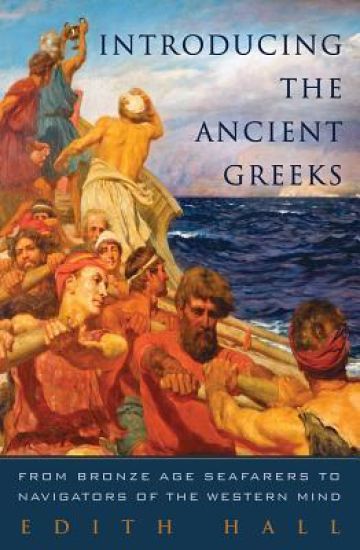
The ancient Greeks invented democracy, theater, rational science, and philosophy. They built the Parthenon and the Library of Alexandria. They wrote down the timeless myths of Odysseus and Oedipus, and the histories of Leonidas s three hundred Spartans and Alexander the Great. But understanding these uniquely influential people has been hampered by their diffusion across the entire Mediterranean. Most ancient Greeks did not live in what is now Greece but in settlements scattered across Turkey, Syria, Egypt, Libya, France, Italy, Bulgaria, Russia, and Ukraine. They never formed a single unified social or political entity. Acclaimed classics scholar Edith Hall s Introducing the Ancient Greeks is the first book to offer a synthesis of the entire ancient Greek experience, from the rise of the Mycenaean kingdoms of the sixteenth century BC to the final victory of Christianity over paganism in AD 391. Each of the ten chapters visits a different Greek community at a different moment during the twenty centuries of ancient Greek history. In the process, the book makes a powerful original argument: A cluster of unique qualities made the Greeks special and made them the right people, at the right time, to take up the baton of human progress. According to Herodotus, the father of history, what made all Greeks identifiably Greek was their common descent from the same heroes, the way they sacrificed to their gods, their rules of decent behavior, and their beautiful language. Edith Hall argues, however, that their mind-set was just as important as their awe-inspiring achievements. They were rebellious, individualistic, inquisitive, open-minded, witty, rivalrous, admiring of excellence, articulate, and addicted to pleasure. But most important was their continuing identity as mariners, the restless seagoing lifestyle that brought them into contact with ethnically diverse peoples in countless new settlements, and the constant stimulus to technological innovation provided by their intense relationship with the sea. Expertly researched and elegantly told, Introducing the Ancient Greeks is an indispensable contribution to our understanding of the Greeks."


Introducing the Ancient Greeks: From Bronze Age Seafarers to Navigators of the Western Mind
Edith Hall
W. W. Norton Company
2015
nidottu
The ancient Greeks invented democracy, theater, rational science, and philosophy. They built the Parthenon and the Library of Alexandria. Yet this accomplished people never formed a single unified social or political identity. In Introducing the Ancient Greeks, acclaimed classics scholar Edith Hall offers a bold synthesis of the full 2,000 years of Hellenic history to show how the ancient Greeks were the right people, at the right time, to take up the baton of human progress. Hall portrays a uniquely rebellious, inquisitive, individualistic people whose ideas and creations continue to enthrall thinkers centuries after the Greek world was conquered by Rome. These are the Greeks as you've never seen them before.
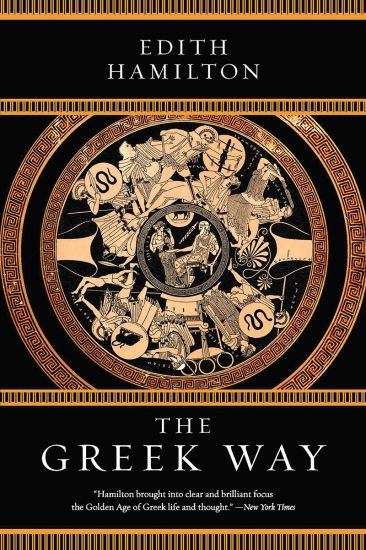
A perennial favourite, Edith Hamilton’s best-selling The Greek Way captures with "Homeric power and simplicity" (The New York Times) the spirit of the golden age of Greece in the fifth century BC, the time of its highest achievements. She explores the Greek aesthetics of sculpture and writing and the lack of ornamentation in both. She examines the works of Homer, Pindar, Aeschylus, Sophocles, Aristophanes and Euripides, amongst others; the philosophy of Socrates and Plato's role in preserving it; the historical accounts by Herodotus and Thucydides on the Greek wars with Persia and Sparta and by Xenophon on civilised living.
In this informal history of Roman civilization, Edith Hamilton vividly depicts the Roman life and spirit as they are revealed in the greatest writers of the time. Among these literary guides are Cicero, who left an incomparable collection of letters; Catullus, the quintessential poet of love; Horace, the chronicler of a cruel and materialistic Rome; and the Romantics Virgil, Livy and Seneca. The story concludes with the stark contrast between high-minded Stoicism and the collapse of values witnessed by Tacitus and Juvenal.

In 1930s and 1940s Vienna, child psychiatrist Hans Asperger sought to define autism as a diagnostic category, treating those children he deemed capable of participating fully in society. Depicted as compassionate and devoted, Asperger was in fact deeply influenced by Nazi psychiatry. Although he offered care to children he deemed promising, he prescribed harsh institutionalisation and even transfer to one of the Reich’s killing centres, for children with greater disabilities. With sensitivity and passion, Edith Sheffer reveals the heart-breaking voices and experiences of many of these children, whilst illuminating a Nazi regime obsessed with sorting the population into categories, cataloguing people by race, heredity, politics, religion, sexuality, criminality and biological defects—labels that became the basis of either rehabilitation or persecution and extermination.

In 1930s and 1940s Vienna, child psychiatrist Hans Asperger sought to define autism as a diagnostic category, treating those children he deemed capable of participating fully in society. Depicted as compassionate and devoted, Asperger was in fact deeply influenced by Nazi psychiatry. Although he offered care to children he deemed promising, he prescribed harsh institutionalisation and even transfer to one of the Reich’s killing centres, for children with greater disabilities. With sensitivity and passion, Edith Sheffer reveals the heart-breaking voices and experiences of many of these children, whilst illuminating a Nazi regime obsessed with sorting the population into categories, cataloguing people by race, heredity, politics, religion, sexuality, criminality and biological defects—labels that became the basis of either rehabilitation or persecution and extermination.

This Norton Critical Edition includes: • The 1905 book edition of the novel, complete with A. B. Wenzell’s eight original illustrations. • A preface and explanatory footnotes by Elizabeth Ammons. • An abundant selection of contextual material, including excerpts from Wharton’s letters, contemporary reviews, six drawings by Charles Dana Gibson, Thorstein Veblen on conspicuous consumption, Charlotte Perkins Gilman on women and economics, and various others writing about women’s place in society at the turn of the century. • Six modern critical views, considering issues of economics, race, materialism, body image, nature and feminism within the novel. • A Chronology and a Selected Bibliography.

If we are not to define people by their deficits, how can we organize our understanding of them? The concept of competence provides the needed framework. Beginning with the idea that most symptoms represent adaptive attempts gone awry, a competence approach develops the healthy urges that reside within symptoms and helps clients organize around those instead of around the problems themselves. This book delineates the why and how of this way of building therapy around hidden strengths, based on a strong partnership with families. Courage, hope, vision, and other concepts not usually treated in psychotherapy are taken seriously and developed as important aspects of treatment. Ultimately, this approach offers people a direct, positive challenge to find and develop the best that is in them.

The text has been introduced and thoroughly annotated by the editor for student readers. Backgrounds and Contexts includes selections from Edith Wharton's letters; articles from the period about etiquette, vocations for women, factory life, and Working Girls' Clubs; excerpts from the work of contemporary social thinkers including Thorstein Veblen, Charlotte Perkins Gilman, and Olive Schreiner; and a consideration of anti-Semitism at the turn of the century by historian John Higham. Also included are Charles Dana Gibson's precautionary piece "Marrying for Money" (including four Gibson drawings) and a tableau vivant of "The Dying Gladiator." Criticism reprints six central contemporary reviews of the novel and six biographical and interpretive modern essays by Millicent Bell, Louis Auchincloss, Cynthia Griffin Wolff, R. W. B. Lewis, Elaine Showalter, and Elizabeth Ammons. A Chronology and Selected Bibliography are also included.

It is fully annotated for undergraduate readers. "Backgrounds and Contexts" includes a rich selection of materials, some previously unavailable, for the study of contemporary psychological, social, and economic issues, as well as Wharton's private correspondence and writings and biographical accounts of the author. Arranged under two headings, "Criticism" reveals Ethan Frome's impact as both a literary work and a social commentary. "Contemporary Reviews" consists of eight prominent assessments of Ethan Frome, including reviews from the New York Times Book Review, Outlook, The Nation, the Saturday Review, and those penned by Frederic Taber Cooper and Elizabeth Shepley Sergeant, among others. "Modern Criticism" (1956-1991) includes seven interpretations of the novella by Lionel Trilling, Elizabeth Ammons, Judith Fryer, Jean Frantz Blackall, Lev Raphael, Candace Waid, and Cynthia Griffin Wolff. A Chronology and a Selected Bibliography are also included.

"Contexts" constructs the historical foundation for this very historical novel. Many documents are included on the "New York Four Hundred," elite social gatherings, archery (the sport for upper-crust daughters), as well as Wharton’s manuscript outlines, letters, and related writings. "Criticism" collects eleven American and British contemporary reviews and nine major essays on The Age of Innocence, including a groundbreaking piece on the two film adaptations of the novel. “A Chronology and Selected Bibliography” are also included.
A Step 4 HISTORY reader. "The drama of natural disasters provides prime material to entice young independent readers. In this volume, the account of the eruption of Mount Vesuvius describes village life 2,000 years ago, the eruption itself and its aftermath, and the excitement when the buried town is rediscovered centuries later. A lively and factual glimpse of a devastating moment in history, in an accessible, attractive package."--Publishers Weekly. Step 4 Readers use challenging vocabulary and short paragraphs to tell exciting stories. For newly independent readers who read simple sentences with confidence. With full-color illustrations.

The student of biological science in his final years as an undergraduate and his first years as a graduate is expected to gain some familiarity with current research at the frontiers of his discipline. New research work is published in a perplexing diversity of publications and is inevitably concerned with the minutiae of the subject. The sheer number of research journals and papers also causes confusion and difficulties of assimilation. Review articles usually presuppose a background knowledge of the field and are inevitably rather restricted in scope. There is thus a need for short but authoritative introductions to those areas of modern biological research which are either not dealt with in standard introductory textbooks or are not dealt with in sufficient detail to enable the student to go on from them to read scholarly reviews with profit. This series of books is designed to satisfy this need. The authors have been asked to produce a brief outline of their subject assuming that their readers will have read and remembered much of a standard introductory textbook of biology. This outline then sets out to provide by building on this basis, the conceptual framework within which modern research work is progressing and aims to give the reader an indication of the problems, both conceptual and practical, which must be overcome if progress is to be maintained.

This book is a study of the economics of the large international firm, but is at the same time a study of one of the world’s most important industries. International firms face difficult problems in attempting to deal with the conflicts between their own interest as world-wide economic organisations on the one hand, that of the countries in which they operate on the other, and with the conflicts of interest among the countries which are related to the international policies of the firms. The author analyses the underlying problems and points to possible solutions. When it was first published this was the first book by a professional economist to look widely at the economics of the international petroleum industry outside the industrialized countries.